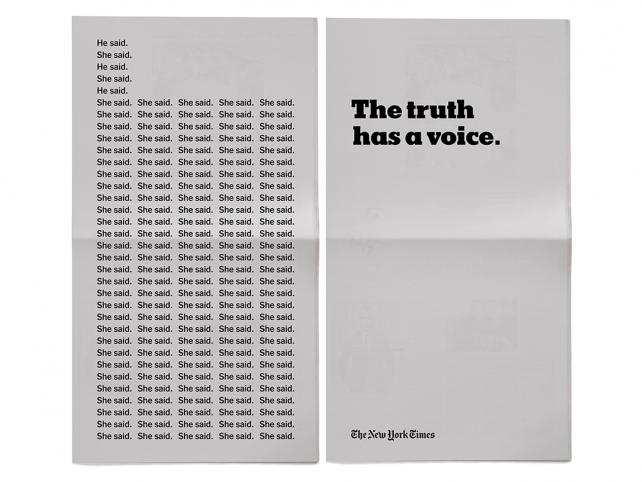
The New York Times is continuing its year-long Truth campaign with this spot on Sunday’s Golden Globes broadcast, spotlighting its coverage of sexual harassers from Weinstein to O’Reilly to dozens more.
According to Ad Age reporter Ann-Christine Diaz, “[the] campaign will also include print as well as digital assets that will focus on actual Times stories.” Here’s the print ad:
Interestingly, neither ad plugs the nytimes.com/truth link, which previously led to the Times subscription department. Now it leads to . . . the Times subscription department.
Truth is, leaving it out seems like a wasted opportunity.
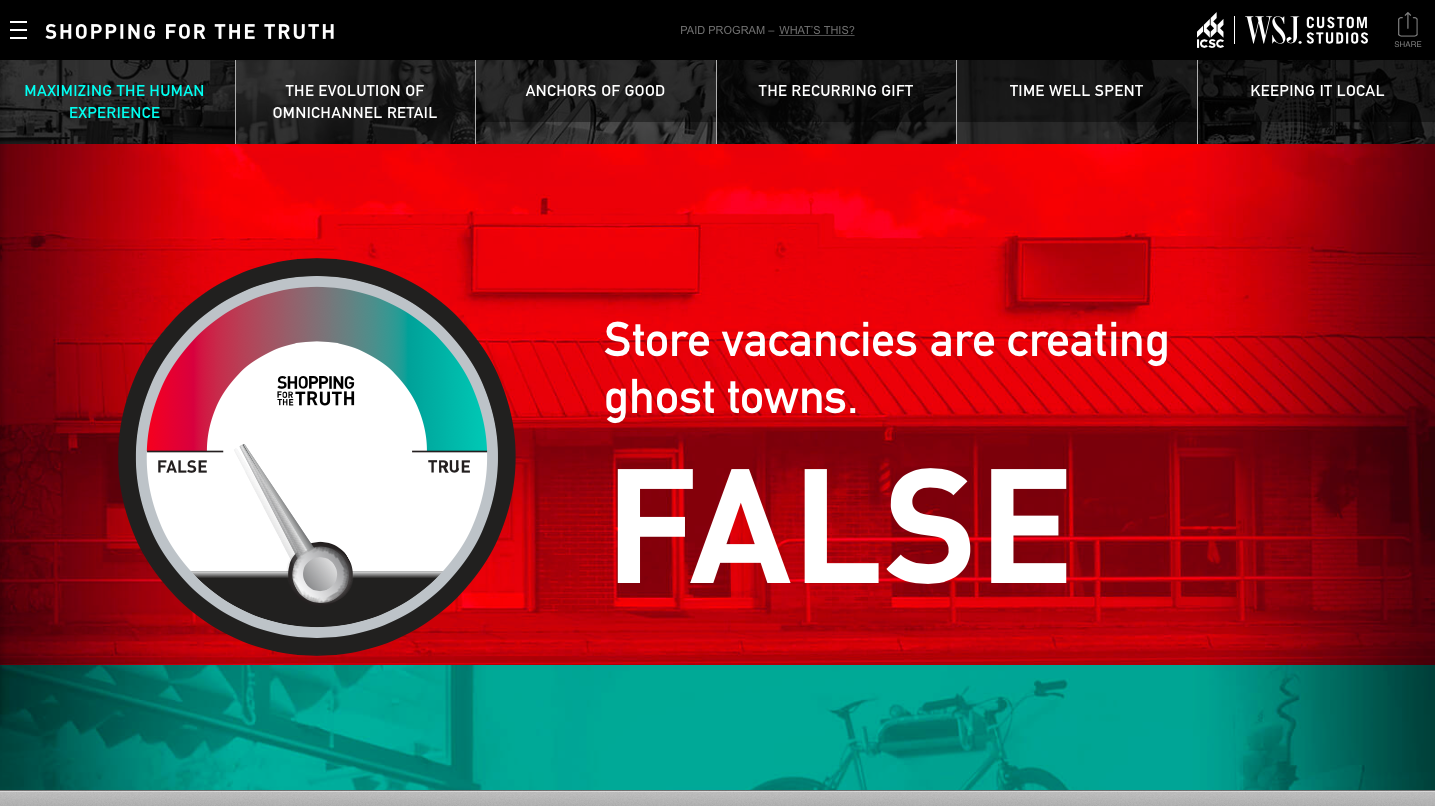
This week the Wall Street Journal started running tag-team ads in its print edition that direct readers to digital ads created by the paper’s in-house native advertising shop.
This quarter-page ad, for example, ran on Tuesday.
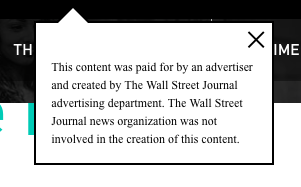
At the top, in the center, in small type so light you barely notice it, is this: “Paid Post – What’s This?” Click on the latter and you get a sort of explanation.
Right – it was created by WSJ.Custom Studios, which describes itself as “an in-house content agency packed with experienced editors, journalists, designers, web developers and project managers.”
In other words, it’s shadow journalism.
But weird shadow journalism. Just check out the headers.
Big Retail is coming off its worst year since the financial crash and there will be more bloodletting: 50 retailers declared bankruptcy in 2017, and next year looks worse.
Fitch [Group] forecasts $7 billion in retail defaults in 2018, 23% higher than the $5.7 billion this year. That is stunning, as retail accounted for a whopping 30% of all 2017 defaults.
Fitch lists these retailers, among others, as most in danger — Sears, Neiman Marcus, J Crew, Talbots, Lands’ End and Cole Haan.
Add to that, this passage from Scott Galloway’s The Four: “Forty-four percent of the value of U.S. malls is in just a hundred places, and sales per square foot dropped 24 percent in the last decade.”
Ouch.
But back to the Wall Street Journal nesting ads.
There’s nothing especially new about this double-barreled advertising approach (the New York Times has been doing it for several years now) and there’s nothing especially wrong about it.
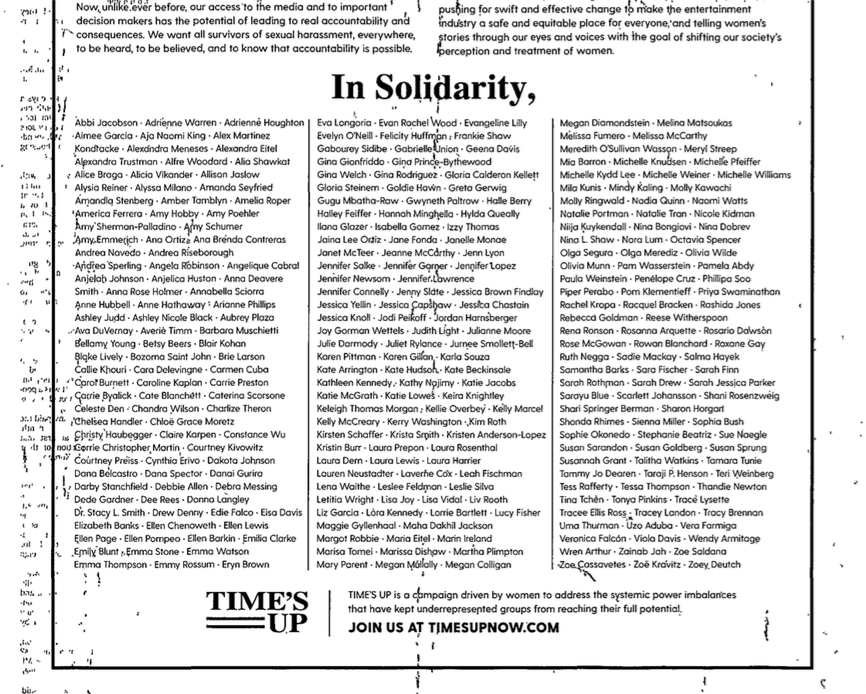
A group of high-profile show business women have formed a group called Time’s Up, which describes itself as “a unified call for change from women in entertainment for women everywhere.” New York Times culture reporter Cara Buckley writes it up in today’s paper.
300 Strong: Hollywood Women Unite to Fight Harassment
Driven by outrage and a resolve to correct a power imbalance that seemed intractable just months ago, 300 prominent actresses and female agents, writers, directors, producers and entertainment executives have formed an ambitious, sprawling initiative to fight systemic sexual harassment in Hollywood and in blue-collar workplaces nationwide . . .
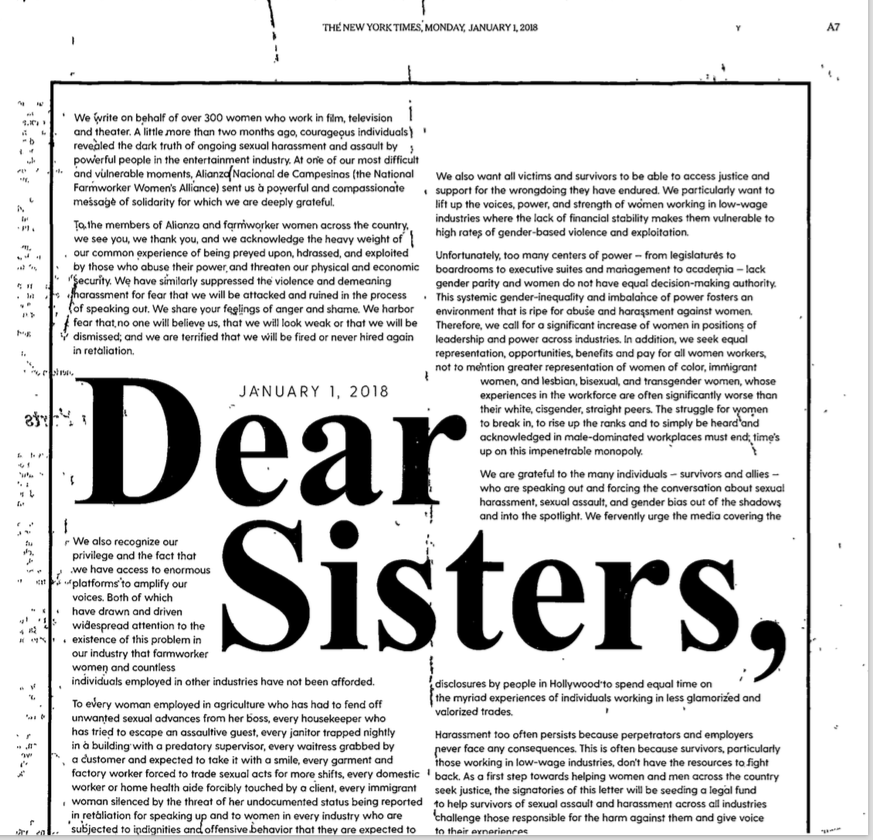
Called Time’s Up, the movement was announced on Monday with an impassioned pledge of support to working-class women in an open letter signed by hundreds of women in show business, many of them A-listers. The letter also ran as a full-page ad in The New York Times, and in La Opinion, a Spanish-language newspaper.
Here’s the ad (apologies for the poor reproduction – the Times Replica Edition is still on the fritz.)
(The Times helpfully provides the text of the letter here.)
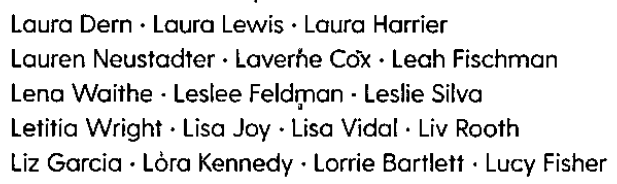
The signers are listed in alphabetical order by first name; here are the L’s.
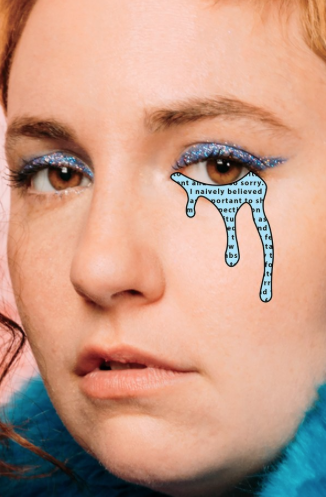
Conspicuous by her absence: Lena (Bad News) Dunham
James Wolcott’s Vanity Fair piece last month gives some indication why.
Can Lena Dunham Recover from Her High-Profile Mistakes?
How do you solve a problem like Lena? It may not be the most pressing musical question before the nation, yet it must be addressed, otherwise Lena Dunham—writer, director, actor, essayist, memoirist, and varsity-league exhibitionist—will persist in being an irksome source of distraction, like a moth flapping against a bare lightbulb. If Noël Coward possessed a talent to amuse, Dunham has a knack to annoy. Every few months she perpetrates a gaffe or lets pop a sound bite that gives social media a fiery rash and sets off a tribal war dance, and these cycles of outrage do grow wearisome. Worse, for her, each cycle erodes the value of Dunham’s personal and creative brand, her actual output receding into the background as her prominence as the millennial generation’s needless uproar generator blunders to the fore. She’s in no immediate danger of having her work and livelihood flushed overboard, but she is flirting with radioactivity. She has become problematic with a capital P.
Ouch. Walcott goes on to say, “The inspirational selling points of her individual journey are being flipped against her, which is hard to defend. What was once sold as quirky and individualistic is now attacked as tone-deaf and pampered, a by-product of cushy white privilege.”
Apparently, that’s not the sort if resumé Time’s Up is accepting right now.
As you splendid readers doubtless realize by now, the hardlooking staff annually tallies the results of the New York Times Year in Pictures review. And that time-honored tradition continues with this year’s edition.
Header:
Tragedy. Triumph. Trump.
Photographs that tell the story of a world in tumult.
(We’d actually show it to you except the Times Replica Edition is still AWOL.)
So . . . drumroll . . . this year’s bull-goose shooter is: Todd Heisler, with four entries in the Times photo album.
Representative sample:
SUTHERLAND SPRINGS, TEX., Nov. 6
Crosses commemorated the 26 people who died when a man opened fire on parishioners during a Sunday service at a small church in rural Texas.
Honorable mention goes to Thomas Munita, who had three photos in the review, including this cover image.
THE NAF RIVER BETWEEN MYANMAR AND BANGLADESH, Nov. 11
Refugees used a makeshift raft they built to escape Myanmar’s brutal crackdown on its Rohingya minority.
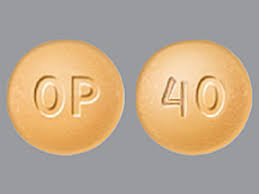
Let us now speak of the Sackler brothers – Arthur, Mortimer, and Raymond – patriarchs of the pharmaceutical-fueled family that has made billions of dollars from the sale of OxyContin, the marketing of which has undeniably triggered America’s current opioid crisis.
The newly installed Sackler Courtyard at London’s Victoria and Albert Museum is one of the most glittering places in the developed world . . .
The Sackler Courtyard is the latest addition to an impressive portfolio. There’s the Sackler Wing at New York’s Metropolitan Museum of Art, which houses the majestic Temple of Dendur, a sandstone shrine from ancient Egypt; additional Sackler wings at the Louvre and the Royal Academy; stand-alone Sackler museums at Harvard and Peking Universities; and named Sackler galleries at the Smithsonian, the Serpentine, and Oxford’s Ashmolean. The Guggenheim in New York has a Sackler Center, and the American Museum of Natural History has a Sackler Educational Lab.
More: “Members of the family, legendary in museum circles for their pursuit of naming rights, have also underwritten projects of a more modest caliber—a Sackler Staircase at Berlin’s Jewish Museum; a Sackler Escalator at the Tate Modern; a Sackler Crossing in Kew Gardens.”
Too much: “A popular species of pink rose is named after a Sackler. So is an asteroid.”
So, to recap, two generations of Sacklers have slapped their name on anything that doesn’t move, and at least one thing that does.
But the place you will never find their name? Anywhere that OxyContin appears, as Esquire’s Glazek points out.
By any assessment, the family’s leaders have pulled off three of the great marketing triumphs of the modern era: The first is selling OxyContin; the second is promoting the Sackler name; and the third is ensuring that, as far as the public is aware, the first and the second have nothing to do with one another.
But the first – in the form of Purdue Pharma, the Sacklers’ company – has plenty to do with the current opioid crisis, according to Patrick Radden Keefe’s major takeout in The New Yorker, which appeared around the same time as the Esquire piece in mid-October. Keefe refers to the Sackler dynasty’s “ruthless marketing of painkillers” and quotes one medical expert saying, “Most of the questionable practices that propelled the pharmaceutical industry into the scourge it is today can be attributed to Arthur Sackler.”
Ideally, the goal with a painkiller as powerful as OxyContin should have been to “sell the least dose of the drug to the smallest number of patients.” Purdue Pharma was hellbent to do the opposite. The company promoted OxyContin as “virtually non-addicting” and paid doctors to produce studies and deliver testimonials.
As Keefe writes, “[t]he marketing of OxyContin relied on an empirical circularity: the company convinced doctors of the drug’s safety with literature that had been produced by doctors who were paid, or funded, by the company.”
The result? The U.S. accounts for about one-third of the global opioid market, with an estimated two and a half million Americans having an opioid-use disorder.
Glazek adds that, according to a study published by the American Public Health Association, “the total economic burden from opioid use [since 2013] stood at about $80 billion, adding together health costs, criminal-justice costs, and GDP loss from drug-dependent Americans leaving the workforce.”
And the cost in human life?
This past July, Donald Trump’s Commission on Combating Drug Addiction and the Opioid Crisis, led by New Jersey governor Chris Christie, declared that opioids were killing roughly 142 Americans each day, a tally vividly described as “September 11th every three weeks.”
In 2007 Purdue pleaded guilty to felony charges for “criminally ‘misbranding’ OxyContin,” Glazek writes. “As the company later admitted, it misleadingly promoted OxyContin as less addictive than older opioids on the market.” Purdue paid $600 million in fines – lunch money compared to the $35 billion in revenues OxyContin has generated for the company.
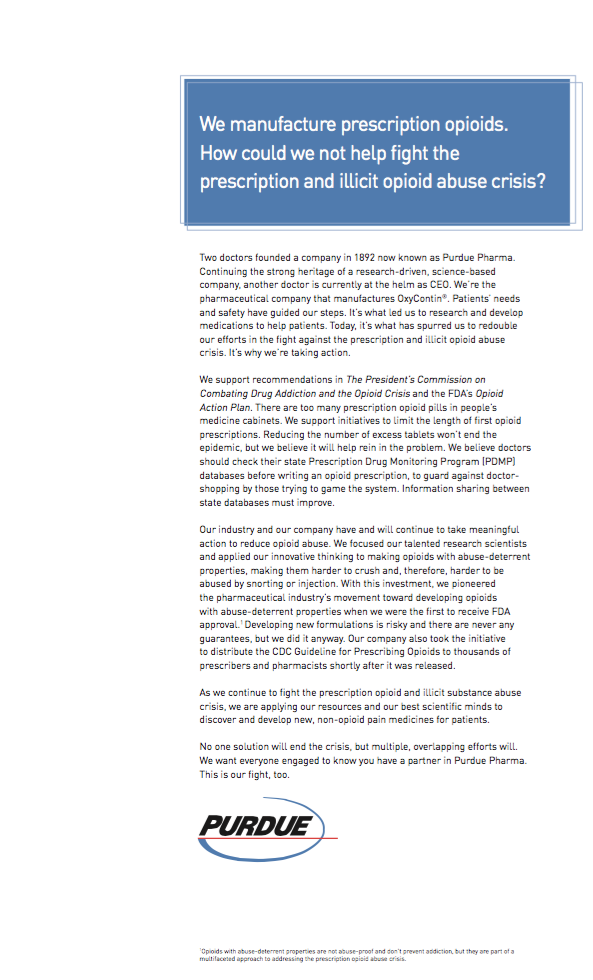
With both the Esquire and New Yorker pieces landing with a big bang (and with multiple cities and counties suing opioid makers), it’s likely no coincidence that Purdue has been running this full-page ad in the New York Times and Wall Street Journal for the past few weeks.
The headline, of course, is laughable, but the last paragraph is an even bigger joke.
No one solution will end the crisis, but multiple, overlapping efforts will. We want everyone engaged to know you have a partner in Purdue Pharma. This is our fight, too.
Really? One final quote from Keefe: “This is one dreadful paradox of the history of OxyContin: the original formulation [which you could crush and snort or melt and shoot] created a generation addicted to pills; the reformulation [which you couldn’t do either], by forcing younger users off the drug, helped create a generation addicted to heroin.”
And no Potemkin marketing campaign is going to change that.
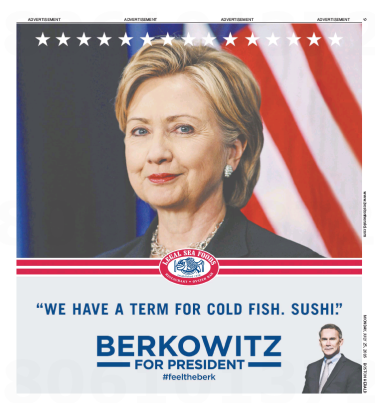
As the hardtsking staff has noted on numerous occasions, Legal Sea Foods owner Roger Berkowitz has a penchant for ads that are equal parts puerile, tasteless, and banned by the MBTA.
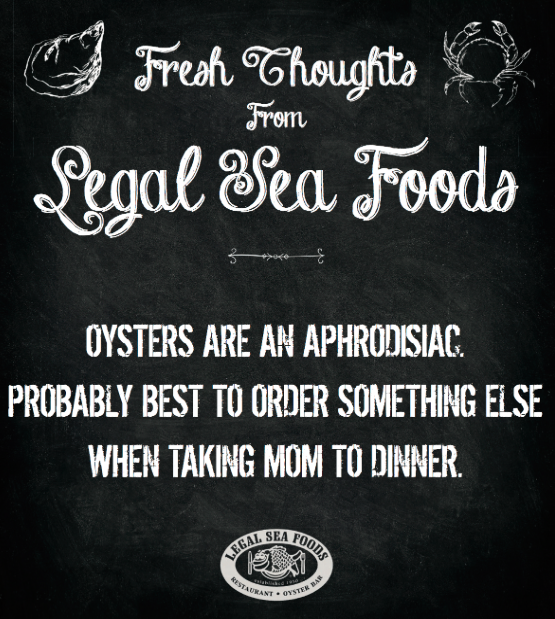
Now comes the latest hook, line, and stinker ad from Berkowitz, which we happened to see yesterday on the MBTA’s Green Line.
That’s not just tasteless. It’s sorta sick.
(More fishy creative from the campaign can be found on Ad Forum.)
Memo to Roger Berkowitz: You’re getting scrod by hotshot New York agency DeVito/Verdi (which has also turned Bernie & Phyl’s way too phunky, and in the process gotten their ads banned by – yes – the MBTA). Those ads are all about awards shows, not your business.
Maybe Legal Sea Foods should dial back on that “if it isn’t fresh” bit, yeah? #feelthejerk
As the hardworking staff has previously noted, the New York Times routinely deploys its journalists to accompany (and schmooze with) civilians on Times Journeys to the four corners of the earth – an enterprise that is rife with potential conflicts of interest, as the Washington Post’s Paul Farhi pointed out recently.
Now the Grey Lady is asking its newsroom staffers to sing for their supper in a series of sycophantic salutes to the paper’s subscribers.
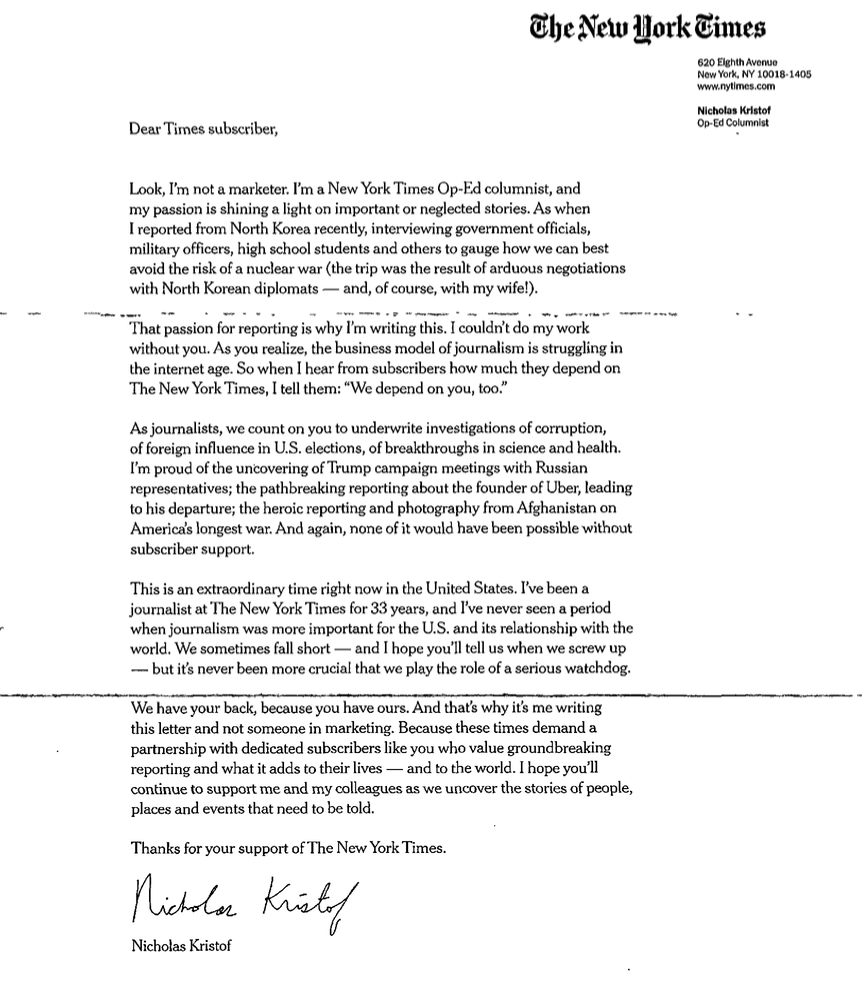
There was this letter sent to subscribers last month.
Politico’s senior media writer Jack Shafer promptly blowtorched the Times in a piece headlined “New York Times Journalists Are Groveling to Their Readers. That’s Pathetic.” Subhed: I don’t want my favorite hacks turned into marketers.
Nuts-to-them graf:
Two things bugged me about the letter. First was Kristof’s presumption that I might be a willing vessel for his gratitude. My relationship with him is more like my relationship to the station manager of the subway—he’s just another interchangeable employee producing a service that I use. I need or want a letter of thanks from Kristof as much as I do one from the station manager for riding the train. The truth of the matter is that I don’t subscribe to the Times so that he can, in his words, shine “a light on important or neglected stories.” I tolerate his heavy moral preening and self-indulgence so that I can read the rest of the Times package. His gratitude is the last thing I want from the paper.
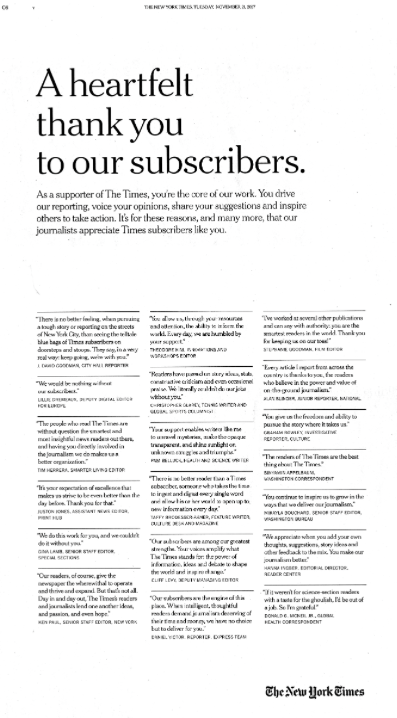
Shafer was equally unhappy with this “cringeworthy” full-page ad that ran the day after he’d gotten the letter.
Representative sample from Washington correspondent Binyamin Appelbaum: “The readers of The Times are the best thing about The Times.”
Ugh. Whatever happened to the separation of church and fourth estate?
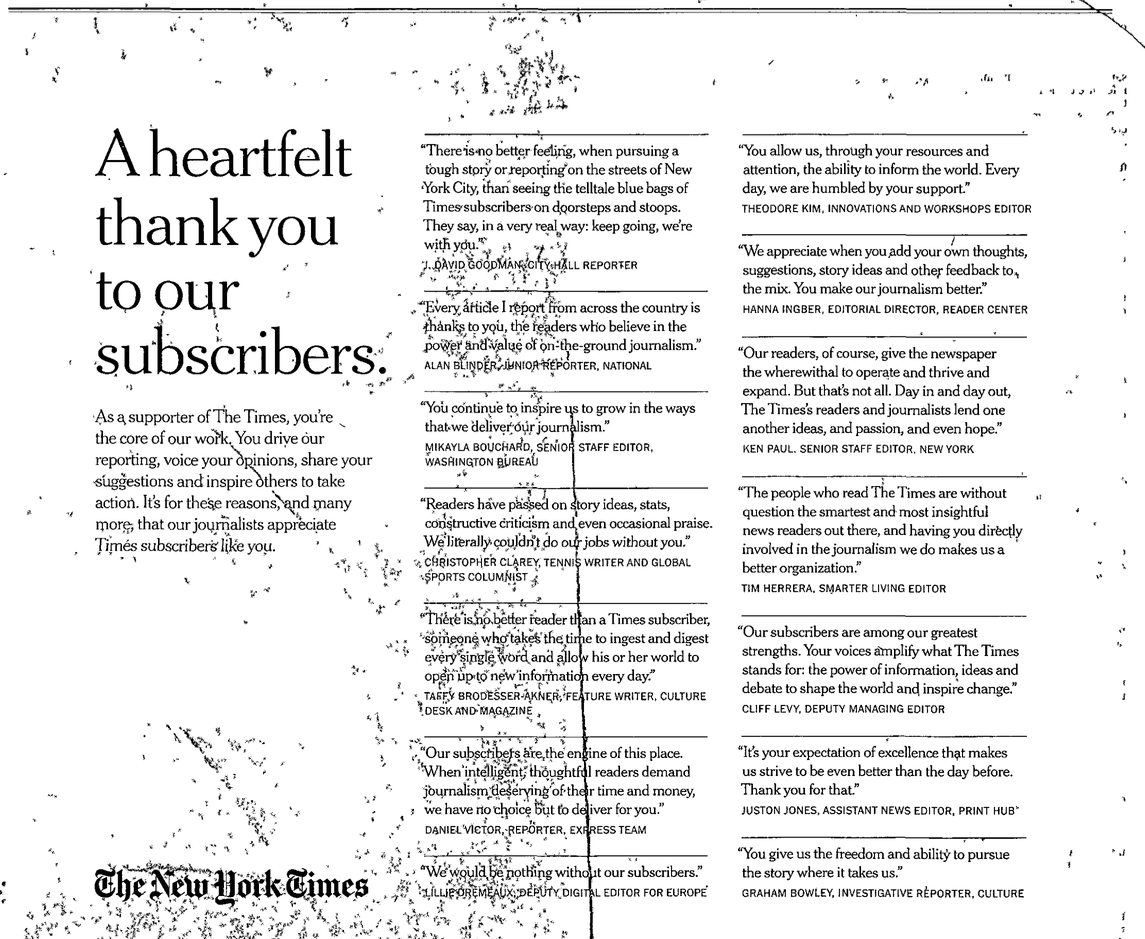
Yesterday’s Times featured this half-page version of the big wet kiss-up.
Campaign Outsider Official Sidebar (pat. pending):
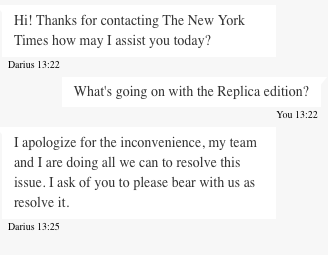
The quality of that screenshot is so poor because the Times’s Replica Edition has been unavailable for the past few months, so we were left to our own devices for the image. Earlier today the hardtsking staff had this exchange with a Customer Care representative.
That’s the same thing we were told six weeks ago when we inquired about the Replica Edition. Maybe they should stick that in their next ad.
HOW BRANDS SECRETLY BUY THEIR WAY INTO FORBES, FAST COMPANY, AND HUFFPOST STORIES
An Outline investigation found that contributors to prominent publications have taken payments in exchange for positive coverage.
In late October, TechCrunch editor-at-large John Biggs noticed a Facebook Messenger request from someone he didn’t know, a man named Varun Satyam. When Biggs accepted the request, Satyam introduced himself as a marketer for technology startups. He was looking for coverage of some clients, he said, and he was willing to pay Biggs to write about them.
It was a bold opening move, and an unethical proposition for any journalist who wants to retain their credibility. But Biggs wasn’t surprised. He estimates that he receives two or three similar offers each month, and he doesn’t take them seriously.
“They’re stupid,” said Biggs. “Organic press is far more effective and anyone with a brain can see through them.”
By them Biggs means the plugs that an increasing number of brands seek to insert into editorial content on major media websites.
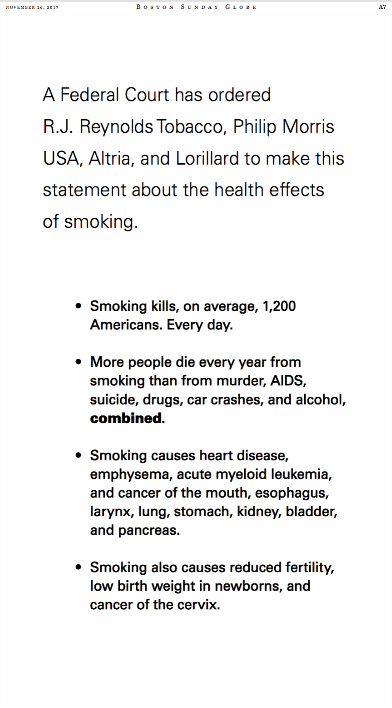
Yesterday, this full-page ad ran in about 50 major U.S. newspapers.
And for the next year, this TV spot will run five times a week during prime time on ABC, NBC, and CBS.
Ouch.
Or maybe not. We’ll get to that in a minute.
First, though, here’s why you’ll be seeing those ads for the next 52 weeks.
As Katie Lannan of the State House News Service has recounted, in 1999 the Clinton Department of Justice “filed racketeering charges against nine cigarette manufacturers and two industry organizations, alleging they had violated racketeering laws by engaging in conspiracy to deceive the public about the health effects of smoking, the addictiveness of nicotine, and related matters.”
The DOJ sought to recover $280 billion in either 1) ill-gotten profits from deceiving the public about the health risks of cigarette smoking, or 2) healthcare costs associated with tobacco-related illnesses, depending on which news reports you believe.
Regardless, in 2006 Federal District Court Judge Gladys Kessler ruled that the tobacco companies had deceived the American public about the devastating health effects of smoking, suppressed research, destroyed documents, manipulated the use of nicotine, and distorted the truth about low tar and light cigarettes.
But . . . there could be no financial penalties under the civil racketeering charges the tobacco companies were convicted of, so they were ordered to issue “corrective statements” to inform the public of their decades-long deception.
Which led to a decade-long wrangle over the language in those statements. And to their eventual watering down. From the New York Times:
Proposed versions of the ads in 2011 appeared tougher. One said: “We told Congress under oath that we believed nicotine is not addictive. We told you that smoking is not an addiction and all it takes to quit is willpower. Here’s the truth: Smoking is very addictive. And it’s not easy to quit. We manipulated cigarettes to make them more addictive.”
But the tobacco companies said statements like that were “forced public confessions” designed to “shame and humiliate them.” So they were reduced to what you see above.
Then again, some say those statements aren’t corrective at all. Robert N. Proctor, a professor of history at Stanford and the author of Golden Holocaust: Origins of the Cigarette Catastrophe and the Case for Abolition, wrote this in a Saturday Times op-ed.
What’s crucial to appreciate is that the corrective statements are not being issued voluntarily. And nowhere in the statements do the companies acknowledge the truth of what they are saying. In this sense, the statements are not really even admissions. Judge Kessler’s original order had required them to be prefaced by a clear “Here is the truth.” That requirement is now gone.
Part of that is true: There’s no “Here is the truth” in the ads. But they do state that “A Federal Court has ordered . . . ” So that’s not exactly “voluntary.” Cold comfort, to be sure.
Others say this whole campaign is too little too late, given Big Tobacco’s usual modus operandi. From the Richmond Times-Dispatch:
“Their legal strategy is always obstruct, delay, create confusion and buy more time,” said Ruth Malone of the University of California, San Francisco, who has studied the industry for 20 years. “So by the time this was finally settled, newspapers have a much smaller readership and, nowadays, who watches network TV?”
Well, not to get technical about it, lots of people. But not so many young people, who are the ones who need to see anti-smoking messages.
Then again . . .
Those corrective statements might be the only anti-smoking messages anyone sees in mainstream media for the next year.
That’s because state governments, which used to underwrite the bulk of the anti-smoking advertising, have largely decided to take the tobacco money and run . . . almost nothing.
Case in point: The Commonwealth of Massachusetts, which was once a leader in the public health community’s anti-smoking efforts, devoting as much as $55 million in 2000 to fight tobacco use.
Now, the Department of Public Health spends about $4 million a year toward that end, despite raking in almost $900 million annually in tobacco taxes thanks to 1) the $206 billion 1998 Master Settlement Agreement with the major cigarette companies, and 2) the Massachusetts $3.51 per pack tobacco excise tax (fourth highest in the nation, behind New York, Connecticut, and Rhode Island).
According to this 2015 piece in the Gloucester Times, though, “tobacco companies put more than $134 million into advertising in the Bay State during fiscal 2015 — outspending tobacco control efforts 35 to 1 — according to the Campaign for Tobacco-free Kids.”
Meanwhile, the “corrective statements” campaign will cost the tobacco industry a paltry $31 million over the next year.
Sure seems like the real correction should be occurring elsewhere.
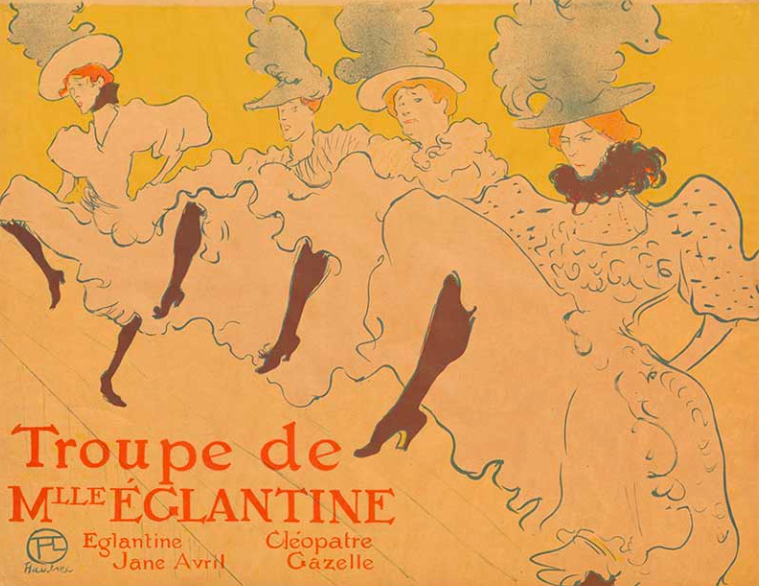
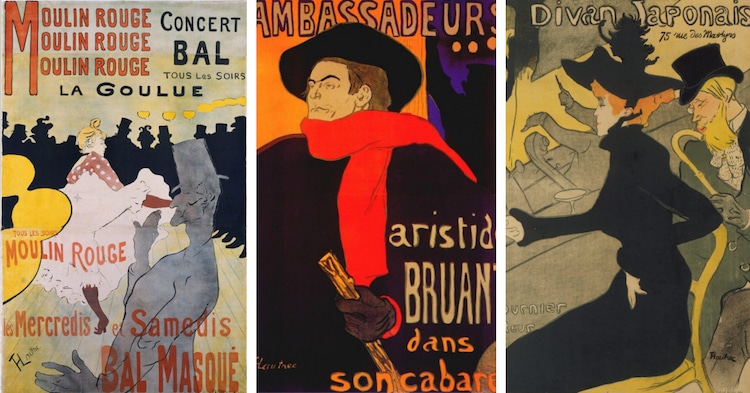
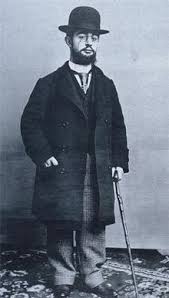
Henri de Toulouse-Lautrec’s instantly recognizable posters are fixtures on the walls of millions of homes worldwide. Although the original works of art are more than 100 years old, their continued prevalence is a reminder of the influence he continues to have on art, and especially graphic design. Lautrec’s often colorful lithographs reveal the enduring beauty of Paris. They also feature the city’s more shadowy figures, whose lives the artist celebrated through his art. Drawn from the collection of the Museum of Modern Art, the Currier’s exclusive New England presentation will present more than 100 posters, prints and illustrated books.
Other Lautrec works you’ll see in the exhibit:
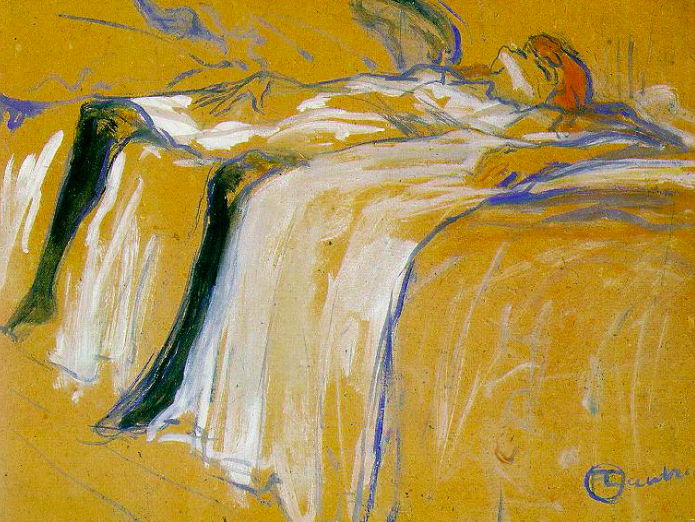
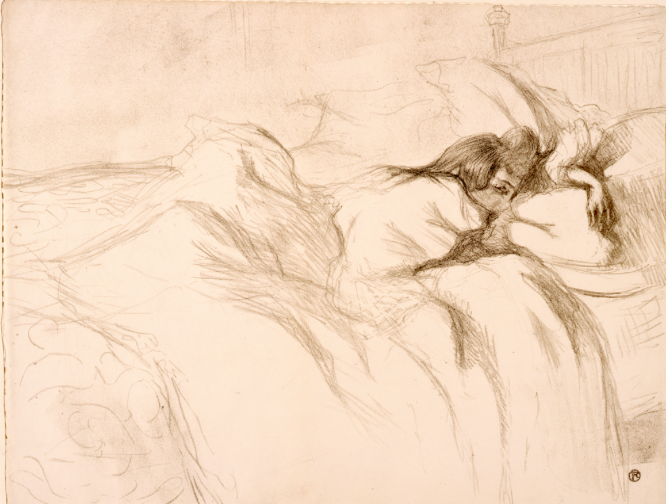
As well as these:
Lautrec spent roughly equal time in the nightclubs and brothels of 1890s Paris, but – as the exhibit tells us – he had dinner with his mother almost every night.
There were, however, some notable exceptions – among them this letter from Lautrec to his Mom that the Missus happens to have hanging on her wall.
Loose translation:
My dear Mother,
Did you break both your arms or did you forget your ironclad rule: a short note, please, to keep me informed. Everything is fine here and I am working hard.
All best,
Yours
H
Interesting, as the Missus notes, considering that Lautrec broke both his legs as a young man and grew to be only 4′ 11″ tall.
Regardless, Lautrec turned out to be a giant of the lithographic arts, which was no mean feat. Lithography, as Barbie might say, is hard. A quick tutorial, compliments of – yes – MoMA.
What Lautrec did with lithography was truly remarkable, including the development of new techniques that were adopted by numerous other artists of his era.
His career lasted just over a decade and coincided with two major developments in late nineteenth-century Paris: the birth of modern printmaking and the explosion of nightlife culture. Lautrec’s posters promoted Montmartre entertainers as celebrities, and elevated the popular medium of the advertising lithograph to the realm of high art . . .
Though he died tragically young (at age thirty-six) due to complications from alcoholism and syphilis, his influence was long-lasting. It is fair to say that without Lautrec, there would be no Andy Warhol.
And without MoMA, there would be no Currier Museum exhibit.








 Campaign Outsider