Well the Missus and I trundled down to the Big Town last weekend to catch one thing and another and say, it was swell.
First, of course, there was crosstown traffic, which takes roughly 30 minutes to navigate.
Official Campaign Outsider Jimi Hendrix Interlude™:
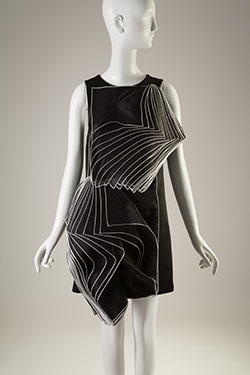
After that, we stopped by the Fashion Institute of Technology for its Global Fashion Capitals exhibit that “explores the history of the established fashion capitals—Paris, New York, Milan, and London—and the emergence of 16 new fashion cities.”
The Missus and I agreed that Best of Show was this Christopher Kane dress:
From there we moseyed down to the new Whitney Museum to take in America Is Hard to See and found it . . . hard to find (we missed our left turn). But eventually we stumbled upon the New Palace of American Art with its razzle-dazzle exterior.

Inside, we found a bright, airy environment, quite different from the old Marcel Breuer Whitney on Madison Ave. We also found the showcase exhibit.
Drawn entirely from the Whitney Museum of American Art’s collection, America Is Hard to See takes the inauguration of the Museum’s new building as an opportunity to reexamine the history of art in the United States from the beginning of the
twentieth century to the present. Comprising more than six hundred works, the exhibition elaborates the themes, ideas, beliefs, and passions that have galvanized American artists in their struggle to work within and against established conventions, often directly engaging their political and social contexts. Numerous pieces that have rarely, if ever, been shown appear alongside beloved icons in a conscious effort to unsettle assumptions about the American art canon.

That’s true. Who woulda thunk this piece was created by Arthur Dove?

Beyond the contents of the exhibit, though, the new Whitney has become a sort of Fine Arts Rorschach Test.
Here’s an art critic – Jerry Saltz of New York magazine – who loves the new Whitney.
And here’s a critic – James Gardner in The Weekly Standard – who really doesn’t.
Our verdict?
Meh.
The new digs are fine – a nice enough place to view the Whitney’s absolutely stunning collection. The views from the outdoor decks are . . . panoramic. And the sculptures on the decks are . . . pleasant.
But all the bells and whistles? And the overpriced cafes? We don’t care much.
(Fun fact to know and tell: The Missus says Thursday evening is the best – that is to say least crowded – time to visit the Whitney. You can see America Is Hard to See through September 27.)
* * * * * * *
Today is Celebrity Artist Day!
Start at the Museum of Modern Art with Yoko Ono: One Woman Show, 1960-1971, an exhibit MoMA describes this way:
The Museum of Modern Art presents its first exhibition dedicated exclusively to the work of Yoko Ono, taking as its point of departure the artist’s unofficial MoMA debut in late 1971. At that time, Ono advertised her “one woman show,” titled Museum of Modern [F]art. However, when visitors arrived at the Museum there was little evidence of her work. According to a
sign outside the entrance, Ono had released flies on the Museum grounds, and the public was invited to track them as they dispersed across the city. Now, over 40 years later, Yoko Ono: One Woman Show, 1960–1971 surveys the decisive decade that led up to Ono’s unauthorized exhibition at MoMA, bringing together approximately 125 of her early objects, works on paper, installations, performances, audio recordings, and films, alongside rarely seen archival materials. A number of works invite interaction, including Painting to Be Stepped On (1960/1961) and Ono’s groundbreaking performance, Bag Piece (1964). The exhibition draws upon the 2008 acquisition of the Gilbert and Lila Silverman Fluxus Collection Gift, which added approximately 100 of Ono’s artworks and related ephemera to the Museum’s holdings.

The still above is from Ono’s 1965 Cut Piece, filmed by Albert Maysles + David Maysles at Carnegie Hall.
(To be honest graf goes here)
To be honest, I’m not really smart enough to get all of what Yoko Ono was doing back then, but I get that she was breaking through something or other. As for the exhibit (through September 7), some of it is fun to look at and some of it less so. But worth seeing.
We thence hied ourselves to another celebrity MoMA exhibit, Andy Warhol: Campbell’s Soup Cans and Other Works, 1953–1967.
Andy Warhol’s Campbell’s Soup Cans is the signature work in the artist’s career and a landmark in MoMA’s collection. The 1962 series of 32 paintings is the centerpiece in this focused collection exhibition of Warhol’s work during the crucial years between 1953 and 1967. The Soup Cans mark a breakthrough for
Warhol, when he began to apply his seminal strategies of serial repetition and reproduction to key subjects derived from American commodity culture. Warhol also developed his signature use of the flat, uniform aesthetic of photo-screenprinting just after he completed the Soup Cans. For the first time at MoMA, the 32 Soup Cans are shown in a line (rather than a grid), echoing the way they were first exhibited at the Ferus Gallery, Los Angeles, in 1962. The exhibition also includes drawings and illustrated books Warhol made in the 1950s, when he started his career as a commercial artist, and other paintings and prints from the 1960s, when he became a beacon of the Pop art movement.

As if you even care. Through October 18.
Actually, the real winner at MoMA right now is From Bauhaus to Buenos Aires: Grete Stern and Horacio Coppola.
From Bauhaus to Buenos Aires: Grete Stern and Horacio Coppola is the first major exhibition to focus on the German-born Grete Stern and the Argentinean Horacio Coppola, two leading figures of avant-garde photography who established themselves on both sides of the Atlantic. The exhibition begins in the late 1920s with each artist’s initial forays into photography and typographic design. In Berlin in 1927, Stern began taking private classes with Walter Peterhans, who was soon to become
head of photography at the Bauhaus. A year later, in Peterhans’s studio, she met Ellen (Rosenberg) Auerbach, with whom she opened a pioneering studio specializing in portraiture and advertising. Named after their childhood nicknames, the studio ringl + pit embraced both commercial and avant-garde loyalties, creating proto-feminist works. In Buenos Aires during the same period, Coppola initiated his photographic experimentations, exploring his surroundings and contributing to the discourse on modernist practices across media in local cultural magazines. In 1929 he founded the Buenos Aires Film Club to introduce the most innovative foreign films to Argentine audiences. His early works show the burgeoning interest in new modes of photographic expression that led him to the Bauhaus in 1932, where he met Stern and they began their joint history.

It’s a knockout, through October 4.
From there we headed to the New York Public Library for the Performing Arts (at Lincoln Center) for Sinatra: An American Icon (through September 4).
Great quote:
Frank Sinatra is a singer who comes along once in a lifetime, but why did he have to come in mine?
– Bing Crosby
The exhibit marks the Frank Sinatra Centennial and includes “never-before-seen photos, family mementos, rare correspondence, personal items, artwork, and, of course, music make up the exhibit. Most of the pieces come directly from the Sinatra family and have never been on public display before.”
Then again, some have:
The Sinatra: An American Icon exhibition has many wonderful media stations for visitors—songs, excerpts from television specials, films trailers and featurettes, and a juke box. But the one that is garnering the most attention is “The House I Live
In,” the RKO short film that won Sinatra his first Oscar.
The producers Frank Ross and Mervyn LeRoy made the short subject for RKO Radio Pictures, combining footage of Sinatra recording the ballad “If This is But a Dream” with a narrative section of him coming across a group of boys harassing a foreign-looking boy and teaching them about tolerance with the title song. In the phrase recommended for publicizing the featurette: “The theme of Tolerance, impassioned and thrilling in its fervent plea in Frank Sinatra’s sincere, human way.. an epochal inspiration of the public conscience.”

And here it is.
The NYPL show completed our Sinatra hat trick this past month: exhibit, HBO documentary All Or Nothing At All, and Gay Talese’s classic profile Frank Sinatra Has a Cold.
Swingin’!
Next stop: The New-York Historical Society to catch The Hirschfeld Century: The Art of Al Hirschfeld (through October 12).
From the website:
Al Hirschfeld (1903–2003) brought a distinct style to celebrity drawings, making his work instantly recognizable —to be
“Hirschfelded” was a sign that a performer had arrived. Now for the first time, nine decades of Hirschfeld’s work will be on display at the New-York Historical Society in The Hirschfeld Century: The Art of Al Hirschfeld, a multimedia exhibition organized in partnership with The Al Hirschfeld Foundation and in conjunction with Alfred A. Knopf’s publication of curator David Leopold’s groundbreaking book on the artist. The exhibition of over 100 original works includes many highlights from Hirschfeld’s prolific career with a special emphasis on the New York Times—where he was a contributor for over seven decades.

Hirshfeld indeed had a “distinct style” but what’s remarkable is the variety he displayed within it. Just three examples:


Now go count the Ninas.
Before we left N-YHS, we swung by Picasso’s “Le Tricorne”.
Pablo Picasso painted the stage curtain for the two-act ballet The Three-Cornered Hat (El sombrero de tres picos or Le tricorne). The ballet and curtain were commissioned by the impresario Sergei Diaghilev for his avant-garde, Paris-based Ballets Russes, the most influential ballet company of the twentieth-century. The ballet was choreographed by Léonide Massine with music by the Spanish composer Manuel de Falla. It premiered on July 22, 1919, at the Alhambra Theatre in London with sets, costume designs, and the monumental stage curtain created by Picasso. Picasso biographer John Richardson once called “Le Tricorne” the artist’s “supreme theatrical achievement.”
Le Tricorne:

It’ll be there for awhile. (You can watch the installation here.)
Then it was back to Lincoln Center for Shows for Days (through August 23), the new play by Douglas Carter Beane that stars the ever-fabulous Patti Lupone, accompanied by a terrific cast.
You might have caught the rumpus the other week around LuPone’s snatching the cellphone from a woman who had been texting throughout the entire show.
Here’s LuPone the following night (tip o’ the pixel to Gothamist):
A theater legend is born.
* * * * * * *
Start today at the too-often-neglected Museum of the City of New York and its exhibit Everything Is Design: The Work of Paul Rand (through October 13).

Everything Is Design: The Work of Paul Rand features more than 150 advertisements, posters, corporate brochures, and books by this master of American design. It was Rand who most creatively brought European avant-garde art movements such as Cubism and Constructivism to graphic design in the United States. His philosophy, as expressed in his work and writings, including the recently republished 1947 Thoughts on Design, argued that visual language should integrate form and function. Born in Brooklyn in humble circumstances, Rand (1914-1996) launched his career in the 1930s with magazine cover design and, starting in the early 1940s, he worked as an art director on Madison Avenue, where he helped revolutionize the advertising profession. He later served as design consultant to leading corporations like IBM, ABC, UPS, and Steve Jobs’s NeXT, for whom he conceived comprehensive visual communications systems, ranging from packaging to building signage, all grounded in recognizable logos, many of which are still in use today.
Illustrative video from Rand’s One Club Creative Hall of Fame 2007 induction.
Fun fact to know and tell: Rand always presented just one concept. You want other solutions, he said, talk to other designers.
Excellent!
Also at MCNY: a shiny Gilded New York (with a Tiffany & Co. tie-in), a cacophonous Folk City: New York and the Folk Music Revival, and the truly impressive Saving Place: 50 Years of New York City Landmarks.
From there it was just ten blocks to the Jewish Museum for Revolution of the Eye: Modern Art and the Birth of American Television (through September 27).
Revolution of the Eye: Modern Art and the Birth of American Television is the first exhibition to explore how avant-garde art influenced and shaped the look and content of network television in its formative years, from the late 1940s to the mid-1970s. During this period, the pioneers of American television—many of them young, Jewish, and aesthetically adventurous—had adopted modernism as a source of inspiration. Revolution of the Eye looks at how the dynamic new medium, in its risk-taking and aesthetic experimentation, paralleled and embraced cutting-edge art and design.
It’s a terrific exhibit, ranging from Ernie Kovacs to Andy Warhol.
But . . .
How does an “exhibition to explore how avant-garde art influenced and shaped the look and content of network television in its formative years” not include Fractured Fairy Tales?
Just askin’.
We drifted down Fifth Avenue to the Neue Galerie where Gustav Klimt and Adele Bloch-Bauer: The Woman in Gold (through September 7) is doing land-office business. But we were just as captivated by Russian Modernism: Cross-Currents of German and Russian Art, 1907-1917 (through August 31).
This exhibition is dedicated to modernist movements in German and Russian art at the beginning of the 20th century. Their
development was parallel and often intersected.
This is the first exhibition at an American museum to focus exclusively on the important artistic links between these two countries, featuring works by artists Natalia Goncharova, Erich Heckel, Alexei von Jawlensky, Vasily Kandinsky, Ernst Ludwig Kirchner, Mikhail Larionov, and Gabriele Münter, among others.
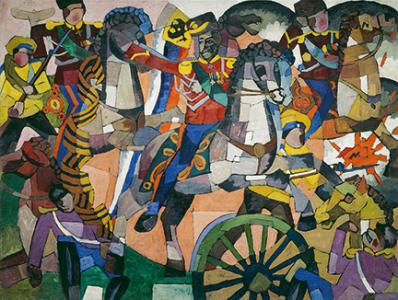
Love those guys.
Four more blocks south and we’re at the Metropolitan Museum of Art, where there are two blockbuster exhibits.
Start slow with Sargent: Portraits of Artists & Friends, which “brings together ninety-two of the artist’s paintings and drawings of members of his impressive artistic circle. The individuals seen through Sargent’s eyes represent a range of leading figures in the creative arts of the time such as artists Claude Monet and Auguste Rodin, writers Robert Louis Stevenson and Henry James, and the actor Ellen Terry, among others.”
Favorites include W. Graham Robertson (“he’s nothing without the coat”):

Presented by W. Graham Robertson 1940
And Robert Louis Stevenson in decline:

Then accelerate into China: Through the Looking Glass (through September 7), a knee-buckling exhibit that occupies parts of three floors of the museum and presents an almost hallucinogenic survey of Chinese-inspired fashion.
This exhibition explores the impact of Chinese aesthetics on Western fashion and how China has fueled the fashionable imagination for centuries. In this collaboration between The Costume Institute and the Department of Asian Art, high fashion is juxtaposed with Chinese costumes, paintings, porcelains, and other art, including films, to reveal enchanting reflections of Chinese imagery.
From the earliest period of European contact with China in the
sixteenth century, the West has been enchanted with enigmatic objects and imagery from the East, providing inspiration for fashion designers from Paul Poiret to Yves Saint Laurent, whose fashions are infused at every turn with romance, nostalgia, and make-believe. Through the looking glass of fashion, designers conjoin disparate stylistic references into a pastiche of Chinese aesthetic and cultural traditions.
The exhibition features more than 140 examples of haute couture and avant-garde ready-to-wear alongside Chinese art. Filmic representations of China are incorporated throughout to reveal how our visions of China are framed by narratives that draw upon popular culture, and also to recognize the importance of cinema as a medium through which to understand the richness of Chinese history.

You really gotta see it to believe it.
* * * * * * *
On the way home we swung by the Bruce Museum in Greenwich to catch The Seven Deadly Sins: Pride, part of a seven-venue series of exhibitions mounted by the Fairfield/Westchester Museum Alliance (FWMA). The engrossing exhibit is “[a] study of exquisite master prints, drawings, paintings, rare books, and a video installation [that demonstrates] the breadth and endurance of the imagery of this deadly sin,” and runs through October 18.
We also visited Walls of Color: The Murals of Hans Hofmann (through September 6), “[the] first-ever exhibition to focus on the artist’s varied and under-appreciated public mural projects. The centerpiece of Walls of Color: The Murals of Hans Hofmann [is] nine oil studies by Hofmann, each seven feet tall, for the redesign of the Peruvian city of Chimbote. This was Hofmann’s extraordinary collaboration, in 1950, with Catalan architect José Luis Sert – the man who designed the Spanish Pavilion at the Paris World’s Fair in 1937, for which Picasso’s great mural Guernica was conceived.”
Those murals were never produced. But these were:
Although now nearly forgotten, Hofmann also created two huge public murals in Manhattan. In 1956, for the developer William
Kaufman, and in collaboration with the noted pioneer modernist architect William Lescaze, Hofmann created an astonishing, brilliantly colored mosaic mural, wrapped around the elevator bank in the main entrance hall of the office building at 711 Third Avenue. Two years later, in 1958, commissioned by the New York City Board of Education, Hofmann created a 64-foot long and 11-foot tall mosaic-tile mural for the High School of Printing (now the High School of Graphic Arts Communication) on West 49th Street.

Very cool.
From there we swung by the Yale University Art Gallery to catch the last day of Whistler in Paris, London, and Venice, “three of his earliest and most innovative sets of etchings, the so-called French, Thames, and Venice Sets.”
Representative samples:


Whistler qualifies as one of the greatest etchers in history, and this exhibit showed why. It also featured etchings by some of Whistler’s contemporaries – his brother-in-law Francis Seymour Haden, Mortimer Menpes, Joseph Pennell – but with all of them the Missus and I had the same reaction: “Too many details.”
By coincidence, the curator of the Yale exhibit, Heather Nolin, gave a terrific lecture about Whistler and his etchings at Boston’s Museum of Fine Arts on Tuesday. But . . . that’s over as well.
Sorry.