From Thursday’s Boston Globe:

The stately local broadsheet made a mistake reviewing “My Mistake”?
File under: There but for the grace of God and etc.
From Thursday’s Boston Globe:
The stately local broadsheet made a mistake reviewing “My Mistake”?
File under: There but for the grace of God and etc.
Wednesday’s New York Times called the roll of State Gun Laws Enacted in the Year Since Newtown.

Nutshell version:
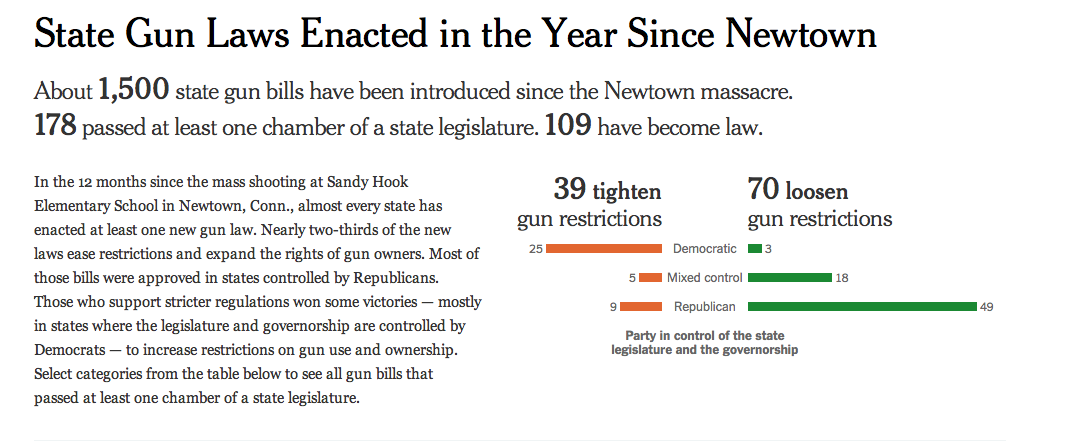
Twenty-nine laws loosened concealed carry laws; none tightened them.
Twenty-three laws tightened background checks and mental health reporting; three loosened them.
Critics would say publishing this tally promotes a liberal agenda.
But any sane person would say it simply provides a public service.
P.S. Today’s Boston Globe features this post-Newtown report:
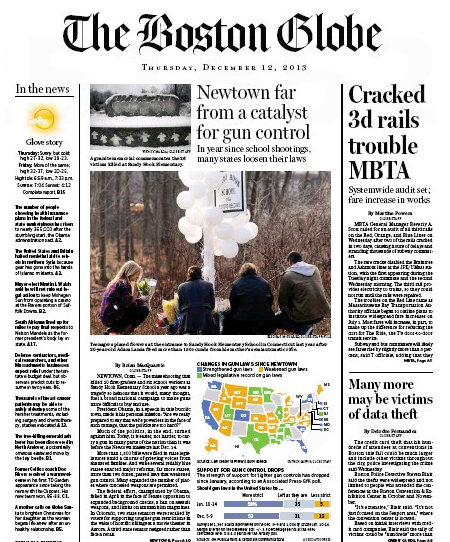
By the numbers:

Not as exhaustive as the Times piece, but not as exhausting either.
Andrea Elliott’s New York Times Invisible Child series (photographs by Ruth Fremson) gets more heartbreaking by the day as it chronicles the life of a family consigned to a hellish homeless shelter in Fort Greene, Brooklyn.
Wednesday’s chapter reads like a novel, with the remarkable 11-year-old Dasani experiencing inexplicable hardships (losing a home on Staten Island), inconsolable losses (having her grandmother’s ashes stolen from the Auburn Family Residence), and inconceivable setbacks (getting suspended from school for defending herself in a fight).
The next day, [her mother] Chanel escorts Dasani to school. In the hallway, she spots the girl Dasani fought in the park. “You can fight my kid,” she says hotly, taking the girl by surprise. “I’m with that.”
Minutes later, the principal, Paula Holmes, sits Dasani down. “I believe you can change, but you’re not showing me that,” she says.
Dasani returns to class feeling jaunty. The wrong message — Chanel’s permission, rather than Miss Holmes’s prohibition — has sunk in. “I’ma fight you,” she tells another girl. “My mother said she’ll let me fight.”
With that, Dasani is suspended.
Miss Holmes knows it is a risky move, but nothing else has worked. The girl needs to be shocked out of her behavior. The alternative is to fail in school and beyond.
“Get your things and leave,” Miss Holmes tells her.
Dasani will be out of school for a whole week. She cannot speak.
To be suspended is to be truly homeless.
And then there are the unexpected triumphs.
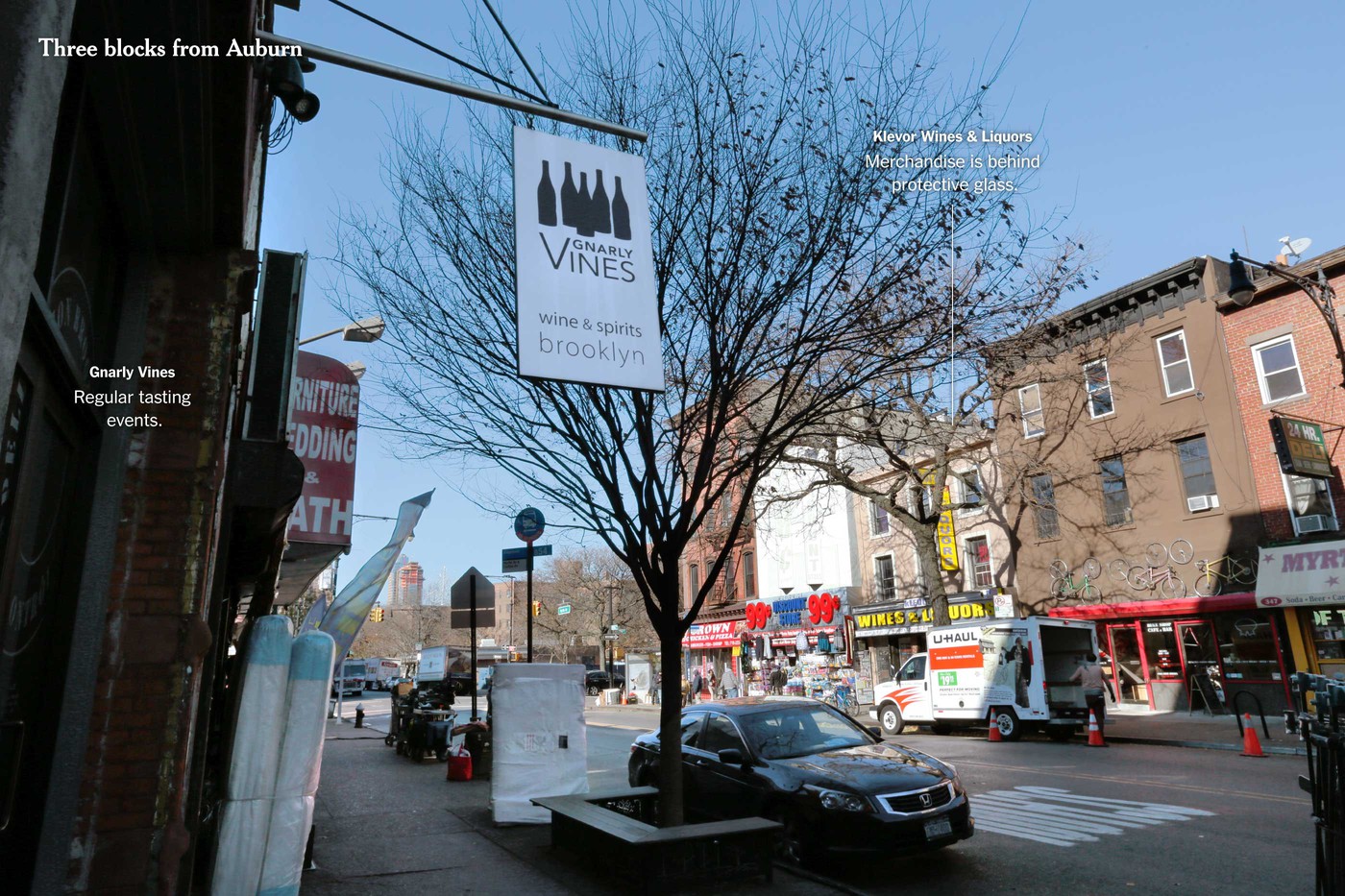
On the Brooklyn block that is Dasani’s dominion, shoppers can buy a $3 malt liquor in an airless deli where food stamps are traded for cigarettes. Or they can cross the street for a $740 bottle of chardonnay at an industrial wine shop accented with modern art.
It is a sign outside that locale, Gnarly Vines, that catches
Dasani’s notice one spring afternoon: “Wine Tasting Tonight 5-8.”
Dasani is hardly conversant in the subject of libations, but this much she knows: A little drink will take off her mother’s edge. Without further ado, Chanel heads into the wine shop on Myrtle Avenue, trailed by four of her eight children. They are lugging two greasy boxes of pizza and a jumbo pack of diapers from Target.
The cashier pauses. The sommelier smiles.
“Wanna try a little rosé?” she asks brightly, pouring from a 2012 bottle of Mas de Gourgonnier. “I would describe it as definitely fruit forward at the beginning.”
Chanel polishes it.
“But really crisp, dry, refreshing ——”
“Not refreshing,” Chanel says. “I just think dry.”
“No, it’s very dry,” says the sommelier, a peppy blonde in wire-rim glasses. “It’s high acid, a little citrusy.”
Chanel sticks out her tongue. She finds the woman’s choice of words unappetizing. To the side of the wine display is a large, silver vase that recalls the family urn, prompting Chanel’s son Khaliq to ask if it contains the ashes of a dead person.
“Oh my gosh, for cremation?” the sommelier asks, shaking her head. “We just use it for spitting in.”
“For spitting?” Chanel says with horror.
“Yeah, it’s got rejected wine in it,” the sommelier says.
Chanel scoffs. She might not like the wine, but she sees no reason to spit it out. She moves on to a Tuscan sangiovese.
Ignoring the spectacle, Dasani scans the room, frowning at a sign on the wall: Liqueur. “They got liquor spelled wrong,” she yelps victoriously.
Actually, the sommelier interjects, that is the French word for the delicate, liquid spirits derived from fruits such as pomegranates and raspberries. “But you’re very right,” she offers sweetly. “That is not how you spell liquor.”
“Not the hood liquor,” Chanel says.
God, this series hurts.
Recipe for marketing in the 21st Century:
Ingredients
1 part news
1 part entertainment
1 part advertising
Directions
Combine in blender. Hit puree.
Serves: Everyone but the Jurassic types who think you have a right to know when you’re being advertised to.
Welcome to branded content, a.k.a. ads in sheep’s clothing.
It’s everywhere these days, from TV programs that let advertisers use characters from the show in commercial breaks, to cast members who deliver product pitchesduring the show, to advertisers paying their way into top trend lists, to thepioneering sponsored content in Mike Allen’s Politico Playbook daily tip sheet.
Regarding that last one:
A review of “Playbook” archives shows that the special interests
that pay for slots in the newsletter get adoring coverage elsewhere in the playing field of “Playbook.” The pattern is a bit difficult to suss out if you glance at “Playbook” each day for a shot of news and gossip. When searching for references to advertisers in “Playbook,” however, it is unmistakable. And its practitioner is expanding the franchise.
Allen has added Capital Playbook, “a newsletter stemming from Capital New York, the news site that Politico acquired earlier this year,” to his growing roster of daily production. Presumably Politico Playbook’s branded content – and powderpuff coverage – will tag along with him.
But that’s to be expected, because publishers are on branded content like Brown on Williamson.
According to a new survey by Hexagram and Spada, 62% of publishers currently offer branded content/native advertising and another 16% plan to do so in the next year. Beyond that, MediaPost notes, “41% of brands and 34% of agencies currently use native advertising, with an additional 20% of brands and 12% of agencies planning to begin using it within the year.”
Part of the shell game resides in the multiple labels the marketers attach to native advertising, as illustrated in this graph . . .
Read the rest (and there’s a lot of it) at Sneak Adtack.
 Well the Doc opened up the old mailbag today and here’s what poured out.
Dear Dr. Ads,
I don’t read the New York Times much (I’m a Washington Post kind of guy), but I happened upon Monday’s edition and here’s what I saw.
That’s some Murderers’ Row, eh? But don’t you think there’s a big name missing? I’m talking about a company that collects mountains of information the government could find useful in determining what people might do next, or what like-minded people already have done.
See where I’m headed here, Doc?
– Jeff B
Dear Jeff B,
The Doc feels your pain. We’ve never gotten over losing the Acting Surgeon General gig to Rear Admiral (RADM) Boris D. Lushniak, M.D., M.P.H., who’s a total hack . . .
Read the rest at Ask Dr. Ads.
Read this New York Times piece and weep for the 22,000 homeless children in NYC, especially Dasani.

It’s a totally heartbreaking story stretching over four full pages of Monday’s Times.
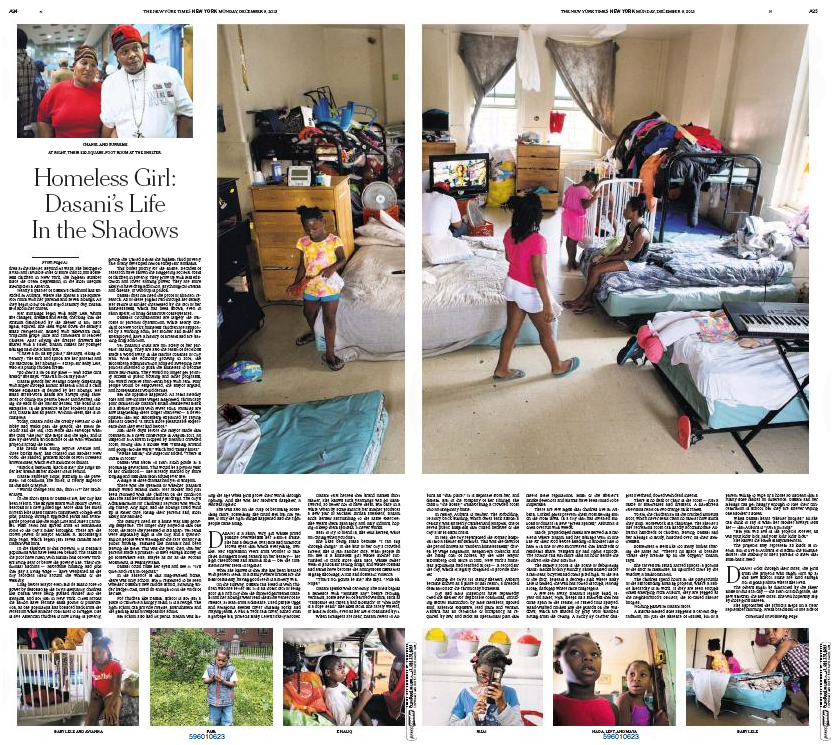

Outgoing New York Mayor Michael Bloomberg has some ‘splainin’ to do.
And incoming New York Mayor Bill de Blasio has his work cut out for him.
Well the Missus and I trundled out to the Rose Art Museum at Brandeis University the other day to catch Image Machine: Andy Warhol and Photography (through December 15) and, say, it was . . . interesting.
From the Rose website:
Iconic American artist Andy Warhol (1928 – 1987) created much of his art from photographs—those he collected from
mass media and those he shot himself. Image Machine, which is drawn largely from the Rose Art Museum’s permanent collection, focuses on how Warhol used photography throughout his career as source material, medium, and subject matter. The phrase “image machine” refers to both the artist himself—he produced tens of thousands of photographs over his lifetime—and the technologies he employed. Warhol adopted the image-making machines of popular culture, including still cameras, movie cameras, and commercial silkscreen printing.
Especially appealing: Warhol’s 10 Portraits of Jews of the 20th Century.
Representative samples include Louis Brandeis:

and the Marx Brothers:

Observation #1:
Here’s yet another basement-and-attic exhibit occasioned by these parlous times for art museums.
Observation #2:
Catch it if you can.
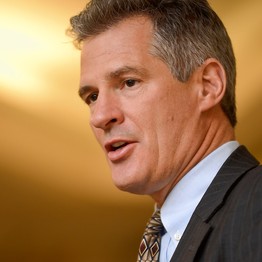
The peripatetic Scott Brown (R-Elsewhere) has taken his Hamlet, New Hampshire act to the Big Town.
From the Weekend Wall Street Journal:
Former Senator Weighs a Race Next Door
Former Republican Sen. Scott Brown of Massachusetts likes to
joke that his sole ambitions now are to master Spanish and the electric guitar.
Increasing signs point to an added aim: A possible Senate run next year in neighboring New Hampshire against the Democratic incumbent, Sen. Jeanne Shaheen.
You might well ask, “What can Brown do for New Hampshire?”
Just this:
Ms. Shaheen, Mr. Brown said in an interview, “needs to explain to voters why she was the deciding vote on Obamacare.” Ms. Shaheen’s office declined to comment.
Maybe because when you plug deciding vote on Obamacare into the Googletron, you get this:

Then again, as H.L. Mencken said, no one ever went broke underestimating the intelligence of the American public.
Not even Scott Brown.
In her New York Times column today, Public Editor Margaret Sullivan takes on The Thorny Challenge of Covering China.
Thorny in two ways for the Times: First because the Chinese government is aggressively responding to news organizations that produce coverage critical of the government or high-ranking officials by blocking their websites or denying residency-visa renewals for their journalists.
And second, because the biggest China story lately was one that didn’t run:
On Nov. 9, The Times published an article on its front page about one of its chief business-news competitors, Bloomberg News, describing how the organization had decided against the planned publication of an article for fear of reprisal by the Chinese government. The Times story, which came from unidentified Bloomberg employees, included denials by Bloomberg news executives, including the editor in chief, Matthew Winkler, that the story was killed.
Sullivan says Bloomberg made a formal complaint to her, criticizing the Times for “‘sabotaging a competitor’ by describing the news in the unpublished article.” Sullivan came to the conclusion that “the initial initial Times article was essentially solid — and certainly eye-opening. Still, one can reasonably question whether it was sound judgment to put an article focused on a competitor’s news decision at the top of The Times’s front page.”
Fallout from the Times piece included Bloomberg having its offices in Shanghai and Beijing tossed by Chinese authorities, and this:
Publicly, Bloomberg has continued to say that its article was held back for more reporting, not permanently killed. One of the reporters of that article, Michael Forsythe, was suspended from Bloomberg; he later left the company. It would not be surprising if Mr. Forsythe soon joined the reporting staff of The Times.
Wait a second . . . that’s it? No followup from Sullivan? Because to the gimlet eye that could look an awful lot like a quid pro quo, couldn’t it? You give us a scoop, we give you a job.
Maybe that’s the case or maybe it isn’t, but it sure feels like Sullivan should have addressed it. The hardworking staff thinks Sullivan has done a pretty good job as Public Editor, but we also think she let this one slip by her.
P.S. We just checked the comments submitted by readers and the only one addressing this topic was complimentary:
Another sentence, about the now-jobless reporter who worked on that competitor’s as-yet-unpublished article, was also quite deft: “It would not be surprising if Mr. Forsythe soon joined the reporting staff of The Times.”
Deft? More like tone-deaf to us.
In this week’s Great Boston MediaWatch Dogfight, it’s not, as often happens, that the local media hall monitors are operating in different universes.
It’s that they’re operating on different days.
Start as always with the Boston Herald’s Underdog Press Party.
This week’s Press Party media show features an ethical debate on the Sandy Hook shooting 911 calls, a little bit of fun with Ron Burgundy, and a discussion about the future of news magazines.
Notice anything missing? Like the death of Nelson Mandela? That’s because the Wayne’s World Webcast tapes on Thursday instead of Friday the way a normal week in review show does.
Cut to WGBH’s Big Dog Beat the Press, which featured this Mandela valedictory:
The hardpartying staff isn’t in the business of dispensing advice, but memo to the Herald:
For God’s sake, move Press Party back to Friday.
 Click to subscribe to RSS