Dead Blogging ‘Prifti: Drawn by Light’ at the Griffin Museum

Well the Missus and I trundled out to Winchester yesterday to catch the David Prifti exhibit at the Griffin Museum and, say, it was swell.

(As was our breakfast at the Swanton Street Diner.)

From the museum’s website:

PRIFTI_facesplit-420x559

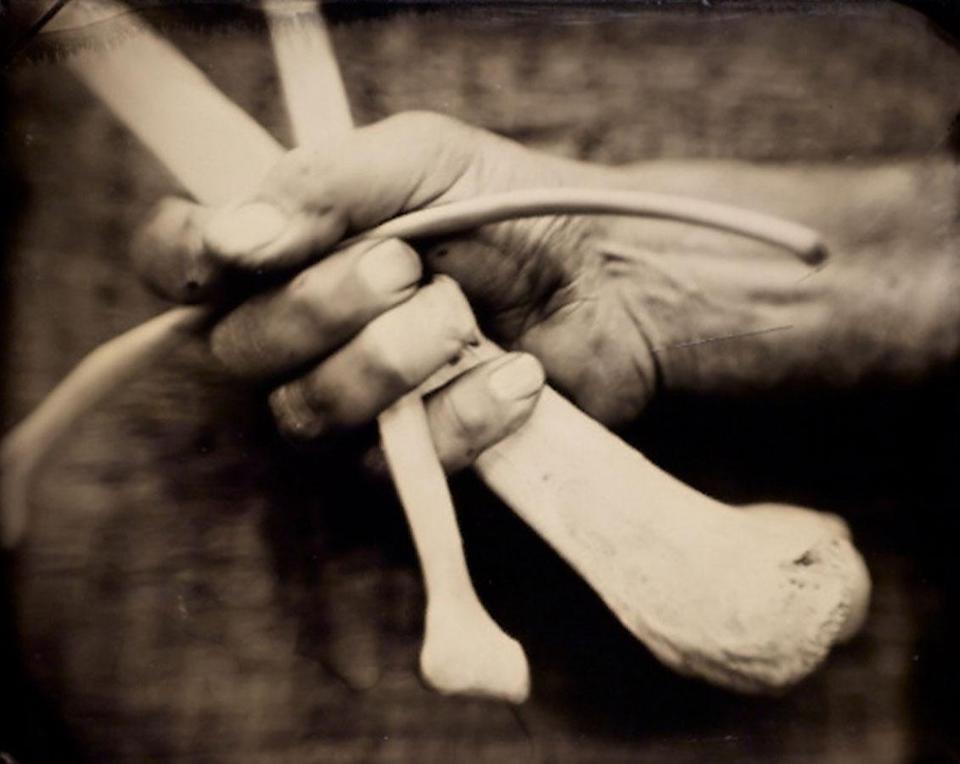
In an artist statement Concord resident, David Prifti once wrote that is was his desire to explore his life through the things that shaped his life. These formative elements were his relationships, his memories, his sense of family, rites of passage, aging and death. The creative process that led to all of his photographs was indirectly a very personal journey for him.

Boston Globe columnist Mark Feeney captured Prifti’s art much better than we ever could in this piece.

Time is of the essence at Griffin

editedgriffin012

WINCHESTER — Every photograph is rooted in the past. Click the shutter even on some super-slick digital camera, one that makes photography seem all but instantaneous, and the super-slickness doesn’t help. No matter how quickly you look to see the image just taken — even if you had split-second reflexes and the dexterity of a demigod — what you see is always the past preserved, never the present framed. The click demarcates then and now. The image bridges them.

That’s obvious enough. To connect then with now is why people take pictures. Grammatically, a photograph manages the neat trick of being in the past tense while seeming to be in the eternal present.

What makes David Prifti’s show “Drawn by Light” so arresting is how the images strive to eliminate any illusion of mixed tenses. They embrace pastness. They proclaim their past state, doing so either through a distressed corporeality or the elegant sneakiness of process substitution. The show is one of several at the Griffin Museum of Photography that run through March 2.
The Missus and I were lucky enough some years ago to meet David Prifti, a relentlessly likable, immensely talented man. The Griffin Museum exhibit does justice to both sides of him.
 

Posted in Uncategorized | Tagged , , , , , | Leave a comment

‘The Most Interesting Front Page in the World’

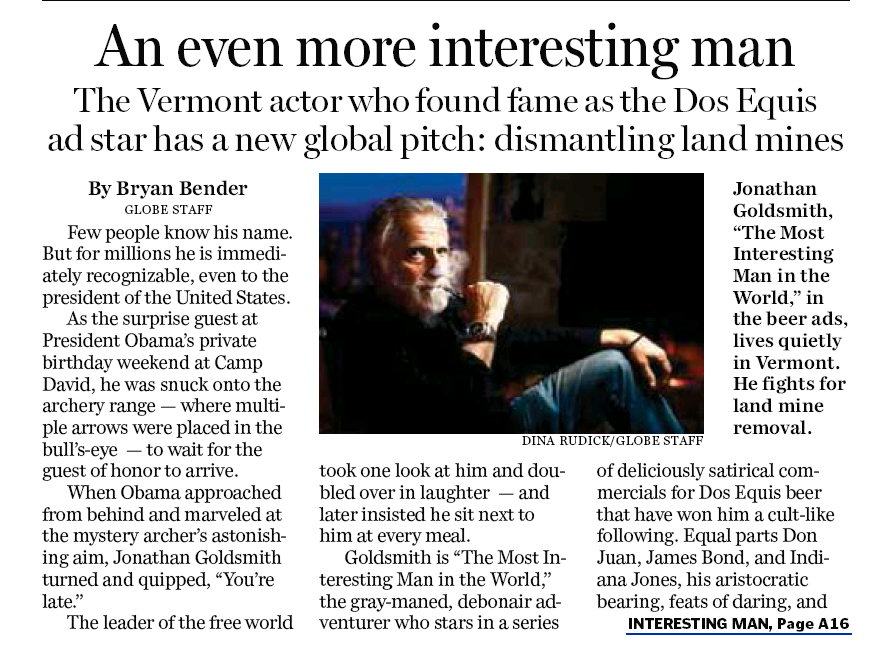
Sharp Page One piece in yesterday’s Boston Sunday Globe about Jonathan Goldsmith, the Vermont actor who plays The Most Interesting Man in the World in Dos Equis commercials.


Screen Shot 2014-01-20 at 1.32.58 AM


The hardworking staff does always read local front pages, and when we do, we prefer the Globe.

Stay thirsty, my Globeniks.

Posted in Uncategorized | Tagged , , , , , , | Leave a comment

Has Google Replaced U.S. Postal Stamps in Celebrating Cultural Giants?

Call it the Dawn of the Great Google Doodle Backlash.

From today’s Washington Post Outlook section (via Politico Playbook):

The case against the Google Doodle

JMH artWhen Google honored African American author Zora Neale Hurston with a custom logo — a Google Doodle — on its homepage earlier this month, the company won praise.

Time and the Los Angeles Times wrote approving stories. “Google’s tribute was fitting for Hurston, who was ‘a groundbreaking experimental novelist, champion of black vernacular culture and a daring anthropological scholar,’ ” Daphne A. Brooks, a Princeton University English professor, told the Root . . .

But is Google the right booster for one of the Harlem Renaissance’s greatest treasures? We’d be appalled if McDonald’s used Martin Luther King Jr.’s image to sell hamburgers or if Coca-Cola put Mohandas Gandhi on a soda can. So why is it any different when a tech behemoth uses Hurston to hawk searches?

Justin Moyers’s piece then postulates this: “Since Google began Doodling in 1998, it’s aligned its brand with some of the greatest human beings who ever walked the Earth, borrowing the pixie dust of GandhiMLK and others. In a role once reserved for the U.S. Postal Service and its stamps, Google now decides who deserves tribute —Hurston yes, Malcolm X no.”

In other words, WaPo asserts – U.S. Postal Service yes, Google no.

Yes?

Or no.

Posted in Uncategorized | Tagged , , , , , , , , , , , , , , , , , , , , | 3 Comments

The Sneak in Review: Native (Advertising) Intelligence

Sneakinreview2The Reading Room at the Global Worldwide Headquarters of Sneak Adtack is starting to fill up, so the hardtracking staff is offloading these ads ‘n’ ends.

Start with this piece from the New York Times:

Promoting Its Own Products, a Magazine Labels an Ad as News


CONTENT from advertisers that resembles editorial coverage, commonly called native advertising, is drawing heightened scrutiny from the Federal Trade Commission, which wants to establish guidelines for labeling it clearly. Now Shape magazine has drawn a rebuke for such content from advertising regulators for an unusual case in which it served as both publisher and advertiser.

In the September issue of Shape, a full-page article carried the headline “Water works!” under the heading of “News.” After citing many studies espousing hydration, and a warning from the Center for Science in the Public Interest against high-calorie sugary drinks, the non-bylined article said that about 20 percent of Americans did not like the taste of water.

But, according to the Times piece, “[t]he National Advertising Division, the investigative arm of the ad industry’s voluntary self-regulation system, which operates under the aegis of the Better Business Bureau, conducted [an] inquiry. Shape ‘blurred the line between advertising and editorial content in a way which could confuse consumers,’ the division stated in a ruling released last week.”

Ya think?

So we can all agree that the default mode of native advertising is deception, as MediaPost notes . . .

Read the rest at Sneak Adtack.

Posted in Uncategorized | Tagged , , , , , , , , , , , , , , , , , | Leave a comment

Ask Dr. Ads: What’s Up with the Adholes at Sports Illustrated?

DrAdsforProfileWell the Doc opened up the old mailbag today and here’s what poured out.

Dear Dr. Ads,

I was cruising around the Net and happened upon this Sports Illustrated piece – The writer and the puzzle: Richard Ben Cramer couldn’t crack A-Rod – at Longform. But when I clicked on the link, I got this:


Screen Shot 2014-01-17 at 2.06.53 PM


So I had to watch one of those spots before I could read the piece. But I didn’t.

Whaddaya think of that, Doc?

– Ad Nauseum

Dear Ad Nauseum,

I think it means I had to watch one of the spots instead. So I did. I watched the Picabo Street ad . . .

Read the rest at Ask Dr. Ads.

Posted in Uncategorized | Tagged , , , , , , , , , | Leave a comment

Gawker Channels Dr. Ads!

Snarknado website Gawker featured this item yesterday:

New York Times Doesn’t Know Who Bought Strange Pro-Bloomberg Ad


Michael Bloomberg


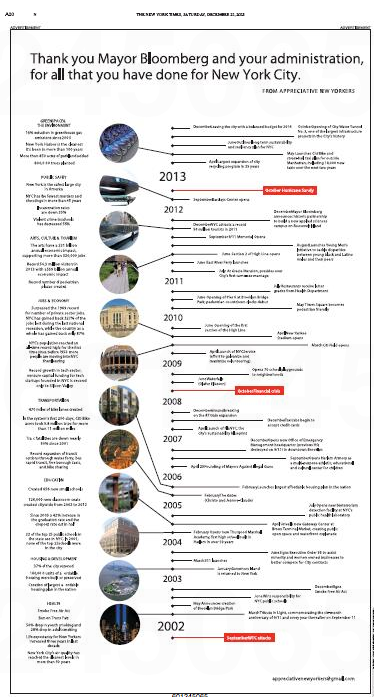
Late last year, print readers of  The New York Times discovered a full-page color ad, signed by a group called “Appreciative New Yorkers,” touting former mayor Michael Bloomberg’s policy achievements. “Thank you, Mayor Bloomberg and your administration, for all that you have done for New York City,” it read in large lettering. Who are these thankful New Yorkers with a spare $70,000 to spend on praising a politician? Not even the Times knows.

Usually the Times will disclose the names of advertisers when asked, even if the ads themselves are unclear—for example, when a PR firm owned by the personal flack of Roger Ailes purchased two Times Book Review ads for Zev Chafets’ 2013 Ailes biography, in an effort to distract from Gabriel Sherman’s unauthorized biography of the Fox News chief.

Whoever wanted to thank Mayor Bloomberg, however, took unusual steps to make sure they couldn’t be identified . . .

(Clicking on discovered in the first sentence takes you to this excellent Dr. Ads post.)

In case you missed it, here’s the ad:


Screen Shot 2013-12-21 at 1.47.36 PM


More from the Gawker piece:

According to a Times executive briefed on the matter, the business side agreed to an arrangement in which the buyer needed only to submit an alias and a billing address, which the buyer supplied only after Times personnel promised not to divulge it. Payment was made with an untraceable traveler’s check.

The business side never determined the buyer’s identity. “The entire process was extremely secretive,” the executive said.

Last month – after we tried several times to contact the Appreciative New Yorkers, to no avail – the hardworking staff asked Did Michael Bloomberg Pay For A NYT Ad Praising Michael Bloomberg? and, a week later, Did Michael Bloomberg Run Another NYT Ad Praising Michael Bloomberg?

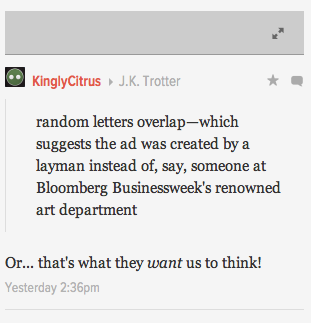
Apparently Gawker readers share our suspicions. From its comments section:


Screen Shot 2014-01-16 at 4.27.47 PM


Screen Shot 2014-01-16 at 4.29.05 PM


Screen Shot 2014-01-16 at 4.28.36 PM


Stranger things have happened, yeah?

Posted in Uncategorized | Tagged , , , , , , , , , , , , | Leave a comment

Correction o’ the Day (Wait – What? Edition)

From our Scratch Your Head desk

This correction ran in Wednesday’s Boston Globe:

Screen Shot 2014-01-16 at 12.12.16 AM

Huh?

So the hardclicking staff went back to the original Globe piece and found this:

Also being featured in Christie’s Jan. 24 sale is “Favorites From the Collection of Kristina Barbara Johnson,’’ 78 lots of folk art. Listed as one of America’s top 100 collectors of art and antiques from 1986-96 and a former trustee of the American Folk Art Museum in New York, Johnson died in April at 76 in her native Poland after a lengthy illness.

In 1968, Basia Piasecka emigrated from Poland to the United States, reportedly with only $200, but when she died, her net worth was $3.6 billion, according to Forbes.

Her life, described alternately as a rags-to-riches story and a fractured fairy tale, changed when shortly after her arrival in this country she took a job as a chambermaid in the New Jersey home of J. Seward Johnson Sr., an heir to the Johnson & Johnson Band-Aid and baby powder fortune.

A year later Basia, who had studied art history in Poland, quit her job, moved into a Manhattan apartment provided by Johnson, and started taking art classes at New York University. Two years later Johnson, 76, and the father of six grown children, married 34-year-old Basia. Upon his death at 87 in 1983, Barbara Johnson (her name now) inherited the bulk of his fortune, estimated at around $500 million, which after a three-year legal battle with his children that ended in a settlement, was reduced to about $340 million.

No worry – Johnson eventually “became a billionaire and world famous as an art and antiques collector.”

Except maybe not, according to the Globe correction.

Which leaves the headscratching staff saying Hey, Globeniks: Any chance you’ll give us the real “life story of Kristina Barbara Johnson”?

Or should we make up our own?

Posted in Uncategorized | Tagged , , , , , , , , , , | 1 Comment

‘Dr. Evil’ of Politics Strikes Again on Minimum Wage

Corporate gunsel Rick Berman, memorably profiled as Dr. Evil on 60 Minutes in 2007, is front-and-center in the minimum wage battle now being, er, waged at the state and federal level.

From Tuesday’s New York Times:


Screen Shot 2014-01-15 at 12.49.40 AM


Fun fact to know and tell: The Employment Policies Institute, which paid for the ad, is a front group established by Berman’s lobbying firm on behalf of the restaurant, hotel, alcoholic beverage and tobacco industries, according to the liberal Center for Media and Democracy’s SourceWatch.

Which makes minimum wage.com a Potemkin website.

Although you’re welcome to visit it anytime.

Posted in Uncategorized | Tagged , , , , , , , , , | 3 Comments

Correction o’ the Day (Boston Globe Humblenag Edition)

This is really impressive: Tuesday’s Boston Globe managed to correct and promote the paper in one swell foop.

Screen Shot 2014-01-15 at 1.13.40 AM

Man, that’s sweet.

UPDATE: Wait – should that be Bumblebrag? We’re confused.

Posted in Uncategorized | Tagged , , , , , , , , | 2 Comments

Journalists Screwed Twice by Native Advertisers

So it’s not bad enough that native advertising – those ads in sheep’s clothing tricked out to look like editorial content – is slowly chipping away at the authority and credibility of real journalism. Now it’s also chipping away at the livelihoods of real journalists.

From Adweek (via Pew Research Daily Media Briefing):

Skimping on Fees and Avoiding Journalists: Are Publishers Doing Native on the Cheap?

Could be moving toward an advertorial model

revenue-graph-chart-hed-2013_0From publishers to creative agencies to writer networks, many seem to be making money from native advertising. But one group that doesn’t always share equally in the booty is journalists.

While some are paying standard freelance rates or more to those who create native ads, some bad apples are skimping on fees or avoiding hiring journalists altogether.

One brand marketer told of an established news organization promising native content produced by its top journalists but that ultimately used marketing freelancers. “They represented themselves as giving access to their editorial staff,” the exec said. “Then they delivered articles written by copywriters instead of journalists.”

Okay, a couple of things . . .

Read the rest at Sneak Adtack.

Posted in Uncategorized | Tagged , , , , , , , | Leave a comment