The Arts Seen in Philly (Tim & Julia’s Excellent Wedding Edition)

Well the Missus and I trundled down to Philadelphia this past weekend for the wedding of our nephew Tim and, say, it was swellegant.

On the endless drive down there (hey, Friday . . . summer . . . 95 South – nightmare, right?), we stopped by the Bush-Holley House Museum to break up the trip. The house was  built in stages starting in 1728 and has quite a history, but what interested us was the part it played in the Cos Cob Art Colony.

From the early 1890s until the 1920s the Holley House was the gathering place for a group of artists and writers who were members of what became known as the Cos Cob Art Colony, the first Impressionist art colony in Connecticut. The Cos Cob Art Colony played a major role in the development of American art, because it was here that the leading American Impressionist artists gathered to discuss their work and to teach. Among the early members were Childe Hassam [his Clarissa at right], Ernest Lawson, Theodore Robinson, John Henry Twachtman and J. Alden Weir.

We got a lovely tour of the house from Deborah, then we got back on the road and drove. And drove. And drove . . .

The next morning we moseyed over to the (relatively) new Barnes Foundation, the staggering collection of artwork acquired by Albert Barnes (46 Picassos, 59 Matisses, 69 Cézannes, a knee-buckling 181 Renoirs, and countless other master works from Greco-Roman art to El Greco) that was formerly housed in a two-story Renaissance-style building in Merion, Pennsylvania, 20 minutes from downtown Philadelphia.

The Barnes was established much like the Isabella Stewart Gardner Museum – nothing moves, everything stays the same in perpetuity. But after a protracted – and extremely bitter –  legal battle, the Barnes collection was uprooted and relocated to Benjamin Franklin Parkway, Philly’s Museum Mile, where a new building houses the collection along with two classrooms, a great hall, a restaurant, a gift shop, and an indoor garden.

Here’s how art critic Lance Esplund described the proposed move in a 2010 Weekly Standard piece titled “No Museum Left Behind.”

The Barnes Foundation is not just another way to look at art; it is the way artists look at art.

To move the Barnes collection is to inflict havoc on a distinctive museum experience, one designed to get us closer to the minds of art’s makers. To invite in all of the available 21st-century museum amenities and distractions (merely because we can) is to kill the essential spirit of the Barnes.

(New Republic art critic Jed Perl didn’t like it any better after the move. “The Barnes Foundation, that grand old curmudgeonly lion of a museum, has been turned into what may be the world’s most elegant petting zoo,” he wrote in 2012. New York Times art critic Roberta Smith begged to differ. All three are great reads,)

Anyway, here’s a representative sample of the collection.



According to one of the lawyers for the Movers (vs. the Stayers), “the new galleries . . . retain the scale, proportion, and configuration of the existing galleries and, through an interior garden, will reinforce the connection between art and nature.” (There’s a fascinating exchange between Esplund and the lawyer, Brett Miller, here.)

Now, I am nowhere near as smart at the aforementioned art critics, but it seems to me that if the Barnes Foundation had to be moved (the question at the very heart of that whole rumpus), what now sits on Benjamin Franklin Parkway (cost: north of $150 million) is about the best we could have expected.

There. That should tick off both sides.

After we left the Barnes, the Missus and I dropped by the Rodin Museum, whose Beaux-Arts-style building was designed by Paul Philippe Cret, who also designed the original Barnes.  As the museum’s website says, “[w]ith over 140 bronzes, marbles, and plasters, the distinguished collection housed in the Rodin Museum represents every phase of Auguste Rodin’s career.”

Nice.

Then it was on to the Philadelphia Museum of Art, which has always struck us as truly impressive. A great collection of European paintings, wonderful sculpture, and major galleries from a Japanese teahouse to this New York town house drawing room.

Also currently on view (through September 17th) is the eye-popping exhibit, Wild: Michael Nichols.

“It’s all about respect for the natural world.”—Michael Nichols

Explore the work of legendary photographer Michael “Nick” Nichols: artist, technical innovator, and ardent advocate for preserving natural habitats. Be transported through the split-second magic of images captured in some of the most remote areas of the world. Nichols’s stunning photographs offer intense confrontations with the power and fragility of the wild and a reflection of our own humanity.For more than three decades, Nichols has ventured to the farthest reaches of the world to document nature’s wildest creatures and landscapes. As an award-winning photographer for National Geographic, he has recorded animals and habitats in locations as expansive as the Congo Basin, the Serengeti, and the American West with an unparalleled intensity.

Excellent!

(One other note: Although the denizens of the City of Brotherly Love are legendarily rude, the museum personnel and guards there were the nicest people we’ve ever encountered in those roles. Go figure.)

Then it was on to the main event: The splendid nuptials of Tim (my brother Bob’s boy) and Julia, a most delightful couple who tied the knot at the Free Library of Philadelphia. It was a wonderful night and we wish them many years of happiness.

The next day we drove home without incident, unless you count that thing at the Joyce Kilmer rest stop on the Jersey Pike. But, hey – that’s life on the road.

Posted in Uncategorized | Tagged , , , , , , , , , , , , , , , , , , , , , , , , , , | 3 Comments

The Grey Lady Moneti$es Yet Another of Her Journalists

As the hardworking staff has diligently chronicled, the New York Times is turning itself into a full-service, well, service.

Travel agency, tchotchke shop, conference center – you name it, the Times will do it.

For money, of course.

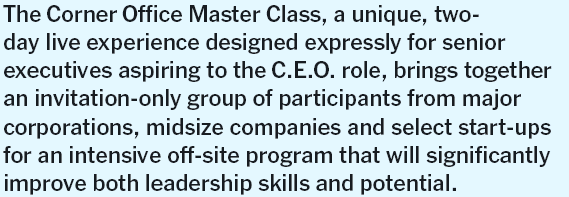
Now comes the Grey Lady’s latest money-making scheme: The Corner Office Master Class, touted in this full-page ad in Wednesday’s Times.

Nuts ‘n’ bolts graf:

Hosting the master class is Times reporter Adam Bryant, “a celebrated authority on leadership,” who writes a column called, yes, Corner Office. As our kissin’ cousins at Sneak Adtack recently noted, the Times is “increasingly blurring the line between advertising and editorial” in its efforts to offset knee-buckling declines in print ad revenues.

(See Jeff Gerth’s major Columbia Journalism Review takeout for further details.)

We totally get the need for newspaper organizations to find new sources of revenue. But there’s a fine line between selling Times coffee mugs and selling access to Times journalists.

Here’s hoping the Grey Lady doesn’t cross it.

Posted in Uncategorized | Tagged , , , , , , , , , | 6 Comments

Shut Up: Ring Lardner Explained

From the first time I read a Ring Lardner short story (“Haircut,” I believe, like a billion other American high schoolers), I’ve been a huge fan of his work. So much so that back in the ’70s and ’80s I set out to collect original editions of all his books, haunting used bookstores from New York to California and multiple stops in between.

(That was, of course, pre-Amazon, pre-eBay, pre-Internet. So it took awhile. Like 15 years, at which time I got the last one for my collection, Own Your Own Home. I could buy it now in 15 seconds.)

As I’ve mentioned before, every October I re-read “A World’s Serious,” one of my favorites (available in The Portable Ring Lardner). Another favorite is The Young Immigrunts, which gave us this immortal exchange between one of Lardner’s sons and the old man.

Are you lost daddy I arsked tenderly.

Shut up he explained.

So I’m a bug for Lardner, as he might put it. Consequently, I read with interest Andrew Ferguson’s piece, “The Savvy Rube,” a review of the new book The Lost Journalism of Ring Lardner in the current issue of The Weekly Standard.

It started out a bit ominously.

“All readers know the disappointment of returning years later to some fondly remembered piece of writing and finding it withered with age.”

Been there, felt that, eh?

But then, this:

Every tendril of 20th-century American literature and entertainment shows [Lardner’s] influence. You find him in art high and low. The grotesques of Flannery O’Connor, Eudora Welty’s sly Southern hicks, the laconic heroes of Hemingway’s first stories, Liebling’s boxers, the rummies of Joseph Mitchell​—​they are unimaginable without Lardner’s having gone before. We can say the same about James Thurber and Dave Barry, Li’l Abner and Pogo, even the great Warner Bros. cartoons, on up to the surreal comedy of Donald Barthelme and George Saunders. Lardner the short-story writer looms at the top of the family tree.

But what about Lardner as a journalist, writing at times a thousand words a day, six days a week? Ferguson renders this judgment.

He was a slap-hitter, going for singles and doubles, rather than a long-ball slugger, swinging the heavy lumber and aiming for the fences. He considered himself a tradesman, a journalist through and through, from his spats to his boater. It seems accidental that he produced imperishable art.

And yet, “here and there some of the journalism rises to the sublime level of the short stories, and in it you can hear Lardner’s most enduring voice. It’s the strange mix that gave his fiction its power​—​the mind of a journalist married to the heart of an artist, making a creature as rare and improbable as the jackalope and heffalump.”

If you love good writing, you should read Ferguson’s piece.

If you love Ring Lardner, so much the better.

Posted in Uncategorized | Tagged , , , , , , , , , , , , , , , , , , , , , | 3 Comments

Seats Still Available for NYT’s Worldwind Global Journey!

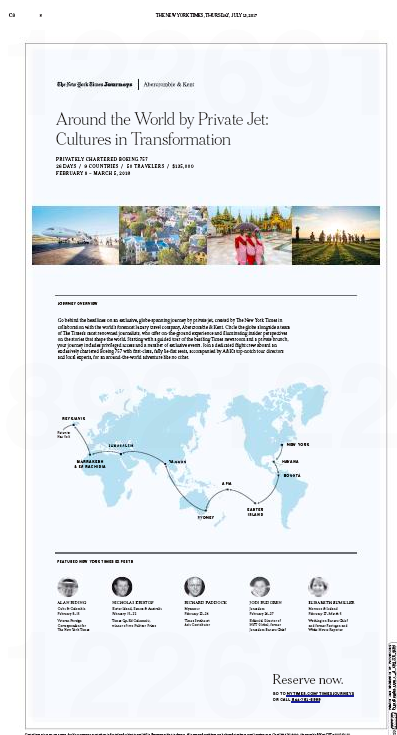
In journalism nowadays, there’s sell out, and then there’s sold out. The New York Times’s Around the World by Private Jet: Cultures in Transformation might be the former, but it’s apparently not the latter.

Here’s how the Times Journeys site describes the globetrotting adventure.

Fly around the world in a customized Boeing 757 jet for the ultimate in luxury travel. Spend 26 days visiting such places as Israel, Cuba, Colombia, Australia, Myanmar and Iceland. Four award-winning New York Times journalists will accompany you, each for several days as you visit areas where they have expertise.

(Helpful webinar here detailing the axis of travel: New York Times Company/Abercrombie & Kent/NYT journalists.)

But . . .

Here’s how the Washington Post’s Paul Farhi describes it.

[The Times’s trip raises] a question among journalism ethics experts about ethics and access: Is the Times effectively selling its journalists to private interests? Could, for example, corporate lobbyists or political operatives sign on and seek to influence the Times’s coverage?

A Times spokeswoman told Farhi that’s nonsense. “Danielle Rhoades Ha said the paper’s travel packages are ‘educational travel experiences’ and that its journalists don’t engage in any reporting or writing while abroad or afloat.”

Other media hall monitors note that these schmooze cruises happen all the time – from The Weekly Standard to the PBS NewsHour.

Then again, Andrew Seaman, the chairman of the ethics committee for the Society of Professional Journalists and a reporter for Reuters, told Farhi “[an] already skeptical public is left wondering if the paper may give preferential treatment to the person who just gave a very large chunk of change to their news organization. I don’t think that’s the question the Times or any news organization wants floating around in the world.”

Regardless, this ad ran in Thursday’s Times.

So, to recap.

The Times global private jet romp might or might not be a sell out.

But it’s not yet sold out.

Posted in Uncategorized | Tagged , , , , , , , , , , , | 3 Comments

The Grey Lady Opens the Kimono All the Way

As the hard tracking staff at Sneak Adtack has dutifully noted, the New York Times is increasingly blurring the line between advertising and editorial.

Especially prevalent are the Russian nesting ads the Times has developed – advertising in the print edition that promotes online native ads that its T Brand Studio creates for marketers. (Representative sample here.)

It’s State of the Cuisinart marketing.

And now it’s mating with the extracurricular activities the Times has initiated in an effort to “monetize the Times brand.”

As the hardworking staff  has previously documented, the Times is more than a news organization these days. It’s also “the Times Journeys travel agency, the Times Store retail outlet, and New York Times Conferences, which brings together the international chinstrokerati ‘to deepen understanding of vital topics, advance innovative solutions to major challenges and provide new opportunities for businesses.’”

Sounds, well, vital – yeah?

Now comes former Times investigative reporter Jeff Gerth’s fascinating Columbia Journalism Review takeout of the news and advertising pas de deux at the Times.

In the digital age, The New York Times treads an increasingly slippery path between news and advertising

The April 2 edition of the Sunday New York Times, where the paper features its best journalism, included a six-page special section, “Women Today,” pegged to a summit in Manhattan a few days later.

The featured piece, on the state of the women’s movement, was by Tina Brown, the well-known journalist who founded the summit. In addition, eight women participating in the conference offered brief first-person accounts, and other articles appeared on topics that ranged from campus feminism to abortion.

What wasn’t in any of the stories was the fact that the Times itself owned a minority stake in the conference. Although the paper’s own standards call for transparency in this area, the section didn’t disclose the paper’s financial interest.

There are all kinds of other shenadigans going on at the Times as well.

Exhibit A: “[T]he newsroom and the company’s marketing department now work together in an effort to generate new sources of revenue. The editor of these sections meets once a week with the advertising department to discuss possible projects, while the advertising studio of the Times acts as a matchmaker between reporters and sponsors.”

Drive the purists nuts graf:

Dean Baquet, who has been executive editor of the paper since May 2014, says flatly that the traditional news-advertising divide has become a luxury the Times can no longer afford.

Yikes.

You should read Gerth’s entire piece just for the priceless Half Moon Bay/New Work Summit Conference rumpus.

Summary:

Times business reporter fillets hedge fund manager Ray Dalio.

Times monetizer Charles Duhigg woos Dalio to appear at conference.

Dalio agrees.

Times business reporter re-fillets Dalio on day one of conference.

Dalio spends conference appearance filleting Times.

Duhigg defends Times in aftermath.

Dalio buys online ads re-filleting Times. Some run in the Times.

Brilliant!

As fascinating as Gerth’s piece might be, it was hardly exhaustive. One week later, the Washington Post’s redoubtable Paul Farhi filed this piece.

The New York Times will fly you around the world for $135,000. Is that a problem?

It’s the trip of a lifetime — around the world in 26 days, with stops in nine countries. Just 50 people will travel on this guided tour next year via a private Boeing 757 to places like Marrakesh, Easter Island and Reykjavik, Iceland.

The price: $135,000 per person.

And that’s not all. Those who make the journey will be accompanied on various legs by journalists from the New York Times. The newspaper is organizing and promoting the package, which it calls “Around the World by Private Jet: Cultures in Transformation.” Among those scheduled to join the traveling party are Washington bureau chief Elisabeth Bumiller, op-ed columnist Nicholas Kristof and Publisher Arthur O. Sulzberger Jr.

So – is that a problem?

[T]he Times “essentially gives unrestricted access to some of the paper’s best-known journalists and names,” said Andrew Seaman, the chairman of the ethics committee for the Society of Professional Journalists and a reporter for Reuters.

Said Seaman: “No matter what safeguards the paper puts in place, it looks like a bunch of journalists flying off to far corners of the world with incredibly wealthy people. Of course, it looks like that, because that’s what it is.”

Not so brilliant!

But definitely relevant.

P.S. Yes, the Post piece did acknowledge its own checkered past in access-mongering.

Although the question [about the Times promotion] is largely theoretical, the issue has come up before in a somewhat different context. In 2009, The Washington Post aborted an effort to produce “salons,” or small private dinners that would bring together the newspaper’s top editors and publisher with government officials and industry lobbyists. The off-the-record dinners were to be sponsored by individuals or corporations willing to pay anywhere from $25,000 to $250,000.

Media reports about The Post’s plans triggered a public outcry. Critics said the paper was violating its own principles by peddling its journalists to vested interests and cutting its readers out of the dinner party. The acrimony prompted the paper to back away from the idea before it was ever implemented.

-30-?

Originally posted at Sneak Adtack.

Posted in Uncategorized | Tagged , , , , , , , , , , , , , , , , , , , , , , , , , , | 4 Comments

Campaign Outsider Gets No Love From ThirdLove Press Room

Yesterday the headscratching staff wrote about some puzzling ads that have run recently in major daily newspapers, including this one from Tuesday’s Wall Street Journal.


About which we commented thusly:

First of all, a bra ad in the Journal? On B6? Seriously?

But beyond that . . . according to a piece in CNNMoney, “the Journal’s subscriber base . . . is overwhelmingly wealthy older men: 79% of Journal subscribers are male, 88% are above the age of 50 and 70% make over $100,000 a year.”

And, presumably, a very small percentage of them wear bras on a regular basis.

So why did ThirdLove choose the Journal?

We’ll give them a holler and ask.

And so we did, writing “[we] know a full-page ad in the Journal is a major investment. Could you tell [us] where else you advertise . . .  and what your strategy was for including the WSJ in the mix?”

Much to our surprise, we received a response within minutes. But not surprisingly, it was less than enlightening.

Due to the high volume of press inquiries sent to press@thirdlove.com, we unfortunately can’t respond to everybody and will get back to you if there is a fit in working together. As the Founder, starting ThirdLove in my living room just a few short years ago, I still can’t believe we have grown as quickly as we have (pinch me!). I am constantly in awe by the passion of our customers and inspired by all of you.

Thank you, so so much!
Heidi

That would be ThirdLove co-founder Heidi Zak, and somehow we don’t believe there will be “a fit in working together” with us. So we’re not expecting to hear from Ms. Zak again.

But the reverse might not be true. Let’s see if she runs an ad in Fortune or Forbes.

Posted in Uncategorized | Tagged , , , , , , , , , , , , , , , | Leave a comment

Very Strange Ads ‘n’ Ends From This Week’s Daily Papers

As the hardworking staff diligently perused its costly home-delivered newspapers the past few days, we’ve encountered a number of full-page ads that have left us, well, bemused.

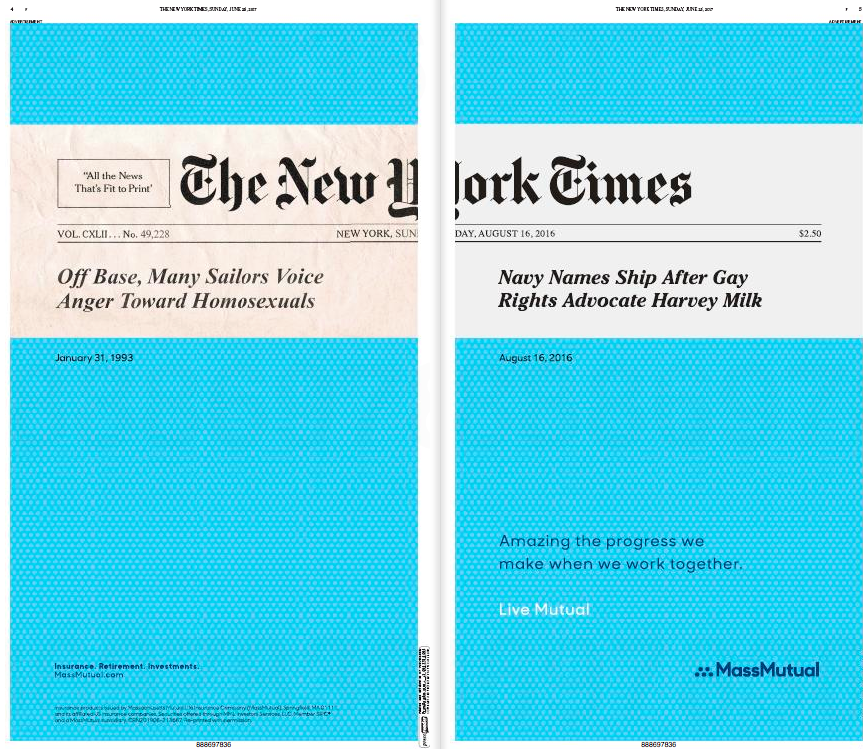
Start with this two-page spread in the Sunday New York Times Pride 2017 Special Section.


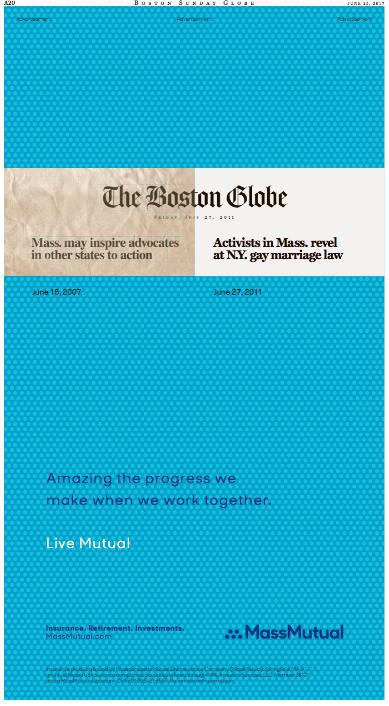
That Mass Mutual ad was mirrored in the Boston Sunday Globe A section.


We’ve always found it odd that a news organization would allow advertisers to appropriate its banner or editorial content in their ads, but maybe that’s just us.

More puzzling was this full-page ad, also in Sunday’s Times.


The ad, tagged by the Internet Defense League, was paid for by an outfit called Private Internet Access, as detailed here.

Private Internet Access shines the cat signal for net neutrality

Today, Private Internet Access is shining the cat signal with a full page ad in the New York Times to gain support for the Net Neutrality Day of Action on July 12th that Fight for the Future and other organizations are planning at Battle for the Net.

We, the people of the Internet, have stopped these draconian attempts to close our access to the open internet in the past with the Internet Blackout, and we must do so again each time. Whether you represent a company, a community, or an individual, join us at the Internet Defense League for this and future actions.

Here’s the thing: Any ad that features just a graphic and a website makes the audience, rather than the marketer, do all the work. Which  the vast majority of Sunday’s New York Times readers would likely not do.

As legendary adman David Ogilvy noted, “[on] the average, five times as many people read the headline as read the body copy. When you have written your headline, you have spent eighty cents out of your dollar.”

The Cat Signal ad has no headline and no body copy. You do the math.

Finally, this ThirdLove ad in Tuesday’s Wall Street Journal had the headscratching staff totally befuddled.


First of all, a bra ad in the Journal? On B6? Seriously?

But beyond that . . . according to a piece in CNNMoney, “the Journal’s subscriber base . . . is overwhelmingly wealthy older men: 79% of Journal subscribers are male, 88% are above the age of 50 and 70% make over $100,000 a year.”

And, presumably, a very small percentage of them wear bras on a regular basis.

So why did ThirdLove choose the Journal?

We’ll give them a holler and ask.

Posted in Uncategorized | Tagged , , , , , , , , , , , , , , | 3 Comments

Quote o’ the Day (‘To Know Trump’ Pre-Verbal Edition)

From our To Know Trump (established in 2010!) desk

Last month STAT’s Sharon Begley wrote this piece about Donald Trump’s increasing disconnection with the English language.

Trump wasn’t always so linguistically challenged. What could explain the change?

It was the kind of utterance that makes professional transcribers question their career choice:

“ … there is no collusion between certainly myself and my campaign, but I can always speak for myself — and the Russians, zero.”

When President Trump offered that response to a question at a press conference last week, it was the latest example of his tortured syntax, mid-thought changes of subject, and apparent trouble formulating complete sentences, let alone a coherent paragraph, in unscripted speech.

This is nuts graf.

STAT reviewed decades of Trump’s on-air interviews and compared them to Q&A sessions since his inauguration. The differences are striking and unmistakable.

(Check out this very nuanced exploration of those differences on Slate’s irrepressible Trumpcast.)

Now comes Exhibit Umpteen, courtesy of the essential Maggie Haberman in her New York Times piece yesterday that detailed Trump’s latest interview on White House organ Fox & Friends, in which he tapewormed about his conversations with fired FBI director James Comey.

“I’ve been reading about it for the last couple of months, about the seriousness of the horribleness of the situation with surveillance all over the place,” the president said in the interview. “So you never know what’s out there. But I didn’t tape, and I don’t have any tape and I didn’t tape.”

That is one pre-verbal President of the United States.

Scary, yeah?

Posted in Uncategorized | Tagged , , , , , , , , , , , , | 2 Comments

When a Nation Forgets Its Own Clichés (‘Tamper Down’ Edition)

From our That’s Just Sad desk

Every now and again the hardclipping staff chronicles the mangled phrases uttered by the differently clichéd among us and, man, they are legion. Here’s our latest batch, in reverse chronological order.

• The other day the Boston Herald reported that “Boston’s Irish community is on high alert after ICE agents detained a local leader for deportation, sparking fears that thousands of other illegal immigrants living and working here for years could be next.”

Boston Mayor Marty Walsh had this to say: “There’s a fear out there, we have to try and tamper the fear down.”

All due respect, Mistah Mayah, but you can temper the fear, or tamp the fear down. Either way, please stop tampering with the English language.

• Back in January, the New York Times featured this headline on Page One of the Business section: “Fears for the Future Prompt a Boon for Dystopian Classics.”

Er, not to get all negative on the Grey Lady, but wethinks you either prompt a boom or are a boon. Bon?

• Also in January, NPR’s All Things Considered ran a piece about young undocumented immigrants currently protected under the Obama DACA policy but worried that Donald Trump might rescind it. Without that protection, a young woman said, “maybe I could do a job under the books.”

Actually, she would do the job under the table, or off the books. We just hope she’s okay.

• Last December, as Trump struggled to find “top-name talent for his January inauguration,” the Herald reported that Ayla Brown, American Idol distant runner-up and daughter of Scott Brown and Gail Huff, said she’d be “‘honored to perform’ if tapped by the  president-elect.”

Brown added, “It surprises me that a lot of people are turning the other cheek.”

Turning him down, yes. Giving him the back of their hand, maybe. But turning the other cheek? Nah.

• Last November, a Boston Globe piece in the Sports section featured this statement on trade rumors swirling about the Boston Celtics: “And, unsurprisingly, they caught like wildfire . . .”

Surprisingly, the writer didn’t know that the rumors would have either spread like wildfire or caught fire. Not to damper things down.

• Headline on Mediaite last September: “Colbert Shreds Into Gary Johnson’s Gaffe History: ‘Bombing That Bad Should Be a War Crime'”.

Sorry – you could tear into Gary Johnson’s gaffe history, or you could shred it. Either way, Johnson definitely deserved to be ripped.

• Also last September, Politico’s 2016 Blast tipsheet featured this item about the jockeying over whether NBC’s Lester Holt should fact-check Donald Trump in his first debate with Hillary Clinton.

HILLARY CLINTON’s campaign is pressing its case to anyone listening not to let DONALD TRUMP get away with it, POLITICO’s Nolan D. McCaskill reports. Trump’s campaign is firing back, arguing that the media is biased against the GOP nominee and that Clinton is, in fact, trying to “game the refs.”

Not to get technical about it, but she would have been trying to game the system, or work the refs. Just for future reference.

• Again last September, during a discussion of New Hampshire’s “silver tsunami” of seniors on WGBH radio’s aptly named Under the Radar, Granite State radio personality Arnie Arnesen said “we’ve really been dragging our knuckles in addressing this problem.”

Ouch. Much less painful to be dragging your feet, yeah?

• Yet again last September, former U.N. Ambassador John Bolton talked to Politico’s Campaign Pro about his super PAC’s focus on digital advertising in the 2016 elections.

A factor that distinguishes us is that we buy almost no broadcast TV. Almost everything we do is digital and social media communications because, one, it’s the way of the future, and two, it’s much more cost effective and three, we want to catch up with Democrats on digital.

Not to get super PICy about it, but one, digital and social media communications might be the wave of the future, or two, they might be the way forward. As Sam Spade would insist, there’s no third way.

• Finally – from both last September and Politico’s New York Playbook – Gov. Andrew Cuomo (D-Mario Not) said this about the 2016 New York State Fair, which broke the previous attendance record from 2001: “This fair is a different fair than it was. Not to cast dispersion on what it looked like last year, but I’m casting dispersion on what it looked like last year.”

First of all, it’s cast aspersions.

Second of all, the definition of dispersion is “the action or process of distributing things or people over a wide area.”

Which is exactly what Andrew Cuomo has not done as governor of the Empire State.

So maybe shut up.

Posted in Uncategorized | Tagged , , , , , , , , , , , , , , , , , , , , , , , , , , , , , , , , , , , , , | Leave a comment

Instagram Fesses Up to Instascamming Users

Turns out it’s not a pretty picture at Instagram.

The wholly owned subsidiary of Facebook (a bargain at $1 billion five years ago) is the mobile equivalent of three-ad monte, allowing sponsored posts to masquerade as genuine content.

As Gavin O’Malley wrote on MediaPost, “as its star has risen, Instagram has become a hotbed of shady marketing tactics, and influencers who specialize in blurring the line between their personal and paid-for product preferences.”

Problem #1: The Federal Trade Commission has busted about 90 Instagram influencers and told them to disclose that their posts are ads in Instaclothing.

Problem #2: Many of Instagram’s 700 million users are being bot-licked by marketers, as the New York Times’s Sapna Maheshwari reported . . .

Read the rest at Sneak Adtack.

Posted in Uncategorized | Tagged , , , , , , , , , , , , , , | Leave a comment