The 26-day, $135,000 jaunt by private chartered jet for a select 50 travelers is described by the website thusly:
Fly around the world in a customized Boeing 757 jet for the ultimate in luxury travel. Spend 26 days visiting such places as Israel, Cuba, Colombia, Australia, Myanmar and Iceland. Four award-winning New York Times journalists will accompany you, each for several days as you visit areas where they have expertise.
Said journalists who will accompany the luck 50 (or so):
But . . .
The Washington Post’s Paul Farhi asks whether the Times is “effectively selling its journalists to private interests? Could, for example, corporate lobbyists or political operatives sign on and seek to influence the Times’s coverage?”
Other media hall monitors note that these schmooze cruises happen all the time – from The Weekly Standard to the PBS NewsHour.
Regardless, you gotta wonder when the Times can’t sell out its highest-profile sellout, no?
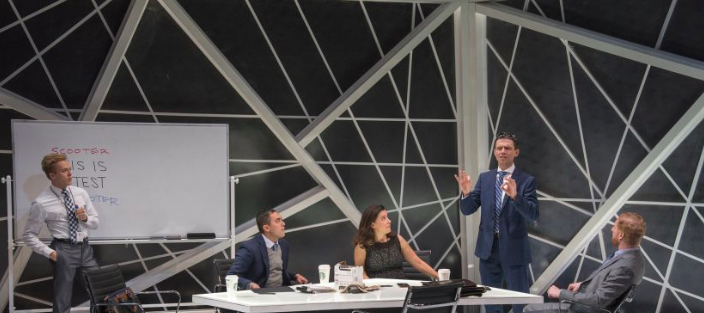
Well the Missus and I trundled out to Watertown last week to catch Ideation (through September 24) at the New Repertory Theatre and say, it was swell.
Playwright Aaron Loeb has created “a darkly comic psychological thriller” that starts out as your run-of-the-mill brainstorming meeting at a consulting firm for a mysterious client, then turns increasingly sinister as we learn more about both the “morally ambiguous” hypothetical project being pursued and about the consultants themselves.
The actors – Christine Hamel, Ed Hoopman, Matt Ketai, Jake Murphy, and Lewis D. Wheeler – submit uniformly sharp performances. Jim Petosa’s direction is tight, and the set design by Ryan Bates nicely captures the play’s fractured sensibility.
* * * * * * *
On Saturday the Missus and I trundled over to the Central Square Theater to see Constellations (through October 8), Nick Payne’s play about life as a multiple choice test, and say, it too was swell.
A mesmerizing romantic journey begins simply. Marianne and Roland meet at a party. They go for a drink. They fall madly in love and start dating. Or do they? There are infinite possibilities, and a single word may alter their lives at any moment.
Beyond that there’s beekeeping and quantum physics and ballroom dancing and lots more disconnected topics and emotions.
Marianna Bassham is wonderful as Marianne, and Nael Nacer is equally moving as Roland. Both exhibit an amazing ability to shift gears and personalities as their twinned narrative splits, resolves, unravels, and resolves again.
Kudos also to scenic designer Susan Zeeman Rogers and lighting designer Jeff Adelberg for their inventive staging.
This interview with Nael Nacer (who was heartbreaking in the Lyric Stage production of Intimate Apparel two years ago – for which he won an Elliot Norton Award) might give you a sense of the Russian Nesting Dolls quality of the drama.
* * * * * * *
So, to summarize:
Two really smart, thought-provoking, superbly acted plays are currently running in the Boston area.
This item by Meredith Goldstein ran in yesterday’s Boston Globe Names column.
JFK’s grandson named to Vanity Fair’s Best-Dressed List
Jack Schlossberg, John F. Kennedy’s grandson, has made Vanity Fair’s 2017 International Best-Dressed List, which was released Wednesday. The 24-year-old, who has a degree from Yale and is on the John F. Kennedy Library New Frontier Award Committee, starts Harvard Law this fall. Vanity Fair says Schlossberg wore his most memorable look at the Met Gala in May. It was a black suit with a gray camouflage tie. He was at the event with his mom, Caroline Kennedy.
The same Caroline Kennedy, clearly, who is a first-ballot lock for any and all 2017 International Worst-Dressed Lists.
Paging Ivana Martini. Paging the Boston Herald’s Ivana Martini.
Sad to see that Walter Becker, the great guitarist and songwriting partner of Donald Fagen in the redoubtable Steely Dan, died last week at the age of 67.
Or, as Becker’s Associated Press obit characterized them, “subversive and literary lyrics that neither expected many fans to understand — and which they themselves sometimes claimed to not understand.”
Seriously?
Tell us you don’t get the heartachey narrative of Any Major Dude from Pretzel Logic.
Or the cinematic train wreck of Haitian Divorce from The Royal Scam.
A few months ago the New York Times ran a New York City in 17 Syllables contest, soliciting haikus (three lines of five, seven and five syllables) about the Big Town.
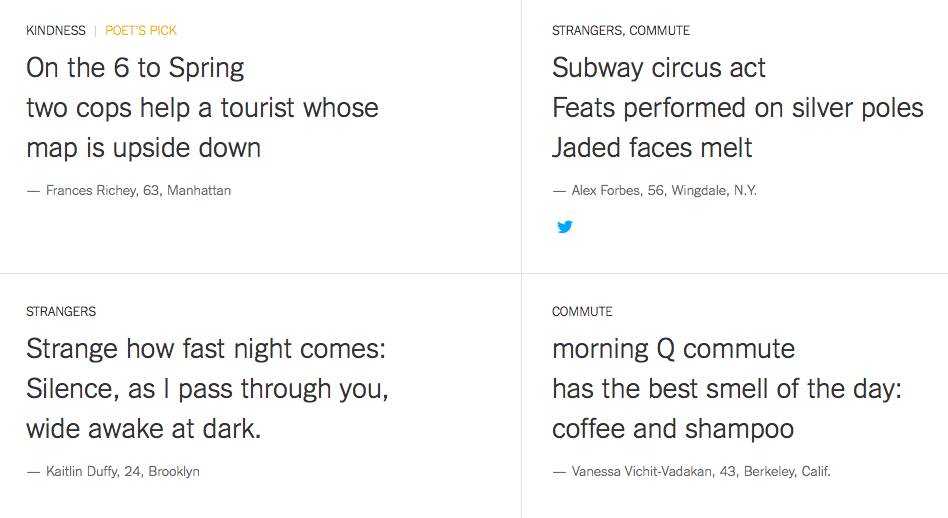
For National Poetry Month, The New York Times asked readers to write haiku about the city: three lines of five, seven and five syllables. The response — more than 2,800 submissions in 10 days — was as impressive, and as exhausting, as the city itself. Writers were asked to stick to six subjects: the island, strangers, solitude, commuting, 6 a.m. and kindness. Beyond that, poems could be fashioned from whatever inspiration the five boroughs provided.
Representative samples:
Now there’s a book of the city ditties, as this ad in yesterday’s Times announced.
Excellent: A thoughtful and fun testament to the city and its people.
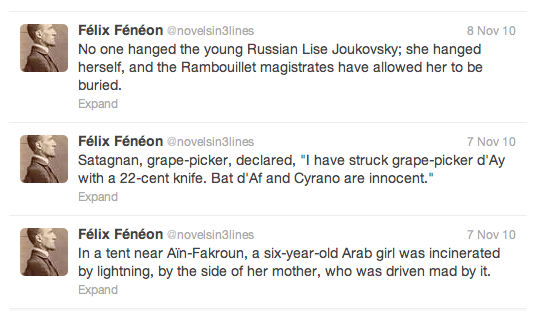
But those haiku are a trifle compared to what Félix Fénéon produced in 1906 with his 1,220 faits-divers (“sundry events”) in the Paris daily Le Matin, almost all of which are collected in Novels in Three Lines.
Félix Fénéon was “invisibly famous,” as Luc Sante wrote in his introduction to the book, a major literary and cultural figure who “kept himself to himself.” In a 2007 London Review of Books piece, Julian Barnes provided a partial resumé.
Art critic, art dealer, owner of the best eye in Paris as the century turned, promoter of Seurat, the only galleryist Matisse ever trusted; journalist, ghost-writer for Colette’s Willy, literary adviser then chief editor of the Revue Blanche; friend of Verlaine, Huysmans and Mallarmé, publisher of Laforgue, editor and organiser of Rimbaud’s Les Illuminations; publisher of Joyce and translator of Northanger Abbey.
Best of all: Fénéon was a committed anarchist – while working for 13 years as a clerk in the French government’s War Office. Barnes again:
He supported the cause as journalist, editor and – almost certainly – bomb-planter. In 1894, he was arrested in a sweep of anarchists and charged under the kind of catch-all law which governments panicked by terror attacks stupidly tend to enact …
When the presiding judge put it to him that he had been spotted talking to a known anarchist behind a gas lamp, he replied coolly: ‘Can you tell me, Monsieur le Président, which side of a gas lamp is its behind?’ This being France, wit did him no disservice with the jury, and he was acquitted.
In his work for Le Matin, Fénéon was in many ways the first micro-blogger, so it’s only fitting he has his own Twitter feed.
Here’s something else you’ll see about once every hundreds years: The Wall Street Journal taking out a full-page ad in the Sunday New York Times.
The hardsipping staff has no idea how many Times readers will discover the WSJwine Discovery Club, but here’s hoping the Grey Lady runs one of her around-the-world-for-$135,000 ads in the Journal soon.
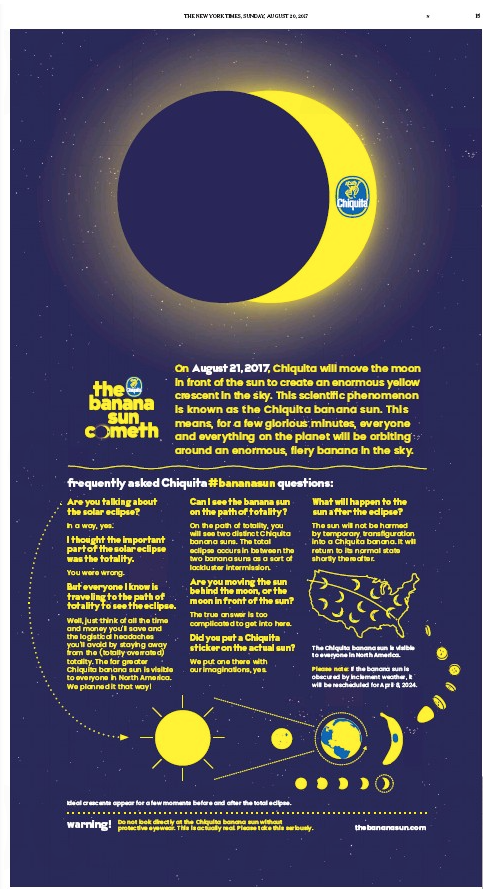
And while we’re waiting for the actual eclipse, here’s another full-page ad that ran in yesterday’s Times.
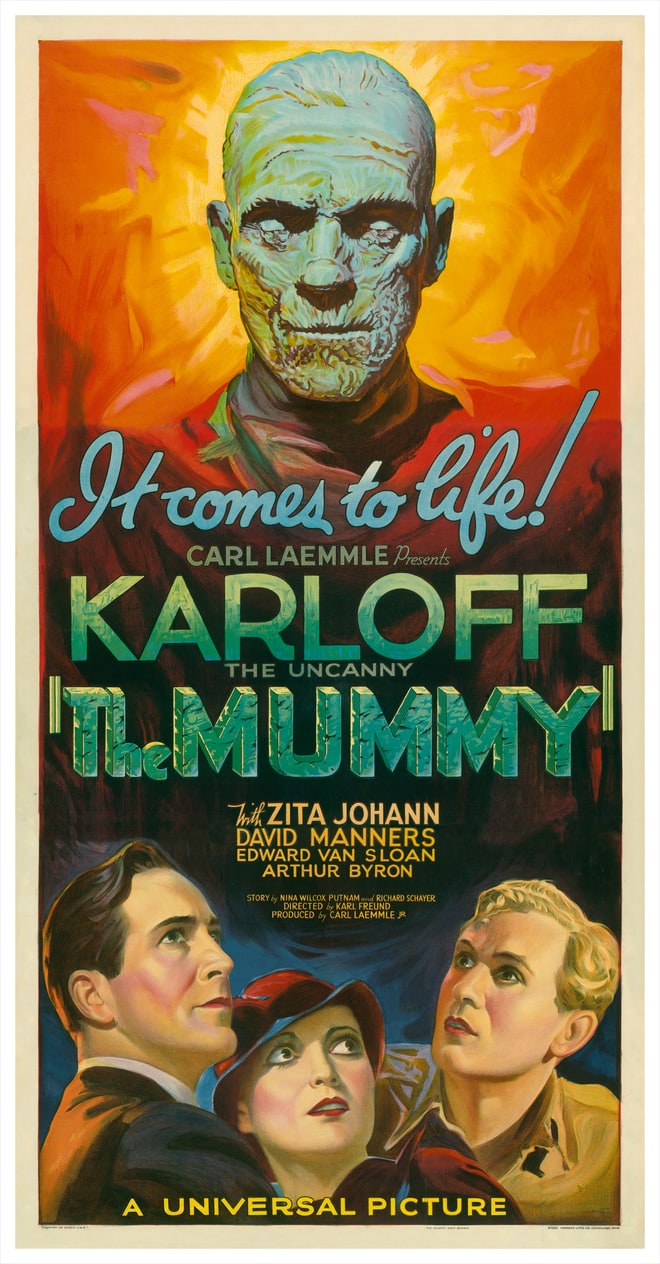
Kirk Hammett, best known as the guitarist of the rock band Metallica, is also an avid collector of classic horror and sci-fi movie posters. This exhibition explores the interplay of creativity, emotion and popular culture through 135 works from 20th-century cinema, including posters by an international array of graphic designers, rare works by unidentified masters as well as related memorabilia such as electric guitars, lobby cards, film props and costumes.
The exhibit is a total hoot, chockablock full of posters like this one.
Full disclosure: The Missus and I didn’t get the whole “Karloff the Uncanny” thing, which seemed to surface in the early ’30s and disappear around 1935. This 1933 New York Times movie review isn’t all that enlightening, but this Google Books link to After Dracula: The 1930s Horror Film by Alsion Peirse is more helpful (if a bit oblique).
From the mid-19th century through the mid-20th century, ocean liners were floating showcases of technology, opulence and social sophistication. As icons of modernity and aspirational living, artists, engineers, architects and passengers all vied for influence and access in the creation and enjoyment of these man-made islands at sea.
Ocean liners were intricately constructed pieces of culture — in the appearance of their design, the elegance of their engineering and the division of their social space — and each with its own distinct personality. Drawing from international institutions and private collections, the exhibition brings together nearly 200 works including paintings, sculpture, models, furniture, lighting, wall panels, textiles, fashion, photographs, posters and film.
There’s been a fair amount of pearl clutching the past few days over the “Real News” videos that TrumpWorld has just started cranking out. The debut edition appeared on Donald Trump’s Facebook page last week and featured First (or Second) Daughter-in-Law Lara Trump, wife of Eric, gushing about all the wonderful things Trump has done lately that the fake news of course ignored.
Then yesterday came this Real News edition from Trumpkin Kayleigh McEnany, charter member of RoboBlondes for Trump and newly minted mouthpiece for the Republican National Committee.
Almost immediately, windmill-tilter Evan McMullin went DEFCON 3 on his Twitter feed.
Actually, no.
Given that it’s Trump’s campaign organization that’s paying to produce the videos, what Jeff Greenfield told CNN’s Reliable Sources is more, well, reliable. It’s just, Greenfield said, part of a “long tradition, if not entirely noble tradition, of political campaign propaganda.”
That makes the whole enterprise, in turn, quite different from the media machine Barack Obama constructed during his two terms in the White House.
As the 2012 presidential campaign kicks into gear, President Obama’s White House media operation is demonstrating an unprecedented ability to broadcast its message through social media and the Internet, at times doing an end-run around the traditional press.
The White House Press Office now not only produces a website, blog, YouTube channel, Flickr photo stream, and Facebook and Twitter profiles, but also a mix of daily video programming, including live coverage of the president’s appearances and news-like shows that highlight his accomplishments.
Let’s take just one: West Wing Week, specifically the April 13, 2012 edition that chronicled, among other things, the annual White House Easter Egg Roll.
Did you catch that nothing-but-net jumpshot Obama hit at 1:50? Here’s what really happened (via Politico).
If the hardworking staff has told you once, we’ve told you one time that the name of Rocket J. Squirrel’s sidekick is Bullwinkle T. Moose.
The death of the great June Foray, who voiced Rocky, has resurfaced the issue. Before we get to that, though, respeck for the First Lady of Animated Voicing, via her New York Times obituary.
Often compared to Mel Blanc, the cartoon virtuoso who supplied the voices of Bugs Bunny, Daffy Duck and Porky Pig, Ms. Foray cackled, chirped, meowed and sometimes sang her way through nearly 300 animated productions, often playing several parts at once with quick shifts of accent, dialect and personality. Her work, unlike that of Mr. Blanc, was often uncredited, particularly in her early years . . .
“June Foray is not the female Mel Blanc,” said Chuck Jones, the legendary animator who proposed her star on Hollywood’s Walk of Fame. “Mel Blanc was the male June Foray.”
Unfortunately, Ms. Foray’s Associated Press obit (which ran in both the Boston Globe and the Boston Herald) included this paragraph.
“Rocky and His Friends” ran on ABC weekday afternoons from 1959 through 1961, and then “The Bullwinkle Show” was on NBC from 1961 to 1964, first in prime-time and later in daytime.
Besides Bullwinkle J. Moose and Rocket J. Squirrel, the show featured such sequences as “Fractured Fairy Tales”; “Peabody’s Improbable History”; “Aesop and Son”; and “Adventures of Dudley Do- Right.”
Answer: First, it’s impossible to believe that the brilliant Jay Ward and Bill Scott would give two characters the same middle initial. Second, we can still hear – five decades later – Bullwinkle saying, T is for The(e).
As the hardworking staff has noted on several occasions, the New York Times has over the past few months jettisoned its “low-value line editing” and replaced it with “bespoke editing.”
Cashiered Times public editor Liz Spayd wrote earlier this year that the paper’s “editing architecture” has traditionally employed multiple layers of editors, with most stories blue-penciled by three editors, “with up to six or more if the article is headed for home page prominence or A1.”
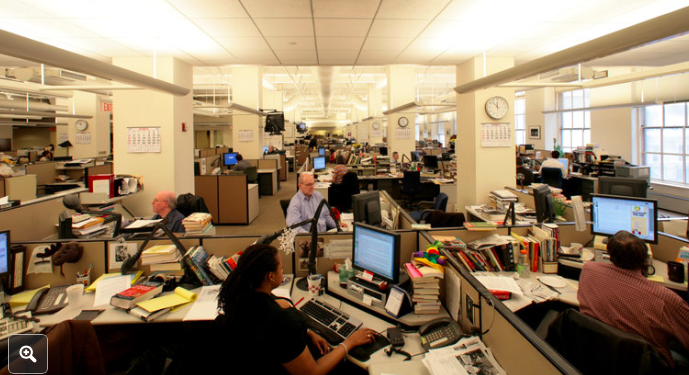
As the deadline nears for Times newsroom employees to apply for a buyout, it is already clear that the elimination of free-standing copy desks will be a wrenching change.
Of course, it falls most heavily on the copy editors who were told they do not have a future at The Times. But in time, it will fall on just about everybody in the news department, as the responsibilities of copy reading are dispersed.
So does that mean the Times is now a print-second news organization?
On Tuesday, at least, it sure looked that way.
P.S. Before any of you splendid readers start bombarding me with barbed comments: No, the error above is certainly not earth-shattering, but it also was not the only example of sloppy editing in that edition of the newspaper – or any edition lately.