Why the Wall Street Journal Is a Great Newspaper (Malaysia Airlines Flight 370 Edition)

Friday’s Wall Street Journal featured this staggering Page One piece.

Tales From Malaysia Airlines Flight 370: Life’s Small Moments Loom Large

As night fell last Friday in Kuala Lumpur, businessman Philip Wood hurried to gather his bags for a trip to Beijing. He had confused the dates, but his girlfriend in China texted him to make sure he got on the plane.

A group of Chinese artists capped off their exhibition at a local cultural center in Malaysia’s capital city with a day of sightseeing and a banquet lunch of duck soup, fried shrimp and BN-BX100_0313na_G_20140313131046pork in brown sauce.

Norli Akmar Hamid finished packing for her long-overdue honeymoon and posted a photograph on Facebook of her cat trying to sneak into her suitcase. The cat chewed the lining near the administrative assistant’s neatly folded blue T-shirt and beige towel.

All of them boarded Malaysia Airlines Flight 370 late Friday night and flew away shortly after midnight in the tropical night sky toward Beijing. Soon after, the widebody Boeing 777 jet carrying 239 people vanished from radar screens.

Nut graf:

Flight 370 took off carrying 239 life stories, each filled with moments big and small, ordinary lives soon to be swept up in a tragic mystery. Now, as the hopes for a miracle fade by the day, memory transforms the random and routine into the meaningful and momentous.

It’s a heartbreaking read.


Posted in Uncategorized | Tagged , , , , , , | Leave a comment

‘Breaking Boston’ Breaks Bad in Boston Globe, Better in NYT

Breaking news: The Boston Globe’s redoubtable Matthew Gilbert seems to be back on the TV beat after a brief fling with his Bookish column.

And just in time to render judgment on the new A&E series Breaking Boston.

Big moments in ‘Breaking Boston’ feel staged

BB1PROMOSTILL7

Sigh. The good intentions come rolling off the screen in the new reality show “Breaking Boston.” The latest effort to parade the Boston accent in front of our nation — behind “Southie Rules,” “Wicked Single,” and “Wahlburgers” — follows four young working-class women who are trying hard to improve their lives. Each is struggling to shake off a history of bad choices involving drugs, alcohol, and troubled romances with irresponsible man-children who sport cool tattoos but cold eyes.

They want to “break good,” to borrow sloppily from the title, which, like “Breaking Amish,” borrows sloppily from the title “Breaking Bad,” which, if there is any justice in this world, will never, ever be borrowed from again.

Nut graf:

The artificiality of the mechanics of the show undermines its effectiveness. Every scene seems staged to the hilt, every comment — even those made to the “diary-cam,” which has replaced the “Real World” confessional in the reality genre — feels coaxed and coached. When Kristina is happily lying in bed with her maybe-boyfriend (“You gotta earn that right,” he tells her), the phone rings and, of course, it’s her ex from prison. The timing is awful, as in perfect for TV.

Down I-95 in the Big Town, it’s an entirely different story in Alessandra Stanley’s New York Times piece.

Those Kings of Southie Unveil Some Princesses

The Wahlberg Family Business Grows With ‘Breaking Boston’

Kristina has been dating Mikey for about a year, but Mikey says she has not yet earned the right to call him her boyfriend. As he jpbreaking-master180puts it, “I’m pretty certain if it keeps going this way, we will have that label.”

Valerie worries that a local college won’t give her a scholarship because she has done time. Courtney, a single mother and high school dropout, weeps at the thought of having to get her G.E.D. And Noelle, who lives with her mother, is the classy one. “I would never go to a strip club on Christmas,” she says.

Nut graf:

[W]hile it could easily be just another celebration of hot-mess reality stars, somewhere between a Boston edition of “The Real Housewives” and “The Governor’s Wife,” this show comes with an unimpeachable seal of approval: Mark Wahlberg is an executive producer, and he has put a redemptive underlay to all the Southie stereotypes. These women who talk with a broad “ah” and curse a lot are working-class heroines, striving to better themselves — despite smothering families, loser boyfriends and dead-end jobs.

Working-class heroines? Wow.

For once, the standards in Boston are more stringent than the Big Town’s.

Say yeah, yeah?


Posted in Uncategorized | Tagged , , , , , , , , , , , , , , | 2 Comments

WSJ Makes ‘Faustian Pact’ with Native Advertising

Apparently there’s no resisting the allure of native advertising these days. The latest converts to ads in sheep’s clothing? USA Today and the Wall Street Journal.

The latter’s surrender is the more interesting of the two, given the low opinion of native ads previously expressed by the paper’s top editor.

From Michael Sebastian of Advertising Age:

The Wall Street Journal is introducing native advertising to its website less than six months after Editor-in-Chief Gerard Baker described many publishers’ moves in the arena as a “Faustian pact.”

For those unfamiliar with German folklore, that’s a deal with the devil. 

Right. Here’s more on that deal from Chris O’Shea at MediaBistro’s FishbowlNY:

Sponsored content, native advertising, ads that are annoyingly similar to editorial content — whatever you want to call them, they’re coming to The Wall Street Journal.

wsj-300x212Welcome to the party.

The paper has announced that WSJ Custom Studios will create the ads labeled as “Sponsor Generated Content,” and they’ll be embedded among other editorial content. The first native ads, from Brocade, will debut tomorrow. Each ad will be created by staffers hired specifically for WSJ Custom Studios. No Journal staffer will be involved in the ads.

And – no surprise here – editor Baker’s estimation of native advertising is now decidedly more positive. FishbowlNY’s report includes this statement from Baker . . . 

Read the rest at Sneak Adtack.


Posted in Uncategorized | Tagged , , , , , , , , , , , , , , | 2 Comments

Is There Something Wrong with the Official Boston Bombings Story?

Russ Baker at WhoWhatWhy is challenging the accepted narrative of Tamerlan and Dzhokhar Tsarnaev’s actions in the wake of the Boston Marathon bombings (tip o’ the pixel to AlterNet).

Boston Bomber Carjacking Unravels

An exclusive WhoWhatWhy investigation has found serious 1-300x300factual inconsistencies in accounts provided by the only witness to the alleged confession of the Boston Marathon bombing suspects.

Why does this matter? Because this witness is the sole source for the entire publicly accepted narrative of who was behind the bombing and its aftermath—and why these events occurred.

Nut graf:

[O]ur sense of certainty that the Tsarnaevs did this—and did it alone without America’s security apparatus knowing a thing—is actually dependent largely on the say-so of one person, one witness. While we’ve been told that authorities have definitive proof, including a video showing the brothers leaving the backpack with the bomb, we’ve never actually seen it.

Thus, the problems we have uncovered with the witness’s testimony (as represented by law enforcement) now raise questions about almost everything concerning what has been described as the largest terrorist attack on American soil since 9/11.

[To be sure graf comes next]

To be sure, Baker has a history of questioning the official version of events up to and after the Boston Marathon bombings. Plug him into the Googletron and up pops this:

Screen Shot 2014-03-12 at 4.43.59 PM

That’s just Page 1. Beyond that you’ll find an assortment of Grassy Knollers talking among themselves. But that doesn’t mean they’re necessarily wrong. Baker goes to great lengths to demonstrate that the story told by the witness (“Danny”) – who says he was carjacked by the Tsarnaev brothers three days after the bombings – has resulted in wildly divergent accounts in the media.

One example:

How Did Danny Gain His Freedom?

Danny said: He escaped when Tamerlan, seated next to him, was momentarily distracted, according the Boston Globe, NBC and CBS.

Conflicting version 1: He simply got out of the car when both brothers were outside the car, having left him alone, according to WMUR.

Conflicting version 2: The Tsarnaev brothers never held Danny as a captive, according to the Associated Press and Cambridge Police Department. They simply detained him for a few minutes, then left him by the roadside, essentially confiscating his vehicle. In this scenario, he had almost no interaction with the brothers, raising questions as to whether they would have confessed to the two crimes before taking off with his car.

There’s lots more along those lines in Baker’s report (which is Part I of II).

[To be clear graf comes next]

To be clear, the hardworking staff isn’t endorsing what Baker wrote.

But it might be grist for someone who has a larger mill than we do.


Posted in Uncategorized | Tagged , , , , , , , , , , , , , | 4 Comments

Dead Blogging ‘Whistler and the Thames’ at Addison Gallery

Well the Missus and I trundled up to Andover to catch An American in London: Whistler and the Thames at the Addison Gallery of American Art and say, it was swell.

From the Addison’s website:

In the 1860s and 1870s, James Abbott McNeill Whistler immersed himself in the life of Victorian London, with a particular focus on the bustling neighborhood surrounding 1_192855_LGBattersea Bridge, including the workers and women who frequented the Thames-side wharves and pubs, the barges that navigated the perilous passage under the bridges, and the steamboats and wherries crowded with daytrippers that paddled up and down Battersea Reach. This exhibition brings together numerous paintings, prints, and drawings from this pivotal period in Whistler’s career, providing a detailed examination of his approach to composition, subject, and technique.

(That’s Brown and Silver: Old Battersea Bridge above.)

The hard looking staff has always had a soft spot for Whistler, who’s either a minor major artist or a major minor artist. Either way, he was a highly innovative painter, one of the greatest etchers in the history of Western art, and a world-class eccentric.  (See I, James McNeill Whistler: A Novel by Lawrence Williams for the fabulous details.)

That mastery of etching is evident throughout the exhibit, as Black Lion Wharf attests.

15_ColbyBlacklionwharf_LG

There are also some landmark paintings in the exhibit, including the notorious Nocturne in Black and Gold: The Falling Rocket, which not only got the magisterially demented critic John Ruskin all lathered up (“I have seen, and heard, much of cockney impudence before now; but never expected to hear a coxcomb ask two hundred guineas for flinging a pot of paint in the public’s face.”), it also got him sued by Whistler (with disastrous effects for the artist: The jury found in his favor but awarded him only one farthing, leaving Whistler insulted and broke).

The work itself:


schwabsky_whistlersbattles_ba_img


The exhibit (through April 13) is just as impressive.

P.S. If you want more Whistlerania, check out Whistler’s Battles in the Nation, and A Story of the Beautiful in the Wall Street Journal. Both are reviews of Daniel E. Sutherland’s new biography, Whistler.


Posted in Uncategorized | Tagged , , , , , , , , , , , , , , , , , | 2 Comments

Do We HAVE to Root for Michael Skakel?

Michael Skakel is the Halloween of crime stories: trick or treat everywhere you look. Last month he wanted to move his GPS tracker to fit his ski boot. (Honest.) Now he’s got a libel suit against legal-schmeagel television personality Nancy Grace that just might be a winner.

From yesterday’s New York Times:

Ruling Clears Way for Skakel Libel Suit

A federal judge ruled that Michael C. Skakel’s libel claim could proceed against the television personality Nancy Grace and her associates over comments made on her current affairs show that falsely suggested DNA evidence tied him to Martha Moxley’s 1975 murder.

In a 27-page ruling that came down late Friday in Hartford, Judge Vanessa L. Bryant of United States District Court denied the defendants’ motion to dismiss, clearing the way for Mr. Skakel’s civil complaint to move forward. The request to dismiss had been brought by Ms. Grace; Beth Karas, a legal commentator; and the program’s producers at Time Warner and Turner Broadcasting System.

The statements Mr. Skakel found objectionable were “not just a minor inaccuracy,” according to the judge, but rather ones involving some “stark” distinctions.

To wit: Grace and Karas asserted on the former’s HLN show that Skakel’s “DNA was found” in a tree near the crime scene. Except it wasn’t. Near, that is.  Not to mention, DNA evidence played no role in his conviction.

So that’s problematic.

To counter Skakel’s lawsuit, Grace et. al. argued that the judge should treat him as someone who might be libel-proof, “undeserving of a trial, simply because he had been convicted of a notorious murder and could not suffer any further reputational damage.”

That didn’t fly, either.

We’re not sure what the definition of justice is here for Skakel or Grace. But we’re pretty sure we know what poetic justice looks like.

Any way they could both lose? (See Iran-Iraq war for further details.)


Posted in Uncategorized | Tagged , , , , , , , , , | 2 Comments

BPL Gets Some Love from NYT

The Boston Public Library got a spotlight dance in Saturday’s New York Times.

Breaking Out of the Library Mold, in Boston and Beyond

BOSTON — An old joke about libraries goes like this: A boy walks into a library and asks for a burger and fries. “Young man!” the startled librarian reprimands. “You are in a library.” So the boy repeats his order, only this time, he whispers.

So much has changed in libraries in recent years that such a LIBRARY-1-master675scene may not be so far-fetched. Many libraries have become bustling community centers where talking out loud and even eating are perfectly acceptable.

The Boston Public Library, which was founded in 1848 and is the oldest public urban library in the country, is moving rapidly in that direction. With a major renovation underway, this Copley Square institution is breaking out of its granite shell to show an airier, more welcoming side to the passing multitudes. Interior plans include new retail space, a souped-up section for teenagers, and a high-stool bar where patrons can bring their laptops and look out over Boylston Street.

“You’ll be able to sit here and work and see the world go by,” said Amy Ryan, president of the library, on a recent tour. “We’re turning ourselves outward.”

All the way to the Big Town. And to the 21st century, apparently.

That will be evident at the Boston library’s new section for teenagers. Teen Central is to become what is known as “homago” space — where teenagers can “hang out, mess around and geek out.” It will include lounges, restaurant booths, game rooms and digital labs, as well as software and equipment to record music and create comic books. The vibe will be that of an industrial loft, with exposed pipes and polished concrete floors, what Ms. Ryan called “eco-urban chic.”

We just don’t want to be around when they tell that to the Back Bay Hysterical Society.

Posted in Uncategorized | Tagged , , , , , , | 4 Comments

College Parents: You Have GOT to Read This Atlantic Piece

The current edition of The Atlantic features a staggering cover piece by Caitlin Flanagan on the uses and abuses of college frats.

The Dark Power of Fraternities

A yearlong investigation of Greek houses reveals their endemic, lurid, and sometimes tragic problems—and a sophisticated system for shifting the blame.


Screen Shot 2014-03-08 at 1.26.37 AM


One warm spring night in 2011, a young man named Travis Hughes stood on the back deck of the Alpha Tau Omega fraternity house at Marshall University, in West Virginia, and was struck by what seemed to him—under the influence of powerful inebriants, not least among them the clear ether of youth itself—to be an excellent idea: he would shove a bottle rocket up his ass and blast it into the sweet night air. And perhaps it was an excellent idea. What was not an excellent idea, however, was to misjudge the relative tightness of a 20-year-old sphincter and the propulsive reliability of a 20-cent bottle rocket. What followed ignition was not the bright report of a successful blastoff, but the muffled thud of fire in the hole.

Also on the deck, and also in the thrall of the night’s pleasures, was one Louis Helmburg III, an education major and ace benchwarmer for the Thundering Herd baseball team. His response to the proposed launch was the obvious one: he reportedly whipped out his cellphone to record it on video, which would turn out to be yet another of the night’s seemingly excellent but ultimately misguided ideas. When the bottle rocket exploded in Hughes’s rectum, Helmburg was seized by the kind of battlefield panic that has claimed brave men from outfits far more illustrious than even the Thundering Herd. Terrified, he staggered away from the human bomb and fell off the deck. Fortunately for him, and adding to the Chaplinesque aspect of the night’s miseries, the deck was no more than four feet off the ground, but such was the urgency of his escape that he managed to get himself wedged between the structure and an air-conditioning unit, sustaining injuries that would require medical attention, cut short his baseball season, and—in the fullness of time—pit him against the mighty forces of the Alpha Tau Omega national organization, which had been waiting for him.

Thus begins a tale of ass-blasting, ass-kicking, and ass-covering of monumental proportions.

Nut graf:

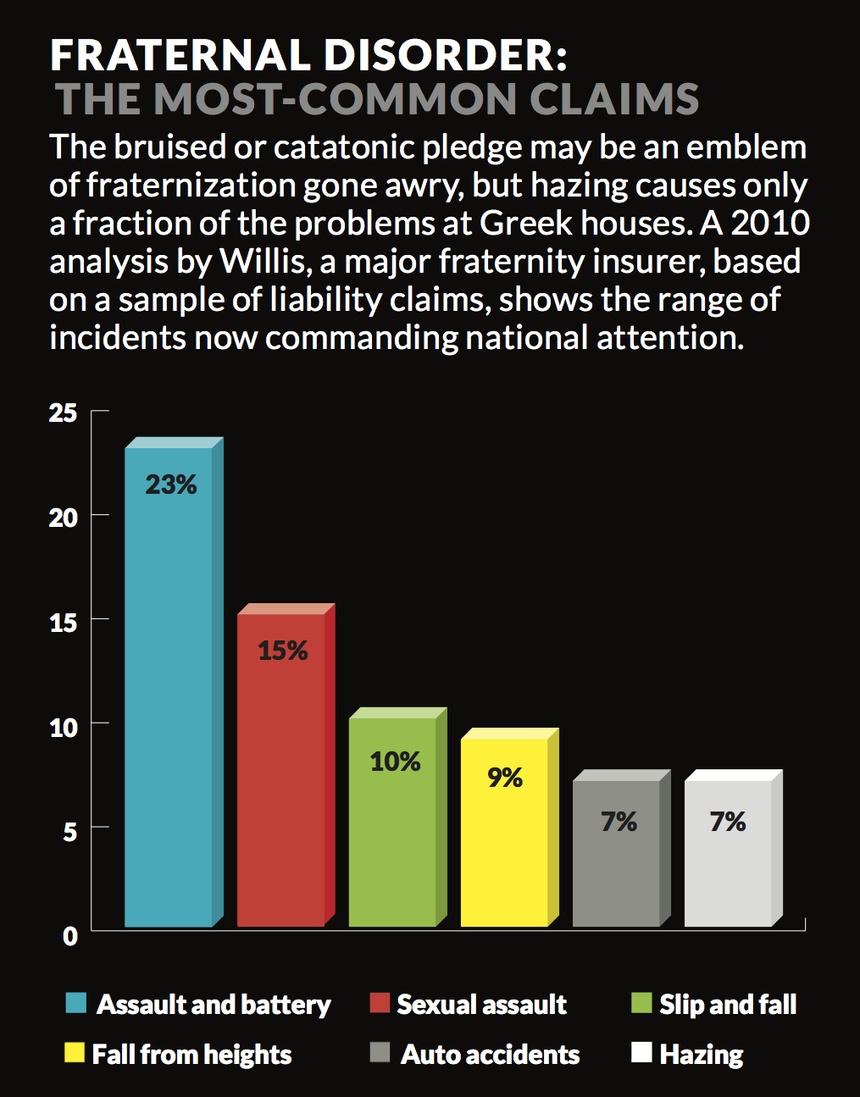
Lawsuits against fraternities are becoming a growing matter of public interest, in part because they record such lurid events, some of them ludicrous, many more of them horrendous. For every butt bomb, there’s a complaint of manslaughter, rape, sexual torture, psychological trauma. A recent series of articles on fraternities by Bloomberg News’s David Glovin and John Hechinger notes that since 2005, more than 60 people—the majority of them students—have died in incidents linked to fraternities, a sobering number in itself, but one that is dwarfed by the numbers of serious injuries, assaults, and sexual crimes that regularly take place in these houses.

Helpful graphic:


ffadfce9e


Of special interest for parents of college students:

Gentle reader, if you happen to have a son currently in a college fraternity, I would ask that you take several carbon dioxide–rich deep breaths from a paper bag before reading the next paragraph. I’ll assume you are sitting down. Ready?

“I’ve recovered millions and millions of dollars from homeowners’ policies,” a top fraternal plaintiff’s attorney told me. For that is how many of the claims against boys who violate the strict policies are paid: from their parents’ homeowners’ insurance. As for the exorbitant cost of providing the young man with a legal defense for the civil case (in which, of course, there are no public defenders), that is money he and his parents are going to have to scramble to come up with, perhaps transforming the family home into an ATM to do it. The financial consequences of fraternity membership can be devastating, and they devolve not on the 18-year-old “man” but on his planning-for-retirement parents.

It’s totally knee-buckling. Not unlike the average frat party.


Posted in Uncategorized | Tagged , , , , , , , , | 2 Comments

Kinky Friedman Rides Again!

Among the least-noticed results of Tuesday’s little-noticed Texas primary was this (via Politico):

Kinky Friedman makes Texas runoff

Richard “Kinky” Friedman, a humorist and country music singer, got one step closer Tuesday to adding another line to his résumé: agriculture commissioner of Texas.

It’s highly unlikely that the colorful candidate will go on to win 2012 Americana Music Festival - Day 4a statewide position in deep-red Texas, but Friedman did make the Democratic primary runoff for the position. . . .

Friedman has run for office in the Lone Star State several times before, including for the same position in 2010. Then he also made the cut for a runoff before losing the ultimate battle for the nomination.

Legalizing marijuana is one of Friedman’s top priorities.

Agricultural product, yes?

The hardworking staff is proud to say that in our callow youth we read up to a half dozen of Friedman’s detective novels (When the Cat’s Away and A Case of Lone Star being particular favorites) and have never regretted it for a moment.

We’re also not reluctant to say that if we lived in Texas (heaven forfend!), we’d be proud to vote for the leader of the Texas Jewboys.

But don’t expect Friedman to be agriculture commissioner of Texas anytime soon.

More’s the pity, yes?


Posted in Uncategorized | Tagged , , , , , , , , , , , , , , | 2 Comments

Northeastern University’s National Ad Campaign, Part II

As the hardworking staff previously noted, Northeastern University launched an advertising campaign last week that included this full-page ad in the Boston Globe, the New York Times, and the Wall Street Journal.

Screen Shot 2014-02-25 at 1.08.35 AM

Turns out, we didn’t know the half of it.

According to Michael Armini, Northeastern’s senior vice president for external affairs, the ad also ran in the Washington Post, Chicago Tribune, Los Angeles Times, San Francisco Chronicle, and Chronicle of Higher Education.

The rationale for that unusually large media buy?

“We see the national conversation about higher education moving toward outcomes and value propositions,” Armini told the hardasking staff. So the university is trying to get out in front of it.

The campaign – which ran only in newspapers – got “good feedback” from alumni and other higher ed institutions, Armini said, although not so much in terms of press coverage.

He added that Northeastern has also invested in a Making Tomorrow Happen campaign that features both print and online components, such as this YouTube video.


A banner effort compared to what we’ve seen from other local universities.

Let us know if you’ve seen something different.


Posted in Uncategorized | Tagged , , , , , , , , , , , | Leave a comment