Federal Government Once Again Wants You to Pay It Backward

Here’s yet another example of the U.S. government squeezing the disadvantaged for back payments they don’t have.

From the Huffington Post:

Seniors Forced Into Poverty As Education Department Demands Payment

The Education Department is demanding so much money from seniors with defaulted student loans that it’s forcing tens of thousands of them into poverty, according to a government audit.

At least 22,000 Americans aged 65 and older had a part of their Social Security benefits garnished last year to the point that their monthly benefits were below federal poverty thresholds, according to the Government Accountability Office.

Education Department-initiated collections on defaulted federal student loans left at least another 83,000 Americans aged 64 and younger with poverty-level Social Security payments, GAO data show. Federal auditors cautioned that the number of Americans forced to accept poverty-level benefits because of past defaults on federal student loans are surely higher.

That reminds the hardworking staff of its time at the Social Security Administration when, in a much more egregious clawback, the Feds tried to recover excess money it had paid to welfare recipients through no fault of their own.

From our acid-free flashback, The Redemption Unit:

Pay It Backward

When the last claimant’s benefits had been redetermined and the government added up its losses, it immediately decided to recoup them by initiating the Overpayment Recovery Program. Letters went out – on green paper this time – telling claimants they had to come in to the DO [District Office]. And the whole kabuki dance started all over again.

Claimant plunks green letter down on desk. File comes out. Conversation begins.

“Mrs. Patterson, our records show that you were overpaid during the past two years by a total of $2162.”

“I never got no check for $2162.”

Conversation effectively ends.

In essence the Overpayment Recovery Program took people who’d just had their welfare checks cut, and cut them some more. One day my next-desk neighbor, Tricia McDermott, flipped a file across her desk and leaned back in her chair. Tricia was too compassionate for the job but too strait-laced not to do it by the book. She stared toward the windows and said to no one in particular, “What we need here is an overpayment recovery incentive. Do you think they’d ever consider giving us a cut of the take?”

“In this lifetime?”

“No, really – 10% off the top of any money we recover. We could limit it to refunds and exclude adjustments or returned checks.”

“Uh-huh.”

That there were three different ways to achieve a single result was pure SSA [Social Security Administration]. Back then the Social Security system was virtually all exceptions and no rules (it may still be – I’ll find out in a few years). SSI [Supplemental Security Income] wasn’t quite as bad, but it was still a contraption only Rube Goldberg could love. To make matters worse, the CRTs [Claims Representatives (Term)] received a steady stream of what were called “claims transmittals” – memos that were supposed to clarify, but more often complicated, SSI’s crazy-quilt regulations.

Representative sample: “Transmit payment status code of WO4, WO5, or WO9. However, because of systems limitations do not input these PSCs. Use force pay to pay correct amount.” (SSIH, 13515-2)

So nobody read the transmittals. Except me. I figured I needed something on the plus side of the ledger to offset being chronically late and generally out of step. Consequently I read every transmittal, which probably was why I got the computer to do things no one else could.

In the course of my reading I also discovered that two obscure SSI regulations, when combined, essentially allowed a claims rep to waive any overpayment.

So that’s what I did.

A claimant would come in, sit down at my desk and wearily hand over his green letter.

“Yes. Mr. Randolph. Our records show – let’s see here – that during the past two years you were overpaid by $846.”

“I never got no check for $846.”

“That’s right, Mr. Randolph. This is really just a bookkeeping thing. I need you to sign a couple of forms and you’ll be all set.”

I had decided to hand-write the two forms each time; if I had a stack of copies around, they might accuse me of premeditated overpayment waiving. Better to have a sort of eureka element involved. I’d scribble out the forms, turn them toward the claimant, and spend a good five minutes convincing him to sign them. The claimant would walk away looking slightly puzzled. Then someone else would come to my desk with a green letter.

For a while my waive-‘em-all policy stayed under the radar. But I ran into problems when people began asking for me by name. Apparently word had gotten around the claimant community that I was the guy to see with your overpayment letter. So they would come into the DO and – completely disregarding SSI’s sophisticated system of assigning claimants alphabetically – say they wanted to be interviewed by me. Suddenly I was very much on the radar screen.

The Operations Supervisor came by one day and sat on the corner of my desk, an exercise always fraught with peril.

“You’re an asshole, but you know the system better than the bosses do. They hate that. What if everybody did what you’re doing?”

“Then I’d be a fool not to, like Yossarian said in Catch-22.”

“Sometimes it’s not so smart to be so smart. Too bad you won’t be around long enough to appreciate that.”

I started to think he was right, especially when management decided to walk me up the ladder – from OS to ADM [Assistant District Manager] to DM [District Manager] to AD [Area Director]. The drill was the same each time: I’d be summoned to the manager’s office, I’d sit down, and he’d say, “You can’t waive overpayments the way you’re doing. This is money that the claimants were not entitled to, and it’s your job to recover it from them.”

Each time my response was the same.

“I’m doing this by the book. It’s all there in the transmittals. You don’t like it, change the system.”

That, of course, was like saying make the Gabor sisters stop getting married.

“There’s nothing wrong with the system – there’s something wrong with you. What are you thinking, writing all these waivers?”

“I’m thinking that these people were overpaid through no fault of their own. They didn’t cheat the government; the government cheated the government. Why should they pay for that?”

“Because that’s what the regulations say.”

“The regulations also say overpayments can be waived under certain conditions, at the discretion of the claims rep. I’m just exercising my discretion.”

“Very poorly, I would say.”

“Yes, a CRT’s pay is nothing if not minimal.”

“Get out of here.”

Sooner rather than later, I did. The seniors who can’t repay their loans aren’t quite so lucky.

Posted in Uncategorized | Tagged , , , , , | 2 Comments

Dead Blogging ‘Over Here’ at Boston Athenaeum

Well the Missus and I trundled downtown yesterday to catch Over Here: World War I Posters From Around The World and say, it was swell.

The Boston Athenæum holds an extraordinary, but little known, collection of World War I posters. Consisting of nearly 1,800 savewheat1posters from fourteen countries, this collection provides a unique graphic record of the War of Nations. The exhibition, Over Here: World War I Posters from around the World, timed to coincide with centennial observances of World War I, will feature highlights from the collection, including forty-four framed posters and cases filled with leaflets, postcards, and book and magazine illustrations.

Boston is currently awash in World War I posters, from the Athenaeum exhibit to the MFA’s Over There! Posters from World War I to the Howard Gotlieb Archival Research Center’s Ardent for Some Desperate Glory: Remembering World War I at Boston University.

Catch them all if you can.

Posted in Uncategorized | Tagged , , , , , , | Leave a comment

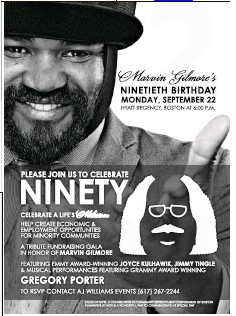
Who Is Marvin Gilmore Again?

From our Late to the Ninetieth Birthday Party desk

This ad ran in the A section of yesterday’s Boston Globe:


Screen Shot 2014-09-12 at 12.46.30 AM


Marvin Gilmore? Do we know him?

Yes we do.

From the May 21, 2010 edition of the Boston Globe:

Legion of Honor comes 66 years later

D-day veteran says he suffered discrimination

539w

Marvin E. Gilmore Jr. has cofounded a bank and helped revive parts of Roxbury. He owns a Cambridge nightspot and at 86 is considered one of the most stylish men in Greater Boston.

Yesterday, however, Gilmore was honored for what he did as a teenager: drop out of school, enlist in the US Army, and storm Normandy’s beaches on June 6, 1944, even though as an African-American, he said, he faced ruthless racism from fellow soldiers.

At a State House ceremony, Gilmore was awarded the Legion of Honor, France’s highest civilian award, for his role in liberating France and for his refusal to let discrimination hold him back while in the Army and at home afterward.

He is the first African-American in New England to be awarded the Legion of Honor, said the office of the consul general of France in Boston.

In addition, “Gilmore cofounded the Unity Bank in Roxbury, the first black-owned commercial bank in Boston, and played key roles in redevelopment of the Southwest Corridor, the Newmarket industrial district, and the CrossTown industrial park near the Boston Medical Center in Roxbury.”

Marvinpalooza is Monday, September 22. We’re guessing a splendid time is guaranteed for all.

Posted in Uncategorized | Tagged , , , , , , , | 2 Comments

TAG Heuer Needs a New TAGline

Say, that was some US Open the past fortnight, yeah?

It was Upset Central from start to finish, with the 1 seed (Serena Williams) playing the 10 seed (Caroline Wozniacki) in the women’s singles finals, and the 10 seed (Kei Nishikori) playing the 14 seed (Marin Cilic) in the men’s singles final.

Wow.

In the wake of Cilic’s dismantling of Nishikori in Monday’s championship match, this TAG Heuer ad ran in Tuesday’s New York Times.


Screen Shot 2014-09-10 at 1.34.31 AM


Except Nishikori did crack.


Not to get technical about it.

Posted in Uncategorized | Tagged , , , , , | Leave a comment

Round Midnight at the Global Worldwide Headquarters (Wishbone Ash Rockpalast ’76 Edition)

Let’s stipulate (as they say on Law & Order) that Andy Powell of Wishbone Ash was one helluva lead guitarist.

Then let’s enjoy this Rockpalast Cologne gig in 1976 (especially Time Was and Blowin’ Free 59:40-1:14:18).


Channeling Amazon, we think you might also like Wishbone Ash, the group’s first album, especially Error of My Ways (9:58) and Handy (20:19).


(To be sure graf comes next.)

To be sure, Andy Powell was no Jimi Hendrix.

But, damn, he was good.

Posted in Uncategorized | Tagged , , , , , , , , , | 2 Comments

The Great BU Coffee Bean Brewoff! (Starbucks v. DD)

All summer the hardwalking staff has watched the extensive retail renovations along the Warren Towers stretch of Comm Ave – especially the big bucks Starbucks upgrade and the Subway migration to inside City Convenience.

But yesterday we were delighted to see a sign indicating that City Convenience also houses Dunkin’ Donuts.

Not a Dunkin’ Donuts – just DD coffee and, yes, donuts.

Still, it’s nice to have an alternative on the block to overpriced overroasted overcrowded Charbucks. You can guess where the hardcaffing staff will be on a regular basis.

(A quick walk-by this morning found Starbucks packed to the gills, while two people were grabbing DD at CC. So it goes.)

Posted in Uncategorized | Tagged , , , , , , | 4 Comments

Dead Blogging ‘Calder and Abstraction’ at PEM

Well the Missus and I trundled up to Salem yesterday to catch Calder and Abstraction: From Avant-Garde to Iconic at the Peabody Essex Museum and, say, it was swell.

Alexander Calder’s abstract works revolutionized modern
01_bluefthrsculpture and made him one of the most celebrated artists of the 20th century. In collaboration with the Calder Foundation, this exhibition brings together 40 of the artist’s mobiles (kinetic metal works) and stabiles (dynamic monumental sculptures) to explore how Alexander Calder introduced the visual vocabulary of the French Surrealists into the American vernacular.

It was Opening Day, so PEM had some special events planned. There was the panel discussion On Redefining Sculpture, which featured “Stephanie Barron, chief curator of modern and contemporary art at the Los Angeles County Museum of Art and curator of the exhibition, and Jed Perl, art critic for The New Republic and author of a forthcoming biography about Alexander Calder.”

Perl was especially engaging – smart, accessible, and interesting. He was the same during the Q&A after a showing of Works of Calder, in which (via Creative Salem) “[filmmaker] Herbert Matter traces the narrative of a child who stumbles upon Calder at work. This short film, with music by John Cage, illustrates how the artist drew on nature for inspiration.”

Excerpt:


The narrator/producer was Burgess (The Penguin) Meredith, so that was fun too.

(Even more fun is Perl’s vivisection of Jeff Koons in the current issue of the New York Review of Books, which the hardworking staff read upon arriving home. Killer lede:

Imagine the Jeff Koons retrospective at the Whitney Museum of American Art as the perfect storm. And at the center of the perfect storm there is a perfect vacuum. The storm is everything going on around Jeff Koons: the multimillion-dollar auction prices, the blue chip dealers, the hyperbolic claims of the critics, the adulation and the controversy and the public that quite naturally wants to know what all the fuss is about. The vacuum is the work itself, displayed on five of the six floors of the Whitney, a succession of pop culture trophies so emotionally dead that museumgoers appear a little dazed as they dutifully take out their iPhones and produce their selfies.

(Ouch.)

The Calder exhibit is on view at PEM through January 4. Not an ouch in the bunch.

Posted in Uncategorized | Tagged , , , , , , , , , , , , , , , , , , , | 2 Comments

Round Midnight at the Global Worldwide Headquarters (God Bless Linda Ronstadt Edition)

In 1967 the hardyearning staff, like any red-blooded American male, had a knee-buckling crush on Linda Ronstadt.

Exhibit All-You-Need-to-Know:


And it just got crushier from there.

So it was bittersweet the other week to hear Kurt Andersen’s Studio 360 interview with Ronstadt, who is now suffering from Parkinson’s disease. Amazingly, it turns out she was less enamored of herself in the ’70s than we were.

Ronstadt was uncomfortable with her early stardom, feeling insecure about her voice. “It takes a long time to do anything well. I took about ten years to learn how to sing … Until after 1980 was when I really got going.”

This live concert from 1980 (with a helluva backup band) presumably qualifies.


But now, Ronstadt says, that’s all gone.

“There’s a guy sitting in your brain making a phone call to the muscles saying ‘Move in this certain exquisite way.’ I can’t get to the note — it’s like taking the elevator, you push 9 and it goes to 13.”

That’s just too sad. So it seems only right to include a few bonus tracks.

Long Long Time (1970 on the Glen Campbell Goodtime Hour):


Colorado (1973 Don’t Cry Now album):


Walk Away Renee, with Ann Savoy (2006 Adieu False Heart album):


God, she had a beautiful voice.

Posted in Uncategorized | Tagged , , , , , , , , , , , | 5 Comments

Oxymoron o’ the Day (#FashionTruth Edition)

The hardworking staff always enjoys reading the New York Times Thursday Styles section because it’s so, well, Times-ish.

Exhibit Umpteen from yesterday’s edition:

Screen Shot 2014-09-05 at 1.01.14 AM

Ooookay.

We’re happy for you.

But what really caught our eye was this full-page ad for ModCloth.


Screen Shot 2014-09-05 at 1.08.03 AM


Soup-to-nuts graf (from co-founder Susan G. Koger):


Screen Shot 2014-09-05 at 1.12.15 AM


This is just one more example of the Go-Girl Marketing trend detailed in the latest edition of Advertising Age. (Not to be confused with pinkwashing.)

Only problem is: Fashion is all about artifice, not truth. Even when it’s about truth. That’s the beauty of it.

Posted in Uncategorized | Tagged , , , , , , , , | 2 Comments

The Great Liberal ‘Overturn Citizens United’ Scam

Admittedly, the hardworking staff attended the Jerry Orbach School of Law (& Order) for only 12 years, but all this hubbub from the left about reversing Citizens United (the 2010 Supreme Court decision that allows unlimited expenditures by corporations, unions, and individuals to promote or oppose political candidates) seems to be perpetrating a fraud on the voting public.

Take, for instance, the absolute pandermonium in last night’s Massachusetts Democratic gubernatorial debate. In her attempt to saddle every liberal hobbyhorse in the stable, Attorney General Martha Coakley repeatedly insisted that she has “worked hard to eliminate Citizens United.”

Except to eliminate Citizens United, one of two things has to happen: 1) the Supreme Court overturns its own decision (your stare decisis aside goes here) or 2) the U.S. Constitution is amended.

Worked hard on either of those, Ms. Coakley?

Ditto for yesterday’s Boston Globe Letter to the Editor from Anne Borg and Marilyn Peterson of the League of Women Voters of Massachusetts.

Put up a fight vs. super PAC money

THANK YOU for calling attention to the outsize role super PAC money is poised to play in the Massachusetts governor’s race (“Follow the money,” Capital, Aug. 29). We urge citizens to demand that their senators and representatives in Congress pursue every avenue to stop the corrupting influence of big money on our political system. Tell them to change the campaign finance laws, reverse recent Supreme Court decisions permitting the unfettered flow of money, and establish public funding of elections to replace private purchasing of elections.

Tell Congress to reverse recent Supreme Court decisions? Seriously?

Refresher course in amending the Constitution:

The United States Constitution is unusually difficult to amend. As spelled out in Article V, the Constitution can be amended in one of two ways. First, amendment can take place by a vote of two-thirds of both the House of Representatives and the Senate followed by a ratification of three-fourths of the various state legislatures (ratification by thirty-eight states would be required to ratify an amendment today). This first method of amendment is the only one used to date. Second, the Constitution might be amended by a Convention called for this purpose by two-thirds of the state legislatures, if the Convention’s proposed amendments are later ratified by three-fourths of the state legislatures.

Good luck with that, eh? It’s a lot easier to just dupe the true believers, isn’t it?

Posted in Uncategorized | Tagged , , , , , , , , , , , , , , , , , | 4 Comments