What To Do In The Big Town (Andy Warhol Edition)

Well, the Missus and I came down the city and here’s what we found (links and graphics to follow when the hardworking staff returns to the Global Worldwide Headquarters):

* The fabulous “Abstract Expressionism: Reloading the Canon” exhibit at Michael Rosenfeld Gallery. Personal favorites: Seymour Lipton’s “Dragon” and standout works by Adolph Gottlieb, Lee Krasner, and Richard Stankiewicz (although just about everything there is excellent)

* “American Modernism” at Spanierman Gallery, which has too many knockout paintings to detail, although Max Weber’s “Joel’s Cafe” will stick with you for a long time

* “Warhol Soup” at Armand Bartos Fine Art, a collection of Campbell’s cans to write home about

* “Frankenthaler: East and Beyond” at Knoedler & Company. Don’t miss the to-die-for bronze screen on the second floor

* “Good People” at the Manhattan Theatre Club, a new play by David Lindsay-Abaire set mostly in South Boston and starring a riveting Frances McDormand, along with Estelle Parsons, who almost steals the show but not quite.

More (we’re glad to say) tomorrow.

– Posted using BlogPress from my iPad

Posted in Uncategorized | Leave a comment

A Tweet New Advertising Gambit

Consumer-generated ads are so last Super Bowl.

(See Pepsi Max and Doritos spots from version XLV.)

Trending now are social-network-fueled ads.

Thursday New York Times report:

Chobani, Greek Yogurt Leader, Lets Its Fans Tell the Story

THE leading brand in a growing grocery category is introducing its first television advertising in an effort to stay ahead of a growing field of competitors.

The brand is Chobani, which is No. 1 in sales in the booming Greek yogurt segment of the yogurt market. In addition to television commercials, the campaign for Chobani, sold by Agro Farma, includes the Chobani Web site (chobani.com), billboards and social media like FacebookTwitter andYouTube — all to encourage “real” fans of the brand to share their “real love stories” by submitting video clips, photographs and comments.

Such as, this billboard:

And, of course, the campaign is hooked up with other social media sites:

[Unruly Media, which specializes in so-called social video] is arranging for sites like mommydaddyblog.comnotecook.com and passportdelicious.com to carry the Chobani commercials along with a two-minute clip about the making of the spots.

Swell.

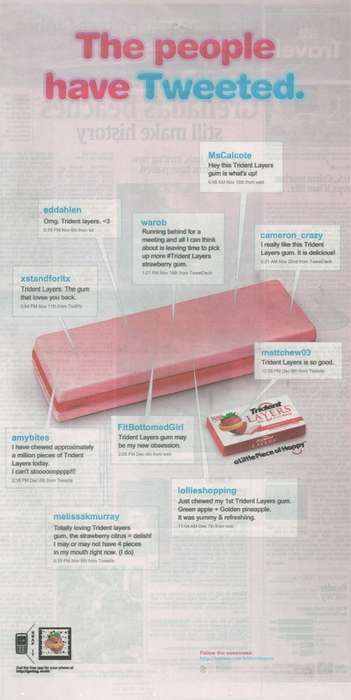
Preceding this social gathering was the American Express Twitter-charged WhatsBooming campaign, which happened to feature ads in the same day’s Business and Styles sections of the Times; a Motorola campaign that highlighted tweets and blog raves about the Android phone; and this print ad for Trident Gum that ran in USA Today:

Free content: From an advertiser’s standpoint, tastes tweet, yes?

Posted in Uncategorized | Tagged , , , , , , , , , , , , , | 3 Comments

Harry Houdini And The Boston 1600-Pound Sea Monster

Houdini: Art & Magic at New York’s Jewish Museum was pretty much panned in Wednesday’s Wall Street Journal review:

[T]he exhibition, whose dramatic presentation at times upstages Houdini’s magical effects, falls somewhat flat. The artistry of one of the greatest showmen of all time (perhaps the first modern performance artist) cannot be conveyed by stage props, silent film clips and ephemera—things not particularly interesting as objets d’art, but because of the aura of the extraordinary man they represent.

But then there’s this from the Journal piece:

Houdini could walk a tightrope, untie knots with his toes, scale skyscrapers, dislocate his shoulders, and hold his breath for over three minutes. He was an inventor, businessman, scientist, philanthropist, magazine publisher, newspaper columnist and author of books.

[snip]

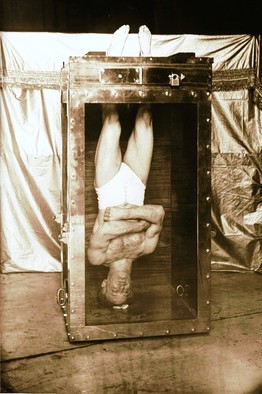
He escaped nude from jails and prisons all over the world, as well as from buried coffins, lit cannons, boilers, safes and, on a Boston stage, the belly of a 1,600-pound sea monster.

The hardworking staff was, of course, intrigued. So we plugged “Houdini Boston sea monster” into the Googletron, and here’s what we found:

1) An excerpt from The Secret Life of Houdini: The Making of America’s First Superhero:

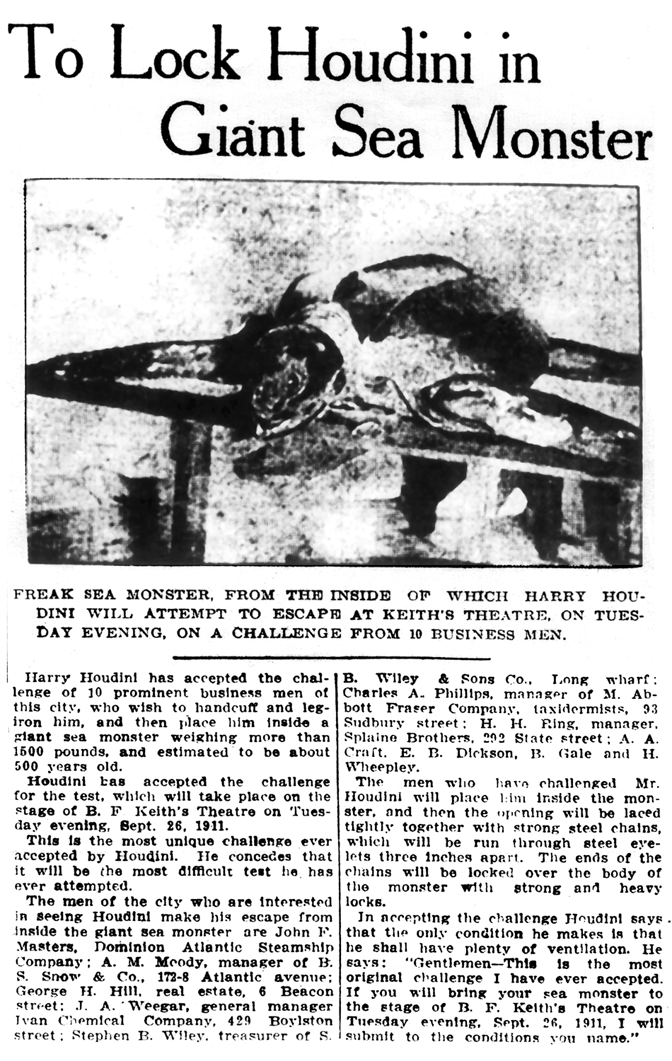
The procession started on the Long Wharf of Boston Harbor and continued through the winding streets to Keiths Theatre. Crowds of people followed the bizarre parade, others just stood on the sidewalk and watched in awe as Houdini’s next great challenge was publicly displayed. “It” was a giant 1,600 pound sea monster that had been fished out of the ocean, a “what is it” that locals had identified as a cross between a whale and an octopus. Ten prominent Boston businessmen had challenged Houdini to be fettered with handcuffs and leg irons and escape from the hollowed-out “belly of the beast.’

The scene onstage on September 26, 1911 was unbelievable. It took a dozen stagehands to carry out the “turtle-tortoise-fish or whatever it is,” and turn it on its back on the center of the stage. Its abdomen had been sliced open, affixed with metal eyelets, which held a long thread of steel chain. Before the escape was attempted, Houdini was forced to sign a document that would release the owners of this monster from any liability should Houdini fail the test.

Then the steel chain was slackened, and Houdini crawled into the carcass, pausing to spray some strong perfume where his head would lie. He gave a signal, and handcuffs and leg irons were fastened to him. Then the committee went to work. Smiling through their labor, they tightened the chain, passed it around the creature’s back, and secured it with locks. The cabinet was then placed around the beast and the orchestra struck up.

After fifteen minutes, the screens of the cabinet were thrown open, and there was Houdini, “grease-covered, pallid and perspiring,” holding the handcuffs and leg irons aloft in triumph. On examination, the beast was as securely locked as it had been before. Houdini was not unscathed. His first words were to the stagehands, requesting them to open the windows and give him some air. Houdini had underestimated the toxicity of the arsenic solution that the taxidermist had used to preserve the sea monster, and, locked inside, he had been adversely affected by the fumes.

2) A September, 1911 newspaper article, complete with photograph:

The hardtraveling staff is going to the Big Town this weekend and will report firsthand on the exhibit.

In the meantime:

How cool was that?

Posted in Uncategorized | Tagged , , , , , | 4 Comments

Dead Letter Artifice: The Triangle Waist Company Fire

Excellent piece in Tuesday’s New York Times about documentary filmmaker Anthony Giacchino’s project to memorialize the 100th anniversary of the Triangle Waist Company fire in the Big Town that claimed 146 lives.

Anthony Giacchino thumbed through a stack of letters, all of them marked with yellow stickers, red stamps or a simple, final X slashed through the addressee’s names: Clotilde Terranova. Rosie Friedman. Rosaria, Lucia and Catherine Maltese. “Return to sender,” he said. “Return. Return. Return. It’s like, ‘Who is this person?’ They’re forgotten, and unfortunately there’s a lot of truth to that.”

Dead letters? Not to Mr. Giacchino, who thinks of them more as correspondence with another century, addressed to the 146 victims of the Triangle Waist Company factory fire.

As New York prepares to mark the centennial of the tragedy on March 25, he has mailed the letters to the places where each victim lived in 1911, as part of an art project to commemorate the workers and their place in the city. He is also reclaiming a part of Italian-American history — 39 Italian workers were among the dead — that has gone unexplored.

Mr. Giacchino has actually been exploring this subject for awhile:

In recent years, Mr. Giacchino has joined in commemorations of the catastrophe, writing the names of the victims in chalk on the sidewalks outside the addresses where they once lived.

But last year, he said, he got the idea to visualize the victims in a different way. “I just kept thinking about the number 146,” he said. “I would put names in front of the buildings, but it still did not give me a sense of it. Why not send letters? They’d probably come back. Then I’d be able to see what 146 looks like.”

130 did. And now you can see what that looks like.

Posted in Uncategorized | Tagged , , , | 3 Comments

Who’s More Ridiculous: Robert DeLeo Or The Boston Herald?

From our Late to the Party desk:

Massachusetts House Speaker Robert DeLeo (D-Broken Ankle) has decided to goose his profile by cracking down on welfare abuse.

To wit (via the Boston Herald):

A frustrated House Speaker Robert A. DeLeo is cracking down on welfare card abuse after a Herald review found that Bay State recipients blew nearly $200,000 in taxpayer dough last year on a broad array of luxuries — including booze, lingerie, tanning parlors, jewelry, movie theaters and even pets.

That would be $200,000 out of the “$46.4 million that welfare recipients spent using the debit cards in fiscal year 2010.”

Seriously, Mr. Speaker? You’re going all Schwarzenneger over .004 of welfare spending?

T-wit.

About the only thing more idiotic was the Herald’s front page on Tuesday:

In addition to the moronic header “WELFARE CARD STUNNER: FIRST LIQUOR . . . NOW LINGERIE,” the feisty local tabloid featured some swell graphics (sorry, not online) to illustrate the profligate spending, which included:

• $175,000 on liquor stores, including a $102 tab at a Dracut bar;

• $827 at Victoria’s Secret stores across the state, including $208 at a Hyannis outlet;

• $644 at beauty supply stores, salons, and even a tanning booth in Fall River.

• $664 at PETCOs and other pet supply stores; $127 on jewelry stores; $3,427 at AT&T mobile phone stores; and about $100 at Chuck E. Cheese.

If you ask the hardworking staff, the real story is how little welfare money goes toward those types of purchases.

But why get technical about it.

Posted in Uncategorized | Tagged , , , , , | 7 Comments

The Redemption Unit, VI

(See IIIIIIIV and V)

It was something to be in Boston that summer. The spirit of ’76 was everywhere, from the massive fireworks displays on the Esplanade to the stately procession of Tall Ships into Boston harbor to the red-white-and-blue redecoration of Li’l Stevie’s House of Pizza on Boylston street.

Bicentennial Fever Grips Hub.

That was the same summer I was supposed to get married to my college girlfriend, who two years earlier had chosen to live in the Midwest with her folks until we tied the knot and settled down in Boston. Six weeks before the wedding I looked up and realized that: a) I still hadn’t found us a place to live; b) I still hadn’t gone for a tuxedo fitting, even though all the ushers (spread out over three states) had; and c) between a and b, it was time to call off the wedding.

That night I did – “postponed” it, actually. I got in just under the wire, since the invitations were sitting on my ex-fiancée’s kitchen table, stamped and ready to go out the next morning.  The rest of the details you don’t want to know. Suffice it to say Charles Manson had nothing on me in at least one Midwestern household.

And Here’s to You, Mr. Robinson

The thirty or so hours a week I actually was at work started getting tougher to handle, so I did what any sensible person back then would do: I took to smoking the occasional joint in the alley behind the Boston DO – but only on my morning and afternoon breaks, never at lunch. Unfortunately, it tended to make things worse. One day, for instance, I returned to my desk from a refreshing break bearing a large cup of coffee and a devil-may-care attitude. A few minutes later a claimant, puffing hard on a cigarette, walked up, handed me his redetermination letter, and sat down.

“You called me in?”

“Yes, Mr. Porter, we need to review your file.”

God only knows what was in the file, but the next thing Mr. Porter did was take the cigarette out of his mouth and drop it – snick – into my fresh cup of coffee. Then he really panicked. He lunged toward the coffee and knocked it over, barely missing me but thoroughly caffeinating that day’s paperwork. We rescheduled the meeting.

Another day, also post-break, an especially difficult claimant decided, in the course of our interview, to play what he thought was his trump card.

“You should be takin’ care of me here, man. You should be treatin’ me right. I pay your salary, man.”

That was all I needed to hear.

You pay my salary? You pay my salary? You’re on welfare, you moron. You’re not a taxpayer. Or hadn’t you noticed?”

He stood up quickly.

“Hey! You can’t call me a moron, man!”

The Operations Supervisor happened to be walking by and quickly came over to my desk. He leaned his considerable bulk toward the claimant and said in a low voice, “Is there a problem here, Mister Moron?”

“Nossir. Nossir. I was just leaving.”

I decided I could use another break.

* * * * * * *

I look up and the Robinsons are at my desk – father, mother, two kids – straight out of some Southern Gothic novel. “We’re here for the welfare,” Mr. Robinson says, his tone indicating that he expects to be turned down.

“No problem. Let’s do the forms.”

It went well until the second question.

“What’s your home address?”

“Ain’t got no home address.”

“Well, Mr. Robinson, I need someplace to send your check, assuming you’re eligible for one. Where does your family stay?”

“Don’t stay anywhere. I’ll come in and pick up the check every month.”

“It doesn’t work that way, Mr. Robinson. We don’t write the checks here. They’re mailed out from a payment center.”

“Okay – I’ll go there.”

“There’s no there, Mr. Robinson. It’s all computerized down in Birmingham, Alabama. You need a home address – maybe the Long Island Shelter or the Pine Street Inn. You could get your check mailed to either place.”

“Ain’t goin’ there.”

And with that, the Dismiss Family Robinson got up and left.

A couple of weeks later I walked into the DO about 9:30 and was told to go right to the Assistant District Manager’s office. I was expecting another lecture on punctuality, but instead the ADM said, “Guess who paid a little visit to the Birmingham DO?”

“Who?”

“Take a guess.”

“Vice President Rockefeller?”

“No. Why would you say that? No – it was Mr. Robinson.”

“Mr. Robinson . . . our Mr. Robinson?”

“That’s right. Mr. Robinson went down to Birmingham and demanded his check. And when they said they couldn’t issue him one – “

“Wait – how’d he get there?”

“How the heck would I know?”

“He must’ve hitchhiked. Wonder where he left his family.”

“His family was with him.”

“The whole family hitchhiked to Alabama?”

“How the heck would I know? The point is, when they didn’t give him a check, he – and this is a quote – he destroyed the outer office of the Birmingham DO, which, by the way, had just been renovated.”

“Really? Do they have a mural too – maybe Bull Connor with some German shepherds and fire hoses?”

The ADM glared at me.

“When they finally subdued Mr. Robinson, he said he was told to go there for his check. And he used your name.”

“Of course he did.”

“What do you mean of course he did?”

“Of course he used my name.”

“Why?”

“Because he knows it. Why else? If he knew your name, he’d have used that too.”

The ADM glared some more.

“You should know, they’re holding you personally responsible for the damage he did.”

“What, I’m supposed to pay to fix the place up?”
“Probably not, but they could make you pay for it. One other thing: the Area Director wants you in his office at nine o’clock tomorrow.”

“That’s pretty early.” I got up and headed for the door. “Hey, if they charge me for the repairs, do I get to design a new mural?”

The Area Director’s office was high atop the JFK federal building in Government Center, with views of downtown Boston and the harbor. The AD told me to sit down and leaned back in his government-approved leather chair.

“You’re a troublemaker, son. You know it and I know it.”

“Anyone else know it?”

“Everyone knows it. Why’d you tell that claimant to go to Birmingham?”

“For the hundredth time, I didn’t tell Mr. Robinson to go to Birmingham. I said that he couldn’t pick up a check at the Boston DO, that the checks come from the payment center in Birmingham, and that he needed to have an address so that we could mail him one. It’s not my fault he has an active imagination.”

The AD leaned forward.

“You know why you still have a job? Do you? Not because of your performance, that’s for sure. You’re chronically late, you have an attitude problem, you forced the ADM to shut down that . . . that newsletter of yours – oh yes, I’ve checked your file. Despite all that, you still have a job at SSA. You know why?”

“Sure – ‘cause I’m a term employee and if you let me go, you can’t replace me. You figure it’s better to have 30 hours of me than 40 hours of nobody.”

The AD leaned back.

“You’re lucky, son. If we didn’t have the Overpayment Recovery Program just starting up, you’d be out of here.”

The AD leaned forward.

“Now get out of here.”

Posted in Uncategorized | Tagged , , , , , | 4 Comments

James Carroll Channels Marshall McLuhan

Author and Boston Globe columnist James Carroll (who’s not me, despite widespread local confusion over the past two decades) had a terrific piece on Monday about the difference between analog and digital clocks.

Time’s face, time’s digits

OUR TWO kinds of clocks give us two kinds of time. The old fashioned clock defines time as a continuity. Thus, its numerically defined face and pointed hands sweep through an endless succession of circles, marking seconds, minutes, and hours. This is the so-called analog clock, and the analogy it offers is of measurable flow.

But the digital clock is different, Carroll writes:

In the common form showing only hours and minutes, the numbers remain static until a shift occurs. A well-placed colon defines the distinction between hours and minutes, pictured as frozen. Periodically, the numbers jump. Time is not continuous, but episodic. The digital clock renders a perennial present, effectively denying the existence of the past and the future.

And this matters why? Because it shapes our perception – and our experience – of the world.

The reduction of time to numerical value promotes the reduction of meaning, too. The shift from the accumulation of experiences that are understood by virtue of their connection to one another, adding up to “experience,’’ to life perceived as a series of unrelated happenings, the present moment forever isolated from past or future, is an impoverishment. No need to call such digital instants “seconds’’ anymore, since their sequence is neither represented nor counted. The narrative imagination, which is concerned with linkage and causality, thus gives way to episodic thinking.

That’s the very definition of media visionary/loon Marshall McLuhan’s dictum that the medium is the message. Print media told us the world is linear, connected, coherent. Electronic media told us the world is disconnected, instantaneous, simultaneous.

Don’t even ask about digital media.

James Carroll, quite rightly, mourns the loss:

Humans are creatures for whom now takes its meaning from then. The old clock shows that. It has a face and hands because it resembles us.

Marshall McLuhan (who maintained that cataloguing the effects of new media didn’t necessarily signal approval) would have wholeheartedly agreed.

Posted in Uncategorized | Tagged , , , , , | 2 Comments

Not Everyone Mad About ‘Mad Men’

From the Sunday Boston Globe Ideas section:

Everybody loves “Mad Men” — except, apparently, Daniel Mendelsohn, a distinguished translator and critic who writes for The New York Review of Books. In a smart and scathing review of the show, Mendelsohn says the unsayable — that “Mad Men” is “a soap-opera decked out in high-end clothes.” And then he asks: If the show is so silly, then why do people love it so much?

A better question: Does everyone love “Mad Men” so much?

The reality is, more viewers watch SpongeBob SquarePants on Saturday morning at 9:30 than watch the average episode of “Mad Men.”

(Trust me – or check the New York Times Monday cable ratings index.)

Truth is, the cultural footprint of “Mad Men” has always exceeded the show’s viewership.

Not to get technical about it.

Posted in Uncategorized | Tagged , , , | 3 Comments

The Slow Journalism Company: News Only A Dead-Blogger Could Love

This week BBC radio profiled the Slow Journalism Company, a news organization which “offers an antidote to throwaway media and makes a virtue of being the last to breaking news.”

That’s reflected in the magazine Delayed Gratification:

Delayed Gratification is a new quarterly publication from The Slow Journalism Company. Each issue distils three months of the UK’s political, cultural, scientific and sporting life into a witty magazine of record. A combination of almanac, essays and reportage, Delayed Gratification operates on the principles of Slow Journalism.

More details from Journalism.com.uk:

A new magazine dedicated to “slow journalism” has been launched by the international editor of Time Out.

Marcus Webb will edit Delayed Gratification, which will publish quarterly from January. The title is the first launch by the Slow Journalism Company headed by Webb and director Rob Orchard, who met Webb while working in Dubai as a writer eight years ago.

The magazine describes itself as “an antidote to throwaway media” with the tagline ‘Last to breaking news’ and wants to be a collectible for readers. It will cover politics, culture, science and sport through a combination of essays and reportage using the principles of slow journalism: “It measures news in months not minutes, returning to stories after the dust has settled.”

The magazine will aim to provide new angles on big news stories of the quarter, cartoons, infographics and expert insight and reportage on major news events.

Dead-bloggers of the world (population 1 so far), rejoice!

Posted in Uncategorized | Tagged , , , | Leave a comment

After Disastrous Super Bowl Ads, Groupon Tries To Regroup

From the New York Times:

Groupon is ending a campaign that made its debut on Super Bowl Sunday, days after making changes in response to considerable criticism of the ads.

The decision is a major setback for Groupon, the purveyor of online discount coupons, because the campaign represented its first national mainstream advertising.

The withdrawal of a Super Bowl ad after the game in the face of complaints is not unprecedented. Mars stopped running a spot for Snickers after the game in 2007 because it was deemed homophobic.

The Groupon ad:

The Times, again:

Groupon ran one commercial during Super Bowl XLV on Fox, featuring the actor Timothy Hutton, as well as one spot before the game and one after; those featured Cuba Gooding Jr. and Elizabeth Hurley.

All three spots, which carried the theme “Save the money,” were intended to spoof celebrity do-gooders who support causes like saving whales or the rain forest or urge the public to care about Tibetan refugees.

The stars in each spot started talking about a cause, then veered off to describe how they were saving money by using Groupon’s discount coupons.

The twist was that the campaign was also intended to help those causes, with Groupon matching donations that consumers would make to organizations like Greenpeace. There were explanations about the philanthropic component on a special Web site, savethemoney.org, and on a section of the Groupon Web site, savethemoney.groupon.com.

But the charitable element was never mentioned in the commercials, which led many viewers to perceive the parodies as callous and insensitive, mocking the causes and those who care about them.

The spots were re-edited this week “to add language about how viewers could help the causes,” but it was a lost cause.

Your cautionary tale goes here.

Posted in Uncategorized | Tagged , , , , , , , | 2 Comments