Snappy lede: “Hill Holliday no longer runs on Dunkin’.” The Canton-based chain dropped its ad agency of two decades and moved its account to New York shop BBDO Worldwide. “Every now and then you’ve got to look to change things up a bit,” [independent franchise group executive director Ed] Shanahan said.
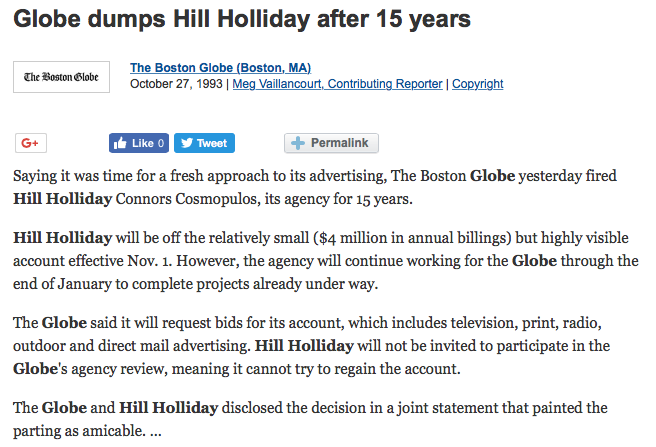
That statement – and the headline of Chesto’s report – echoes an infamous Globe Business piece from 25 years ago that has stuck with me for a variety of reasons.
Not so amicable, however, was the dustup that the story – and especially the headline – triggered between Globe editor Matt Storin and business editor Steve Bailey, which in turn led to this headline.
Globe selects Edelman to be business editor
Larry Edelman will become business editor of The Boston Globe Jan. 1, replacing Steve Bailey, who has held the post for five years, Matthew V. Storin, the newspaper’s editor, said yesterday.
Bailey, 43, said he chose to take a reporting job in the Business section, where he has been a popular editor and assistant editor for the past 12 years. Storin said Bailey’s “return to a management position in the future would be welcomed by me.”
“We’ve had a great run here,” said Bailey, who joined the newspaper in 1977. “I’m proud of what we’ve accomplished. The Globe gave me a good opportunity, and I appreciate it.”
That piece ran the same morning I was scheduled to meet with Bailey and finalize my deal to write a weekly advertising/media column for the Business section. I was up bright and early and figured I should check that day’s edition of the Globe to be on top of things.
Oops.
I wasn’t sure what to do at that point, but the Missus, in her infinite wisdom, said, “Just go to the meeting.”
So I did.
In the Globe newsroom, I was told to take a seat: “Mr. Bailey is in a meeting.” A meeting that everyone could hear through the closed door of Storin’s office.
About 20 minutes later Bailey walked up to me and said, “You know I’ve been fired, right?”
I said, “Yeah – is our meeting still on?”
After a moment’s hesitation, Bailey summoned Edelman, who moseyed into Bailey’s office, looked around, and said to no one in particular, “I wonder if my desk will fit in here.”
Ouch.
Bailey laid out the situation and Edelman, to his credit, said “Okay, let’s give it a go for six months.” Not long after I was filing columns like this one.
A story goes with that too.
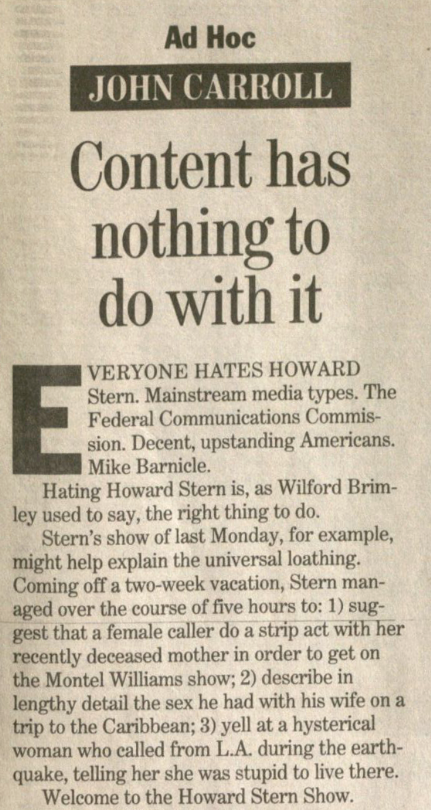
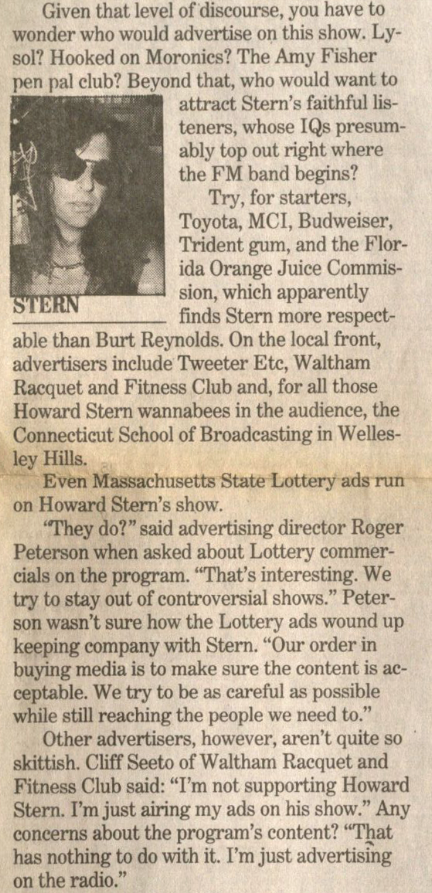
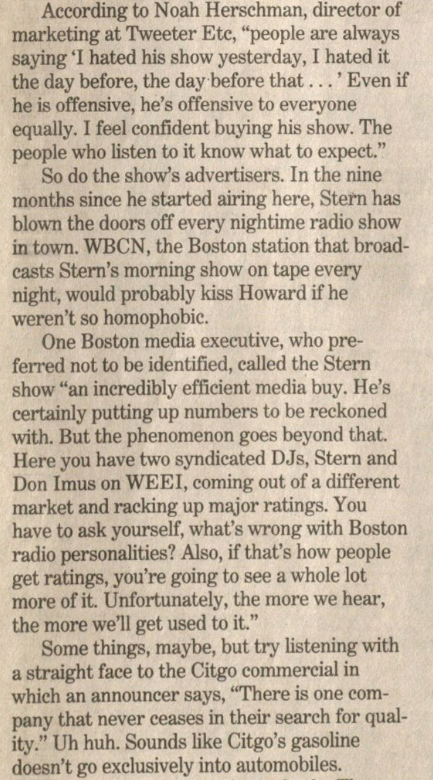
A couple of weeks after the column ran, I got a call from a radio monitoring service telling me I had been the subject of a segment on that morning’s Howard Stern Show and asking if I’d like a copy of it. I said no thanks – because the Stern show at that time was re-broadcast in Boston every night.
So I tuned in and listened to Stern blowtorch me for the better part of an hour. He had just returned from vacation and was working his way through a clip file that had been assembled in his absence. My Globe column was one of those clips. (Spoiler alert: All his listeners came to know that I did not make as much money as the King of All Media.)
And then – remember, this was pre-Internet – the Sterniacs started calling my business phone in droves to leave messages like “Howard rules, man” and “We’re coming after you, man.”
Which they never did, presumably because they were too stoned, man.
Anyway, I continued to write the Globe column for the next 15 months. I never had occasion to mention Howard Stern again.
Leave it to the redoubtable Wall Street Journal columnist (and Massachusetts native) Jason Gay to nail the New! Improved! Boston Red Sox/New York Yankees basebrawl rivalry.
Well, baseball, you’ve had a nice run lately—but it’s over.
You’ve been so likable! Baseball’s been new, exciting, delightful—even open to change. The Cubs and the Astros won the last two World Series. The Cubs and the Astros! One club’s first title since 1908—and the other club’s first title since, well, ever.
There’s been thrilling, upstart talent, none bigger than the Angels newcomer Shohei Ohtani, the Japanese phenom who’s a brilliant two-fer—a world-class pitcher, and, it appears, a world-class home run slugger.
This has all been fantastic for baseball. It’s impossible to not enjoy.
But now it’s over. Kaput. Finished. Because they’re back.
Them.
That would be the Red Sox and the Yankees.
And that would be where Jason Gay shifts into high gear.
Ugh. It’s brutal. If you hate Boston or New York—or both—it’s time to flee the country. Or at least follow hockey and basketball. Baseball’s most oxygen-sucking rivalry is about to suck all of the oxygen out of the sport again.
It’s like finding out that your uncle who threw up on the couch is coming for an indefinite stay.
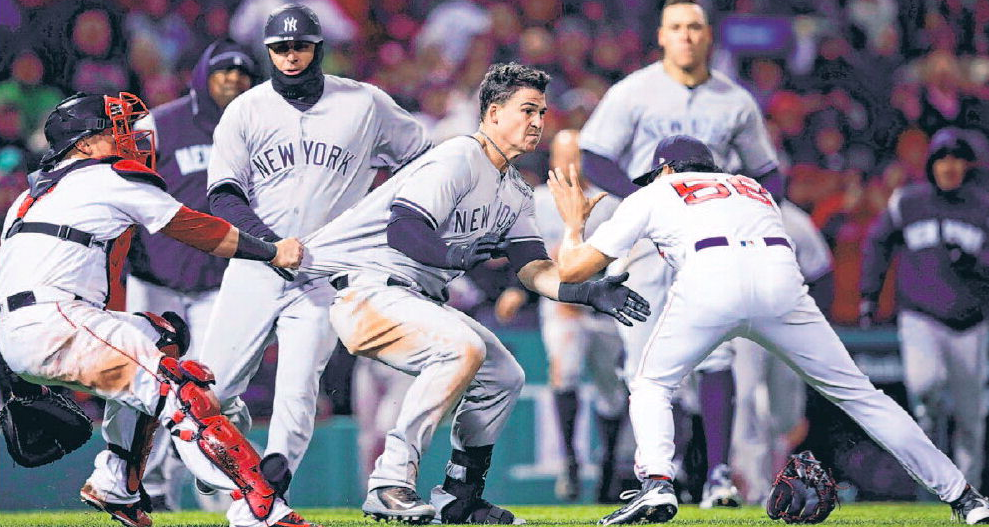
Why the revival? That’s easy: the hate is percolating. For the first time in a while, Red Sox and the Yankees A) are simultaneously stacked, and, far more importantly, B) don’t want to snuggle. On Wednesday night at Fenway, the teams got into a zesty, bench-clearing brawl—pushing, shoving, and taking swings like old, Pedro vs. Zimmer times.
You need to read the entire piece if only for lines like this: ” I think a photo of Jason Varitek mashing his catcher’s mitt into A-Rod’s face should be printed on $20 bills.”
Excellent!
Except . . .
It’s only going to get worse. If you think it’s obnoxious now, wait until this rivalry gets back to the Bronx in May. Wait until that series right before the Fourth of July. It’s gonna be hot and bonkers.
But likable? Not really. Boston vs. New York is back. Sorry, baseball.
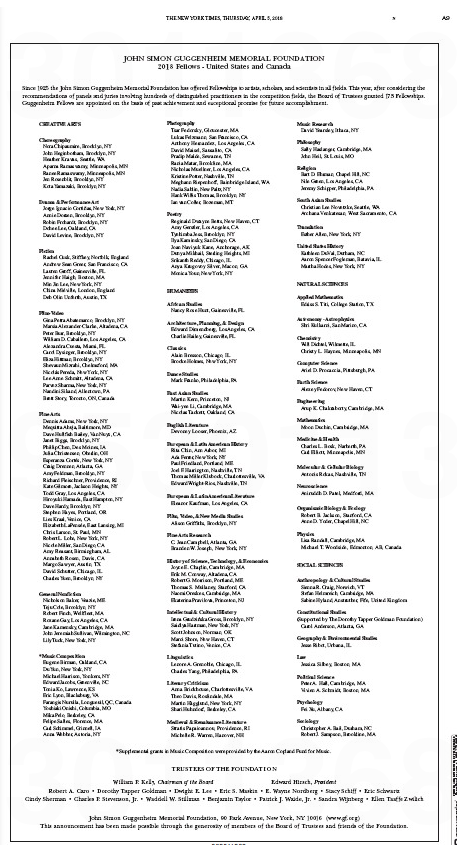
By our count, the Greater Boston area garnered 17 Fellowships, while Brooklyn (Borough Motto: “You can’t afford to live here”) took home 18.
Hey, wait till next year, as Brooklynites used to say about Dem Bums. (Except in 1956, when – according to legend – a Brooklyn paper ran the headline “Wait till last year” after the Dodgers lost the World’s Serious.)
Then again, the local eggheads absolutely killed it in the social sciences.
One further consolation: Boston flat-out crushed Canada, which nabbed a paltry three Fellowships.
The Boston news bakeoff between the Big Town and the Beanie Town usually goes to the local broadsheet, but not yesterday.
The New York Times Science section featured this piece by Nicholas St. Fleur.
Cracking a Cold Case
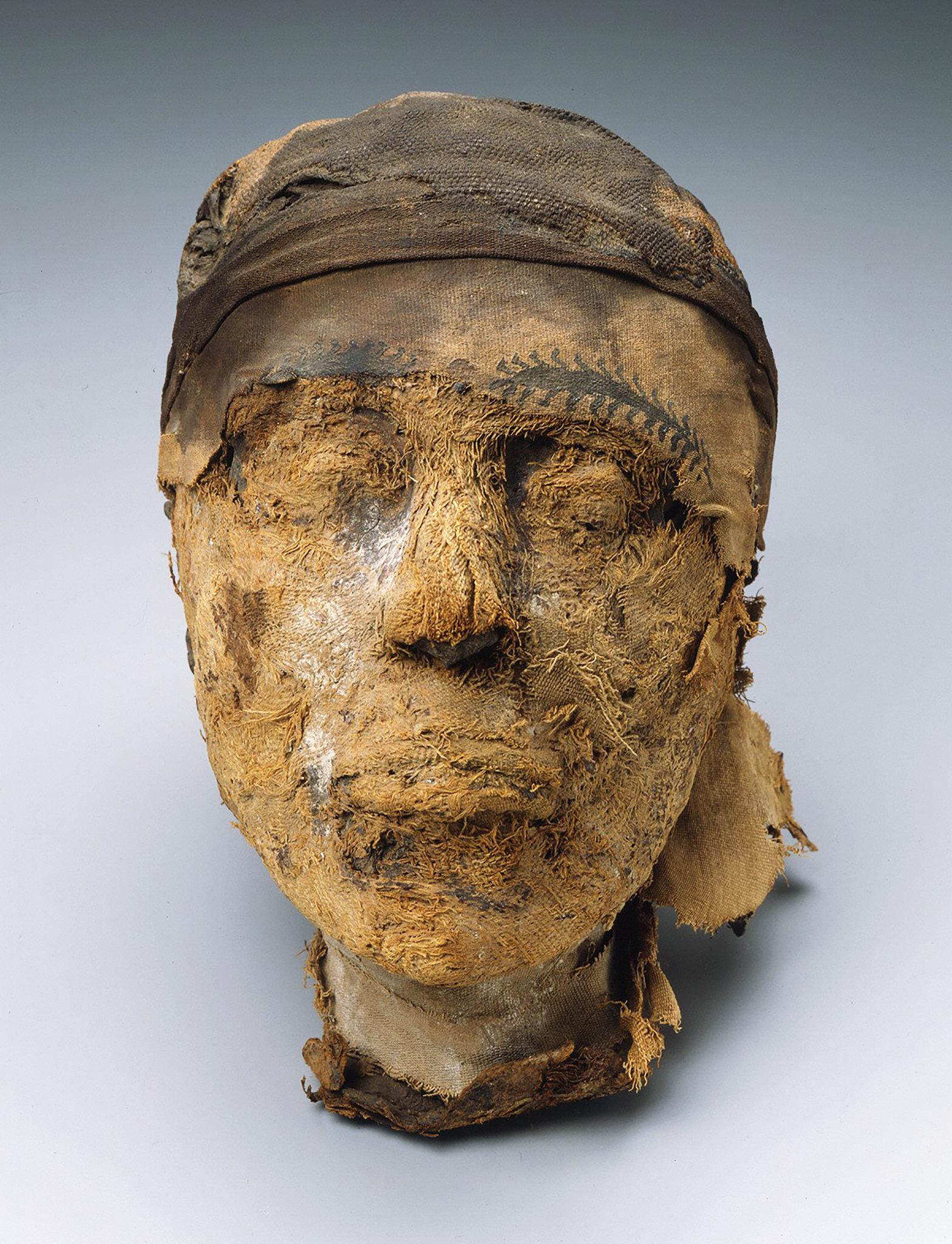
The F.B.I. extracts DNA from a severed head to help a Boston museum identify a 4,000-year-old Egyptian mummy.
In 1915, a team of American archaeologists excavating the ancient Egyptian necropolis of Deir el-Bersha blasted into a hidden tomb. Inside the cramped limestone chamber, they were greeted by a gruesome sight: a mummy’s severed head perched on a cedar coffin.
The room, which the researchers labeled Tomb 10A, was the final resting place for a governor named Djehutynakht (pronounced “juh-HOO-tuh-knocked”) and his wife. At some point during the couple’s 4,000-year-long slumber, grave robbers ransacked their burial chamber and plundered its gold and jewels. The looters tossed a headless, limbless mummified torso into a corner before attempting to set the room on fire to cover their tracks.
The archaeologists went on to recover painted coffins and wooden figurines that survived the raid and sent them to the Museum of Fine Arts, Boston in 1921. Most of the collection stayed in storage until 2009 when the museum exhibited them. Though the torso remained in Egypt, the decapitated head became the star of the showcase. With its painted-on eyebrows, somber expression and wavy brown hair peeking through its tattered bandages, the mummy’s noggin brought viewers face-to-face with a mystery.
His head, or her head?
And could the F.B.I. even get DNA from a 4000-year-old specimen, something no one had ever done?
It’s a cracking good tale, with great visual elements (you’ll especially want to check out the ancient Egyptian Opening of the Mouth Ceremony).
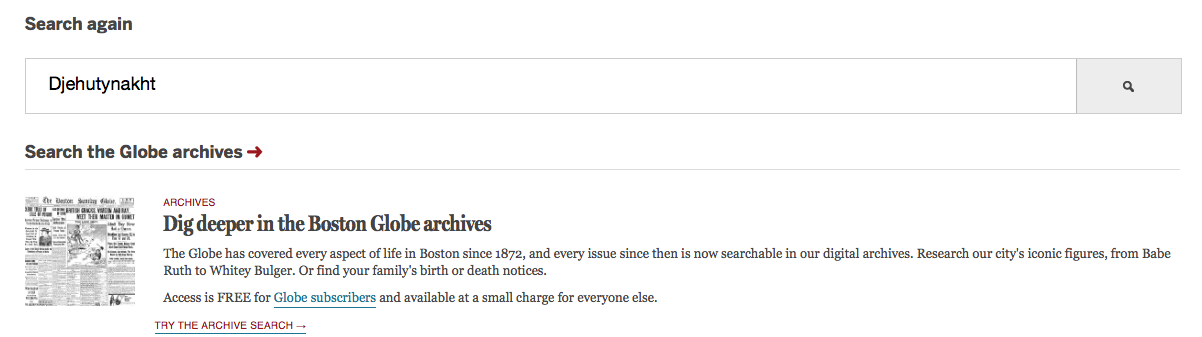
Downtown at the Boston Globe, there’s neither hide nor hair of the story.
Plugging “Djehutynakht” into the Googletron, however, yields these pick-ups (and counting) from the Times piece.
We’ll keep an eye on how – and when – the stately local broadsheet catches up.
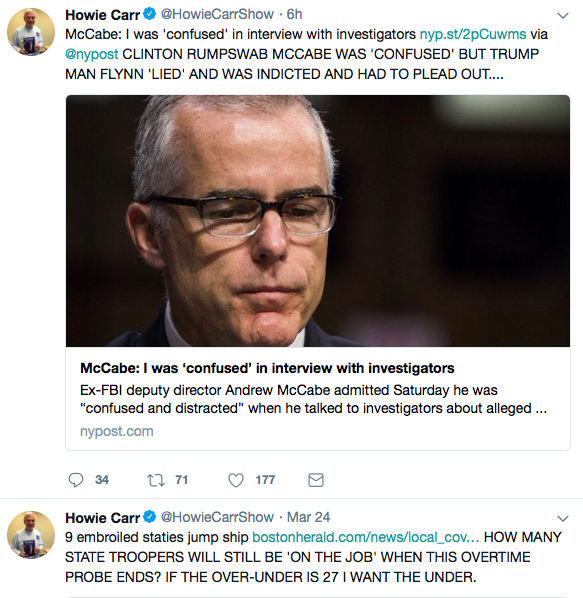
Our kissin’ cousins at Two-Daily Town have amply chronicled Boston Herald columnist Howie Carr’s relentless pilot fishy suck-up to the Onanist-in-Chief.
Now the Accidental President has returned the favor.
In reality nobody’s talking about it, but why nitpick.
Coincidentally (or not), Howie Cartoon typed up this piece in yesterday’s Herald.
Definitely not coincidentally, this quarter-page ad also ran in yesterday’s selly local tabloid.
“Pre-Order” likely means the book isn’t written yet. Regardless, whenever it does get published it will assuredly be yet more agitprop from the Trumpian-Cartoonish Complex.
Later last night, Carr apparently had not seen his presidential kudos.
The Daily Mail piece is that rag’s usual over-caffeinated mishmash of fact and fiction. Totally appropriate in light of the Trump-Carr-Daniels Axis of Ego, yeah?
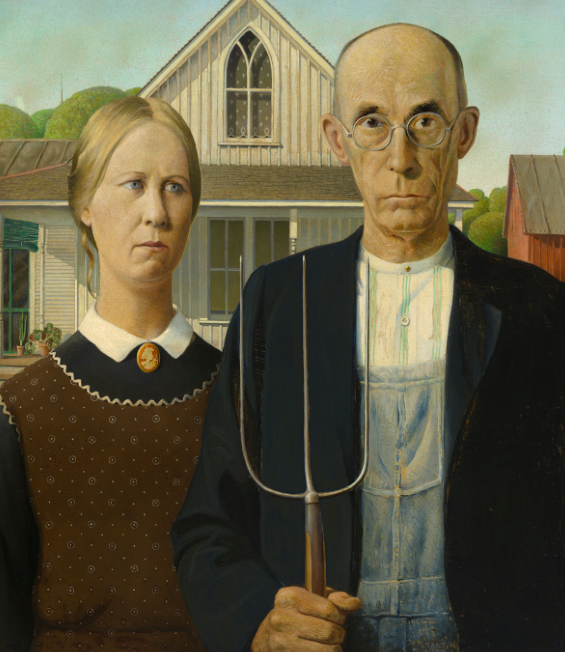
Here’s what 99% of the world that knows about Grant Wood knows about Grant Wood.
But there’s more to the artist than one painting of what’s routinely referred to as a Midwestern couple but which was really meant to depict a father and daughter. (In real life it was Wood’s sister and his dentist.)
From the Whitney’s website:
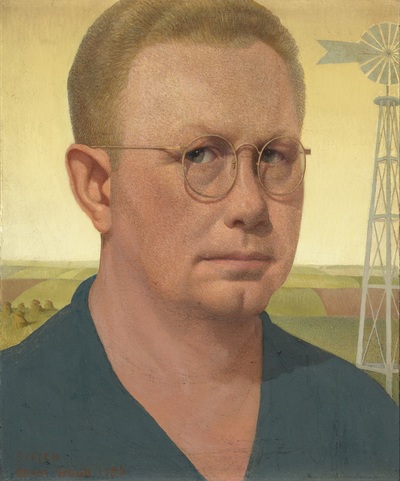
Grant Wood: American Gothic and Other Fables brings together the full range of his art, from his early Arts and Crafts decorative objects and Impressionist oils through his mature paintings, murals, and book illustrations. The exhibition reveals a complex, sophisticated artist whose image as a farmer-painter was as mythical as the fables he depicted in his art. Wood sought pictorially to fashion a world of harmony and prosperity that would answer America’s need for reassurance at a time of economic and social upheaval occasioned by the Depression. Yet underneath its bucolic exterior, his art reflects the anxiety of being an artist and a deeply repressed homosexual in the Midwest in the 1930s.
We liked some of his Arts and Crafts work, such as this corncob chandelier he designed for a number of hotels.
We also got a kick out of Wood’s Lilies of the Alley series.
Wood’s paintings over the course of his career ranged from Impressionistic works to starkly realistic portraits to often-dreamy landscapes. But they’re clearly not to everyone’s taste.
Exhibit Ugh: Peter Schjeldahl’s New Yorker review. Representative sample:
[Wood] was a strange man who made occasionally impressive, predominantly weird, sometimes god-awful art in thrall to a programmatic sense of mission: to exalt rural America in a manner adapted from Flemish Old Masters. “American Gothic” . . . made Wood, at the onset of his maturity as an artist, a national celebrity, and the attendant pressures pretty well wrecked him. I came away from the show with a sense of waste and sadness.
Okay then.
From there we moseyed up to The Museum at FIT for something completely different, starting with Norell: Dean of American Fashion (through April 14), a knockout retrospective tracing the career of Norman Norell, “one of the greatest fashion designers of the mid-twentieth century . . . best remembered for redefining sleek, sophisticated, American glamour.”
Gives a whole new dimension to keep it under your hat, eh?
* * * * * * *
Saturday morning we bussed up to the Museum of the City of New York with the intention of doing the Museum Mile in reverse. First stop was Mod New York: Fashion Takes a Trip (through April 1). Talk about the Wayback Machine.
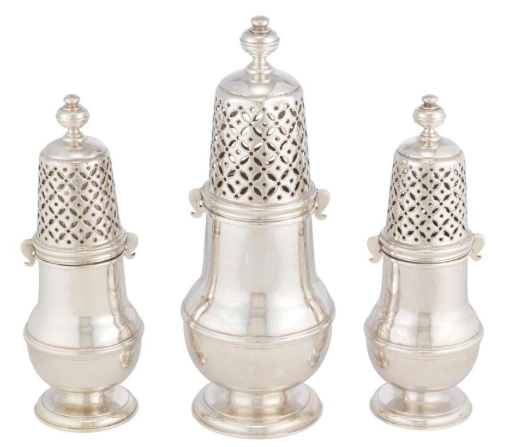
New York Silver, Then and Now links the rich history of silversmithing in New York City to present-day artistic practice. It features newly commissioned works by leading metalworkers, created in response to historical objects from the Museum’s collection.
The Museum’s holdings, widely recognized as one of the foremost collections of American silver in the nation, include leading examples of silver designed and produced in New York from the mid-17th through the 20th century. Comprised of more than 1,800 works by such notable craftsmen as Cornelius Kierstede, Myer Myers, and Charles LeRoux , and renowned retailer/manufacturers like Black, Starr & Frost and Tiffany & Co., the collection demonstrates how, for over four centuries, the city’s silversmiths and designers have adapted international styles to make them distinctively “New York” in look and feel.
You can get a behind-the-scenes look at the exhibition here.
Well worth seeing, though, is Scenes from the Collection, “a new, major exhibition of the Jewish Museum’s unparalleled collection featuring nearly 600 works from antiquities to contemporary art — many of which will be on view for the first time.”
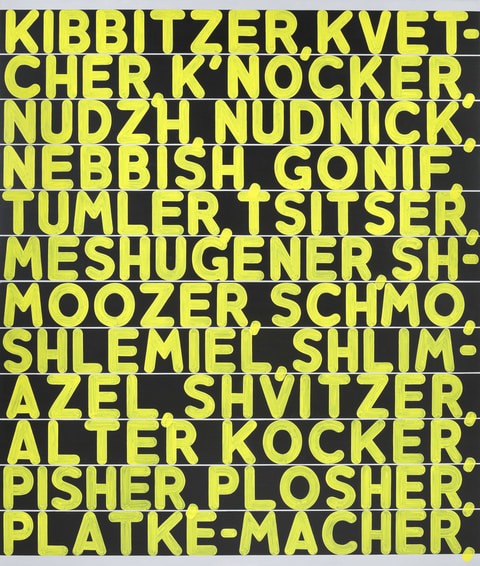
Among those works, there was Mel Bochner’s The Joys of Yiddish.
And Louise Nevelson’s Self-Portrait.
Plus 59o-something other absorbing works.
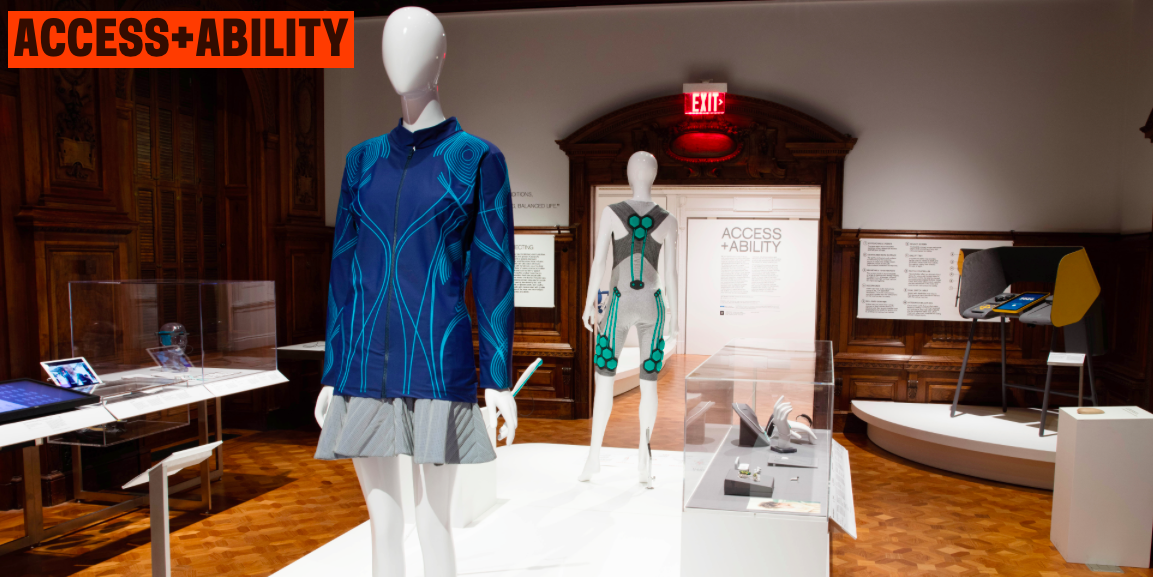
Absorbing in a very different way was the Cooper Hewitt’s main exhibit, Access + Ability (through September 3).
There has been a surge of design with and by people with a wide range of physical, cognitive, and sensory abilities. Fueled by advances in research, technology, and fabrication, this proliferation of functional, life-enhancing products is creating unprecedented access in homes, schools, workplaces, and the world at large. Access+Ability features over 70 innovative designs developed in the last decade. From low-tech products that assist with daily routines to the newest technologies, the exhibition explores how users and designers are expanding and adapting accessible products and solutions in ways previously unimaginable.
This exhibition, comprised of nearly 150 paintings and works on paper, [traces] the many routes traveled by German and Austrian artists and [demonstrates] the artistic developments that foreshadowed, reflected, and accompanied the beginning of World War II. Central topics of the exhibition [are] the reaction of the artists towards their historical circumstances, the development of style with regard to the appropriation of various artistic idioms, the personal fate of artists, and major political events that shaped the era.
The Missus’s description: “As someone who loves German Expressionism, I think this exhibit is creepy and not very good.”
So moving on . . .
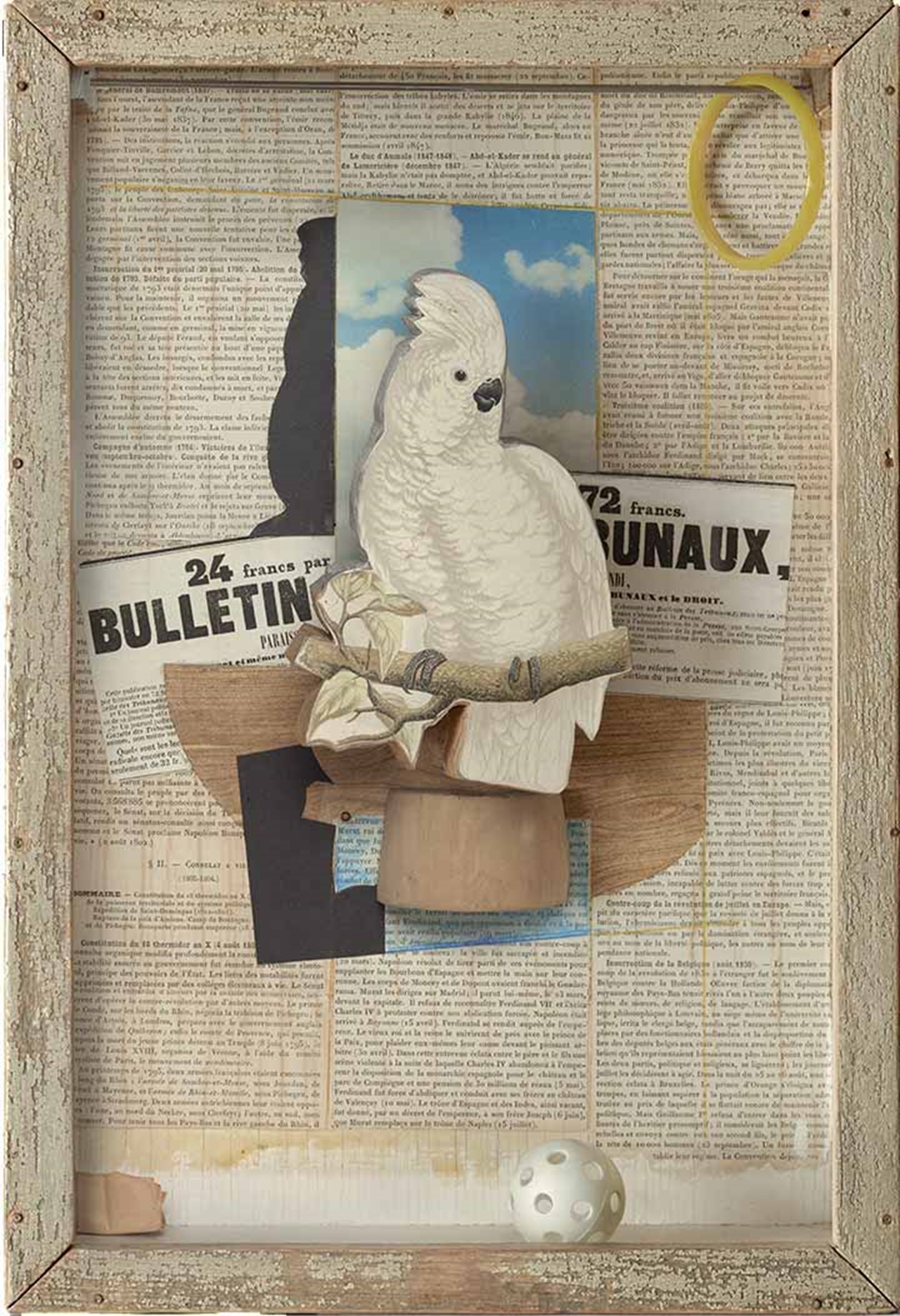
Our last marker on the Museum Mile was the Met, where we made a beeline for Birds of a Feather: Joseph Cornell’s Homage to Juan Gris (through April 15), ” 18 boxes, two collages, and one sand tray created in homage to Juan Gris, whom [Cornell] called a ‘warm fraternal spirit.'”
Here’s what started Cornell’s homage.
From the Met website:
The Man at the Café is the largest collage by Gris, and the only one to feature a human figure. Inspired by the fictional criminal mastermind Fantômas, popular in serial novels and silent films, Gris humorously captured a shady character hiding his face, his fedora casting an ominous shadow. The newspaper article, cut and pasted from Le Matin, reads, “One will no longer be able to make fake works of art,” although Gris himself attempted to trick the eye with the wood-grain paneling of the café interior.
Cornell’s Gris boxes include various collage materials that mimic this image: the French newsprint and mastheads, trompe l’oeil wood grain, and black cut-paper silhouettes. They also subtly reiterate the blue, yellow, and orange accents. The white plumage of the cockatoo that inhabits these boxes even “parrots” the brimming foam of the man’s beer.
Representative sample:
As with much of Cornell’s work, it was both engaging and engrossing.
A member of the “international set” in fin-de-siècle Europe, Baron Adolf de Meyer (1868–1946) was also a pioneering photographer, known for creating works that transformed reality into a beautiful fantasy. Quicksilver Brilliance is the first museum exhibition devoted to the artist in more than 20 years and the first ever at The Met. Some 40 works, drawn entirely from The Met collection, demonstrate the impressive breadth of his career.
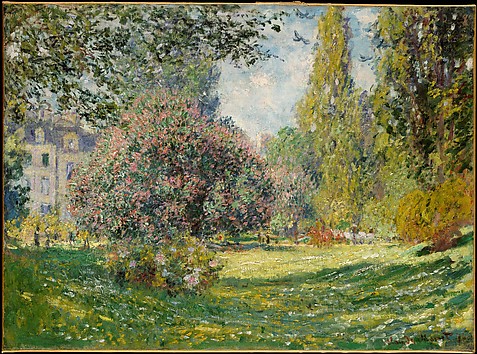
Drawn from seven curatorial departments at The Met and supplemented by a selection of private collection loans, Public Parks, Private Gardens: Paris to Provence [features] some 150 works by more than 70 artists, spanning the late eighteenth through early twentieth century. Anchored by Impressionist scenes of outdoor leisure, the presentation will offer a fresh, multisided perspective on best-known and hidden treasures housed in a Museum that took root in a park: namely, New York’s Central Park, which was designed in the spirit of Parisian public parks of the same period.
Including one of our favorites, Parc Monceau (here by Claude Monet).
From there we drifted down to our coffee shop of choice, The Red Flame, miles away from the Museum Mile.
* * * * * * *
On the way back to Boston we swung by Hartford’s Wadsworth Atheneum to catch Gorey’s Worlds (through May 6).
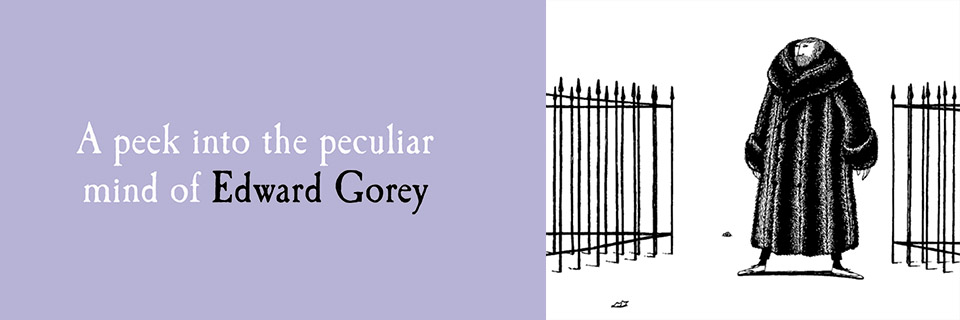
For more than 50 years, Edward Gorey’s spare pen and ink drawings illustrating tales of hapless children, kohl-eyed swooning maidens, and whimsical creatures have delighted and amused audiences. Gorey’s Worlds is the first museum exhibition to explore the artistic inspiration of the famed American artist and author by presenting his personal art collection alongside art of his own creation.
Gorey’s Worlds is centered on his personal art collection, which he chose to bequeath to the Wadsworth Atheneum Museum of Art, the only public institution to receive his legacy. Gorey held the institution in high regard for reasons including a shared connection to the ballet and famed choreographer George Balanchine, whose histories date back to 1933 at the Wadsworth Atheneum. When Gorey lived in New York City, he attended nearly every performance of the New York City Ballet under Balanchine’s direction from 1953-1983, and he frequently stopped in Hartford when traveling between the city and his Cape Cod house in Yarmouth Port.
The exhibit was, well, peculiar. But worth seeing regardless.
As the New York Times notes in this piece today, the 2018 version of International Women’s Day has a special dimension to it.
International Women’s Day 2018: Beyond #MeToo, With Pride, Protests and Pressure
ROME — In the era of #MeToo and Time’s Up, International Women’s Day arrived on Thursday with a sense of urgency and determination.
For many women, there was a keen awareness that there had been a major shift in the firmament when it came to gender parity, the treatment of women in the workplace and sexual dynamics.
But others — scratching out lives in developing countries in Africa, toiling away at jobs with little pay in Latin America or scrambling to raise children without help in the Middle East — most likely had little time left over to reflect on the one day of the year designated to celebrate “the social, economic, cultural and political achievements of women,” as the website says.
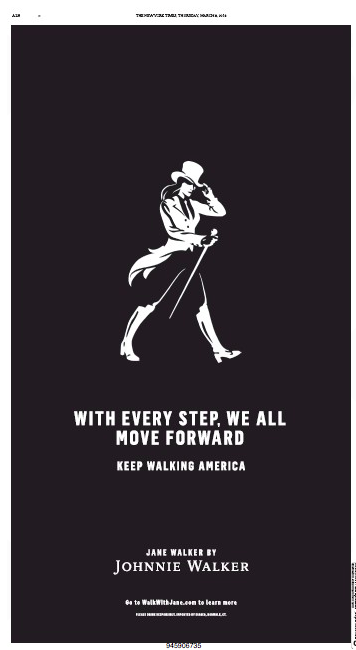
And then . . . there’s the advertising . . . in the Times.
Special gift with purchase for Gucci: Olympic skater Adam Rippon is wearing a sweater with “Gucci” written all over it in this front-page Style section profile.
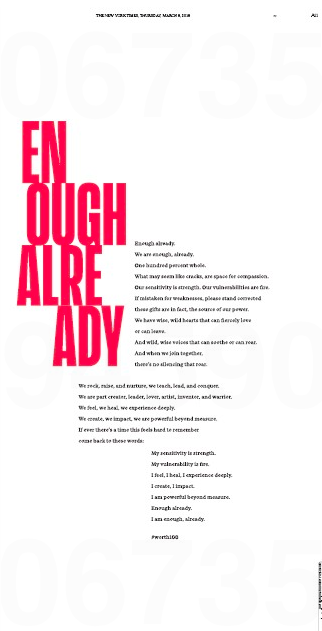
Next up: Lululemon.
Final graf:Funny thing, “enough already” is what market watcher Seeking Alpha is also saying about Lululemon’s stock.
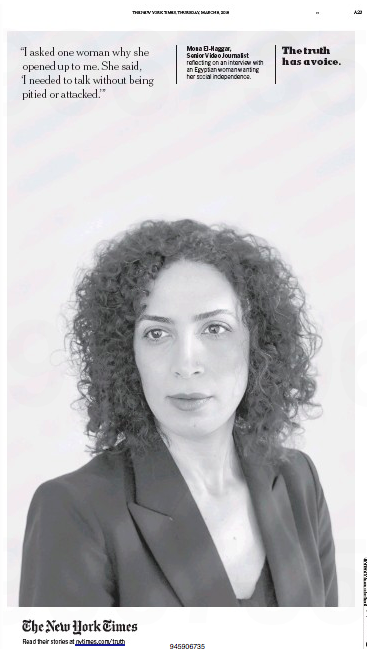
From there the Times drops in a couple of house ads, the first of which features senior video journalist Mona El-Naggar.
For those of you keeping score at home, it’s been five months since Serena Williams almost died giving birth to her daughter, Olympia. But now Williams is ready to see her tennis career reborn, as Sports Illustrated notes.
Williams restarts her tennis career on the WTA tour next week with 23 major titles. She’ll play an exhibition match Monday night at Madison Square Garden in New York, then compete at Indian Wells, California, in her first tour event in more than a year.
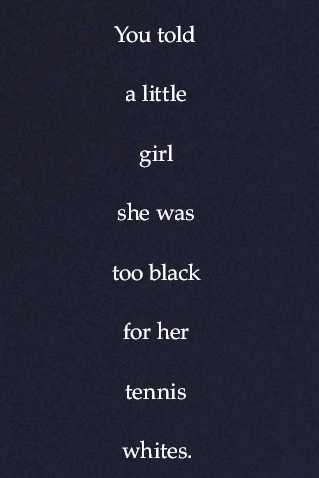
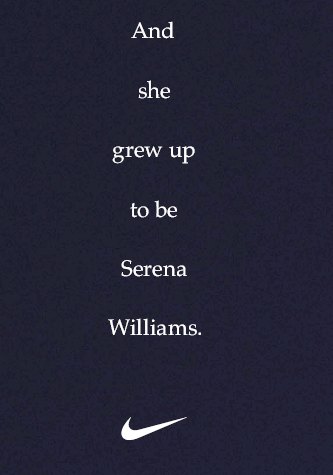
And to celebrate her return, Williams’ doubles partner Nike is serving up something of an adstravaganza.
Start with this double-truck in yesterday’s New York Times.
Well the Missus and I trundled over to Cambridge the other day to catch Inventur—Art in Germany, 1943–55 at the Harvard Art Museums and, say, it was wunderbar.
From their website:
The first exhibition of its kind, Inventur examines the highly charged artistic landscape in Germany from the mid-1940s to mid-1950s. Taking its name from a 1945 poem by Günter Eich, the exhibition focuses on modern art created at a time when Germans were forced to acknowledge and reckon with the atrocities of World War II and the Holocaust, the country’s defeat and occupation by the Allies, and the ideological ramifications of the fledgling Cold War. Chosen for the way it helps characterize the art of this period, the word Inventur (inventory) implies not just an artistic stocktaking, but a physical and moral one as well—the reassurance of one’s own existence as reflected in the stuff of everyday life. The exhibition, too, “takes stock,” introducing the richness and variety of the modern art of this period to new audiences, while prompting broader questions on the role of the creative individual living under totalitarianism and in its wake.
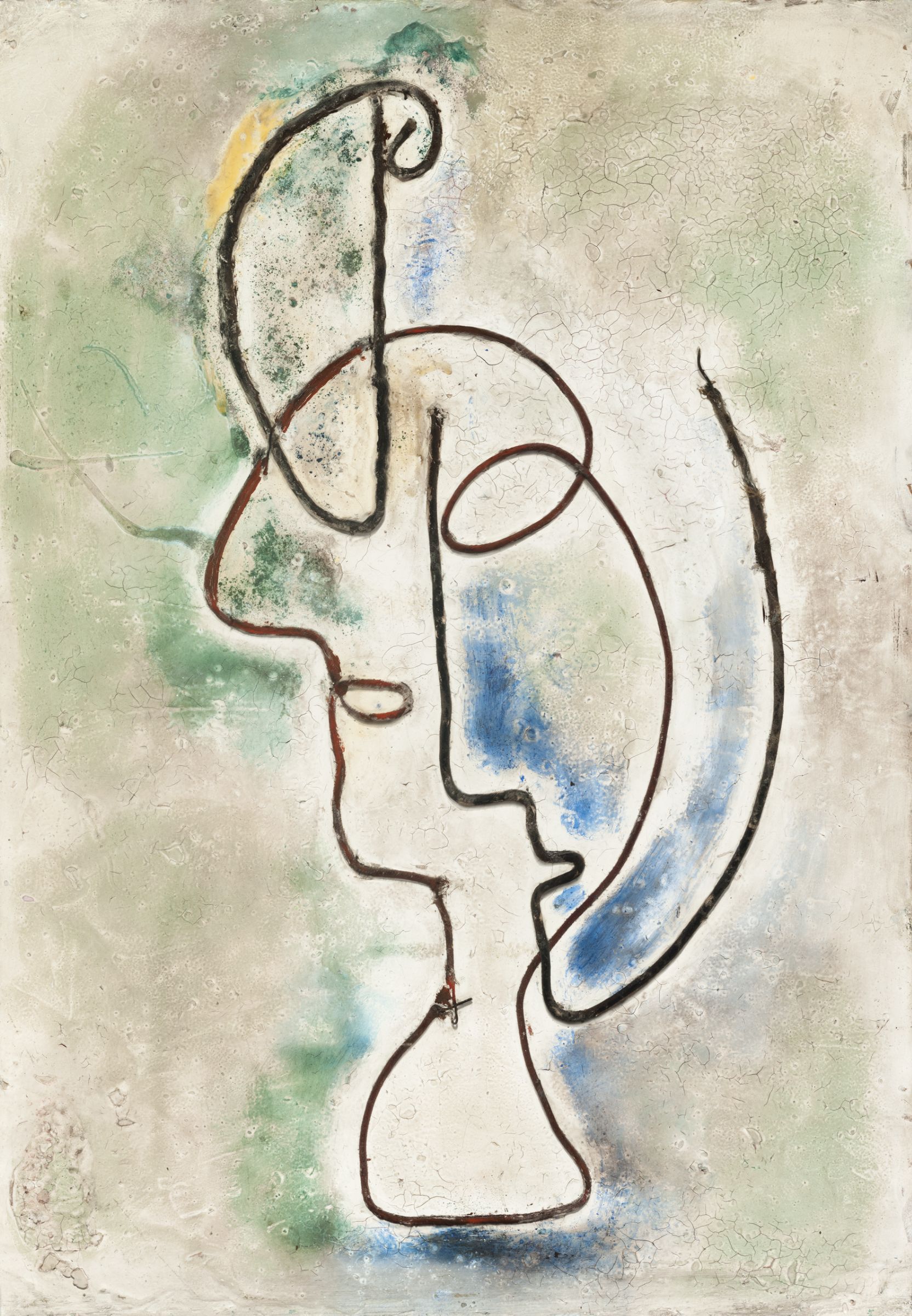
There are a lot of terrific artworks there, among them this piece by Jeanne Mammen.
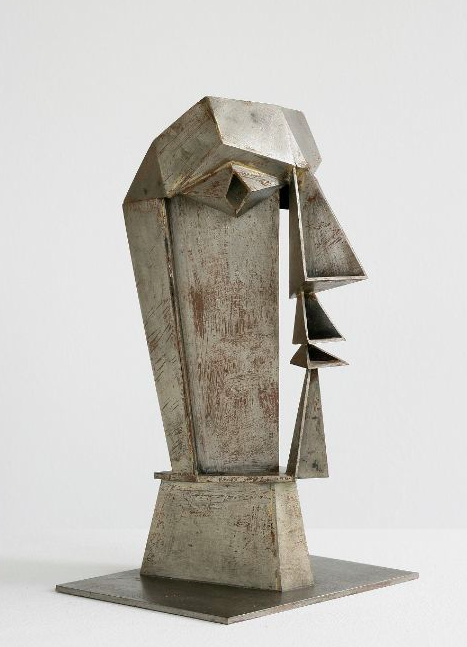
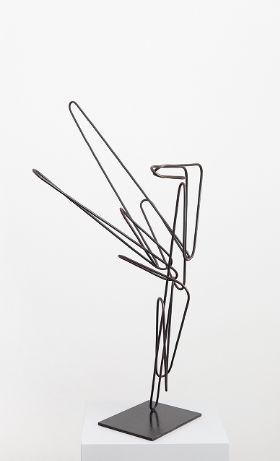
We also especially liked the sculptures of Hans Uhlmann (pictured above and below).
The exhibit runs through June 3rd. Trundle over if you get a chance.
As someone said about the blizzard of Barackaphernalia at the 2008 Obama inauguration, “When Americans want to celebrate, they turn to merchandise.”
But Mitt Romney (R-Wherever) is getting downright pushy about merchandising in his nascent quest for the vacant U.S. Senate seat in Utah.
After flacking bumper stickers and t-shirts in vain to the hardducking staff over the past few days, Romney sent us this email with the subject line, “Your request is missing.”
Memo to Mitt: No, our request is not “missing.” It’s actually “never coming.”
The same, we’re guessing, cannot be said of your requests.























 Campaign Outsider