
Well, actually, The Vineyard.
That’s the new unreality show that debuts tonight on ABC Family.
Here’s what the cable channel says about it . . .
Read the rest at It’s Good to Live in a Two-Daily Town.
Well, actually, The Vineyard.
That’s the new unreality show that debuts tonight on ABC Family.
Here’s what the cable channel says about it . . .
Read the rest at It’s Good to Live in a Two-Daily Town.
Interestingly, two New York Times Co. media properties featured positive stories on taxicab alternatives yesterday.
From Monday’s Boston Globe:
A post-taxi population opts for ride-sharing
As the cab industry seethes, tech-savvy drivers and passengers are embracing a burgeoning ride-sharing business model
Compared with the shopworn insides of so many city cabs, Bria Schecker’s for-hire car is an urban oasis.
Her 2010 Honda CR-V is showroom-clean, and her enthusiasm would put a Walmart greeter to shame.
When one passenger, Hunter Perry, climbed into the front seat on a recent muggy night, he got a fist bump from Schecker, a chilled Nantucket Nectars fruit drink, and his choice of music from a windshield-mounted iPhone 5. By the end of the ride they were exchanging e-mails and later found each other on LinkedIn.
For her passengers, “It’s like hopping in a car with your friends,” said the 26-year-old Schecker.
She is among a new breed of drivers who provide taxi-like service, using their private vehicles, through so-called ride-sharing services such as Lyft and Sidecar. Passengers use a smartphone to hail a ride, and Lyft or Sidecar pings drivers for the pick-up.
Also on Monday, the Globe’s kissin’ cousin New York Times featured this Nick Bilton column:
Ride-Sharing Upstarts Challenge Taxi Industry
Last week, when I arrived at the Los Angeles airport on a flight from San Francisco, I made my way to the taxi stand and waited 10 minutes for a cab. Just as I was about to hop in, the driver and the dispatcher began fighting over whose job it was to put my suitcase in the trunk. After a few minutes, I dealt with the bag myself. We then drove off in a filthy taxi that smelled like cigarette smoke and had suspension so old that it felt as if it had square wheels.
This made me think once again: the taxi industry is ripe for disruption.
Several companies in Silicon Valley — like Uber, Lyft and Sidecar — are acting on that very thought.
Coincidence?
Undoubtedly.
Once around the park, James, and don’t spare the horses.
The ‘Dawn’ of a New Documentary
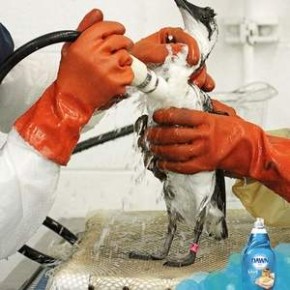
Procter & Gamble has launched a seven-part web series called The Big Picture that “showcases how the consumer products giant’s Dawn [dishwashing detergent] is used by wildlife rescuers to nurture animals back to health after oil spills and other hazards,” according to P&G’s hometown Cincinnati Enquirer.
From the press relea- . . . er, news report
Viewers can watch the first webisode of the series on www.DawnSavesWildlife.com. More webisodes to be released online through September.
Episodes will show stories of animal patients rescued by
Dawn’s wildlife partners, including a newborn seal pup abandoned by his family after unwanted human interaction, and an ailing pelican contaminated by boating oil.
Following each webisode, viewers can send e-thank you cards to the rescue volunteers who take on this wildlife mission everyday.
Okaaaay.
See for yourself . . .
Read the rest at Sneak Adtack.
The Boston Sunday papers featured – hold on now – very similar takes on New York Yankee immortal Mariano Rivera, who’s been on a unique farewell tour in this his final season.
Peter Abraham piece from the Boston Sunday Globe:
Yankees’ Mariano Rivera ending career in style
Retiring Yankees great Rivera meeting with special groups at every ballpark he visits
Mariano Rivera played his first game at Fenway Park on July 16, 1996. He was a setup reliever then and pitched two innings against the Red Sox. Joe Girardi, who manages the Yankees now, was the catcher.
John Basmajian can’t remember for sure, but he probably was at the game that day. The guy everybody at Fenway calls “Baz” has been working at the park for 46 years selling tickets.
In the years since, surely their paths crossed. If you count the postseason, Rivera has walked into Fenway Park more than any ballpark other than Yankee Stadium. Baz? He’s as much a part of Fenway as the Pesky Pole.
On Saturday, the two career baseball men finally met.
“Pretty special,” Basmajian said. “I’ve got tears in my eyes.”
Rivera is doing something special in his final run through the American League . . .
Read the rest at It’s Good to Live in a Two-Daily Town.
New York Times Op-It Girl Maureen Dowd has parachuted into town a couple of times to cover the James “Whitey” Bulger trial.
Dowd kicked off her coverage last month with a column headlined Of Rats and Hit Men, which detailed the testimony of John Martorano, a former Bulger enforcer who committed 20 murders and got 12 years in exchange for ratting Whitey out.
Then, in Sunday’s Times, she chronicled some of last week’s proceedings:
A Tender Gangster Romance
BOSTON — IT was a subtle distinction, for a psychopath.
“I loved her,” Stevie “The Rifleman” Flemmi said of his onetime girlfriend, Debbie Davis, a sparkling blond Farrah Fawcett look-alike, “but I was not in love with her.”
That’s fortunate, since it would have made it ever so much
harder to plan the 26-year-old’s 1981 murder, look into her eyes as she was strangled in your parents’ house, strip off her clothes, yank out her teeth and then dig her grave in marshland by the Neponset River.
Outside of (maybe) that lede, there’s absolutely nothing original about Dowd’s musings on the trial unfolding in the Moakley Courthouse. The Boston Globe, the Boston Herald, Kevin Cullen, even Howie Carr have covered it better.
So why’s she even here?
The Weekend Wall Street Journal devotes three full pages to a piece chronicling the quest by one of Pablo Picasso’s granddaughters to catalogue the more than 2000 sculptures created by the 20th Century’s greatest artist.
A PICASSO HEIR’S EPIC HUNT
Diana Widmaier-Picasso is researching a new inventory of her grandfather’s sculptures that could ignite prices and add tens of millions of dollars to the Picasso market. So why is the family not helping more?
The heirs of Pablo Picasso keep a family office in an unassuming Parisian building near Place Vendôme, behind a tall wooden door wedged between a bistro and a travel agency. Inside, up a creaky gated elevator, the artist’s descendants gather in a row of book-lined rooms to take stock of their empire—including a trove of Picassos and several million dollars a year in related resale and licensing fees.
Two blocks away, another member of the family—Diana Widmaier-Picasso, the artist’s granddaughter via his blonde mistress Marie-Thérèse Walter—is quietly building her own realm in a chic, white atelier formerly used by fashion designer Valentino Garavani. Ms. Widmaier-Picasso, 39 years old, said the art research she is doing there falls under the umbrella of the family firm, but in many ways it also stands apart.
For the past decade, Ms. Widmaier-Picasso has been researching a new catalogue raisonné, or scholarly inventory, of her grandfather’s sculptures, and she is hoping to publish its first volume in a couple of years to coincide with a major Picasso exhibit she is planning for Paris’s Grand Palais.
What follows is a combination of detective story, bildungsroman, and family feud.
Picasso’s most coveted paintings sell for as much as $106.5 million. His sculptures are “arguably the only undervalued segment of [his] oeuvre . . . Picasso’s bronze record-holder is a 1941 bust of his mistress Dora Maar that sold at Sotheby’s six years ago for $29.1 million. But of his top 100 auction prices, only three are for sculptures, according to Artnet, a firm that tracks auctions. (By contrast, one of Alberto Giacometti’s sculptures has topped $100 million.)”
Nut graf:
All that could change with the completion of Ms. Widmaier-Picasso’s catalogue raisonné, said Carmen Gimenez, a curator with the Solomon R. Guggenheim Museum who previously ran the Museo Picasso Málaga in Spain. Ms. Gimenez said dealers and auctioneers are already leveraging Ms. Widmaier-Picasso’s research into the artist’s 1950s sheet-metal sculptures to remind collectors how rare these pieces are compared with his paintings.
The rest of the piece details the tug of war between Diana Widmaier-Picasso and the artist’s other survivors, who are neatly depicted in this invaluable family tree:

Take it from the hardworking staff:
This is one helluva read.
Saturday’s local dailies had – wait for it – very different takes on the State Police photos of Dzhokhar Tsarnaev’s April 19 apprehension by law enforcement officials after a “massive manhunt.”
From the Boston Globe:
Some praise officer for bloody images
Sergeant with State Police faces hearing on action
The State Police sergeant who released dramatic photos of the capture of accused Boston Marathon bomber Dzhokhar Tsarnaev without the agency’s permission received enthusiastic support Friday from an array of backers.
“The department received dozens upon dozens of calls and e-mails today from citizens around the country supporting Sergeant Murphy and what he did,” State Police spokesman David Procopio said Friday.
Sergeant Sean Murphy, who released the images of a bloody Tsarnaev to Boston Magazine Thursday, also drew praise on social media, including Twitter. He said he released the photos in response to Rolling Stone magazine’s putting Tsarnaev on its cover with an image that critics said made him look glamorous.
“Great photos,” one person wrote of Murphy’s images. “I support your decision.”
But not everyone felt the same way, as the Boston Herald’s front page noted . . .
Read the rest at It’s Good to Live in a Two-Daily Town.
Well the hardworking staff has been on hiatus lately, but we’re back now to chronicle the latest installment of the Great Boston Media Watchdog Fight.
Start, as usual, with Underdog Boston Herald’s Wayne’s World webcast:
Rolling Stone’s cover shot makeover of accused Boston Marathon bomber Dzhokhar Tsarnaev drew heavy fire from the Boston Herald’s “Press Party” panel in the latest episode of the media criticism web show.
The panel blasted the magazine for being insensitive to victims of the bombing by showing Tsarnaev in rock star pose on the cover. The panel also took on the media’s handling of the aftermath of the George Zimmerman trial. Cashman criticized MSNBC for allowing host Al Sharpton to push his protest against the verdict. Plus, the show spotlighted a San Francisco TV station broadcasting bogus racist names of the pilots involved in Asiana Airlines crash, as well as a Providence TV reporter’s humorous attempt to show viewers how to ward off bear attacks.
(The Press Partyniks still refuse to upload their festivities to YouTube, so you’ll have to click around for yourselves.)
But . . . sample quotes from the Rolling Stone cover rumpus:
You’ve probably seen or heard about it – and no doubt have a strong reaction to it – The rock ‘n’ roll institution gives the Marathon Bomber a glam makeover. Unbelievable, but true.
Disgusting journalism.
Terrible terrible example of human excrement.
Rolling Stone should hang their head in shame.
Crosstown at WGBH’s Big Dog Beat the Press, it was, not surprisingly, a different story.
Sample quotes:
I thought it was a pretty effective cover. The reason I thought it was effective was because it created a sense of cognitive dissonance. You see kind of the teen idol look of Dzhokhar Tsarnaev but then you see forthrightly the bomber and the monster.
There was no mention of the victims, no input from the community who were especially outraged.
I do think there’s some concern about putting this in front of a lot of other alienated kids who are having violent fantasies and who see this and think, gee, maybe I ought to turn this fantasy into reality. And I think that’s a legitimate concern.
So who had the more interesting – and substantive – discussion?
You tell us.
Today’s political process rewards two things – preemption and money.
Exhibit Umpteen of both, from Thursday’s New York Times:
In TV Ad, Cuomo Vows to Clean Up Corruption
More than a year before he is to appear on the ballot for re-election, Gov. Andrew M. Cuomo is dipping into his ample campaign account to pay for television advertising that showcases his efforts to clean up the scandal-plagued state capital.
Mr. Cuomo, who intends to run for a second term in 2014 but is not expected to announce his bid until sometime next year, reported $27.8 million in cash in his campaign treasury last week. On Tuesday, he began using some of that money to broadcast a 30-second commercial drawing attention to a commission he established to investigate corruption among public officials.
The spot:
Of course, this move by Cuomo has more angles than a spider web, as John Updike would say. Just one: This is a classic “news ad” – Cuomo spends $20,000 to run it and gets a million dollars’ worth of publicity.
Stay tuned for further details.
The Wall Street Journal’s redoubtable Jason Gay gets it pitch-perfect in his latest column:
Let’s Be Cool Like Mariano Rivera
I have a new dream, a fresh life goal. I want to be more like Mariano Rivera. I believe I am not alone. Everybody wants to be more like Mariano Rivera. Especially this week.I’m not going to try and learn Rivera’s cutter, his otherworldly pitch. I do not plan to match his 638 career saves or his five World Series rings. I believe those accomplishments are probably—probably—beyond my reach. I do not intend to play for the New York Yankees, though I believe I am almost old enough and injured enough to get a big contract to play for the Yankees. I don’t think I could handle the pressure of playing for the Yankees. I could play for the Marlins. The Marlins, I could probably handle.
What Gay can’t handle, in general, is life.
I spend three-quarters of my life walking around like I have a raccoon in my pants. I drop a bagel on the subway and I want to call 911. I drive like a nervous cockatiel. I’m anxious in airports, elevators, escalators, supermarkets, pet shops, parties, weddings. I am not Paul Newman cool. I am Newman from “Seinfeld” cool.
I don’t want to be this way. I want Mariano Rivera’s grace, his dignity, his restraint.
Which, in Rivera’s final season, friend and foe alike are not only recognizing, but saluting.
Those All-Star players who got up on the top step and climbed over the rail on Tuesday night to applaud? They weren’t doing that because Mariano Rivera has a lifetime playoff game earned run average of 0.70. I would bet not a single one of them was cheering because of the stats. Lots of great athletes come and go with stats. No, these ballplayers were applauding because of what Mariano Rivera stands for, which is doing it the right way, never trying to be bigger than the game.
But, eventually, being bigger than the game, which New York magazine recently detailed.
As Gay concludes, the game – and the world – could use mo’ Mo.
 Click to subscribe to RSS





 Campaign Outsider