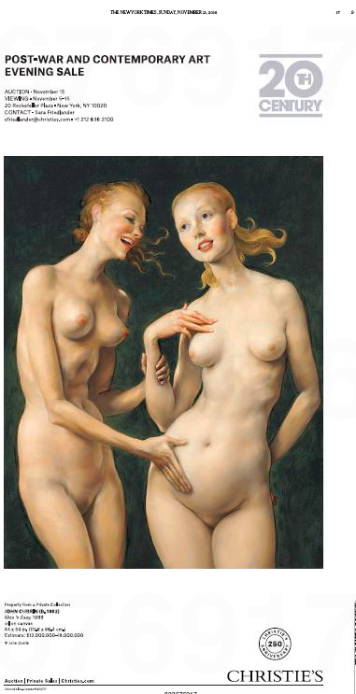
As the hardblushing staff has noted on previous occasions (see here and here), the Grey Lady has been opening the kimono more and more of late, from an ulp-skirt Louis Vuitton ad several years ago to this eye-popping Christie’s ad last fall.
Now comes the latest edition of the Nude York Times – this M.S. Ray Antiques ad on A7 in yesterday’s paper.
An artwork so nice, they showed it twice. Just one more sign o’ the Times.
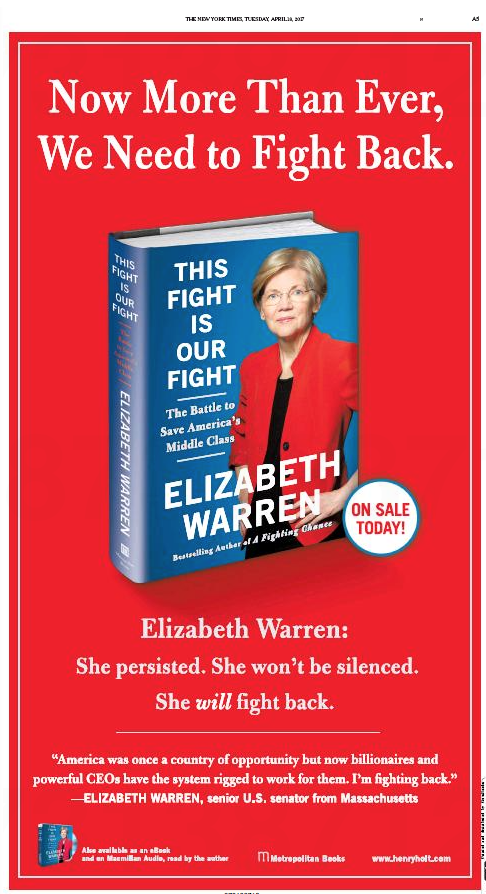
Sen. Elizabeth Warren (D-Nevertheless) has a new book out – This Fight Is Our Fight – and a spiffy marketing campaign to go along with it.
Exhibit A (5): This full-page ad in today’s New York Times.
But that’s not the only publicity Warren’s book will be getting, according to this Politico piece by local gal Lauren Dezenski.
Conservative PAC takes aim at Warren during book tour
BOSTON — America Rising PAC, a conservative group that hounded Hillary Clinton following the release of her book “Hard Choices” in 2014, is about to do the same to Sen. Elizabeth Warren.
Warren’s latest book, “This Fight Is Our Fight: The Battle to Save America’s Middle Class,” will be released on Tuesday. The Massachusetts Democrat will set out on a book tour with stops in New York and Massachusetts this week.
“We view book launch as the soft launch of her presidential campaign. We’ll do the same to her as we did with Hillary Clinton in 2014,” said America Rising executive director Colin Reed.
Dezenski adds that the group “will build and maintain opposition research, use video tracking, Freedom of Information Act and public records, and deploy rapid-response communications to ‘make Warren’s life difficult’ during her 2018 Senate reelection campaign, according to a memo outlining the group’s efforts.”
And, apparently, post videos to YouTube like this one, which uses news clips to contrast Warren with – oddly – Ted Kennedy. The subject: presidential ambitions.
Loved this line: “He would be senator from Massachusetts, uninterrupted, for the next 47 years.” Right – because his attempt to rub out a sitting president of his own party in 1980 failed miserably.
So, what do we have here? The Lion of the Senate vs. the Liawatha of the Senate?
We are reminded every day that Pres. Donald Trump (R-Donald Trump) is, for all practical purposes, pre-verbal. See the transcript from his recent Time interview for the gory details.
But every once in a while we get a glimpse of the Trump who’s, well, precognitive. Latest exhibit: This interview in today’s Wall Street Journal, in which Trump says he has a “renewed confidence in the Freedom Caucus, a group of conservative Republicans he had just two weeks ago suggested targeting for defeat in next year’s midterm election,” because, of course, they blowtorched Trump’s meshugge healthcare reform.
And whence comes this renewed confidence?
Clearly, it’s time to summon Walt Whitman: “Do I contradict myself? Very well, then I contradict myself, I am large, I contain multitudes.”
As the hardtsking staff has diligently noted lo these many years, Rick Berman is a hired gun American corporations use to fight labor unions, public-health advocates, and consumer, safety, animal welfare, and environmental groups, according to Citizens for Responsibility and Ethics in Washington, or CREW, an unabashedly left-leaning organization.
Yesterday’s Wall Street Journal featured yet another instance of Berman’s wet work, in the form of this op-ed.
Honey, I Shrunk the Union
The Service Employees International Union last week held yet another national protest. The “racial justice-themed Fight for $15 day of action” spread to dozens of cities but failed to live up to the hype.
A few dozen people showed up in Boston. The turnout appeared even smaller in San Diego. The Chicago Coalition for the Homeless tweeted a picture of “16 homeless workers.” The union should be embarrassed. Ignore the SEIU’s political theatrics and Potemkin protests, and you’ll find a cash-strapped group waging a losing war.
Potemkin protests? That’s Rick Berman’s middle name.
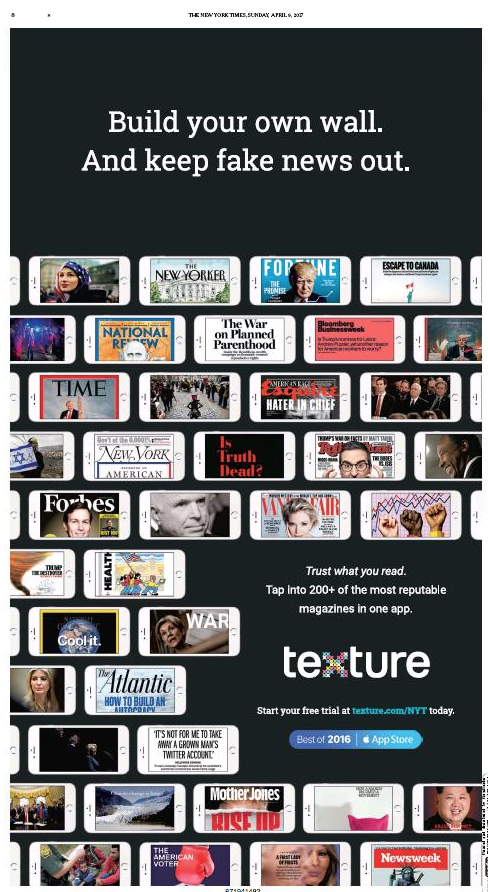
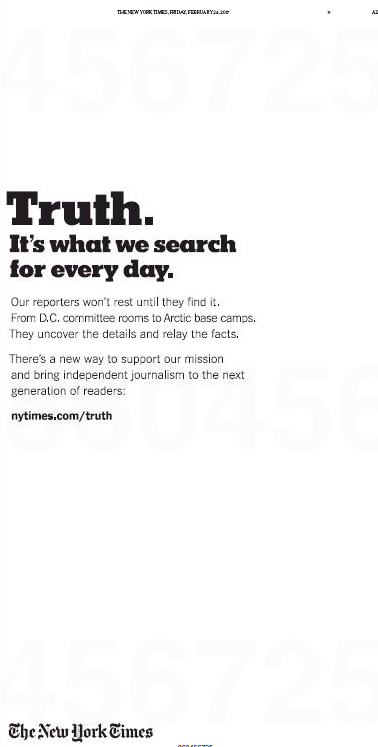
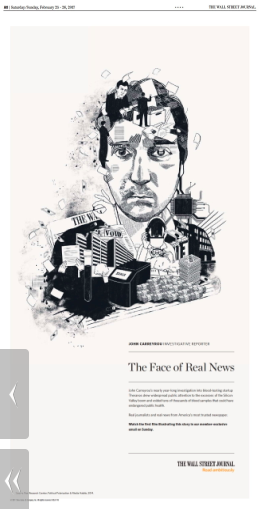
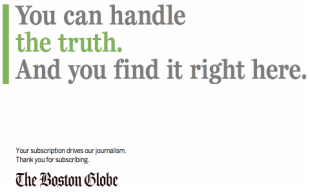
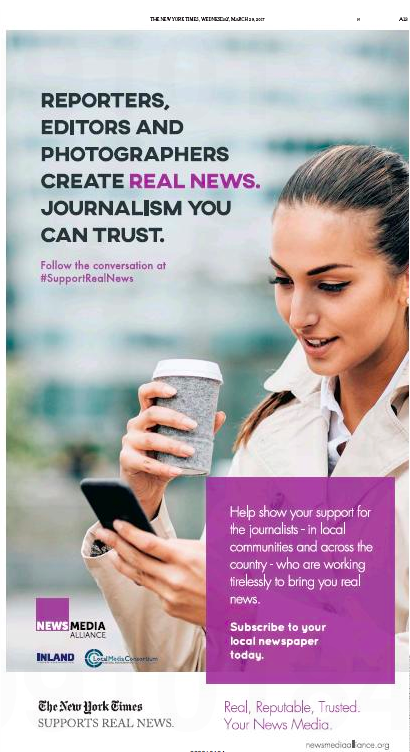
As the hardworking staff has diligently noted, all kinds of news organizations are busily marketing their truthfulness and reliability to a skeptical public.
Call the roll: New York Times, Washington Post, Wall Street Journal, Boston Globe, and some outfit called News Media Alliance.
FT marketing campaign prompts readers to seek trusted journalism in a complex world
11 April 2017: The Financial Times today launches a marketing campaign challenging readers to think beyond ‘black and white’ and turn to the FT for a more complete perspective on the news agenda . . .
The creative images feature issues and events driving the news agenda as overly simplified dichotomies presented in black and white, before prompting readers with the line, ‘For the full perspective, turn to the FT.’ The campaign demonstrates how the FT takes readers beyond the headlines and helps them make the right connections in complex and uncertain times.
Indeed.
Next up is this full-page ad from Sunday’s New York Times.
We can’t figure out if all this effort is a) preaching to the choir, or b) whistling past the graveyard.
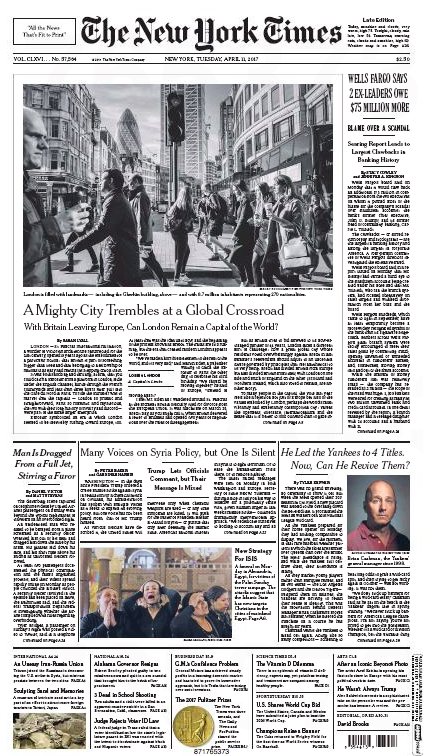
The hardlooking staff has long admired the photographic skill of New York Times shutterbug Sergey Ponomarev, who dominated the paper’s 2013 Year in Pictures review.
Yesterday, though, Ponomarev outdid himself with this front-page photo.
Close up:
Man, that is one beautiful image. And he even worked in The Gherkin.
Brilliant!
The piece by Sarah Lyall gets four – count ’em, four – pages inside with lots of other Ponomarev pix.
Here’s betting you’ll see at least one of them in the Times 2017 Year in Pictures bakeoff.
Get ready for the next Boston Museum of Fine Arts blockbuster.
Matisse in the Studio opens this Sunday, but already it’s gotten two – count ’em, two – boffo reviews in the Wall Street Journal.
Start with this swoon from Susan Delson two weeks ago.
Matisse’s Masterpieces From Ordinary Objects
Boston exhibition traces how a vase, a chair and textiles became immortal
A glass vase, picked up in Spain. A small Congolese figure, bought from a dealer in Paris. A pot for making hot chocolate. A pewter jug. A vivid textile from North Africa.
As we learn from a new exhibition in Boston, such inexpensive, ordinary things often served as the wellsprings of Henri Matisse’s art.
Nut graf:
Opening April 9 at the Museum of Fine Arts, “Matisse in the Studio” assembles some 40 objects that the artist surrounded himself with—including that Venetian chair—along with more than 80 of the paintings, drawings and other artworks that they inspired. The French artist (1869–1954) once said about his collection, “A good actor can have a part in 10 different plays; an object can play a role in 10 different pictures.” Painting a likeness wasn’t the goal. Instead, Matisse wanted to capture his own emotional response to the object at that moment.
‘Matisse in the Studio’ Review: A Master’s Objects of Inspiration
By pairing works by Henri Matisse with objects from his studio, a portrait emerges of the artist and his creative process.
How does an artist’s mind work? There’s no one-size-fits-all answer to that question, but broadly speaking we can say that it passes external stimuli through the refiner’s fire of an individual sensibility or vision. The trouble is, we have almost no access to this process since we see only the end result, the finished work of art on the wall or pedestal.
But the MFA exhibit overcomes that problem, Gibson says. “[The MFA’s] exhibition is nothing short of a revelation—and not just about Matisse. I can think of no other exhibition that has told us so much about what artists do and how they think.”
As our kissin’ cousins at Two-Daily Town noted the other day, newspapers are falling all over themselves trying to convince the American public that the press actually matters in a very real way.
It started with the Washington Post pasting this slogan under its banner on Page One.
New York Times editor Dean Baquet responded that “Democracy Dies in Darkness” would make a great title for the next Batman movie. And that was one of the kinder comments it drew.
Next up was the New York Times with this full-page ad.
The Times also ran this ad during the Academy Awards broadcast.
So the hardlistening staff caught this piece on Weekend All Things Considered the other day.
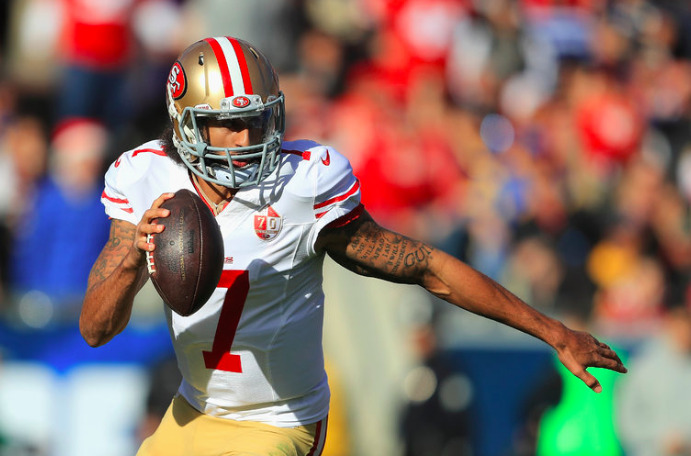
How Much Are Colin Kaepernick’s Political Views Impacting His Unsigned Status?
We’re going to take a few minutes now to talk about sports. Now, even if you’re completely consumed by March Madness, you’re probably keeping an eye on the NFL draft and free agency shuffle. So we thought we’d check in on what’s happening with former San Francisco 49ers quarterback Colin Kaepernick.
You might remember he got a lot of attention last year for choosing to kneel during the national anthem as a protest against police violence. Now he is a free agent and has not yet found a team. Now some critics like President Trump think those are his just desserts.
For the next five minutes ATC host Michel Martin and NFL commentator Bucky Brooks talked about Kaepernick’s struggle to find a new team. But never once did they mention that it’s a self-inflicted wound.
Colin Kaepernick Is Unemployed. Is It Because of His Arm, or His Knee?
Mark Sanchez found a job. Mike Glennon found a job. So did Josh McCown and E. J. Manuel.
But Colin Kaepernick, who led the 49ers to the Super Bowl just four years ago, remains unemployed.
Is Kaepernick not qualified to play quarterback in the N.F.L. anymore? Or is it something else?
Some skeptical fans are wondering if the quarterbacks who have landed jobs with teams have one significant asset that Kaepernick does not have: They all stood for the national anthem last season.
Actually, it’s not Kaepernick’s arm or his knee that’s created this problem. It’s his brains – or lack thereof.
Buried in the Times piece you’ll find the real reason Kaepernick is teamless.
In the off-season, Kaepernick opted out of his contract, hoping for a better situation. So far, that situation has not arrived.
In 2016, Kaepernick restructured the deal the 49ers gave him when they were convinced he was the franchise quarterback. He gave up $14.5 million in injury guarantees for the ability to opt out of his deal at the end of the year.












 Campaign Outsider