This tweet came across the hardworking staff’s desktop this AM:

Because she sucks? Besides, there’s a much better alternative:
Much better value for your YouTube dollar.
This tweet came across the hardworking staff’s desktop this AM:
Because she sucks? Besides, there’s a much better alternative:
Much better value for your YouTube dollar.
For the past several days the hardtracking staff at Sneak Adtack has been chronicling Facebook’s new data-sucking policies, which essentially strip control of online information from the Faceherd.
The Boston Herald noted the change – in its usual minimalistic way – in Saturday’s The Ticker:
Facebook may end voting on privacy
Facebook is proposing to end its practice of letting users vote on changes to its privacy policies. But the social network said it will continue to let users comment on proposed updates.
Which of course means nothing, but why get technical about it . . .
Read the rest at It’s Good to Live in a Two-Daily Town.
The hardtracking staff at Sneak Adtack noted yesterday that Facebook has alerted its Faceherd to several changes in its Data Use Policy, including:
New tools for managing your Facebook Messages
Changes to how we refer to certain products
Tips on managing your Timeline
Reminders about what’s visible to other people on Facebook
Sorry to say, we also buried the lede. Which is this (via the Associated Press) . . .
Read the rest at Sneak Adtack.
From a Thursday New York Times piece about Google’s autocomplete feature, which anticipates what you’re searching for online.
In a statement, Krisztina Radosavljevic-Szilagyi, a Google spokeswoman, wrote: “The search queries that you see as part of autocomplete are a reflection of the search activity of all Web users.” She declined to give an interview about autocomplete, but added in her note that Google tries to accurately reflect the diversity of what is on the Internet, whether good or bad.
Google search results for Krisztina Radosavljevic-Szilagyi:
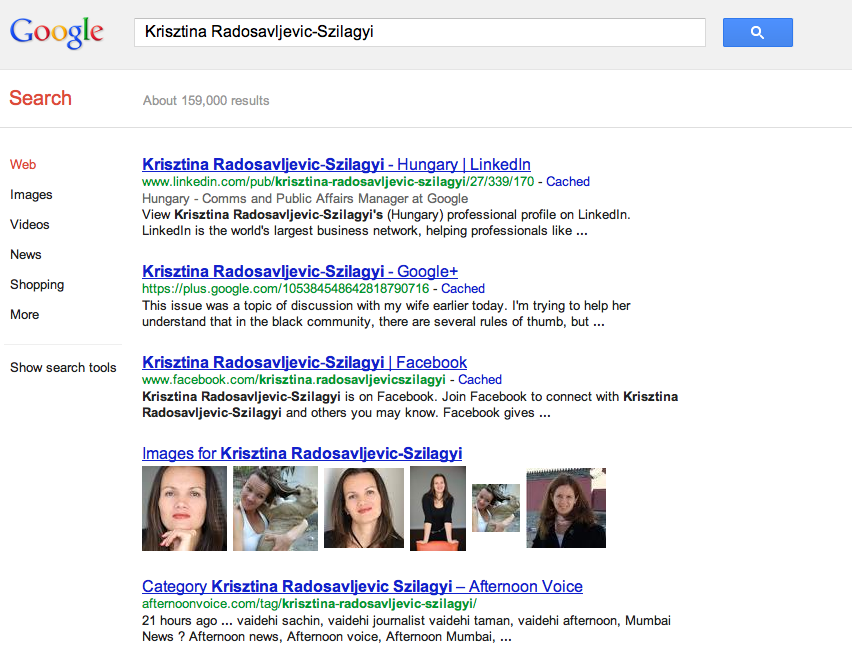
Most of those 159,000 searches, presumably, by reporters quoting her and wanting to get the spelling right.
The New York Times hasn’t just covered the impact of Hurricane Sandy. The paper has illustrated it as well.
From Wednesday’s edition:
A Survey of the Flooding in N.Y.C. After the Hurricane

The web feature has its attractions, but check out the dead-tree edition too. It’s even more compelling.
In the wake of Barack Obama’s historic 2008 presidential victory, there were big plans for the Obama for America machine he had built during the campaign.
Those plans fizzled, as this Campaigns & Elections piece notes:
After the 2008 election, one of the main criticisms of OFA was that the organization was left drifting, pushed aside by the need for the new president’s top command to focus on governing.
At a panel discussion on the 2012 online campaign this past Friday, epolitics.com Editor Colin Delany echoed that criticism lamenting the fact that the campaign waited until 2010 to recruit its online army to fight legislative battles.
Not this time. For starters, the Obamanauts have already sent out a survey to its extensive email list of Barackniks.
Required at the survey’s outset is supporters’ updated contact and demographic information—ZIP code, date of birth and gender. Additionally, the first page asks for affiliated constituencies before delving into questions useful in determining a person’s degree of prior campaign involvement.
[snip]
[The] survey asks for comments on how the campaign could’ve better engaged supporters and volunteers. One question asks supporters whether they met face-to-face with a campaign organizer about volunteering, while others ask about their role on neighborhood teams or what areas they hope to receive training on in the future— that question includes GOTV tools like VAN and Obama for America’s Dashboard.
But more interesting are questions gauging personal interest in supporting new candidates and even running for elected office—hinting at a long term vision from OFA.
Next up, this email the hardworking staff received today from the Obamacrats:
 |
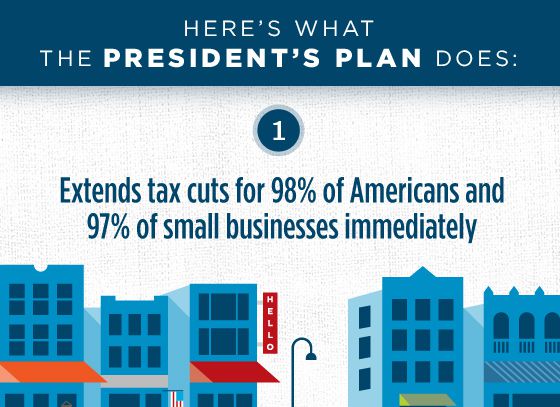
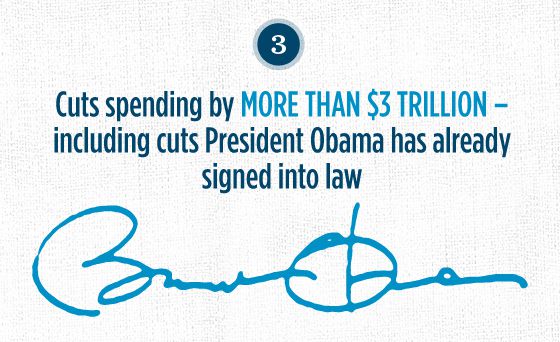
| Friend –Right now, President Obama is working with leaders of both parties in Washington to reduce the deficit in a balanced way so we can lay the foundation for long-term middle-class job growth and prevent your taxes from going up.
Your voice and action helped re-elect President Obama, and hundreds of thousands of you have already responded to our survey, which will help shape our next steps. Thanks to your feedback, we’re taking immediate action on one of your suggestions: keeping you informed about how the President is fighting for you so you can continue to talk to your friends, family, and neighbors. So here’s the deal:
|
The other result: We’re gonna get a lotta emails like this in the next few years.
The hardworking staff received this email from Facebook today:
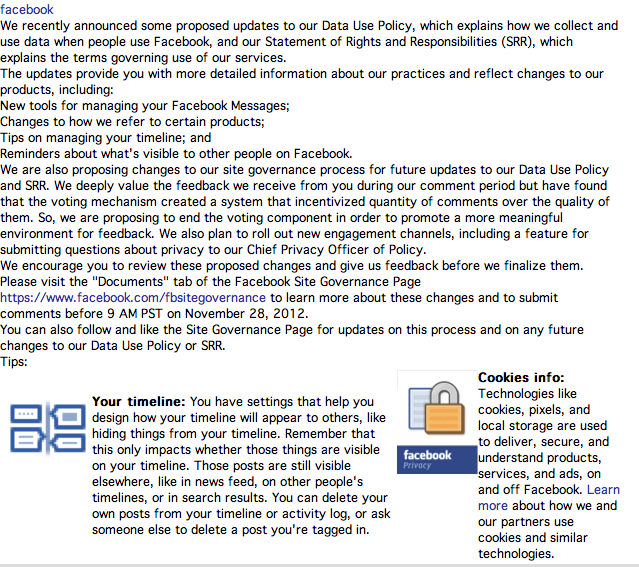
Okay. For starters:
1) Any Facebook reference to privacy means you’ll have less.
2) Protest all you want, but Facebook is a master of two steps forward, one step back.
3) Mark Zuckerberg is the Data Suckah of All Time.
Update that.
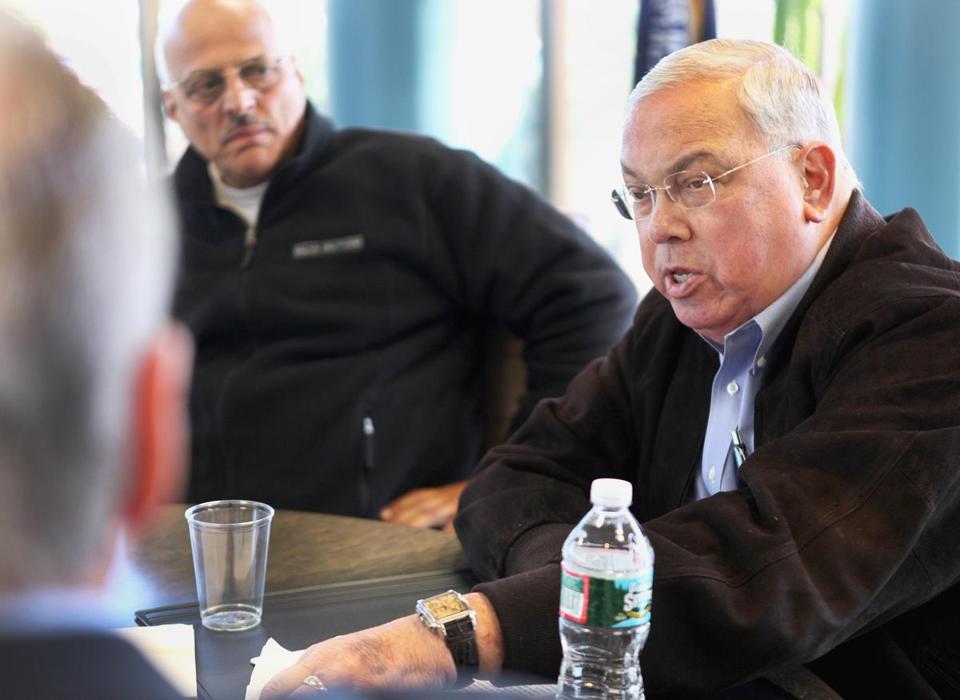
Yesterday’s Boston Globe featured the main course: A front-page piece on the hospital room where Boston Mayor Tom Menino’s been holed up for a month with a Whitman’s Sampler of symptoms from blood clots to spinal cracks.
Hospital room is now Mayor Menino’s office
Top aides help mayor retain links to his city
A black accordion file sits on a desk outside Mayor Thomas M. Menino’s empty office on the fifth floor of Boston City Hall. Most days, city employees stuff paper work into manila folders in the compartments: One sleeve is reserved for documents Menino needs to sign, another for memos the mayor needs to read.
Normally, the bundle goes home with Menino to Readville. But for the past 25 days, the plastic file has been driven the 3½ miles from City Hall to Francis Street, where doctors at Brigham and Women’s Hospital continue to treat Menino for a variety of ailments . . .
Read the rest at It’s Good to Live in a Two-Daily Town.
From Tuesday’s New York Times Business section:
Clouds Lifting Over Murdoch, He’s Out to Buy Again
News Corporation is starting to look like its old self again.
The media conglomerate, which had been on its heels for more than a year because of the phone hacking scandalin Britain, is looking to make acquisitions again. First on the list could be a 49 percent stake in the Yes Network in New York, a purchase that could aid in the formation of a new nationwide sports network to compete with ESPN . . .
“Rupert has his mojo back,” said Todd Juenger, a media analyst at Sanford C. Bernstein. “The stock is up, investors are happy with the company’s recent decisions.”
But then, the Times report says this:
In the last several weeks, Mr. Murdoch has exuded a satisfaction and sure-footedness that people close to the company said they had not seen since before Mr. Murdoch’s British newspaper unit became embroiled in a phone hacking scandal. That is in part because hacking has been overtaken in the press by an unfolding scandal at the British Broadcasting Corporation.
The BBC, which Mr. Murdoch and his son James have frequently criticized, is accused of canceling a news program’s segment about serial child molesting committed by longtime host Jimmy Savile, and broadcasting false reports of pedophilia about a member of Margaret Thatcher’s administration.
Wait – isn’t that supposed to be alleged serial child molesting?
Or has the Times dispensed with such niceties, given its new CEO Mark Thompson’s connection to the scandal?
Just askin’.
Not long ago, the hardtracking staff promised to examine brand journalism, another flavor-of-the-month among the branded content set.
And so, here we go.
Start with PR Newser (“Is ‘Brand Journalism’ the New PR?”), which says American Express’s Open Forum is a legit news source, as is HSBC’s Business without Borders. They are “legitimate media outlets designed to promote their underlying brands without directly selling or marketing the products in question by providing relevant, valuable information to their target audiences via original content, guest writers and media partnerships with other prominent third-party brands like Mashable.”
Cisco’s The Network, however, not so much.
But then there’s Forbes blogger Lewis DVorkin, a gasbag of Citgoesque proportions, who recently wrote this in a post headlined The Birth of Brand Journalism and Why It’s Good for the News Business . . .
Read the rest at Sneak Adtack.
 Click to subscribe to RSS