Well the Missus and I trundled up to Stoneham the other day to Explore the Roar! at Zoo New England’s Stone Zoo (through September 6, advance online ticket purchase required) and say, it was T-rrific.
Take a prehistoric journey through time and walk among the giants that once ruled the planet in Stone Zoo’s all-new T. Rex Adventure!
You’ll come face-to-face with colossal creatures from the past, from a towering 42-foot-long Tyrannosaurus Rex to the 20-foot long plant-eating Plateosaurus. Nestled within the trees, bushes and undergrowth awaits an array of moving and roaring animatronic dinosaurs, as well as realistic dinosaur skeletons. Get colossally curious as you explore the Zoo to make discoveries and connections between animals from the past and present!
The zoo has thoughtfully provided a virtual tour, but you really should see the dinos in person.
The Stone Zoo is always a good time (especially the Boo Zoo at Halloween), the kids being as much fun to watch as the animals. Plus, the Caribbean Flamingos are a hoot, the Chacoan Peccaries are quite handsome, and the Mexican grey wolves are having themselves a moment, complete with their own live cam.
That’s noteworthy, given that a local Mom told us, “I’ve been here a thousand times and I have never seen one of those wolves.”
We saw four of them. You can too. Well worth a trundle.
Well the Missus and I trundled up to Andover the other day to wander around the Addison Gallery of American Art at Phillips Academy (free, but reservations required) and say, it was swell to be back at that gem of a museum.
On the ground floor is the Addison’s 90th anniversary celebration (through December 31), complete with festive cupcakes and a complimentary copy of Treasures of the Addison Gallery of American Art, a hardcover compilation of 240 works from the museum’s collection.
Founded through the largesse of Phillips Academy alumnus Thomas Cochran (PA 1890), the Addison Gallery of American Art opened its doors in May of 1931 with a permanent collection of some 400 works. One of the first museums devoted solely to the art of the United States, the Addison was forged with a dynamic and unrelentingly adventurous spirit that has, through the support of generous donors, allowed the museum to assemble one of the world’s most significant and forward-looking collections of American art across media. The collection, which has since grown to include more than 23,000 works, allows visitors to trace the cultural, political, and social forces that have shaped and defined the American experience from the 18th century to the present day.
Filling the Addison’s first floor galleries, Learning to Look: The Addison at 90 features celebrated favorites, lesser-known gems, and new acquisitions that bring to life the Addison’s storied history and ongoing commitment to groundbreaking artists. With an installation that allows objects to speak across time and media, this exhibition includes masterworks by artists such as Winslow Homer, Thomas Eakins, Georgia O’Keeffe, Jackson Pollock, Donald Judd, Agnes Martin, McArthur Binion, Carrie Mae Weems, and Jaune Quick-to-See Smith.
Among the works in the wide-ranging exhibit:
Thomas Eakins, Salutat, 1898
Georgia O’Keeffe, Black Lines, 1919
Berenice Abbott, Canyon: 46th Street and Lexington Avenue Looking West, 1936
Jaune Quick-to-See Smith, Drive-Thru, 2002
McArthur Binion, DNA: Work, 2019
The exhibit features a Who’s Who of American artists, ranging from James McNeill Whistler to Jacob Lawrence to Arthur Dove to Jasper Johns to Franz Kline to Cindy Sherman and beyond. Totally engaging.
Presenting approximately 60 sculptures as well as a selection of table-top sculptural “sketches,” prints, and photographs spanning this adventurous artist’s decades-long career, this major traveling exhibition will explore how Kendrick exploits the essential properties of his selected medium, whether wood, rubber, or, more recently, concrete, to create sculpture that inherently lays bare the process by which it was made. By leaving visible traces of his trial-and-error process—marks, cuts, paint, oil stains—Kendrick endows his materials with a remarkable sense of immediacy and animation. Moreover, his meditations on the relationships between inside and outside, positive and negative, organic and geometric, nature and culture, sculpture and base, sculpture and sculpture, sculpture and print have led to infinite experimentation.
The dimensions – in both senses of the word – of Kendrick’s sculptures are what’s most striking. His 1983 work Nemo spiders across an entire gallery at the Addison.
Kendrick’s 1995 sculpture Black Trunk was described by the David Nolan Gallery in a 2011 exhibit as “a formidable, hollowed out tree trunk [that] has been cut apart horizontally and reassembled.”
Kendrick also “inked the cylindrical surface of ‘Black Trunk’ to create a ‘woodblock’ of the surface entitled ‘Trunk Drawing.'”
Seeing the two side-by-side is thoroughly immersive.
As are both current exhibits. The Addison, as always, is well worth a trundle.
Well the Missus and I trundled over to The Fenway the other day to wander around the Museum of Fine Arts (reservations required) and say, it was swell just to be back there after a year of staying away.
Also swell was Paul Cézanne: Influence (through October 17), which aims to “explore the artist’s connections over time.”
For Paul Cézanne (1839–1906), creativity grew from a fusion of observing the world, trusting one’s own spirit, and studying the works of his predecessors. In turn, Cézanne’s creative vision—and the paintings that flowed from it—compelled other artists who followed.
Bringing together works by painters from the 18th through the 20th centuries—from Jean-Baptiste Siméon Chardin and Jean-Baptiste-Camille Corot to Pablo Picasso, Charles Sheeler, Georges Braque, and Henri Matisse—this exhibition places Cézanne’s works at the center of a dialogue that speaks to the generative power of the connection between artists across time. Featuring 21 portraits, landscapes, and still lifes, the works on view include MFA icons such as Madame Cézanne in a Red Armchair (about 1877) in addition to seven rarely seen loans of works by Cézanne from private collections.
“Paul Cézanne: Influence” follows “Cézanne: In and Out of Time,” an exhibition that explored the artist’s work within the context of his contemporaries.
The exhibit connected Cézanne’s portrait Madame Cézanne in a Red Armchair (above) with Jean-Baptiste-Camille Corot’s Woman with a Pink Shawl (about 1865-70) . . .
and Pablo Picasso’s Fernande Olivier (1905-06).
Similarly we get the trio of Cézanne’s Vue sur L’Estaqueet Le Château d’If, 1883-85 . . .
with Charles Sheeler’s 1915 Landscape . . .
and William H. Johnson’s Cagnes-Sur-Mer, 1928-29.
The exhibit is small, but there’s a quiet rhythm and harmony among the paintings that’s lovely to absorb.
The post-graffiti moment in 1980s New York City marked the transition of street art from city walls and subway trains onto canvas and into the art world. Jean-Michel Basquiat (1960–1988) became the galvanizing, iconic frontrunner of this transformational and insurgent movement in contemporary American art, which resulted in an unprecedented fusion of creative energies that defied longstanding racial divisions. This exhibition features his works in painting, sculpture, drawing, video, music, and fashion, alongside works by his contemporaries—and sometimes collaborators—A-One, ERO, Fab 5 Freddy, Futura, Keith Haring, Kool Koor, LA2, Lady Pink, Lee Quiñones, Rammellzee, and Toxic. Throughout the 1980s, these artists fueled new directions in fine art, design, and music, driving the now-global popularity of hip-hop culture.
“Writing the Future: Basquiat and the Hip-Hop Generation” illuminates how this group’s subversive abstractions of both visual and verbal language—including neo-expressionism, freestyle sampling, and wildstyle lettering—rocketed their creative voices onto the main stages of international art and music. It is the first major exhibition to contextualize Basquiat’s work in relation to hip-hop and marks the first time his extensive, robust, and reflective portraiture of his Black and Latinx friends and fellow artists has been given prominence in scholarship on his oeuvre.
In the interest of full disclosure, I’ll be the first to admit that I have exactly zERO ability to assess the work in this exhibit.
(To be sure graf goes here)
To be sure, I can see what the artists are doing and I can understand that there is artistic merit in their work. I just don’t know how to judge the good from the bad from the mediocre. I don’t possess that critical yardstick.
I know, for instance, when a Renoir is sappy, the same way I know when a Whistler is luminous. I just don’t have the vocabulary for these works. So I’ll let them speak for themselves.
Why do we differentiate folk art from fine art? “Collecting Stories: The Invention of Folk Art” takes on this seemingly simple question by reconsidering works on paper and sculpture from the MFA’s Karolik Collection of American Folk Art. In the 1940s, Maxim Karolik, a Russian immigrant who became an authority on American art, championed including folk art in an encyclopedic museum—shaking up established standards. MFA curators resisted the idea at first, and although they ultimately accepted the value of folk art, they remained reluctant to display it alongside the Museum’s so-called fine art. Today, the MFA commends Karolik’s visionary steps to diversify the MFA collection and to make it more inclusive.
The exhibit includes a charming 1962 WGBH interview with Maxim Karolik that you need to see in person because the video has inexplicably not been uploaded to YouTube.
Regardless, lots more to see throughout the MFA. Well worth a trundle.
(P.S. It was refreshing to be in a museum where people kept a respectful distance from others and were there to see the art, as opposed to the crowd at the Gardner who seemed mainly there to take selfies in front of empty picture frames. We have Netflix to thank for that.)
Well the Missus and I trundled over to The Fenway yesterday afternoon to take in the Gardner’s annual flower show (reservations required) and say, it was swell.
Cascades of flowering nasturtium vines make their brief—but dramatic—appearance above the courtyard, celebrating the arrival of spring at the Museum. (Nasturtium blooms last about three weeks.) The annual Hanging Nasturtiums display continues an annual tradition started by Isabella during the week before Easter, marking the return of color to the Fenway.
Nasturtium vines (Tropaeolum majus) are started from seed in June, planted in late summer and trained in the Museum’s greenhouses throughout the winter to prepare them for their spectacular spring debut. The vines require continuous care in the greenhouse to ensure dramatic length—up to twenty feet—and require up to ten workers to install in the Museum. The result is a stunning display that cannot be found anywhere else.
Beyond the nasturtiums, the Gardner’s courtyard offers a riotous display of other flowers that are thoroughly cheerful and lovely.
(I need to take a moment here to strike a less flowery note: People, it’s sad to say, are the worst. Exhibit Umpteen: You stand there gazing around the courtyard and two seconds later some beer-bellied bozo is breathing down your neck because he has to take a photo from that exact spot right now. Throughout our visit other people resolutely refused to keep their distance because, really, who gives a damn about us.)
Dancer, choreographer, painter, and filmmaker Shen Wei moves fluidly between disciplines and cultures to create art that expresses a common spirit animating the world around us. His theory of dance seeks to align the energies inside and outside the body, approaching the body and its environment as fundamentally interconnected. As a painter, Shen Wei uses the monumental scale of the canvas to create immersive visual environments that evoke ancient Chinese landscape paintings while enlisting the drips and gestures of twentieth-century abstraction. The size of the paintings invites the viewer on a journey along the canvas, integrating movement into the experience of static works. His films synthesize choreography, time, place, and light to craft ethereal worlds. Shen Wei’s practice transcends the boundaries between visual and performing arts, seeking spiritual meaning that unites his work across disciplines.
Fun fact to know and tell: Shen Wei created this piece by putting paint on the soles of his feet and dancing around the canvas.
Excellent!
The Shen Wei exhibit is there though June 20th. The nasturtiums are there, with any luck, through the end of April
Well the Missus and I trundled out to Lincoln on a beautiful Saturday afternoon last weekend to wander among the outdoor sculptures at the DeCordova Museum (reservations required) and say, it was swell – especially since we hadn’t been in the presence of artworks other than our own for 13 long months.
As we perambulated the grounds of the DeCordova’s ever-inviting Sculpture Park, we encountered 1) a plethora of families happily freed from their pandemic purgatories (the kids were a total hoot and were all over Paul Matisse’s The Musical Fence), and 2) familiar favorites like Nam June Paik’s Requiem for the 20th Century, which combines a silver-painted 1936 Chrysler Airstream sedan with video clips from 1990s television performances and audio of Mozart’s final, unfinished work, Requiem Mass in D minor, K.626.
We’d met the artist several times at the Boston Sculptors Gallery (I wrote about one of his exhibits here) and were saddened by his death four years ago at the too-young age of 68. His sculpture seems to be as well.
To be fair, the DeCordova’s website did its best to help us understand Dorrien’s artwork.
To design an environment that invites viewers to play the part of Little Red Riding Hood, Dorrien brings together three elements: a door, a flying carpet, and a granite floor. For Dorrien, doors and flying carpets are symbolic vehicles for accessing the creative imagination. The door, specifically, appears in Dorrien’s work as a metaphor for embarking on a journey. At the other end of the installation is the flying carpet, a single, thin granite slab that bends up towards the door as if posed to take the viewer on said journey. The elevated granite pathway then functions as a liminal space between the two.
Your liminal space may vary.
On a more accessible note, Jim Dine’s Two Big Black Hearts – peppered with bas relief faces, hands, hand tools, and everyday objects like shoes and a small metal coffeepot – did get some love from us.
Dine leaves his personal mark on Two Big Black Hearts both symbolically, by the choice of objects, and physically, by his hand imprints on the sculpture’s surface. Cast from the same mold, these 3,200-pound sculptures serve as nearly identical versions of the same heart, differentiated only by subtle details that resulted from the casting process. Like Dine’s other multimedia work, Two Big Black Hearts are bronze casts of commonplace items, such as hands, faces, seashells, hammers, and other tools. The repetition of these items transforms them into vehicles of personal expression that evoke emotion. For Dine, the tools reflect childhood memories of the hardware store owned by his grandparents; the heart functions as “a sign that one can care, that there is a constant presence of feeling.”
The “presence of feeling” for the Missus and me was an overwhelming gratitude to be back in the world, to be doing something previously as ordinary as visiting a museum without worrying we might accidentally endanger our lives.
For the past 13 months I’ve whiled away the coronavirus pandemic by compiling, in this space, the media work I produced over four and a half decades as a Boston ad copywriter, freelance journalist, reporter, columnist, and commentator.
Upon completion of that Great Pandemic Portfolio Project, it seemed like a proper endnote to park the five-part series in one place.
Part 1 (1975-1988) is here. Part 2 (1988-1994) is here. Part 3 (1994-1998) is here. Part 4 (1998-2008) is here.
Press release from WBUR on the Friday before Labor Day, 2008.
“Beat the Press” panelist John Carroll will beat a familiar path back to WBUR in the role of senior media analyst starting next week, announced Sam Fleming, managing director of News & Programming at Boston’s NPR news station.
Carroll, a regular WBUR commentator for more than 10 years prior to moving to WGBH-TV’s “Greater Boston” in the mid ’90s, will analyze electoral and print media during the presidential race, and following the election, he will dissect issues related to advertising, politics and culture.
“Our listeners have long missed John’s wry observations about media and advertising, particularly commercial messages peddled by candidates of all persuasions in the midst of elections,” said Fleming. “We look forward to his return.”
In addition to serving as a regular panelist on WGBH-TV’s popular Friday night program “Beat the Press,” Carroll was the executive producer of WGBH-TV’s “Greater Boston” for five years. An assistant professor of Mass Communication at Boston University, Carroll has won numerous national and regional journalism awards, including the RTNDA’s Edward R. Murrow award for writing, the National Press Club’s Arthur Rowse award for press criticism, and multiple New England Emmys for commentary and news writing.
Over the past 20 years, the Xavier University alum has also written extensively on advertising and the media as a regular columnist for The Boston Globe and Adweek magazine. He also spent nearly two decades as a creative director and consultant in the advertising industry.
Nice welcome home.
As WBUR’s newly minted Senior Media Analyst, I produced regular commentaries for Morning Edition, starting with this piece about the decline of the English language in political speech.
Amazing to tell, America may go down in history as the first society ever to forget its own clichés.
It’s amazing because clichés have always been a culture’s common linguistic currency. And right now America’s linguistic currency is being devalued faster than dollars in Zimbabwe.
This year’s presidential election has provided lots of examples of what we’ll call Mangled Phrase Syndrome. Back in April, MSNBC’s First Read online political digest reported that “the [Barack] Obama campaign has launched an intensive registration drive across North Carolina that has reached a pitch this week.”
It used to be things reached a fever pitch, but obviously politics is a lot cooler these days.
The following month, Obama told ABC’s Nightline that House of Clinton consigliere James Carville “is well-known for spouting off his mouth without always knowing what he’s talking about.”
What is he, Moby Dick? I always thought “spouting off” included somebody’s mouth.
Then there was the New York Times piece headlined “Clinton may be hopeful, but Obama rolls on.” The story noted that delegate numbers overwhelmingly favored Obama, but the mainstream media continued to float Hillary Clinton’s presidential boat.
The Times piece asserted “None of this is to say that Clinton has run out of string.” Of course, “run out the string” is the traditional phrase, but maybe Clinton actually did run out of string. She was certainly fit to be tied often enough . . .
The Great Recession of 2008 was the start of a very bad stretch for daily newspapers in the U.S. During the next ten years, advertising revenue would suffer a knee-buckling 62% decrease, while newsroom employment would shrink by 47%. The local dailies were in no way exempt from that decline, as this piece noted upon the rollout of a redesigned Boston Globe.
When the Boston Globe debuted its newly streamlined format, an editor’s note said the changes were designed to help readers “better navigate the news and The Globe.” Real world translation: the changes are designed to help the paper better navigate the dismal financial news at the Globe.
But first, the revamped format, a sort of freeze-dried version of the local broadsheet. The major sections – Main News, a combined Metro & Business, and the Globe’s mainstay Sports pages – are essentially the same, only less so.
The real focus of the Globe redesign is their highly touted section “G” – a name oddly similar to the mother ship New York Times section dubbed “T.” “G” is a mashup of the formerly separate Living/Arts, Food & Arts, Style & Arts, Weekend, and Sidekick sections – although initially it seems to be less mashup than mishmash.
Of course, that crazy-quilt impression could be attributed to a reader’s unfamiliarity with the new design. No mere passage of time, however, could possibly cure the helter-skelter renovation of the comics pages.
For starters, they changed the order of the comic strips, making mornings even more disorienting than they already are. Beyond that, the weekday comics now appear in color, which is at once unwelcome and unnatural. Daily comic strips are supposed to be black-and-white. That’s what makes the Sunday comics special.
Even less funny, though, is the Globe’s financial condition. On that front, the paper’s redesign is more accurately a retrenchment. It reduces the paper’s content by about two dozen pages a week, which saves the Globe significant money at a time when its revenues are going down like the Hindenburg and its circulation is shrinking faster than your 401(k).
Given that the parent New York Times Co. has written down the value of the Globe to a fraction of the $1.1 billion the Times paid for the paper 15 years ago, this could conceivably be the Globe’s Last Stand before some really drastic changes occur.
And the Globe is not alone in its dilemma. Crosstown rival Boston Herald, which has long served as a lively index to the Globe, recently undertook a revamp of its own.
The feisty local tabloid has outsourced its printing to the Wall Street Journal presses in Chicopee, resulting in a smaller format, less late-breaking news, and layoffs of roughly 150 Herald staffers. On the upside, you can actually see the photos in the Herald now.
Problem is, there are fewer and fewer readers to appreciate the upgrade. The Herald’s daily circulation has fallen a knee-buckling nine-and-a-half percent over the past year, leading some media observers to worry about its long-term prospects.
And no wonder. With both the Herald and the Globe offering smaller papers to smaller audiences, less news is bad news in the local daily paper chase.
Actually, the Great Recession hammered a whole lot of people, as I chronicled in this early November piece about the 2008 Christmas economy.
There are three things you can absolutely count on every holiday season. First, there’s never any figgy pudding around when you need it. Second, almost no one remembers the words to Frosty the Snowman. And third, the Christmas season starts earlier every year.
Last week, two Boston radio stations began playing all Christmas songs, all the time. The program director for one station told the Boston Herald, “People are ready for a change. The holiday music really helps to erase your problems temporarily.”
Yeah, like for two minutes and thirty seconds. Then you’re back to the Economic Roll Call of the Damned. As in:
Unemployment is at a 14-year high.
General Motors is hemorrhaging two billion dollars a month.
Art auctions are coming up emptier than a Salvador Dali landscape.
And the stock market is down 35%, roughly half the great 1929 nosedive. As my father-in-law Marvin used to say, tough sledding on Wall Street. No snow.
It’s hardly better on the retail front, where October sales suffered their worst decline since 1969. The upscale Neiman Marcus, for instance, is down 28%, although that hasn’t kept their Christmas catalog from including a $1500 Steif bear dressed as Karl Lagerfeld, or that traditional $94,000 wristwatch.
No his-and-her jet planes or his-and-her elephants as in past years, however.
Macy’s, on the other hand, has gone old school, appropriating the classic “Yes, Virginia, There Is a Santa Claus” editorial from the old New York Sun.
One holiday TV spot features Macy’s spokes-celebrities reciting bits of the Sun editor’s reply to Virginia’s letter in 1897.
“Yes, Virginia, there is a Santa Claus. He exists just as love and generosity exist. How dreary would be the world if there were no Santa Claus.”
That last line is delivered by Donald Trump, a man long known to be filled with the buttermilk of human kindness.
Unfortunately, that’s not the only jarring note in the Macy’s campaign. The old New York Sun folded in 1950. The new New York Sun, revived six years ago, folded last month.
Want a leading indicator of where the US economy is right now?
Xmas marks the spot.
Before the year was out, there was this one thing I just had to get off my chest.
It all started with the N-word, the socially acceptable way to indicate the vilest racial slur in American parlance. Just last month the Wall Street Journal reported that some Indiana voters told Barack Obama supporters, “I am not voting for that N-word.”
But that justifiable euphemism has engendered a tsunami of copycat alphabetizing, almost none of which deserves such delicate treatment.
Just last week, for instance, the New York Times reported that Democrats on Capitol Hill have substituted the word “recovery” for “stimulus.” The piece noted that “Speaker Nancy Pelosi caught herself last week just as she was about to let the S-word slip. ‘We’re not using the word stimulus,'” Mrs. Pelosi said.
Except, of course, when they do.
Closer to home, Boston Globe word maven Jan Freeman wrote about the use of “bemused” – which has traditionally meant “puzzled” – to describe Obama’s benign, unruffled presence. Dozens of newspapers and magazines, Freeman wrote, “[have used] the B-word this way.”
Why she used the “B-word” formulation, however, is, well, puzzling.
Then again, all the kids are doing it, and have been for a while. During the presidential campaign, torture became the T-word, impeachment became the I-word, socialism became the S-word, brand became the B-word, lying became the L-word, and landslide also became the L-word.
It’s enough to make you word-weary.
Which brings us to the G-word – as in Garfield, Bob, co-host of the weekly public radio program On the Media and an excellent columnist for Advertising Age magazine.
In his radio gig, however, Garfield turns out to be a serial alphabetizer. Here he is talking about radio personality Rush Limbaugh.
“And he has already complained on the air of how difficult it is to go after Obama lest he be tarred with the R-word.”
That word would be “racist,” for all of you keeping score at home.
Soon thereafter Garfield was at it again, talking with an editor at ProPublica, a non-profit investigative website.
“I want to ask you about the S-word – S standing for [billionaires Herbert and Marion] Sandler, the benefactors of ProPublica. They have a history of affiliation with progressive political causes.”
All due respect, there’s only one word to describe this trend. And that would be the D-word.
Dopey.
• • • • • • •
I began branching out at ‘BUR in 2009, starting with this Super Bowl ad preview I filed for Only a Game.
The undisputed MVP of Super Bowl ads was Coca-Cola’s Mean Joe Greene commercial, which was very much like the soft drink – sweet and syrupy.
[Kid] Want my Coke – it’s okay – you can have it.
[Mean Joe] No . . . no . . .
[Kid] Really, you can have it.
[Mean Joe] Okay.
[Jingle] Have a Coke and a smile . . .
Not much to smile about these days, especially since the price of Super Bowl advertising has risen dramatically. This year it’s $3 million for a 30-second ad. That’s $100,000 a second for those of you following along on your calculators.
But as the cost of the ads has gone up, the quality has gone down. These days Super Bowl spots try too hard, get too much pre-press, and generally wind up being over-hyped underachievers.
And that’s not including the downright offensive ads . . .
At the end of March I chronicled more cutbacks at the local dailies.
It’s bad news in Boston’s newspaper business these days. The feisty local tabloid Boston Herald just let 24 employees go, mostly on the business side. Crosstown rival Boston Globe has cut twice that many staffers – all in the newsroom.
That’s because the Globe’s parent New York Times Company is paper-shredding again. In rapid succession the Times company has slashed non-union employee pay at its newspapers by five percent, and engineered two dozen staff departures at the Globe with its umpteenth buyout offer . . .
Two weeks later I was back on ‘BUR documenting the Globe’s M.C. Escher act in covering the NYT’s paper-shredding.
The Boston Globe is in the unfortunate position of having to document its own dismantling.
The New York Times Co. jump-started its demolition derby with a demand that the local daily commandeer $20 million in union concessions. The Globe responded in its Saturday edition with a Page 1 above the fold five-column headline that read, “Times Co. threatens to shut Globe, seeks $20m in cuts from unions.”
That’s what’s known in psychological circles as repressed hostility. Or maybe not so repressed.
The next day’s Page One above the fold four-column headline read, “Threat to Globe triggers flood of feelings.” Globe reporters fanned out across doughnut shops, newsstands, libraries, luncheonettes and convenience stores to interview distressed Globe readers.
Local luminaries also piped up, from politicians suddenly enamored with the Globe, to religious, cultural and entertainment figures lamenting the prospect of Boston Globe-less.
All that Globe breast-beating, however, struck one observer as entirely counter-productive. Veteran media executive Alan Mutter, who writes the Reflections of a Newsosaur blog, said the Globe coverage “not only was vastly overplayed but also may serve to unnecessarily damage the newspaper’s already weakened business.
“The editors, who evidently let emotion overcome their news judgment, should have known better,” Mutter concluded.
No problem in that department at the Times, where the Globe-ectomy has been business as usual – and not even high-profile business at that. The only story the mother ship has run about Globe cutbacks appeared on page B5.
On Saturday.
You can’t get more buried than that unless you’re Jimmy Hoffa . . .
On the political front, the 2009 Boston mayoral race featured an unusually early ad campaign from incumbent Tom Menino, despite the commanding lead that polls indicated he held over his three challengers. This ‘BUR piece detailed Menino’s traditional approach to campaign advertising, in stark contrast to his opponents’ new-media marketing efforts.
In any election year, incumbents have a built-in advantage in both fundraising and publicity. The latter, however, has always been a mixed blessing for Boston Mayor Tom Menino, whose every public appearance is an adventure.
Here, for example, is Menino at last month’s Urban Improv charity fundraiser, in a skit where he plays Abe Lincoln — don’t ask — visiting Michelle Obama:
“Hey Michelle. How bout a little Sam Adams? And some guaca-mala?” the mayor asked.
When Menino’s not askin’ for guaca-mala, he’s askin’ for votes in a hundred-thousand-dollar advertising campaign . . .
I capped off the commentary year at ‘BUR with this Only a Game piece about ESPN’s 30th anniversary, which posited that the once-brash cable upstart did not remain that way over the past three decades; rather, it had become the Soviet Union of sports networks.
For much of its 30 years ESPN was sort of the class clown of the sports world. Smart-alecky and sarcastic, the all-sports cable outfit presented itself as the perfect antidote to the ponderous, self-important broadcast networks.
From its first cablecast in September of 1979, ESPN promised a different kind of sports coverage.
“Welcome, everyone, to the ESPN Sports Center. From this very desk in the coming weeks and months we’ll be filling you in on the pulse of sports activity not only around the country but around the world as well. If it takes an interview, we’ll do it. If it takes play-by-play, we’ll do it. If it takes commentary, we’ll do that too.”
In fact, the guys at ESPN – and it’s been virtually all guys at ESPN – did a lot of commentary, the snarkier the better.
But how the mighty funny have fallen since the Walt Disney Company acquired ESPN in 1995. Before long you couldn’t spit without hitting an ESPN offshoot, from ESPN2 to ESPN News to ESPN Classic to ESPN HD to ESPN.com to ESPN The Magazine to ESPN The Dessert Topping.
Just kidding about that last one, but you never know.
What critics know is that EPSN is now officially Same As the Old Boss . . .
• • • • • • •
A 2009 postscript . . .
In June of that year I launched a blog called Campaign Outsider. The name reflected my lifelong resolve never to be sucked into the politico-media cocktail party that makes so many people quite reasonably suspicious of both groups.
Debut post:
I’ve filed over 4200 posts since then.
Among them was a series of items headlined It’s Good to Live in a Two-Daily Town. Representative sample: this 2011 post about Mistah Mayah busting the Newbury Street NikeTown over a window display of skateboarder t-shirts stamped with slogans like “Dope” and “Get High.”
About a year later I gave the Two-Daily Town beat its own website with the subhead, “The Globe/Herald Daily Bakeoff.”
Since then I’ve filed about 1260 posts chronicling the bakeoff between the local dailies, which have proven a never-ending source of grist for the mill. Many thanks to both.
• • • • • • •
For reasons that I totally don’t remember, in 2010 I stopped doing commentaries for WBUR and started doing two-ways. During the next decade, I did hundreds of segments on the NPR program Here & Now and on WBUR’s Radio Boston, all of which are available here.
From the fall of 2012 to spring of 2014, I also contributed a series of essays to Cognoscenti, WBUR’s ideas and opinion page. Most of the pieces examined emerging media trends, ranging from make-your-own-reality politics to ads in sheep’s clothing to the government’s tobacco-tax addiction to the digital equivalent of invisible ink.
Twenty-twelve is destined to go down in history as the election year in which almost all of the participants created their own reality.
We shouldn’t be surprised. In fact, we should have seen it coming.
In a 2004 New York Times Magazine piece, Ron Suskind recorded an exchange he had with a Bush administration official who derided Suskind for being part of “the reality-based community . . . We’re an empire now, and when we act, we create our own reality.”
See the war in Iraq for further details.
The 2008 McCain presidential campaign, although never an empire, had the same attitude. A McCain spokesman crowed to Politico: “We’re not too concerned about what the media filter tries to say . . . Somehow you just got to go over the heads of the filter.”
McCain’s campaign did manage to go over the heads of the filter. It also went over like the metric system. But that’s a different story.
2012 is the story of creating parallel universes that never intersect, so there’s no common ground. Democrats and Republicans can’t conduct rational political discourse because there’s no set of facts they mutually agree upon.
The 2012 campaigns go beyond distorting facts or misleading the public. They more resemble the fantasy world-making normally associated with The Matrix or Star Wars franchises. Or with the Obama Derangement Syndrome birthers (He was born in Kenya!), or the 9/11 truthers (Bush did it!), or the recently minted deathers (Osama lives!) . . .
Then there was this piece about the New York Times hauling its digital self into the 21st century with a revamping of its website and a new approach to selling ads.
[T]he Times has chosen the occasion of its redesign to introduce native advertising, those ads in sheep’s clothing tricked out to look like editorial content.
That initiative started last fall when the Times announced its intention to join the branded content set. The announcement was quickly followed by official reservations from Times executive editor Jill Abramson, who worried about “leaving confusion in readers’ minds” and Times public editor Margaret Sullivan, who cautiously previewed the “delicate balance” between advertising and editorial.
But Times ad execs said don’t worry — it’ll all be on the up-and-up. And native advertising’s debut on the redesigned Times website was just that: clearly labeled and set apart from the editorial stream . . .
The problem, as I went on to note, is that native advertising works best when it’s not clearly labeled and not set apart from the editorial stream. The whole point is to make the reader think that it’s editorial content. That’s what brands are paying for in the end.
(In September of 2010 I launched the blog SneakAdtack: Tracking the Hidden War on American Consumers. The New York Times has appeared there a lot. Especially noteworthy are the paper’s innovative Russian Nesting Ads.)
I also wrote this Cognoscenti piece detailing the co-dependent relationship of federal, state, and local governments with tobacco companies.
Will Government Regulation Vaporize E-Cigarettes?
Electronic cigarettes, which deliver nicotine in the form of a vapor through battery-powered devices that often resemble traditional tobacco cigarettes, are currently on the lips not only of consumers, but government officials as well.
The dominoes are starting to fall: States are limiting both the sale of e-cigarettes and their use, placing restrictions on them that mirror the stringent regulations that have become commonplace in a zero-tobacco-tolerance world.
By all appearances, government officials are simply trying to protect the public health, as many people believe they should. But there’s another way of looking at the rush to regulation: E-cigarettes are not rendering unto Caesar the things which are Caesar’s.
That is to say, taxes.
Think about it: States are receiving megabucks every year from tobacco companies thanks to the 1998 Master Settlement Agreement that requires the tobacco industry to pay 46 states approximately $10 billion annually for the indefinite future.
Then there are the extortionate federal and state excise taxes on every pack of cigarettes sold in the U.S. (Fun fact to know and tell: In 2007, states hiked excise taxes on cigarettes by $1 billion. The 2007 increase in state alcohol taxes? $3 million.)
You see where this is headed.
Let’s begin with the co-dependent relationship between tobacco companies and the federal government. According to RJ Reynolds (who should know), 2012 federal cigarette excise taxes equaled $14.8 billion out of a total of $43.3 billion in settlement payments, federal, and state and local taxes on cigarettes.
Then there are the state and local government tobacco-money addicts. According to one estimate, their excise-tax revenues totaled $17.2 billion in 2011. That’s a lot of incentive not to fund anti-smoking campaigns . . .
Tired of carrying all that digital flotsam and jetsam through life? Fed up with those photos of you wearing a lampshade forever being tagged on Facebook?
Well, my friends, just move to the Erasable Internet, where the mantra is “delete is the new default.”
It was Snapchat that put the shelf-life Web on the public radar screen. The photo-sharing service allows users to set a time limit on photos or videos they send to others, a kind of digital spontaneous combustion. It’s very “Mission: Impossible.”
From there, the apps just kept on coming — from Telegram (self-destructing text/images/video) to Frankly (text sent in a blurred box — tap it and a timer counts down to deletion) to Wickr and Blink, all of which make digital content disappear so it’s not attached to you for life.
The sidecar to the Erasable Internet is the Anonymous Web, in which content remains in the digital realm but is not attached to you at all. In other words, the content stays but you disappear.
(The sidebar to this trend is the NYM Wars, a battle over whether you need to attach your real identity to your digital activities or whether you can employ a pseudonym. Increasingly, websites and apps — from music streaming service Spotify to digital slots parlor myVegas to ride-sharing app Lyft to ESPN conversation boards — have begun requiring people to sign in with Facebook. The more that happens, the more your Facebook identity becomes a sort of digital passport. And the more Facebook founder Mark “Data” Zuckerberg likes it.) . . .
As WBUR’s senior media/news analyst, I did similar chinstroking for Radio Boston. But at times I also served as sort of a one-man SWAT team for some of the show’s touchier topics, many of which involved the Boston Globe, a frequent ‘BUR content-production partner.
Chief among those hot potatoes was L’Affaire Ashbrook, triggered by a couple of dozen current and former station employees who accused On Point host Tom Ashbrook of a decade of abusive treatment and bullying behavior.
In the wake of widespread media coverage and a damning internal investigation into Ashbrook’s workplace demeanor, station management (which, by the way, had already given Ashbrook at least three last chances) finally had to toss him overboard.
Amazingly, a few months later Ashbrook resurfaced in a Boston Globe op-ed pleading for a return from exile.
Bad move, as I asserted on Radio Boston’s Week in Review.
For the life of me I don’t understand why the Boston Globe would run such a half-baked, tin-eared, self-serving semi-apology. It doesn’t make sense to me. And I may be old-fashioned but I think the thing that would be normally done here is you go into the desert and you wander around for a decent interval and then you come back and try to earn the trust back of the people you wronged . . . I just think this whole attitude of ‘what I have to say is too important for me to be sidelined more than three months’ – I just find that insulting.
Ten days later I was chinstroking on Radio Boston about another fraught situation: Boston Globe columnist Kevin Cullen’s suspension for wildly fabricating stories about his experience at the 2013 Boston Marathon bombings.
My verdict: No way the Globe should let him back, but the paper’s bonehead executives did – and, even worse, as a columnist. (Follow-ups here and here.)
There was also a segment on the inappropriate text exchanges Boston Globe editor Brian McGrory had with a subordinate. Operative word: creepy. (Follow-up here.)
Then there was the rumpus over Boston Globe opinion columnist Luke O’Neil, who wrote in one piece that “he wished he had urinated on the salmon he was serving one evening to conservative political analyst Bill Kristol, calling it one of his biggest regrets in life. He was referring to his days as a waiter in Cambridge more than a decade ago.”
On Radio Boston O’Neil got first crack at telling his side of the story. Then it was my turn: “Traditional news organizations say they want content that’s fresh and edgy, but they really don’t. They just want content that seems edgy.”
Since then, I’ve remained media analyst for Here & Now as well as WBUR’s senior news analyst. I’m extremely grateful for both opportunities.
I’m also still banging away at Two-Daily Town and Sneak Attack and, obviously, Campaign Outsider.
As for this Great Pandemic Portfolio Project, I’ll just say . . . for now anyway . . .
Part 1 (1975-1988) is here. Part 2 (1988-1994) is here. Part 3 (1994-1998) is here.
I produced about 75 pieces in my first six months as a reporter for Greater Boston – that’s about 12 pieces a month, three pieces a week for those of you keeping score at home. After two decades of freelancing, it was a dream come true: My only job was to go out in the field, conduct interviews and shoot video, then go back to the station to record the voiceover and edit the piece.
Then I’d go on the show and flap my gums for eight or ten minutes.
Excellent!
More than a handful of those early pieces chronicled the misadventures of Boston Globe serial plagiarist/fabricator Mike Barnicle, culminating in this one.
Boston Magazine’s 12,000-word piece on Mike Barnicle is as thorough as an IRS audit. It details 25 years of Barniculture at the Boston Globe, where apparently standards were more flexible than Gumby, and editorial control was decidedly pokey. By now, the rise and fall of Patricia Smith and Mike Barnicle are well-known tales, but the Boston magazine story does add some fun facts to know and tell.
There is, for instance, the folklore about Barnicle’s being a full-time speechwriter for Robert Kennedy during his 1968 presidential campaign. One small problem: RFK’s head speechwriter Adam Walinsky told the magazine he hadn’t even met Barnicle during the ’68 campaign, never mind seen anything Barnicle had written.
Then there’s Barnicle’s alleged connection to Robert Redford’s 1972 film, The Candidate. Screenwriter Jeremy Larner vigorously disputes that, and Barnicle conceded to Boston magazine that his connection to both the Kennedy campaign and the movie has been overstated.
Barnicle is, however, actually acquainted with Redford and was actually seen lunching with the movie star this past week. In its quest to explore all things Barnicle, Boston magazine’s big takeout also includes a sidebar by celebrity lawyer Alan Dershowitz, whose ax to grind has reached Bunyonesque proportions.
The whirling Dersh is still seeking vindication for a racist quote Barnicle falsely attributed to him in 1990, but at this point, he ought to take a number.
From the evidence presented in the Boston magazine piece, Barnicle’s collected works feature more fabrications than a drapery showroom. But it’s probably too much to hope that this 12,000-word undressing will finally draw the curtain on the biggest Boston swindle since the Brinks heist.
• • • • • • •
Around that same time the ‘GBH brass, understandably, put the kibosh on my freelancing at WBUR – an early salvo in what would become a sort of trench warfare between Boston’s two public-broadcast radio stations.
Then again, since Living on Earth was a national program on NPR, it was not on the bosses’ radio silence list. So in May of 2007 I produced a commentary on the return, in a public service announcement, of Iron Eyes Cody, who had years earlier memorably shed a tear over the pollution of America.
In 1971, Native Americans were still Indians and PSAs were still taken seriously as a public responsibility by the major TV networks. Now, of course, Indians are strictly those living in the triangle south of the Himalayas, and television networks have replaced traditional PSAs with politically correct bromides delivered by sitcom stars. But none of them will ever have the impact of Iron Eyes Cody, who gave pollution a bad name without saying a word.
The classic PSA showed Cody canoeing down a river which becomes increasingly choked with trash as he approaches a smog-covered industrial area. After beaching the canoe, he walks up to a highway where a passing motorist tosses a bag of trash at his feet.
(Male voice-over: “Some people have a deep, abiding respect for the natural beauty that was once this country. And some people don’t. People start pollution. People can stop it.”)
The PSA caught the first wave of the environmental movement, making an impression that’s lasted almost as long as a plastic trash bag in a landfill. But the same probably won’t be said for the new version of the anti-litter PSA . . .
A couple of months later this LOE piece chewed over Monsanto’s campaign to plant its genetic-engineered crops in a resistant Europe.
To the average American, Europeans seem a bit, well, eccentric about what they eat. The British, for example, don’t freshness-date their food, they carbon-date it. The French, on the other hand, refuse to eat anything that hasn’t been harvested or eviscerated within the past 24 hours. As for the rest of the European Community, they can’t even agree on the definition of cheese. So it’s really no surprise that Monsanto has had trouble promoting genetic food products in the European market. Monsanto wants to sell biotechnology-enhanced seeds to farmers and get European consumers to eat their genetically engineered soybeans and such. But the general populace, mindful of the British beef scare of several years ago, apparently fears an outbreak of mad corn disease.
That’s driven Monsanto to adopt the weapon of last resort with an uncooperative public: advertising. Monsanto’s European newspaper ads are decidedly more low-key than what Americans are accustomed to seeing. One French ad takes the form of a quiz, offering multiple-choice answers to the question: What is genetic engineering of crops? The answers, loosely translated, are: the production of blue oranges, the study of plants that dance to techno-music, or – and this is the correct one – the science that improves vegetables by giving them new properties. Not exactly Final Jeopardy, but certainly tougher than asking the French why they prefer gum surgery to American tourists . . .
• • • • • • •
I continued producing commentaries for APM’s Marketplace as well. One of them detailed the collision of controversial advertising with controversial programming. During shock jock Howard Stern’s broadcast television debut on the CBS affiliates in New York and Los Angeles, New Jersey-based Ansell Products took the high-profile opportunity to launch a new campaign for Lifestyles condoms.
To some critics, Howard Stern’s entire program is an advertisement for birth control, given the freak-show characters and sideshow atmosphere it features. Regardless, an actual condom ad did appear during the broadcast in New York and Los Angeles, two of the least shockable cities in America. But the real shock is that the new Lifestyles commercial ran at all, given network television’s traditional policy of refusing condom ads except in the form of public service announcements addressing disease prevention.
That changed a bit two years ago when several network affiliates accepted a Lifestyles commercial that contained an animated skeleton dutifully talking about disease prevention . . .
Lifestyles has come back with a new approach featuring a bouncy jingle and a variety of boy-meets-girl settings, from dating bars to the ever-popular horse stable.
While the birth control message may be subtle, the traditional warnings about responsibility and sexually transmitted diseases are entirely absent. Instead, the new Lifestyles campaign concentrates on playing around, with one print ad showing an amorous couple along with the headline “How 2 Have More Fun in Bed.”
Equally bold is the choice of the Stern show as an advertising vehicle for Lifestyles’ new TV spots, which also run on more-receptive cable networks. But the big marketing opportunities are still on the broadcast networks, so the connection with Howard Stern seems to be a gamble worth taking . . .
Around that same time, I added a new freelance radio outlet – On the Media, a weekly NPR program that features reporting and analysis of the media world . One piece addressed the corporate-image polishers on the Sunday morning TV talk shows.
The Sunday morning squawk shows are to corporate advertisers what “The Tonight Show with Jay Leno” is to actors: a chance to plug your work without fear of contradiction. For years the master of corporate image-polishing was the Caterpillar equipment company, which ran feel-good TV spots while earning more federal labor complaints than the average chicken processing plant. It takes a tough company to make a tender union.
Nowadays, commercial breaks on the squawk shows are filled with the likes of Merrill Lynch, which needs to instill confidence after cutting 3400 jobs, and the pharmaceutical industry, working to create a more pills-buried society. But the King of the Sunday morning set remains agribusiness giant Archer Daniels Midland, a company so influential, it practically doubles as a Congressional district.
Last year ADM hired former Sunday morning host David Brinkley as a spokesman to add prestige to its corporate-image campaign. That raised eyebrows in editorial circles, so ADM’s commercials now start with a disclaimer, lest anyone think Brinkley is still a journalist . . .
Shaping public opinion, of course, is a major objective of these corporate-image efforts. They’re also useful for, say, calming a jittery stock market that threatens to bungee 200 points up and down indefinitely. And the high-profile campaigns can boost company morale during difficult times. But perhaps most significant, generous corporate-ad budgets can produce stingy news coverage of company problems.
Just ask Caterpillar and ADM. After they started appearing in commercial breaks on Sunday mornings, they stopped appearing in the programs themselves. On the squawk shows, you pay the price one way or another.
My final piece for On the Media in ’98 addressed the number of marketing campaigns that featured literary figures as pitchmen in ads on the Internet and in magazines.
America enjoys a long tradition of prominent literary figures apprenticing in the advertising world. Dashiell Hammett spent some of his early years writing ad copy, as did F. Scott Fitzgerald. Wallace Stevens was also an adman, although there’s no truth to the theory that his poem “The Emperor of Ice Cream” was based on the Good Humor man.
Regardless, that tradition has been turned upside down lately in a new ad campaign for Absolut vodka, which transforms best-selling authors into copywriters, presumably making them the “litter-ad-i.” The magazine ads are designed to attract an upscale, educated audience by associating the product with the book-jacket set, a variation on the Absolut campaign with brand-name bottles by contemporary artists.
For this campaign, Absolut has trotted out five “literary stars,” as the distiller calls them, who write short fictional pieces jury-rigged to include Absolut vodka as an essential plot device.
Take the contribution from Dominic Dunne, the Sir Walter Scott of celebrity scandal. Dunne’s piece has a stage-door Johnny visiting a theater queen who dumped him years earlier. The good-looking wren in a strapless gown is colder than the White House bedroom – until Boyfriend Johnny plunks a bottle of Absolut on the dressing-room table. Overall, it’s the hardest-boiled copy this side of an Easter ad . . .
• • • • • • •
I also wrote a couple of Globe Focus pieces in ’98. The first one dealt with what seemed at the time as the eternal sameness of political advertising.
Lede:
Every election year, people complain about the numbing effect of political ads, as if Tom Menino is any worse on-screen than Frank Perdue’s kid. The reality is, campaign commercials in general are not especially lurid, deceptive or manipulative. What they are, mostly, is derivative – following in the footsteps of past commercials like bright-eyed tourists on the Freedom Trail. That’s what tends to wear people out . . .
Retraction #1: Campaign commercials, with very few exceptions, turned out to be totally lurid, deceptive or manipulative.
Retraction #2: What wears people out is not that campaign ads are derivative, but that they’re assaultive. Just ask any resident of Georgia during the 2020 election cycle.
Other than that, swell piece.
My second Focus article focused on the 1998 fall TV season.
As any veteran TV watcher knows, most new television shows wear thin faster than hotel soap. That’s hardly surprising, given the steady stream of copycat sitcoms and hand-me-down dramas that constitute the fall season. The question is not why the new shows have a praying-mantis mortality rate. The question all right-thinking Americans want answered is: Who’s to blame? Who should take the fall for the fall TV season?
We’re only a couple of weeks into this year’s slate and already the Class of ’98 has joined sausage- and law-making as things not to watch. Luckily, video Darwinism is even now winnowing the herd through channel selection. “Costello” – the Fox network’s comedy about a wisecracking Boston barmaid – got last call only two weeks into its run, a quicker exit than the Red Sox in post-season . . .
• • • • • • •
In the fall of ’98, two things happened that dramatically changed my writing regimen.
Nine months into my gig as a reporter for Greater Boston, the powers-that-were made me – despite my vigorous protestations – managing editor of the show.
As the Missus has pointed out, my tenure as a full-time reporter at WGBH was kind of like the stick-counting bit from Anne of the Thousand Days: “I can count the days I was his in hundreds, in all, one thousand days, just a thousand.”
Except I was John of the Two Hundred Ninety Days.
That was the trifecta for me, marking the third time I’d started as a writer – along with Filene’s and KK&M Advertising – and wound up as management.
As it happened in all three instances, I also retained my previous position – as a copywriter at the first two jobs, and a reporter at the third.
So I was a kind of a labor/management Minotaur at ‘GBH, although what was slain in that instance was my freelance career, thanks in no small part to the December 1998 debut of Beat the Press, the station’s weekly media review program. Once you start passing judgment on other media outlets, you can’t very well contribute to them at the same time.
(There were, as it turned out, exceptions to that rule, but fewer than I would have liked.)
Meanwhile, in October we produced the Greater Boston Brave News World Forum featuring a panel that included Ken Bode, dean of Northwestern University’s Medill School of Journalism; Kurt Andersen, who had just co-founded a media news website called Inside; Michel McQueen, reporter for ABC’s Nightline; and Deborah Potter, founder of NewsLab.
I wrote the set-up piece for the forum.
Over the past decade, the traditional “Information Please” has given way to “Information – and step on it.” Multiplying cell phones, greased-lightning palm pilots and laptops of luxury have hot-wired our info-culture and our expectations . . .
Headline it “bytes dog man,” where information seeks us rather than vice versa. The problem for journalism arises when the Internet model of unfiltered content seeps into traditional news formats, like Matt Drudge going from cybergossip to squawk-show guest to TV host in a double-click.
News is supposed to be information in context, but nowadays it’s more often in chaos. Good video trumps good issues almost every time. Talk shows across the broadcast spectrum seem to favor argument over discussion.
At the same time, political analysis has taken a back seat to political prediction, while TV news magazines clearly prefer melodrama to reporting.
World news, on the other hand, is driven almost exclusively by famine, pestilence, death and destruction – the Four Geography Teachers of the Apocalypse.
Overall, though, the focus of news keeps feeling smaller – celebrity, scandal, mayhem. Those yearning for the Edward R. Murrow days would probably settle right now for a commercial-free David Brinkley.
I also produced for the forum a piece on the media merger mania at the time.
Last month’s $37 billion marriage of CBS and Viacom leaves the media industry only slightly less concentrated than frozen orange juice. The current urge to merge is driven in part by a desire to achieve synergy, an elaborate version of old- fashioned cross promotion. For example, when Disney opened its Wild Kingdom theme park last year, CEO Michael Eisner got a free ride on Disney subsidiary ABC. Here’s the end of Lisa McRee’s interview with Eisner on Good Morning America.
“Should I call you my liege?”
Good lord.
Since then Disney has become even more synergy-efficient – for instance, hooking up ABC’s World News Sunday with Disney cable subsidiary ESPN.
A certified big deal is ABC’s “Century” project, a multimedia push that ties together a book by Peter Jennings, a web site and regular news segments.
The segment steers viewers toward the web site, where they can buy the book and complete the marketing circle . . .
Across the spectrum, networks have created the most extensive buddy system this side of summer camp – from hitchhiking on other brands to picking up Internet partners.
The question is, in their rush to synergy, do networks run the risk of producing packages that are all wrapping and no gift.
Nowadays, we pretty much know the answer to that.
• • • • • • •
Around the same time, advertisers – alway on the lookout for new places to plaster their commercial messages, the more uncluttered the venue, the better – started testing a new technique of digitally adding products to scenes already shot for TV shows, as I noted in a piece for On the Media.
In the spirit of the long-running Visa campaign, advertisers are everywhere they want to be these days. Go to the beach this summer and you may well see the design of a Skippy Peanut Butter jar stamped in the sand. There are ad stickers on fruit and video monitors on gas-station pumps. And ads will soon begin appearing on Major League baseball uniforms, which will eventually make ballplayers look like the average NASCAR entry.
As if that weren’t enough, ads are also wriggling into previously uncharted territory on TV. Not content with occupying a mere 20% of every primetime hour, advertisers are on the verge of placing ads inside the programs. That would make the line between ads and entertainment blurry enough to require a VP/Optometry at every network . . .
Once that happens, why should advertisers stop at worming their way into the program’s action? Why not insert products into the titles as well. For instance, “Ally McBLT” would be great for tips on nutritional habits. “Lenscrafter’s 20/20” would certainly bring current events into focus, and “NYPD Blue Cheer” could be the cleaned-up version of the steamy police drama. As the ads say, the possibilities are endless. Advertisers are betting that viewer complacency will likely be the same.
Also trying to break through the clutter were automakers like Chevrolet, which hoped to ride celebrity endorsers to increased sales, as I noted on Marketplace.
Celebrity endorsers are the throw pillows of advertising – ideal for brightening up drab campaigns or covering up threadbare ideas. Of course it’s always nice if the celebrity has at least some connection to the product, which is why Michael Jordan will likely never endorse Head & Shoulders shampoo.
But lately some automakers have shifted to using celebrities not as traditional endorsers, but as symbols that are slapped on cars like decals. For example, a new campaign for Chevrolet revives its decades-old “See the USA” jingle and features a century’s-worth of American images – from Iwo Jima and hula hoops to Marilyn Monroe, James Dean, Jimi Hendrix and Muhammed Ali.
It’s certainly takes ingenuity to associate some of these famous figures with a car manufacturer. How many automakers, after all, want to be hooked up with someone who died in a car crash, as James Dean did, not to mention two people who died of drug overdoses – Monroe and Hendrix – and a conscientious objector to the Vietnam War in the person of Ali. The answer, of course, is that Chevy is using these figures not for what they’ve been, but for what they’ve become – two-dimensional American icons . . .
Another piece for Marketplace detailed what might have been the first-ever lawsuit of its kind: an ad agency being sued by its client for committing advertising malpractice. The retail shoe chain Just For Feet said it was bullied by Saatchi & Saatchi Business Communications into running a Super Bowl ad that tarnished the chain’s image and damaged its business.
Retailers are the hypochondriacs of the business world – endlessly taking their temperature at the cash register, constantly checking for downdrafts in the market, and looking over their shoulder at last year’s sales figures so often, it’s a wonder they don’t have chiropractors on staff. As for adventurous advertising, retailers may not be allergic to it, but excess creativity does tend to give them the sniffles.
All the more remarkable, then, that Just For Feet’s Super Bowl ad ever saw the blue light of day. The spot shows a barefoot Kenyan runner being tracked by white paramilitaries in a Humvee. They pull up alongside him, slip a Mickey into a cup of water that he inexplicably accepts, and next thing you know the runner wakes up to find a pair of Nikes on his feet.
(RUNNER) Nooooooooooooo (ANCR) Just for Feet. To protect and serve feet.
Apparently, protecting and serving clients was not a priority for the retailer’s ad agency, Saatchi and Saatchi Business Communications. The press alternately labeled the spot reprehensible and racist, and Just for Feet kept seeing itself in the same sentence as Texaco and Denny’s. So the retailer sued the agency for marketing malpractice, which immediately raises the question, CAN someone violate the standards of an industry that clearly has none?
At least that’s the response Saatchi & Saatchi has filed in court papers according to a story in the Internet magazine Salon. That should put the agency in solid with its other clients . . .
Meanwhile, Just For Feet’s stock is down 75% since last year. Thanks to Saatchi & Saatchi, the stock of the ad industry could be even lower.
Just For Feet eventually dropped its $10 million lawsuit against Saatchi & Saatchi, shortly before the chain filed for bankruptcy.
First, disclosure: I have never seen “Star Wars.” Or “The Empire Strikes Back.” Or “Return of the Jedi.” But that doesn’t disqualify me from assessing the wall-to-wall hype for “Star Wars: Episode I – The Phantom Menace.” Unfettered by knowledge, I’m in fact uniquely qualified for the task. After all, the legions of Star Wars-heads will by definition go to “The Phantom Menace” without the massive publicity buildup. It’s the George Lucas-deprived – call us Dearth Vaders – who need to be brought up to intergalactic speed.
That’s the real value in the publicity blitz, which has been better orchestrated than a John Williams score. For months now, Lucas has Force-fed the news media what he wants, when he wants. His ability to dribble out his story a little at a time is downright Clintonesque, and journalists have been willing stenographers every step of the way . . .
This example, taken from a 60 Minutes interview with George Lucas, should have been subtitled, “Leslie in Wonderland.”
“60 Minutes,” 3/28/99. Actual transcript from Leslie Stahl and George Lucas in his workshop:
GEORGE LUCAS: It starts down in the library . . .
LESLIE STAHL: Ohhhh
GL: in research . . .
LS: look at this
GL: and then it comes up here to . . .
LS: Ohhhh, gahhh
GL: conceptualize, and the art department designs the stuff while I’m writing the screenplay.
Later, at the Lucas manse, Stahl goes from gadgets to Gidget: “You remind me of my girlfriends who work and have children!”
As for Time magazine’s “A conversation between Bill Moyers and George Lucas on the meaning of the Force and the true theology of ‘Star Wars,'” my only reaction was Everything . . . getting . . . dark . . . must . . . not . . . fall . . . asleep . . . DANGER, WILL ROBINSON!
• • • • • • •
I also got a few last gasps at the Globe, including this Focus piece about Bill Clinton’s fundraising pitch to pay off the legal bills that resulted from his congenital lying and chronic corruption.
Some months later I took Focus readers to the movies, decrying the nascent movement to pump out commercials to a captive audience.
Finally, on September 1st, my Boston Globe swan song ran on the op-ed page.
At that point, I had no idea how truly head-spinning the coming year of 2000 would turn out to be. But I found out pretty soon.
• • • • • • •
Y2K started out normal enough, considering that the Fallout Shelter thing never really happened. But the Republican presidential primary did happen, so I wrote a piece for On the Media about the new trend of placing political ads inside television newscasts.
Newscasts used to be the DMZ of political ads. The Whatever O’Clock News was the place where, in theory anyway, the candidates’ messages appeared in some larger context. Newscasts were supposed to deliver the whole story about half-truths, and round partial facts up to the nearest reality.
Not any more. During the presidential primary, political ads have run during the newscasts on at least two out of three network affiliates in Detroit, Columbia, SC, Manchester, NH and Boston – which reaches southern New Hampshire. Some stations restrict the ads to the weather, sports and healthbeat segments, but others run them right up there with the day’s top news, from police chases to pandas.
So, for instance, right after some feature story on a water-skiing squirrel, [an] ad for George W. Bush could come on. . . .
The standard argument against allowing political ads during newscasts is that the spots somehow gain more authority in a traditional journalistic setting. And it’s true that compared to the average meteorologist, George W. Bush actually does seem like someone who knows NATO from natchos. But beyond that, there’s the style political ads have adopted. In a year that values authenticity over mastery of the issues, cinéma vérité spots are all the rage. The problem is, they tend to look more like news footage than some of the real thing . . .
Over at Marketplace I started off a sports-media trifecta with a piece about the ad campaign – themed “Celebrate Humanity” – that the International Olympic Committee launched to pump up interest in the 2000 Summer Games.
For the past year the Olympic Games have been something of a five-ring circus. There were revelations of lavish gifts to International Olympic Committee officials and a million dollars in outright vote buying, leading to a selection process more elaborately rigged than a high-priced yacht. Regardless, the Summer Games will still be held in Sydney, and the 2002 Winter Games will remain in Salt Lake City. Apparently you can pay someone to throw a party in Utah.
With that kind of backdrop, a splashy image campaign is pretty much standard practice – and not surprisingly, the new Olympic ads avoid all mention of the scandals. Instead, the ads feature memorable footage of individual achievement, teamwork, and genuine sportsmanship. But the effect is largely undercut by scripts so ponderous, even Robin Williams can’t carry them off.
Representative sample: “You are my adversary, but you are not my enemy . . . your spirit ennobles me.”
Yes but your prose depresses me.
Even so, some of the spots do work – like the one showing a Bulgarian weightlifter getting giddy over his silver medal, while the copy takes a shot at a Nike billboard from the ’96 Olympics: “Someone once said you don’t win the silver, you lose the gold. Obviously they never won the silver.”
Of course, the Olympic Committee is hoping to get the gold with these ads. Thanks to the scandal-ridden past year, the Sydney games face a reported $300 million shortfall, and Salt Lake City is in similar straits. So Olympic sponsors – at up to $50 million a pop – are as much a target of these ads as the viewing public is. Both groups may wind up buying the campaign’s “Celebrate Humanity” theme, but you can’t help thinking “Demonstrate Humility” would have been a better approach.
Next up was March Madness and Nike’s ad campaign during the NCAA’s annual basketball bakeoff. The commercials featured the town of Bracketville, whose slogan is “Stay as long as you can.”
The NCAA basketball tournament is a month-long disappearing act. March Madness started with 64 teams and 128 brackets or matchups, and has whittled itself down through the tournament to four teams and two brackets. Trust me on the math. Since college basketball occupies a world of its own every March, Nike’s new ad campaign has created the town of Bracketville, where referees direct traffic and team mascots nonchalantly stroll the streets . . .
Bracketville has a hardware store that sells “Beware of the Underdog” signs, along with the Netmaster 2000 – a pair of scissors for cutting down the nets after a big win. Then there’s the Bracketville Drive-In, currently showing the 1992 regional final in which Duke beat Kentucky at the buzzer. Watching from separate cars – although never identified – are losing coach Rick Pitino and winning coach Mike Krzyzewski.
[Krzyzewski]: I love this part. [Pitino]: I hate this movie.
The campaign also includes occasional Community Billboards during game broadcasts, such as the one announcing that top seeds have vanished from the Bracketville Seed & Feed. Don’t worry if you’re scratching your head – the entire campaign is so inside, it’s downright claustrophobic. Just like the sales clerk who says “If you have to ask the price, you can’t afford it,” Nike is saying “If you need an explanation, we’re not talking to you.” It’s a brave advertiser who’s willing to address only hoop fanatics and ignore everyone else – including the casual fan.
Consequently, this may be the smartest campaign almost no one ever got. Instead of being all things to all people, it’s the whole thing to a few people. But that’s the smartest part of all, since those who get it feel like, well, natives of Bracketville. Population 4 – and shrinking.
My final piece for Marketplace started with the digital ads that broadcasters were superimposing on different areas of ballparks during baseball games, and wound up with those same broadcasters testing virtual ads in entertainment programs.
When old-time ballplayer Wee Willie Keeler was asked how he batted .345 lifetime, he said “I hit ’em where they ain’t.” That’s the theory behind virtual ads – put ’em where they ain’t, something that’s now possible with the help of digital technology. For starters, where they ain’t is behind home plate in baseball broadcasts, which have featured virtual ads for several seasons.
Since advertising abhors a vacuum, the savvy marketer’s next logical step is to insert virtual ads into entertainment programs – something that’s already happening in Canada, Mexico and Spain. Apparently, in those countries the separation of programs and advertising is as devalued as the currency.
Then again, the line is is fading in America as well. And with non-virtual commercials and promotions now eating up about 25% of every primetime television hour, sitcoms, dramas and other entertainment programs are the final frontier.
That makes the UPN network the Captain Kirk of virtual ads. Last year UPN placed digital advertising for products from Evian to Coca-Cola in its time-travel drama “Seven Days” . . .
Meanwhile, look for virtuals ads in a sitcom or miniseries near you – not Jerry Seinfeld offering bottles of Snapple, but product images becoming part of the scenery. For anyone who values the separation of entertainment and advertising, that won’t be just a virtual problem, but a literal one.
And that, thanks to a whole lot of nudging from the ‘GBH brass, ended my freelance radio work for the next seven years.
• • • • • • •
Of course, I also had a day (into evening) job at Greater Boston, much of which involved covering the 2000 presidential race. In the run-up to the New Hampshire primary, Sen. John McCain (R-Straight Talk Express) was on a serious roll.
You knew John McCain was New Hampshire’s hot date Tuesday night when documentary filmmocker Michael Moore showed up with his camera crew. That led to a sort of M.C. Escher home movie: A foreign documentary crew shooting Michael Moore’s crew shooting Greater Boston’s crew shooting an interview . . .
As I noted at the time, McCain’s Straight Talk Express was more like the Air Kiss Nonstop, given that the press corps wound up pitching more softballs than the Boston Beer League.
On the flip side, Sen. Bill Bradley (D-New York Knicks) was the polar opposite of McCain.
Bill Bradley is feeling neglected – not just by voters, but by the news media as well. In both cases he has mostly himself to blame – for keeping the press at arm’s length, and for generally making the least of his opportunities in the media spotlight. He spent Wednesday’s debate, for instance, playing pattycake with Al Gore and acting more like a sidekick than Gore’s opponent . . .
In other words, Bradley sounded more like a vice presidential candidate, although that didn’t work out either.
The GOP presidential primary hopefuls (that would be Texas Gov. George W. Bush, Arizona Sen. John McCain, and former Reagan administration Ambassador Alan Keyes) held a debate on – you’re gonna love this – CNN’s Larry King Live.
As Larry King introduced the Republican presidential candidates Tuesday night, you almost expected him to say, “And in the second half of our debate, Steve and Edye will join us.”
He didn’t.
[KING: We are live, as you can tell. There is an audience here of people enjoying it. We have asked them to remain attentive so that you can listen to everything our guests say. A couple of other notes — this is going to be a free-wheeling debate.]
A rare bit of understatement from King, who strove mightily to keep the GOP trio on track and in check.
[KEYES: We have got a country that has abandoned it’s most profound and fundamental principle. Killing babies in the womb every day is a contradiction… KING: I’m going to get to that.]
Although this was less of a debate than a roundtable roughhouse, it wasn’t really King’s fault that upper-echelon candidates acted low class.
[KING: Are you… BUSH: Let me finish. KING: … convinced that everybody on death-row now is guilty? BUSH: That we’ll adjudicate those cases when they come up for… KING: But what if someone isn’t? BUSH: Let me finish. If someone isn’t, they should be put to death. KING: Well, but… BUSH: Let me finish. Let me finish.]
Tell you one thing: Lola Falana would never talk to Larry that way . . .
• • • • • • •
Lacking my usual freelance work and missing my late-night writing routine, I started Campaign Journal, a website where I posted weekly political analysis. For instance, here’s the hardworking staff at Campaign Journal offering advice to a struggling political candidate.
Those Lying I’s
TO: Vice President Al Gore
FROM: Damage Control Unit #3
RE: Uh, damage control
We’re sorry to raise this issue again, Mr. Vice President, but we thought it might be useful at this point to recap our memos of 9/17/98, 2/4/99, 5/21/99, 7/20/99, 12/8/99, 1/15/2000, 1/16/2000, 1/28/2000, 1/31/2000, and 2/1/2000.
All those memos, in case you don’t have them handy, address what we’ve agreed to call the “mark-up factor” – your tendency, with all due respect, to inflate your resume like Dizzy Gillespie’s cheeks.
Not to belabor the point, sir, but your “love” trilogy – Love Story (you and Tipper inspired it), Love Canal (you “found” it) and Love.com (you invented the Internet) – have become as ingrained in the public mind as urban myths about albino alligators in the sewers or Kelsey Grammer’s stage presence.
(For a good defense of the Internet and Love Story mark-ups, check out kausfiles.com on – well, you know – the Internet. Unfortunately, the Love Canal gambit doesn’t fare as well there: Kaus labeled it “not a lie, exactly, but creepy.”)
In the interest of brevity, we’ll pass over in silence your claim of getting a bunch of people indicted and jailed when you were a newspaper reporter (one indictment, one suspended sentence); your claim to be a co-sponsor of the McCain-Feingold campaign-finance bill (you were out of the Senate and in the White House by then); the enemy fire you didn’t face in Vietnam, the Hubert Humphrey speech you didn’t work on, and etc.
Forget those – it’s the current situation we’re worried about. You’re faced with a threefer in the press right now: the doggy arthritis drug stumble, the Strategic Petroleum Reserve stretch, and the union jingle you learned at Mama’s knee.
The dog tale is really the worst of them, especially since you did the math wrong and it turns out the dog’s arthritis drug doesn’t really cost less than Mom-in-law’s. On the bright side, we can say with certainty that you do have a mother-in-law and you do have a dog. Overall, though, this flap isn’t exactly helping us take the high ground on the prescription drug issue. No offense, sir, but have you ever considered getting a cat?
Then there’s your statement that you’ve been involved with the Strategic Petroleum Reserve “since the days it was first established.” Of course, the reserve was established in 1975 and you didn’t enter Congress until 1977, but you were involved in the funding of it, so technically you’re not wrong. (On the other hand, we’re getting arthritis ourselves, grasping at all these straws.)
As for the union label song that you said you heard as a lullaby but wasn’t written until you were 27, well, almost everyone – Republicans included – recognizes you were making a joke. Even so, we need those Woody Guthrie tapes back ASAP.
Big picture? You’re taking a beating on this stuff. Syndicated columnist Robert Novak wrote last week, “Al Gore’s irresistible impulse to expand his own past role gives Republicans the opportunity to take a harsher view, suggesting that it underlies misrepresentation on substantive issues.”
(Translation for the pundit-impaired: If people can’t trust you when you talk about your dog, the rest of what you say is – well, you know.)
It’s true that Al Hunt came to your defense in the Wall Street Journal. “To be sure,” he wrote, “Al Gore has sometimes blatantly misrepresented his opponent’s positions . . . He has also exaggerated some of his own accomplishments to an embarrassing degree.” (Frankly, sir, with friends like that, who needs Bill Clinton?)
Hunt also added a helpful note from Steven Hess of the Brookings Institute: “Many politicians get carried away and exaggerate. It really doesn’t reflect on their integrity.” Somehow, we can’t see that working as a bumper sticker.
But here’s something that could: The New York Times ran a piece last week on Joe Lieberman’s civil-rights work in Mississippi during the ‘60s. Asked by the Times about that historic period, Lieberman said right off, “I don’t want to overstate what I did.”
Now that – Mr. Vice President – is a slogan we could work with.
I wrote a dozen Campaign Journal posts in 2000, and a dozen more in 2002 (a gubernatorial election year in Massachusetts). In 2004 – another presidential election year – I posted 67.
I just loved a blank page. Always have.
• • • • • • •
In 2000 Greater Boston applied for – and received – a grant from the group Best Practices in Journalism to produce a series of data-driven Ad Watches about presidential campaign commercials, such as this one examining claims about prescription drug policies.
Both Vice president Al Gore and Texas Gov. George W. Bush believe that prescription drug plans are beneficial to the health of their campaigns. While the candidates push their pill proposals on the stump, their respective parties have been touting them on the airwaves . . .
The top ten pharmaceutical companies spent $40 million on lobbying in 1998. In this election cycle, the industry has made $8.7 million in campaign contributions – including $392,000 to George W. Bush, $87,000 to Al Gore, and $70,000 to Gore’s running mate Joe Lieberman.
According to one estimate, the cost of prescription drugs has risen almost 80% over the past five years. Gore’s $253 billion plan would give free prescription drug coverage to seniors with annual incomes between $12–14,000. Those with higher incomes would pay a premium, with the government paying half their drug costs up to $5000, and all costs after the Medicare beneficiary has paid $4000 out-of-pocket . . .
It was all pretty wonky, but pretty well intentioned.
As was the Best Practices 2000 Campaign Hangover Workshop that the group scheduled for the beginning of December, where all the grant recipients would gather to showcase the work they’d done.
And so the Missus and I dutifully trundled down to New Orleans – me to do the workshop by day, the two of us to do The Big Easy by night.
Except it all went totally sideways for both of us: The Missus got food poisoning on the way down, and I got Bush v. Gore on the way back.
As for the Hangover Workshop, the Best Practices folks spent as much of their time watching coverage of the legal bakeoff over the Florida recount as they did viewing each other’s work.
And when on Friday, December 8th, the Florida Supreme Court overturned a lower court decision to reject Gore’s request for a recount of the undervote in a few Florida counties and ordered the recount to begin immediately, the ‘GBH brass told me to go to Tallahassee and cover the hanging chad rumpus.
So the Missus and I headed to the New Orleans airport where I put her on a flight back to Boston (God bless you, the check-in agent who took pity on her still sickly self and bumped her up to first class) and then boarded a 10-seat puddle-jumper that made three heart-stopping stops before landing in the Florida capital.
Upon arrival, however, I had several problems: 1) I’d failed to bring my press credentials to the Best Practices workshop (something I never did again traveling anywhere, even to Europe); 2) I didn’t even have any business cards, my supply having been exhausted at the workshop; and 3) I didn’t have any clean underwear.
Luckily, the Missus solved #3 by sending fresh clothes to Tallahassee. Numbers 1 and 2 were solved by Florida’s Sunshine Laws, which gave anyone access to government proceedings at both the state and local levels.
So there I was, all happy to be in on the action, while the reporters and producers in the TV Satellite Farm outside the Florida statehouse – most of whom had been wearing the same three shirts for the entire four weeks of the judicial standoff – thought, what a jerk this newbie is.
Couldn’t argue with that.
Four days later, the U.S. Supreme Court stomped all over the Florida Supreme Court and ended the recounts.
It was crazy watching the reporters on TV (who were a few blocks from my hotel room) trying to figure out, in real time, what SCOTUS had actually decided. Many of them just looked at the dissents for clues, but eventually everyone came to the same conclusion.
George W. Bush would be the 43rd president of the United States.
And then we all went home.
• • • • • • •
During my 11 years at Greater Boston in a variety of capacities (freelancer, reporter, managing editor, executive producer, freelancer), I wrote and produced somewhere north of 1500 pieces.
(Full disclosure: I had a producer for my first piece. After that, I produced myself. Couldn’t see wasting resources, even as a freelancer.)
There’s no way I’m going to slog through all of those scripts. I’ll let this reel from 2004/2005 stand as a representative sample of my work on the show.
Along the way I also [checks notes] won some industry awards.
It was a great gig, a show that gave its staff the freedom to do their best work. But it couldn’t last forever.
• • • • • • •
Boston radio icon David Brudnoy, who died in December of 2004, was also a fabled Boston University professor, so it was no surprise that BU looked to replace him in the months following his death. I got a phone call asking if I’d teach one of his courses in the upcoming semester. The conversation went something like this.
Would you be interested in teaching Prof. Brudnoy’s Persuasion and Public Opinion course in the fall?
Uh, I already work 50 hours a week. Don’t think taking on a course would really be fair to the students.
Oh, okay.
But . . . if you’d like to talk to me about his job, I’d be happy to have that conversation.
And so, in September of 2005, I exited Greater Boston to become an assistant professor of mass communication at Boston University. But I remained at WGBH as a correspondent for Beat the Press. The gig involved writing two pieces a week (one Thursday night, one Friday morning) and flapping my gums on the set during the taping of the show.
Oh yeah – and I unilaterally decided that I could once again freelance freely.
John Carroll to Contribute to Boston Phoenix’s Campaign Coverage
AUGUST 3, 2006 11:50 AM
John Carroll, a professor of Mass Communication at Boston University and a correspondent for WGBH-TV’s award winning media show, “Beat the Press” debuted a new column in the August 4th issue of the Boston Phoenix.
Carroll is himself a prize winner. He’s won five New England Emmys, a national and a regional Edward R. Murrow award, and three National Press Club awards for press criticism.
Titled “Spin Cycle,” Carroll’s column will assess and analysize political advertising and media coverage during the Massachusetts political season. It will run weekly until the November 7th election.
“Contested party-primaries and open-seat generational races produce some of the best — and worst — campaign advertising and media coverage,” said Carroll. “It promises to be lively between now and election day.” Carroll’s column is at http://www.thephoenix.com/article_ektid19244.aspx
Ads ‘n’ ends
Has there ever been a better time for local and statewide candidates to invest in Boston taxi-top ads? The way Big Dig traffic is these days, drivers could probably read War and Peace on their morning commute … Best line of the political-ad season so far: the Kerry Healey supporter who says in one spot, “She’s consistent, she’s articulate, and she tells it like it is.” This, about a candidate who has yet to say a word in her commercials.
Other Spin Cycle innovations included The Spotty Awards™, which we introduced thusly.
Say, those Emmy Awards last week were something else, eh? Nothing we like better than a television industry kissathon where “Will and Grace” steals yet another statuette from four more-deserving nominees. Unless it’s an awards show of our own, that is. So Spin Cycle proudly introduces the First Annual Spotty Awards™, which recognize the height of something or other in local campaign spots.
Of course, given these parlous economic times and the escalating production costs involved in staging the Spottys, we’ve had to solicit sponsorships for each of the categories. Hey, that’s the way the world works these days.
Now, without further ado, we present the Down-Ballot Division of the Spotty Awards. (The Gubernatorial Division awards will be announced as soon as we can find more suckers – er, sponsors.) . . .
Spin Cycle also offered advice for the vote-lorn, which happened to include gubernatorial candidates ranging from Lt. Gov. Kerry Healey to convenience-store magnate Christy Mihos to soon-to-be Gov. Deval Patrick – all of whom should’ve sent these letters, but didn’t.
Here at the Global Worldwide Headquarters of Spin Cycle, up to several letters have poured in during the past few days seeking our sage advice on all things electoral. Since we’re nothing if not helpful, we’ve decided to dip into the mailbag this week and, in the best tradition of Big-J journalism, do our best to comfort the afflicted . . .
And, we filed the requisite 2006 post mortem.
So let’s see if we have this straight.
Some Danish cartoons depicting Mohammed cause rioting in the Muslim world, but the Vice-President of the United States shoots someone in the face and it’s no big deal?
The New York Times gets lacerated for exposing the National Security Agency’s domestic spying, but Reuters essentially gets a pass for doctoring photos to exaggerate Israeli airstrikes in Beirut, and quite possibly manufacturing sources to accuse the US military of misconduct in Iraq?
OJ Simpson gets $3 million for a book that never gets published, while its would-be publisher Judith Regan gets dumped like a Taco Bell burrito?
Steroid slugger Barry Bonds gets outed in the press via leaked grand jury testimony, then gets a $16 million one-year contract from the San Francisco Giants – the very team he disgraced?
Yeah, 2006 officially qualifies as a long strange trip.
Among the other high-lowlights . . .
And with that, my Phoenix fling turned to ashes.
• • • • • • •
Shortly thereafter, some WBUR execs approached me about providing media analysis for their programs, and initially the ‘GBH brass okayed the arrangement. But then they pulled the plug, saying I wasn’t a freelancer, I was actually management. In compensation for the double-cross, I got a weekly WGBH radio slot called John Carroll’s Take.
It was great – I got to write about all kinds of non-political, non-media topics, starting with the Gloucester Stage Company’s 2007 production of Israel Horovitz’s play, The Secret of Mme. Bonnard’s Bath.
When painters produce self portraits, they give us a window into not just how they look, but how they feel about themselves. When writers paint the lives of artists, though, they create a mirror of how they – and often as a result we – feel about the artists.
Case in point: Israel Horovitz’s wonderfully evocative and thoroughly inconvenient new play, The Secret of Mme. Bonnard’s Bath.
Evocative, because it brings to life Pierre Bonnard, the late 19th century French impressionist who continued to be an impressionist well into the 20th century, while his cohorts turned modern in an endless variety of ways.
Inconvenient, because Horovitz’s portrait makes it almost impossible ever to see Bonnard’s lyric depictions of color and light in the same way as before.
The play revolves around Bonnard’s relationship with his longtime lover Marthe, who eventually became Bonnard’s wife as well as the almost fetishistic subject of nearly 400 paintings he produced in a two-decade spree.
The secret in Horovitz’s play is how Marthe became Bonnard’s wife. After living with her for 30 years, Bonnard decided to leave Marthe for another lover, Renee Monchaty, only in the end to – go figure – marry Marthe. Monchaty subsequently committed suicide, drowning in her bathtub, according to one version. Bonnard spent much of the rest of his artistic life painting Marthe in her bathtub, paintings that New York Times art critic Michael Kimmelman has called “mysterious elegies of love.”
To be sure, anyone who admires Bonnard’s artistry would likely know the rough outlines of that story. But knowing it is one thing; experiencing it in dramatic form is something else entirely. There you see Bonnard by turns entranced, tortured, cowardly, and in the end pathetically resigned. To all appearances Bonnard traded independence for codependence.
Well, you might say, all the better for appreciating Bonnard’s work. But what if the three-dimensional experience of the theater actually interferes with the two-dimensional experience of the paintings? What if Bonnard no longer seems, as Kimmelman wrote, “an artist of ecstatic and inward-looking vision”? What if Bonnard only seems a cad?
And, especially, what if his dappled domestic scenes and luminous interiors become clouded by the gray wash of his character?
What then? Well, maybe – just maybe – you start to wish, at least for you, that the Secret of Mme. Bonnard’s Bath had remained a secret.
(Sadly, a decade later nine women accused Horowitz of sexual assault, including in one case, rape. He resigned from the Gloucester Stage Company in disgrace.)
I got to talk about Paul Rudolph’s brutalist building at 133 Federal Street in Boston, which was in danger of being razed for a 1000-foot behemoth dubbed “Tommy’s Tower” in light of mayor Tom Menino’s gang-ho support for it.
It has all the makings of a classic real estate rumpus: A landmark building. A legacy-driven mayor. An aggressive developer. And a largely apathetic public. In short, a recipe for skyline roulette.
The landmark building in question is 133 Federal Street in Boston – the first Modernist building in the city’s downtown district, whose “ornately intricate concrete exterior,” the New York Times reports, “was viewed as a controversial rejoinder to the prevailing International Style of the 1950s, in which high-rises were typically wrapped in glass.”
Designed by noted architect Paul Rudolph, 133 Federal Street is, in the words of one local preservationist, “not beautiful, but significant and important.”
The compact 13-story building features a faceted exterior that alternates between recessed glass windows and glitter-specked concrete piers – all sitting atop a series of Y-shaped columns at the base.
With its understated appearance, 133 Federal provides a welcome contrast to the tricked-up towers around it, from the pot-bellied façade of the First National Bank Building, to the jaunty balancing act of the Fiduciary Trust high-rise . . .
I got to write about boxing when the talented and troubled (and eventually tormented) former prizefighter Emile Griffith returned to the public square.
It was one of the few things my old man and I agreed about when I was a kid: Emile Griffith was one sweet fighter. During the 1960s, the stylish Virgin Islands immigrant – who had shoulders, one boxing writer said, that you could serve dinner for six on – captured the welterweight championship of the world three times, and the middleweight championship twice.
But Griffith – if he’s remembered at all – is remembered for just one thing: his trio of fights against fellow welterweight Benny “Kid” Paret, a busy brawler who, it was said, would take ten punches to get in one, fifty to get in two. True to his aggressive nature, Paret twice called Griffith a “maricon” at their pre-fight weigh-ins – a homosexual slur inspired, no doubt, by Griffith’s known frequenting of New York’s gay bars.
But Griffith was in the closet, the way any boxer would have to be, and he was not amused, as he recounted in the 2005 documentary Ring of Fire.
“He didn’t’t know that I understood a little Spanish but at the time I knew maricon meant faggot and I wasn’t nobody’s faggot.”
Almost as if to prove it, in the rubber match – Griffith had won the first fight, Paret won the second – Griffith essentially beat Paret to death in the 12th round, when the ref didn’t stop the fight and Griffith didn’t stop punching. Here’s how Norman Mailer described it, as documented by Ring of Fire.
“Griffith, making a pent-up whispering sound all the while he attacked, the right hand whipping like a piston rod which has broken through the crankcase or like a baseball bat demolishing a pumpkin . . .”
The tale got even more tangled from there.
I got to write about Black Mask, the early 20th century pulp magazine that published hard-boiled detective fiction from the likes of Dashiell Hammett and Raymond Chandler.
Thanks to the Missus, I have a copy of the January 1937 edition of Black Mask, which at the time cost 15¢, although it cost her considerably more. The magazine features a typically eye-popping front cover along with an eye-wrenching array of ads including astrologers, taxidermy lessons, mail-order false teeth and – not surprisingly – detective kits.
It also features a Raymond Chandler story titled “Try the Girl,” which opens this way:
“The big guy wasn’t any of my business. He never was, then or later, least of all then . . .
“He wasn’t just big. He was a giant. He looked seven feet high, and he wore the loudest clothes I ever saw on a really big man . . . On Central Avenue, not the quietest dressed street in the world, he looked about as unobtrusive as a tarantula on a slice of angel-food.”
“Try the Girl,” as it turned out, was a dry run for Chandler’s finest novel – Farewell, My Lovely, published three years later. But “Try the Girl” has its own allure, such as this description of the desk clerk at the Hotel Sans Souci:
“He wore an ascot tie that had been tied about 1880, and the green stone in his stick pin was not quite as large as a trash barrel. His large loose chin folded down on it gently and his brown hands were soft, peaceful, and clean.”
After “Try the Girl” turned into Farewell, My Lovely, the novel turned into the film noir classic Murder, My Sweet – a title I doubt Chandler would have used at gunpoint . . .
I got to write about the painterly side of the poet e.e. cummings.
E.E. Cummings was more than just the lower-case king of American poetry (the upper-case king, of course, being Walt Whitman). As it turns out, Cummings was also a pretty good painter, producing thousands of works that ranged from American Cubism to representational painting, which he came to view as more challenging than abstraction.
According to one critic, “There’s a series of watercolors in the ’20s of a town in France . . . that are wonderful. They are very Cézanne.”
“[Cummings’] use of color, another critic said, “could only be considered wildly exuberant, even fantastical.”
But, as a recent Wall Street Journal piece noted, “by the 1930s Cummings knew that he was far more original as a poet than a painter.” So his artistic sensibility was relegated to his poetry, where he employed syntax, spacing, and spelling with painterly precision . . .
And I got to write about World War II correspondents.
The Greatest Generation produced the greatest generation of war correspondents as well. There was, of course, the Olympian Edward R. Murrow, whose radio dispatches from England are classics of war reporting.
“This is London, where the autumn twilight closes in much too early. Tonight’s raid started few minutes earlier than last night’s. There are no words to describe the thing that is happening. The courage of the people, the flash and roar of the guns rolling down the streets, the stench of the air raid shelter.”
Murrow was a master at writing for the ear, with an artistic feel for the rhythms of silence. A master of the written word was the legendary Ernie Pyle, whose newspaper reporting gave voice to the U.S. infantry, what he called the mud-rain-frost-and-wind boys.
Here’s how Pyle described a scene from the Italian front as dead soldiers came down a mountain lashed onto the backs of mules:
“The first one came early in the morning. They slid him down from the mule and stood him on his feet for a moment, while they got a new grip. In the half light he might have been merely a sick man standing there, leaning on the others. Then they laid him on the ground in the shadow of the low stone wall alongside the road.
“I don’t know who the first one was. You feel small in the presence of dead men, and ashamed at being alive, and you don’t ask silly questions . . . “
• • • • • • •
Beyond ‘GBH, in 2007 I had some luck pitching commentaries to the NPR mothership.
In partnering with YouTube last night, CNN hoped to invest its Democratic presidential primary debate with an aura of authenticity, which has never been the cable network’s strong suit. CNN’s last authentic moment came when anchor Kyra Philips wore a live microphone into the ladies room and started dishing about her brother-in-law for all the network to hear.
Unfortunately, last night’s foray wasn’t as interesting. But not for lack of participation: Almost 3000 YouTubers, or net potatoes, submitted video questions for the candidates. In the ramp-up to the debate, CNN’s Anderson Cooper had provided some handy hints for the quizzical.
“Be real, be yourselves . . . try to keep it under thirty seconds.’
Right – keep it real in under 30 seconds: the official slogan of cable network news. And from the very start of the debate – when Chris from Portland used air quotes four times in under 30 seconds – you got the sense it was going to be real, alright. Real annoying , , ,
I also produced this WESUN piece about campaign shape-shifting.
Media coverage of presidential campaigns always includes the politics of personal distraction – the touchy subjects that voters may or may not find significant. Touchy Subject #1 is religion. And Exhibit A is GOP presidential hopeful-and-Mormon Mitt Romney.
For the most part, Romney has been circumspect about his religion, as he noted in one of his ads.
“You take the oath of office and the rule of law as your primary promise to God. And that’s the way I feel. My church wouldn’t endeavor to tell me what to do, and I wouldn’t listen to them on it.”
No, Romney would listen to public opinion polls. In his 2002 Massachusetts gubernatorial campaign he vowed not to talk about his faith.
But recently he’s simultaneously bailed on some of Mormonism’s basic tenets, and stated that “there are some pundits out there who are hoping I’ll distance myself from my church . . . and that’s not going to happen.”
Now you know why Mitt Romney represents the weathervane wing of the Republican Party . . .
Back at Weekend ATC, it was All Nicknames Considered.
Presidential campaigns give us more than just drama, conflict, the agony of defeat and, finally, a president. They also provide a quadrennial refresher course in – well, for starters – the word quadrennial. Quadrennial is most often associated with the proverbial road to the White House, although it could just as easily be applied to the Olympic Games, leap years, and Chris Matthews taking a breath.
That road to the White House runs through the primary states, of course. And it invariably provides a primer on state nicknames. For instance, reporters always dust off the nickname the Palmetto State, so they don’t have to say “South Carolina” 17 times in a row.
The moniker march starts with the Hawkeye State caucus and the Granite State primary – the untouchables of the quadrennial presidential process.
This year, another early presidential contest took place in Nevada, known as either the Silver State or the Sagebrush State, depending on how you envision it. In the spirit of Las Vegas, eight-to-five says you envision it as the Silver State.
Virginia is another state with dueling nicknames:
#1) Old Dominion; #2) Mother of Presidents.
Problem is, the Buckeye State – Ohio – claims to be the Mother of Modern Presidents.
Now, maybe Heather has two Mommies, but are we sure an American president is ready for that? Maybe there should be a bakeoff between Ohio and Virginia for official Mother status. And, yes, I do give the edge to Virginia because of its name . . .
• • • • • • •
Two thousand eight was a presidential election year, so I revived Campaign Journal on the WGBH website with this announcement.
FOR IMMEDIATE RELEASE
Global Worldwide Headquarters of Campaign Journal Reopens
BOSTON, MA – April 5, 2008 WGBH and Greater Boston are pleased to announce that the hard-working staff of Campaign Journal has been reunited and reinstalled in the Global Worldwide Headquarters of the weekly Web feature.
Campaign Journal has been an election-year fixture for almost the entire 21st century. The rich history of Campaign Journal – or CJ, as up to several readers like to call it – includes such memorable installments as:
* “Comme d’habitude, comme d’ordinaire“
How Paris newspapers assessed the 2000 Florida chadathon
* “Dear Diary, Love Mitt”
A 2002 Campaign Journal exclusive that proved to be poignant and swashbuckling at the same time
* Our 2004 “Gala Demi-Centennial Edition”
Campaign Journal featured a mind-altering 67 entries in 2004, which just goes to show what happens when you keep enough monkeys in front of enough typewriters long enough
Building upon that storied legacy, here are just a few of the controversial topics CJ will tackle in the upcoming weeks:
* Unsafe At Any Speech
Ralph Nader is – wait for it – running for president. Again. Nader calls Washington, D.C. “corporate occupied territory.” Others think Nader’s brain is “lunatic occupied territory.”
* Leave No (Oliver) Stone Unturned
Mr. Grassy Knoll is producing a biopic of George W. Bush. James “Babe” Cromwell will play Poppy. ‘Nuf said.
* Hillary Clinton’s Perspiration Problem
In a fundraising e–mail, a Hillary Clinton supporter said, “Real achievement is 1% inspiration and 99% perspiration.” Problem is, Barack Obama has pretty much proved the opposite.
Here’s how Boston critics are reacting to the return of Campaign Journal:
* “I wasn’t contacted, so I have no comment.” Alex Beam, Boston Globe
* “There are no words to express my admiration for Campaign Journal, because I’ve never read it.” Jim Braude, NECN
COMING SOON:
Thanks to a generous corporate grant, look for the Gala Opening of Campaign Journal’s LensCrafter 20/20 Hindsight Bureau®.
I filed only 15 Campaign Journals in 2008 because it became clear in April – no point in getting into the particulars – that the ‘GBH brass was not conducting business with me in an entirely aboveboard manner. Right then I decided I would exit the station when my contract expired at the end of August.
In the meantime I kept filing pieces for Beat the Press and producing weekly radio commentaries, like this one about the museums of New York.
There are a lot of things to love about New York. Start with the city’s myriad coffee shops, which serve up the most reliably decent rye bread and cole slaw in the known universe.
Then there are the Manhattan traffic lights timed to let you drive 50 blocks at a clip up Madison Avenue – as opposed to the traffic lights in Boston, which were apparently timed by Joe Cocker.
Best of all, though, is the staggering array of art museums in the Big Town. Chief among them, of course, is the Metropolitan Museum of Art, a sprawling encyclopedia of world artwork that offers blockbuster exhibitions cheek-by-jowl with serious, substantive, less buzz-driven shows.
Exhibit A: The Met’s recent Age of Rembrandt exhibition, which included the museum’s entire collection of Dutch paintings. It dramatically illustrated the spirit of the 17th century Dutch Republic, described here in the exhibit’s audio guide.
“This was an urban culture that collected pictures and had a disposable income. They couldn’t spend it on land – they invested in ships, tulips, country houses, and great numbers of paintings.
“The average house in Amsterdam in 1650 had 10 paintings. I’m not sure you could say that about NY today.”
No, the average American house in 2008 more likely has 10 cellphone photos of paintings. Shutterbug Nation has gone arty, introducing a weird photographic pas de deux between stern-faced museum guards and snappy visitors . . .
Sadly, in 2008 I wrote an obit for the great W.C. Heinz – World War II correspondent, sportswriter, and novelist.
“When I am old,” W.C. Heinz wrote in his mid-forties, “I shall tell them about Ray Robinson . . . When the young assault me with their atomic miracles and reject my Crosby records and find comical the movies that once moved me, I shall entice them into talking about fighters. Robinson will be a form of social security for me, because they will have seen nothing like him, and I am convinced that they never will.”
They’ve also seen nothing like W.C. Heinz, and I am convinced that they never will.
Wilfred Charles Heinz – who preferred the name Bill – was the most gifted sportswriter America has ever known. Heinz first made his mark as a World War II correspondent, chronicling the U.S. infantry’s march through the European theater.
In a 2001 interview I conducted with Heinz, he spoke of the unpayable debt war correspondents owe to the troops. He also told this story.
“One day I flopped down on a hillside in Stolberg next to a GI and a tank got hit just ahead of us and the medics are trying to slide down the hill on their backside so they don’t get killed doing it and this GI looked at me and saw that patch on my shoulder and said, ‘What’s that?’
“I said, ‘War correspondent.’ He said, ‘What a helluva way to make a living.’
“God bless the American.”
As it turned out, Heinz made his living in a very similar way when he returned to the states.
“I gravitated to boxing because I found the comradeship between fighters in Stoney’s gym and elsewhere very similar to the comradeship I found among GIs in battle during the war. They were both experiencing things that were difficult to take.”
And Heinz was acutely aware of the writer’s role in the process. “Where do you get off,” he once said of the armchair critics, “telling another guy he has to take those Sunday shots in the belly and on the chin while you sit at ringside feeling a lot but taking nothing and just looking up?
“I’m a great admirer of team sports but there’s always someone you can lay it off on, and you can’t lay it off in a fight” . . .
Another fighter who couldn’t lay it off was Félix Fénéon, the turn-of-the-century French art critic, editor, publisher, art dealer, and art collector – not to mention anarchist while he was chief clerk at the French Ministry of War.
In 1894, he was arrested in a sweep of anarchists and charged under the kind of catch-all law which governments panicked by terror attacks stupidly tend to enact …
When the presiding judge put it to him that he had been spotted talking to a known anarchist behind a gas lamp, he replied coolly: ‘Can you tell me, Monsieur le Président, which side of a gas lamp is its behind?’ This being France, wit did him no disservice with the jury, and he was acquitted.
I tried to do Félix Fénéon justice in this piece.
At the dawn of the 20th century in France, Félix Fénéon was the ultimate behind-the-scenes guy. For starters, he was one of the most influential critics of art and literature in fin-de-siecle Paris – friend and promoter of artists from Georges Seurat to Paul Signac to Camille Pissaro.
In addition, as the New York Times has noted, Fénéon was “the indefatigable editor of major . . . avant-garde literary and artistic journals of the period,” which showcased the writings of Verlaine, Rimbaud, and Mallarmé, among many others.
In his spare time Fénéon also managed to be a high-profile anarchist. Let the record show, however, that he was in fact acquitted in 1894 of conspiring to kill the president of France, who was actually assassinated by an Italian anarchist.
Oh, yes – and did we mention that Fénéon pretty much qualifies as the world’s first blogger?
Not exactly in the cyberspace sense, of course. For a time in 1906 Fénéon worked as a journalist for the liberal Paris broadsheet Le Matin, where he wrote almost 1400 faits-divers – or news briefs.
Twelve hundred of them are collected in the recently published book Novels in Three Lines. As writer and critic Luc Sante notes in the introduction to the book, Fénéon’s news briefs “cover the same subjects as the rest of the paper – crime, politics, ceremony, catastrophe – but their individual narratives are compressed into a single frame, like photographs.”
Like this:
“An unidentified maker of paste jewels from the third arrondissement was fishing in a boat with his wife at Mézy. She fell. He dived. Both gone . . .”
Over all, I produced about 75 commentaries for ‘GBH radio, many of which are here.
• • • • • • •
Here’s how it all ended for me at WGBH.
As mentioned earlier, I had decided in April not to renew my contract when it expired at the end of August. Early that month the show went on hiatus for three weeks, so on the Friday we taped the season’s last Beat the Press episode, I went to Rooney and the Executive Producer and told them I was done, and why.
Rooney said something along the lines of “Hey, they mistreat everyone here, why should it be any different for you?” Unpersuaded, I gathered my strategically pre-boxed possessions and exited the station for the final time.
Or so I thought.
The last week of August I got a call from the EP who said she needed me to do Beat the Press on Friday the 29th. Rooney was in Denver that week covering the Democratic National Convention and wouldn’t get back to Boston until Friday afternoon. So, the EP told me, she needed me to produce all the pieces for the show and appear on the panel.
I told her it was a bad idea, but I was still under contract so I had to do it. Which meant the EP and Rooney had to decide what to say about my departure at the end of the show.
And what they said was nothing. Not a word. After 11 years I got . . . nothing.
Several years later, I ran into a viewer who said she assumed, when I never appeared on the show again, that I had died.
My demise, as it turned out, was greatly exaggerated.
Part 1 (1975-1988) is here. Part 2 (1988-1994) is here.
While I was banging out my weekly columns for the Boston Globe Business section throughout 1994 and into 1995, I also tried to produce as many radio commentaries as possible in order to compensate for the print freelancing I had given up as part of my Globe deal.
That effort got off to a good start with this 1994 New Year’s Day Monitor Radio piece about the commercialization of college football.
As they settle in for the endless college football games that constitute New Year’s weekend, millions of Americans are asking themselves the same question: Why isn’t there a bowl game named after me? The reason, of course, is that the rich old men who run college sports still haven’t found a slot for the Kellogg Corn Flake Bowl or the Tid-y Bowl. Once those are squared away, though, the field will be wide open, and Ed McMahon will be contacting you personally about sponsoring your own bowl game. Just look for the envelope that says, “You may have already spent $10 million dollars!” . . .
In February, I wrote this WBUR piece about Lexington-based Raytheon Company’s ads in national and international newspapers extolling its Patriot missile. The ads were conveniently timed to coincide with a Pentagon decision to award an advanced-missile contract worth about $1 billion over the next decade.
Ever since classical times, playwrights have gainfully employed a stock character known as miles gloriosus, the braggart soldier who’s invariably a coward, a liar, or both. The crowning achievement in this category is Shakespeare’s Falstaff, who could turn two assailants into eleven with a flick of the tongue. In contemporary life, Ollie North will do until someone better comes along.
On a corporate level, Raytheon has developed something of a Falstaffian reputation for itself in the wake of the Persian gulf war. Despite Raytheon’s claims about the performance of its Patriot missile, a number of defense-industry analysts persist in calling the Patriot a Scud Dud. In fact, Raytheon’s most vocal critics say that the defense system may actually have gone oh-for-Desert Storm. Needless to say, that kind of talk is exceedingly bad for business. . . .
Meanwhile, Raytheon is contending for new defense contracts with the promise that the Patriot is upgraded well beyond its Desert Storm capabilities. Whether the system is fail-safe or Falstaff remains, shall we say, up in the air.
Over at Only a Game, I produced a piece in June about a proposed new football league being formed by a group of sports and TV executives. Called the ‘A’ League – A as in advertiser – it would consist of 12 teams owned by corporations that would sponsor CBS broadcasts with their own commercials.
I did not give the idea an A.
Over the past year, CBS has become the Gerry Cooney of television networks – it doesn’t get in the ring very often, but is invariably outclassed when it does. In a remarkably short period of time, CBS has lost its NFL broadcast rights, eight major affiliates, and $561 million in market value. Now, apparently, CBS has also lost its mind, as it contemplates getting involved in a new advertiser-sponsored football league.
Let’s start off by dismissing a few of the common misconceptions about the proposed ‘A’ League. It will not have Mr. T as its commissioner . . .
‘A’ League teams will not be named after their corporate owners, although the Planet Reeboks would’ve been a great entry in the Universal Conference, Milky Way Division. And the players will not look like Penske drivers; just a discreet patch on the sleeve, according to informed sources . . .
Shortly after that, I made the A League myself by producing several commentaries for NPR’s All Things Considered. The first piece dealt with damage-control efforts by – wait for it – the tobacco industry.
In the interest of full disclosure I should say right off that I’m a practicing smoker, although after several decades I doubt I’m going to get any better at it. Regardless, the ads currently sponsored by the tobacco industry present a classic case of closing the door after the horse has left the barn. The signs that cigarette companies are one pack short of a carton began in April, the day after the tobacco barons got sandbagged at a Congressional subcommittee hearing. Philip Morris ran an ad purporting to give the “facts” about nicotine levels and cigarette addiction, which was vaguely reminiscent of the old Joe McCarthy refrain: “These facts, if true . . . etc. etc.”
The industry continued to play catch-up when the media publicized a list of the ingredients contained in cigarettes. In response, Philip Morris released another newspaper ad stressing the safety of its chemical additives. Presumably freshness dating can’t be far behind . . .
A couple of months later I was back on ATC with a piece about The Business Traveler As Victim.
Business travel is arguably the biggest annoyance in corporate America, outside of Alan Greenspan of course. For that reason, executive travelers used to be lionized by the ad industry as sort of jet-set crusaders.
But thanks to the mom-and-pop psychologists, people are no longer expected to rise above their circumstances, so a growing number of advertisers have begun depicting business travelers as the newest class of victim. Suddenly, every overnight hop to Dayton has turned into Homer’s Odyssey . . .
A few weeks after that I railed against the hypocrisy of the ad campaign run by Caterpillar, the world’s largest construction equipment manufacturer, in the face of a strike by its 14,000 United Auto Workers union members.
If advertising is truly a reflection of society, then image advertising – which promotes a company rather than specific products – serves as the fun house mirror of the business. Image ads can make bloated companies look downright svelte, and make slim bottom lines look fat.
In the case of Caterpillar, the company’s new campaign is designed to turn a corporate scowl into a happy face. Caterpillar’s TV commercials paint a lavish portrait of the company as an international freedom fighter, sort of a hydraulic Lech Wałęsa.
One commercial shows the Kuwait oil fires during the Persian Gulf war, with Caterpillar equipment being used to control them. Another ad alternates between scenes of construction sites and footage of Germans celebrating as the Berlin Wall comes down.
Substitute the United Auto Workers for the Berlin Wall and you have some idea of what Caterpillar’s really up to these days . . .
• • • • • • •
A few words about the JRC Archives . . .
From the mid ’70s to the late ’80s, I wrote my pieces on this eight-pound Olivetti Lettera 22 – accent on pound, which is what I had to do for every keystroke. It was, for the most part, an exercise in aerobic composition.
The thing is, I didn’t actually write on the typewriter; instead, I recorded what I’d composed elsewhere, usually on a pad of paper. There was certainly some cut (with scissors) and paste (with Scotch tape) involved before visiting Copy Cop to print the final version I would deliver to this or that publication, but for the most part, typing was the conclusion rather than the composition.
(There’s an anecdote about Ring Lardner, the great early 20th century sportswriter and short story author, who would sit at his typewriter and stare straight ahead for hours, then type out entire columns or stories without pause.)
For me, however, all that changed in 1989 when I purchased a Macintosh SE computer for – as best I can remember – $3000, which was real money back then. At first I missed the old Lettera 22 – and by “at first” I mean “for up to five minutes.” After that, I just let ‘er rip.
The Mac SE recorded content on floppy disks, of which I filled at least 15 between 1989 and 2000. The problem was, Mac devices progressed technologically from floppy disks, so eventually I had no way to access all that content on newer machines. Luckily, my Brainiac brother-in-law Jonathon was able to transfer eight of the disks onto my MacBook Air, which means I have text versions of roughly half of my work from those 11 years.
That’s life. As Sinead O’Connor said, I do not want what I haven’t got.
• • • • • • •
Early in 1995 I once again talked my way onto All Things Considered with a piece about the chemical concoction called I Can’t Believe It’s Not Butter, which introduced a spray version in a TV spot featuring a spokesperson the company called “an icon of love and romance.”
Back in the old days, companies created classic product names such as Uneeda Biscuit and Bess Eaton Donuts. Lately, though, brand names seem to be trying a bit too hard, like the skin care lotion called Kiss My Face. Also falling into that category is the margarine called I Can’t Believe It’s Not Butter.
To introduce a new spray version of the product, Vanderberg Foods has launched an ad campaign that features romance novel cover boy and sex symbol Fabio, who has recently begun co-authoring his own bodice rippers. Presumably the way that works is, Fabio goes about his daily business, and the ghostwriter takes notes . . .
Kicker: “Despite its elaborate staging and gauzy images, Fabio’s ad is sexy the way Velveeta is cheese: Both leave you hungry for the real thing. Again, I’m not the target market so maybe I just don’t get it. But considering that the ad features ‘an icon of romance and love,’ I can’t believe it’s not better.”
Back at WBUR, I started tracking the 1996 Republican presidential hopefuls, starting with Illinois businessman Morry Taylor and Steve Forbes, who inherited the Forbes magazine empire from his father. They were, I noted, representative of the new class of corporate candidates.
Over the past decade we’ve seen the rise of a special category of politician – the corporate candidate who runs for high office on the sole credential of being totally unburdened by experience. The category actually dates back to 1928, when multimillionaire mining engineer Herbert Hoover won the presidency on the promise of a chicken in every pot. Ask your grandparents how well that worked out.
The modern era has delivered such corporate candidates as Milwaukee Bucks owner and Wisconsin senator Herb Kohl, who put $7.5 million of his own money behind the quintessential outsider slogan, “nobody’s senator but yours.” Locally we had last year’s campaign from venture capitalist Mitt Romney, who turned out to be nobody’s senator at all.
But the big Kahuna among corporate candidates remains Ross Perot, who garnered an improbable 19% of the votes in the last presidential election. The Popeil pocket billionaire not only ran as an independent, but also conducted a thoroughly unorthodox campaign. He built a database of supporters with a toll-free 800 number, haunted Larry King’s cable TV show and, of course, ran a series of half-hour infomercials that rivaled anything produced by Totally Rebuilt Cher . . .
• • • • • • •
In the wake of Globe dumps Ad Hoc after 15 months, I decided to give the stately local broadsheet a good leaving alone for awhile.
So I looked around for some other print publications I could contribute to and latched onto a new magazine launched by Jim Braude, a labor activist whose quixotic efforts at the Tax Equity Alliance of Massachusetts (TEAM) to introduce a graduated income tax in the Bay State I had covered with a gimlet eye for several years.
As Braude himself would later describe it (oddly enough in the third person),”When he left TEAM in the mid-90’s, Jim published an artistically successful (he thought), but financially unsuccessful (that was beyond dispute!) political magazine, Otherwise…”
Hungry as I was for print production at the time, I began contributing to Otherwise, starting with this piece.
A couple of months later, I examined the manipulation of coverage in Boston-area community newspapers by their owner, Fidelity Investments.
Hey – the gig didn’t pay much, but otherwise it was fun while it lasted.
• • • • • • •
After – appropriately – 15 months wandering in the daily newspaper desert, I decided to pitch the Globe again. Focus editor Chris Chinlund (my favorite at that section by far) told me she’d been reading Otherwise, and the only column there she wished she’d been able to publish was my advocacy ad piece.
Through her good graces, I got back into the stately local broadsheet in August of ’96 with a piece about broadcasters – who are required to accept campaign ads from candidates for federal office – starting to police political commercials from outside groups.
Lede:
Pity the television-viewing public in the so-called “battleground” states this election year. California, Arizona, Maine, Florida and most of the Midwestern states – all considered up for grabs in November – have been inundated with political commercials for the past several months. The Democratic National Committee attacks Bob Dole. The Republican National Committee whacks President Clinton, then goes after Democratic congressional candidates for good measure. The AFL-CIO drops the hammer on the GOP’s congressional candidates.
In some areas, Newt Gingrich and Ted Kennedy, the Frick and Frack of attack ads, are on the small screen more often than the Tasters Choice couple.
But many voters are getting something of a break from the battle-grind these days, thanks to an unusual development. Television and radio stations are actually rejecting commercials from political parties and special interest groups . . .
• • • • • • •
Nineteen-ninety-six was also a cracking good year for radio production, starting with this ‘BUR piece about the Massachusetts Department of Public Health’s TV spot designed to generate opposition to youth-oriented promotional items distributed by cigarette companies.
In the interest of full disclosure, let me say right off that I am a cigarette smoker and have been since the age of 10. Despite – or because – of that, I consider tobacco companies a group of ethically bankrupt drug dealers who deserve their own circle in Dante’s Inferno. And nothing would please me more than if no child ever picked up a cigarette from this day forward.
That said, let me also disclose this about the anti-smoking campaign from the Massachusetts Department of Public Health: It’s been pathetically inept at both convincing young people not to smoke and helping them quit once they’ve started. While the DPH has spent roughly $30 million on flashy TV ads, the number of teenage smokers in Massachusetts has failed to decrease, and may actually have risen. Beyond that, the DPH has moved at a snail’s pace to establish smoking cessation programs in high schools around the state . . .
Nor should anyone expect great results from the new commercial produced in collaboration with Doonesbury creator Garry Trudeau. The spot features the cartoon character Mr. Butts appearing before a Congressional committee investigating cigarette promotions aimed at kids.
That’s sharp enough to supply just about anyone’s minimum daily requirement of irony. But consider the ad from the perspective of the average 10-year-old: A cool-looking cartoon cigarette rides a fancy limo up to Capitol Hill, where he gets the star treatment from a gaggle of reporters. Inside, a group of angry adults starts yelling at him, while the cartoon cigarette hugs a group of kids, smiles, makes wisecracks and shows off a ton of neat-looking merchandise.
It’s a wonder the tobacco industry didn’t create this spot on its own . . .
• • • • • • •
I started off July with a piece for Only a Game about the increased presence of mountain biking in TV spots after that activity had become an Olympic sport.
In the interest of full disclosure, I should say right off that I never learned how to ride a bike, having grown up three blocks from a subway stop in Manhattan. Tokens were always a lot cheaper than bikes, and you never had to worry about the IRT line getting stolen. So to my untrained eye, mountain biking looks a lot like a human demolition derby, with stretchers substituting for tow trucks.
But that’s also the way television ads portray the sport, making it look more dangerous than oil viscosity breakdown. Take the current Reebok commercial featuring professional racer Missy Giove, who’s been described as the Dennis Rodman of mountain biking. The ad shows quick cuts of her riding hellbent across all types of terrain, turning motel stairs and balconies into Nautilus machines, making friends with the locals, and painting herself silver while she says, “This is my bike This is my planet.”
Presumably that would be the planet Intravenous, given the 30 broken bones Missy has collected over the years . . .
New England-based Harvard Community Health Plan has spent big bucks running a commercial that alternates black-and-white footage of [mountain biker Michelle] with technicolor visits to the emergency room.
Michelle ends the commercial in a neck brace, which seems to be the mountain biker version of a turtleneck sweater . . .
Mountain-bike safety even came up in a recent ad for Volkswagen, whose commercials move faster than their cars do. The automaker was giving away free mountain bikes with the car, and the ad compared the two vehicles for handling, braking, suspension and safety.
The last demonstration involved two crash dummies on mountain bikes.
Michelle – Missy – is that you?
Also at Only a Game, I took a whack at NBC’s coverage of the ’96 Atlanta Olympics.
NBC’s coverage of the Olympics has so closely resembled a 170-hour infomercial, it’s a wonder that Cher and Dionne Warwick weren’t part of the women’s gymnastics team.
But that hellbent commercialism seems to have riled up the sporting gods, since some of the official sponsors in Atlanta have been more snakebit than Adam and Eve.
BellSouth, for example, had the cellular phone franchise in Atlanta, but the system flat-out didn’t work, giving a new twist to call waiting. The Coca-Cola Co., which is spending roughly the gross national product of Honduras on the Games, fielded complaints from Olympic athletes that all their Cokes were warm . . .
As it turned out, it wasn’t just the sponsors who were snakebit in Atlanta that summer, as Richard Jewell would painfully discover.
When the Clinton White House proposed new FDA rules to keep tobacco marketing from reaching teenagers – specifically through increased restrictions on cigarette ads – I was once again the skunk at the garden party on WBUR.
At the Democratic convention last week, Al Gore told in excruciating detail how cigarette smoking had killed his sister, a recital that threatened to do much the same to his weeping mother.
In addition, the Clinton campaign has been on Bob Dole like Brown on Williamson for Dole’s statements about smoking. One TV ad starts by showing teenagers lighting up, then puts the blame squarely on Dole’s head . . .
Dole opposes the FDA limits on tobacco ads because he thinks they should be regulated at the state level – a specious argument, perhaps, but slightly more nuanced than the ad conveys. As for [his] statements on the relative addictiveness of cigarettes and milk, that simply proves that letting Bob Dole speak ad lib is about as smart as holding Steak Knife Night at Yankee Stadium . . .
Most of my other radio work during that period wound up on APM’s Marketplace. In September, the season premiere of the Fox TV network’s “Party of Five” contained a little something extra in the broadcast seen on Chicago station WFLD-TV. During the program, an advertising message ran along the bottom of the screen, promoting a back-to-school sale at Marshall Field’s department stores.
The most surprising thing about the in-show ad that ran on Fox TV in Chicago is that anyone was really surprised by it. These days, advertising appears on just about everything except tombstones. Check that – in a hilltop cemetary overlooking Florence, [the late] Italian fashion designer Enrico Coveri has his corporate logo engraved on the marble headstone. Maybe you can take it with you . . .
In addition to being everywhere it wants to be, the ad industry is also relentlessly breaking down the traditional barrier between programs and ads. What once was called the Chinese wall has turned into the Berlin Wall – knocked down and sold off brick by brick . . .
Roughly six weeks before Election Day, Marketplace returned me to the presidential ad beat, examining the media buys of the major candidates.
Politicians are, by nature, experts on how to spend other people’s money. They’re constantly writing checks with their mouths that we have to cover with taxpayer dollars. But put aside for a moment the issues of indexing capital gains or giving tax breaks for college tuition. The real question is this: Based on how they buy airtime for their television ads, which of the three major presidential candidates would you send to the supermarket for you?
Start with Pres. Clinton, who begins almost every ad accusing Bob Dole of attacking him, then devotes most of the spot to attacking Dole . . . All of Clinton’s ads have run on a state-by-state basis, rather than on the national networks. That’s the supermarket equivalent of buying the Variety Pak in the cereal aisle, which fits well with Clinton’s all-things-to-all people taste in politics. . . .
Much of Dole’s media money is going toward national spots, probably the least efficient buy in politics, since you pay top dollar for an audience far larger than you want. He’s essentially buying the family-size box of Special K, even though he doesn’t have a family.
As for Ross Perot, his 30-minute infomercials are tantamount to buying the Russian-army-size box of Froot Loops at BJ’s Wholesale Club. Although that approach worked well for Perot in 1992, not only are viewers reluctant to watch his infomercials, the networks don’t want to sell him the time this year either . . .
A couple of weeks later I got to chinstroke about a topic even more contentious than politics: Condom ads on TV.
The piece examined the longtime refusal of major television networks and their local affiliates to accept condom ads, choosing to address the issue of condom use only through public service announcements. But then three local affiliates – KCPM-TV in Chico, CA, KING-TV in Seattle, and WCVB-TV in Boston – started airing commercials for Lifestyles condoms.
On most days, television shows display the same amount of skin as the average Kentucky Fried Chicken outlet. So for years advocacy groups have lobbied TV networks to run condom ads as a counterbalance to television’s steamier side.
Of course broadcast executives made it clear that they’d sooner give Janet Reno her own sitcom. That left TV viewers with public-service announcements, which get on the air less often than Arsenio Hall . . .
Postscript: It appears that I produced eight pieces in September and October of ’96 for the radio program POV, which I have absolutely no memory of doing. There was one memorable line, though, about Ross Perot’s attempts to buy half-hour blocks of TV time in 1996: “Network officials have urged Perot to stick to :30 and :60 ads this year, which, as Ross might say, would be like trading a chicken for an egg salad sandwich.”
• • • • • • •
WGBH dumps
Ten O’Clock News
after 15 years
In the spring of 1991, the management at WGBH pulled the plug on the station’s venerable Ten O’Clock News after a decade and a half on the air. The show’s longtime anchor, Christopher Lydon, said at the time, “It never occurred to me that (WGBH) would bury its proudest standard, the news. It’s like the New York Times going porno.”
(Two years later Lydon would mount a quixotic run for mayor of Boston – see Part Two of this series – employing similarly overblown rhetoric.)
The cancellation was part of a trend in public broadcasting to replace local shows with national programs suitable for syndication. But ‘GBH officials insisted they weren’t entirely abandoning local programs. From a 1991 Los Angeles Times piece:
[WGBH spokeswoman Jeanne] Hopkins said that the program will be replaced with a ‘Ten O’Clock Something,’ although [station manager David] Liroff said the ‘Ten O’Clock Something’ will probably air at 7:30 p.m.
And so it did, when that “Ten O’Clock Something” was finally hatched the following year. The Group – whose existence has been wiped clean from WGBH’s history (see here and here) – was a sort of Darwinian talk show: A roundtable of five panelists, no host, one topic, turn on the cameras as the panelists start talking and turn off the cameras 28:30 later.
Et voilà – that night’s show.
Also of note: There was wine at the roundtable, and fruit – more than one panelist actually ate an apple during the taping. Way more than one panelist was pickled by the time the cameras shut down on any particular night.
Thanks to my local radio and print work, I was an individual known (as they say on the police blotter) to the producers of The Group, so I got calls to appear on the program from time to time. In each instance, around the 20-minute mark I would think, “Who in the hell would watch this show?” – at which point someone invariably asked me a question about comments I had totally failed to listen to.
(During the same time I also made semi-regular appearances on New England Cable News, the fledgling regional news network that had up to several viewers for shows hosted by the likes of Jim Braude and conservative columnist Jeff Jacoby. It was great: I got to develop some on-air chops while no one actually watched me crash and burn on live television.)
After about four years of The Group and increasing press flak about the station’s lack of substantive local news programming, the ‘GBH brass decided to launch a nightly news and public affairs show called Greater Boston.
The host would be former longtime WCVB news director Emily Rooney, who’d barely had a cup of coffee as executive producer of ABC’s World New Tonight and who brought minimal on-air experience to the job.
In early January of 1997, as the program’s producers ramped up for the Greater Boston launch, they asked me if I’d be interested in producing media commentaries for the show. Given my chronic case of byline fever, I said sure and found myself shortly thereafter sitting in front of a camera, delivering a commentary about a familiar topic: the inability of advocacy groups to place their ads on Boston TV stations.
It was a video version of my radio commentaries: Narration to camera followed by cuts from TV spots followed by narration followed by cuts, etc.
Every day, according to advertising analysts, the average American is exposed to anywhere from 1500 to 10,000 commercial messages – the latter presumably if you live in Los Angeles. Given all those ads, you wouldn’t think we’d miss any. But a certain type of ad hasn’t been seen on Boston television for at least five years.
Those commercials are public-interest ads from consumer advocates or liberal activists. You’ll see Michael Jackson on Sesame Street before you see a left-leaning advocacy ad on the major television networks or their local affiliates.
In 1991 peace group Neighbor-to-Neighbor ran an ad on WHDH-TV attacking Procter & Gamble for using Salvadoran beans in Folgers coffee. P&G promptly pulled a million dollars worth of advertising from the station.
Since then, the Boston airwaves have been off-limits to liberal advocates . . .
Right about then, Rooney herself burst into the studio.
Our conversation went something like this.
Who are you?
(Note: Rooney and I had been on a Big J journalism panel not long before, but obviously I hadn’t registered with her.)
John Carroll.
What are you doing?
I’m recording a commentary about Boston TV stations rejecting advocacy advertising.
What? How?
I’m doing on-camera narration interspersed with cuts from advocacy ads.
That doesn’t work!
(To myself): Seriously? It’s what your old man does every Sunday night.
(To Herself): Okay bye.
I subsequently reworked the piece, replacing the on-camera narration with a voiceover, but it never actually aired.
A few weeks later, though, I did appear on the debut episode of Greater Boston with a piece about the previous night’s Super Bowl ads.
For almost 20 years, the Super Bowl was just another football game to advertisers, who appreciated the large audience but didn’t do anything special for it. All that changed in 1984, when Apple picked the Super Bowl to introduce its Macintosh line of personal computers.
The commercial, a Madison Avenue version of George Orwell’s “1984,” cast IBM as Big Brother and Macintosh as a leggy blonde who liberates the brainwashed masses.
That ad, which ran only once, singlehandedly changed the course of Super Bowl advertising and ushered in the era of adstravagazas.
But big productions haven’t always paid off – in 1985 Apple flopped with a Pied Piper update called “Lemmings.” Apparently computer users don’t mind being labeled totalitarian tools, but they draw the line at small rodents . . .
After the show ended my first thought was, man, somebody needs to burn that tape. As it turned out, it was Rooney herself who got burned.
When “Greater Boston” first went on-the-air, Monica Collins, then a TV-reporter for the Boston Herald lambasted the show. Emily read the column during a subsequent show and labeled Monica a fat loser (a la Donald Trump); yet some time later, they apparently made up because Monica sat in on the panel of “Beat the Press”. . .
(Fun fact to know and tell: I engineered that truce a few years after the initial blowup, which turned into a legendary local feud. I was managing editor of Greater Boston at the time, and I was sick of the constant sniping between the two media divas, so I brought the Boston Bickersons together for a lunch and convinced them to bury the hatchet someplace that wasn’t one another’s backs.)
As for the debut debacle, I don’t remember Rooney reading the column on the air, mostly because I didn’t watch the show the entire 11 years I worked there. I was either on the set or in the control room during the tapings. That was plenty for me.
What I do remember is that she called Collins “morbidly obese and unhappy” in an interview with The Improper Bostonian. That turned the feud downright nuclear.
(To be fair graf goes here)
To be fair, Collins wasn’t the only critic who found Rooney less than camera-ready. A week after the show’s debut, Boston Phoenix media critic Dan Kennedy (who would later wind up as a regular on Beat the Press, WGBH’s weekly media review show) wrote this.
Greater Boston is going to need some work. Week One’s topics, which included the Super Bowl and cute animals, were too light and fluffy to qualify the show as a must-watch. And Rooney, who doubles as Greater Boston‘s executive editor, needs to overcome her on-the-set jitters.
I banged away as a freelancer on Greater Boston for most of 1997, during which time the show got less than 1% of the TV viewing audience in its time slot. Not only that, it got no respect from the Boston Globe – WGBH’s Inspector Javert – which published this front-page piece six months into the program’s run.
So no one was Team Rooney – not media critics, not audiences, not nobody.
Except maybe me, but at the time I was still a freelancer and needed the work.
• • • • • • •
Some other stuff I produced in 1997 . . .
For starters I hit the Super Bowl ad review trifecta: In addition to the piece I did for Greater Boston, I produced this preview piece the week before the game for Marketplace.
Nowadays, there are precious few ways to get the attention of 130 millions Americans at the same time. Basically, you can run away from the cops in a white Ford Bronco, or you can advertise on the Super Bowl, one of the last collective experiences we have.
The Super Bowl delivers the only “mass” left for mass marketers anymore, and advertisers do everything they can to make the most of it. So, as much as lopsided games are traditional on the field, commercial extravaganzas are now mandatory on the screen . . .
And this year’s adstravaganza promises more of the same, with celebrities galore. In a spot for Royal Appliances, Fred Astaire will dance with a vacuum cleaner in another example of the growing trend toward necro-filmia. Bob Dole – picking up where Dan Quayle, Mario Cuomo and Ann Richards left off – will do whatever for Visa. Cindy Crawford, who’s done more to popularize moles than Beatrix Potter, will appear in a spot for Cadillac. And if we’re really lucky, the artist formerly known as Prince will team up with the Budweiser frogs – possibly in a Before-and-After format . . .
The day after the big game saw my less-than-triumphant return to the Globe’s Business pages as part of a trio of ad critics rating the Super Bowl spots. The re-entry fee was that Business editor Larry Edelman got to steal the Silver Helmet Awards format I created during my Ad Hoc days.
Final judgments.
A few days later I hit the Super Bowl four-bagger with a ‘BUR post-game piece about Ocean Spray’s ad featuring Sarah Ferguson, the Duchess of York.
There was a time in the advertising business when the image of the company was reflected in the image of its commercial endorser. Joe DiMaggio was Mr. Coffee, and, of course, O.J. Simpson dramatized the benefits of quick getaways by automobile.
Sure, sometimes the choices were a bit of a stretch: Michael Jordan returned to the NBA to play basketball and somehow that made him the ideal spokesman for rechargeable batteries. Even more far-fetched, several years ago ads for a no-tie trash bag featured Robert Mitchum, because he never wears a tie . . .
Lately, however, companies seem to be choosing endorsers more for shock value than corporate values . . .
Ocean Spray has signed up Sarah Ferguson as a spokeswoman to promote the company’s line of juice drinks. In one ad the Duchess dumps a bucket of ice on the stalkerazzi lurking outside her window. In another spot, she talks of breaking the high tea taboo.
Of course, if Fergie were really unconventional, she wouldn’t be flacking for Ocean Spray, Weight Watchers and, next probably, Dr. Scholl’s foot powder. But that’s probably too much to ask . . .
In March Boston Magazine published my magnum smokus about the ill-conceived campaign by the Massachusetts Department of Public Health to Make Smoking History.
Lede:
First, the standard disclaimer: I am a practicing smoker, although I doubt I’ll get any better at it. Second, the financial disclosure: It’s my quarter – and the 25¢-per-pack special excise tax on every other Massachusetts smoker – that funds the state’s anti-smoking crusade. And third, the basic discontent: Smokers are not getting good value for the money.
Ever since voters approved Question 1 in 1992, triggering a 25 cent increase in the state’s excise tax on cigarettes, the Massachusetts Tobacco Control Program has spent between $55 million and $60 million a year on anti-smoking efforts. The net result? Teenage smoking is up from 29% to 37%. Cigarette sales have declined, but at exactly the same rate as they did before the campaign started. Oh, yes – and Dr. Gregory N. Connolly, director of the Department of Health program, and Houston Herstek & Favat, the program’s advertising agency, have both enhanced their reputations through the campaign.
One relevant example of the DPH campaign’s basic dishonesty.
The campaign kicked off with a two-page spread in the Boston Globe that featured enough chest-thumping to fuel a Johnny Weismuller festival. Interspersed among the paroxysms of self-congratulation were handfuls of statistics, which varied widely in their reliability. Under a bold subhead that read “3,000 non-smokers will die from lung cancer this year because of smoking,” the ad included a gas mask and this statement: “Today, in Massachusetts, 3 residents will die due to second-hand smoke.”
Do the arithmetic. Even if you accept the estimate by the U.S. Environmental Protection Agency (EPA) that second-hand smoke kills 3000 people a year – and not every analyst does – that still means, according to the ad, that one in three of them dies in Massachusetts. Our convention business must be better than we thought.
And another.
Beyond that, the DPH couldn’t even keep its own numbers straight. The Globe ad said “Thirty percent of the children who smoke . . . report buying their cigarettes from [vending] machines.” But a state-funded study from the same year pegged vending-machine sales to teenagers at eight percent. Small inconsistencies, perhaps, but what’s sauce for the ‘testilying’ Mark Furman is sauce for the public-health department.
(A note on factual documentation: Back in the pre-Internet ’90s, I was a human search engine, amassing multiple manila folders fat with newspaper clippings – MBTA Ads, Broadcast Networks, PETA Ads, Tobacco Advertising, etc. Tedious, but reliable.)
After the Boston magazine piece ran, DPH honcho Greg Connolly complained to me that “Every time you write about our ad campaign, I lose $10 million at the statehouse.”
That also was a lie.
The piece triggered a number of TV appearances where I faced off against nicofiends like Blake Cady at the American Cancer Society and Dick Daynard from Northeastern University’s Public Health Advocacy Institute. They would invariably ask me – often right before a commercial break – why I hated kids.
My answer – which rarely made it onto the airwaves – appeared at the end of the BoMag piece:
Even a veteran smoker wouldn’t wish this habit on a kid, so let’s hope the DPH’s new initiatives work out. The quarrel here is not with the goal of the program, but with the means. “The ad campaign can’t be evaluated independently on its own,” [Greg] Connolly explains.
Perhaps that’s true. But after $50 million-plus, it’s fair to ask what we have gotten for our money.
• • • • • • •
Back at Living on Earth, I had a few ideas about animals and advertising.
ANCHOR: There are thousands of endangered or imperiled species on earth right now, and scientists say thousands more may disappear by the beginning of the next century. Commentator John Carroll says Madison Avenue, not environmental activists, may have the best plan to save them.
CARROLL: Thanks to excessive farming, widespread deforestation, and modern technology in general, plant and animal species are dwindling faster than Al Gore’s credibility these days. To take just one example, scientists report that the penguin population of Antarctica has shrunk by 20% over the past several decades. At least in this instance, we know where they’ve all gone: to Los Angeles to shoot TV commercials. Lately, penguins have been popping up on the small screen at the same pace as Seinfeld reruns. With the penguins, though, you get a lot more variety. Recent TV spots have featured emperor penguins, African black-footed penguins, and Adelaide penguins: the classic black and white that inspired so many police cars across America. And penguins help sell products from BMW to Canada Dry to Bud Ice to N’ice cough drops.
Now, even though penguins aren’t technically endangered or imperiled yet, their current popularity has to be good for their long-term prospects. So maybe advertisers should think about adopting various endangered species as corporate icons to generate both goodwill and good ecology. How about a marketing campaign built around Ivory Snow leopards, which are 99 and 44/100% gone? I’ll bet Blue Whale Corduroys from Levi’s would be a big hit with the Birkenstock crowd, and after a hard day of saving the rainforest they could kick back with a Molsen Golden Monkey. For the internal combustion crowd, Madagascar Radiated Turtle Wax would probably do a great job of protecting cars against acid rain. And maybe NBC could switch its peacock symbol to the imperiled Chinese pheasant. Not to be confused with Chinese peasants, whose numbers are holding steady despite the spread of capitalism there.
Meanwhile, advertisers of all stripes keep flocking to penguins. Even the Aetna Life Insurance Company is using penguins in magazine ads for its retirement services. Of course, if the new eco-commercialism works, retirement would never have to come for endangered species.
When Globe Focus editor Ande Zellman asked me a few months later to produce a piece about the 30th anniversary of 1967’s Summer of Love, I hadn’t the foggiest notion of what to write. Undaunted, I sat down at the keyboard and this happened.
Lede:
It’s been a banner year for anniversaries. Elvis died 20 years ago yesterday. Aspirin is 100. Last week India marked its 50th year of independence. We’ve celebrated the Golden Jubilee of UFO sightings in Roswell, N.M., and in another invasion of an alien world, Jackie Robinson’s breaking the color barrier in major league baseball. Also, and very timely, 1997 is the 50th anniversary of the passage, over a presidential veto, of the Taft-Hartley Act restricting the rights of labor unions. (New ad slogan: “UPS. Moving at the speed of Jimmy Hoffa. The Elder.)
Locally, we’re about to celebrate the Red Sox’s heart-stopping “Impossible Dream” pennant of 1967, the year in which, coincidentally, Christian Barnard performed the first human heart transplant . . .
But there’s been little or no hoopla about the fabled “Summer of Love” 30 years ago. Somehow, the Strawberry Alarm Clock never went off.
Having participated to the best of my ability in the Summer of Love, I of course remember nothing about it. But reliable historical references remind us that Israel . . .
Just as I was my own Google back then, my home office was also the After Hours Public Library, stocked with reference books ranging from the Compact Oxford English Dictionary to a complete 1911 Encyclopedia Britannica (which cost a month’s rent in 1975) to What’s What: A Visual Glossary of Everyday Objects to Bartlett’s Familiar Quotations to Thesaurus of American Slang to The Timetables of History, which provided a wealth of material from 1967 for that Focus piece.
Elsewhere, during the last two months of ’97, I wrote a bi-weekly column for the short-lived political newspaper, Beacon Hill. This piece addressed the issue of TV broadcasters substituting their financial interests for the public interest.
Around the holidays, I produced a piece for WBUR on the proliferation of mobile phones – and mobile phone calling plans.
During the early ’90s, the cellular telephone was an extremely attractive status symbol: less costly per hour than therapy, and more communicative than a trophy wife. But then the upwardly mobile phone crowd spawned a predictable host of imitators, and millions of people joined the walkie-talkie set.
Nowadays, the most impressive thing about the cell phonies is not that they have one, but that they figured out which one to get . . .
A random survey of ads in one day’s newspapers revealed a staggering array of come-ons, but trying to determine the best offer is like comparing Apples to PC’s . . .
And that was that for 1997.
Except for one thing . . .
• • • • • • •
So there I was waltzing my way through 1997, producing pieces for TV, radio, and print, thinking, this is great: I’m creating work for three different mediums, using the whole reporter’s toolbox. It’s my personal Golden Age of freelance writing!
Just two problems.
One, the Golden Age was producing very little gelt.
And two, the Missus had a high-paying job working with some truly awful people, which needed to end.
For the previous three years I had been teaching as an adjunct lecturer at Brandeis University, so I went to the chair of the American Studies Department and to the brass at WGBH and lobbied each of them for a full-time job.
Greater Boston came through first.
And so, after 23 years of freelance hustling, I was finally – at the age of 49 – a full-time reporter.
Nine months later, however, that was no longer the case.
In the fall of 1988 I parlayed my Adweek columns into an audition to be an on-air commentator at WBUR, the local NPR station that was well on its way to becoming a major player in the Boston mediaverse.
I recorded a spec tape in which the Missus played the role of a WBUR anchor introducing my ad commentary. (No idea what the topic was.)
The ‘BUR execs loved the Missus and thought I was okay, so I became the station’s advertising commentator, thereby taking possession of what was surely at that time the world’s smallest franchise.
Regardless, I shortly thereafter filed these two pieces about the campaign ads run by Democratic presidential nominee Mike Dukakis.
I’ll be the first to admit that those commentaries were slightly less polished than the Dukakis ads. But I’ll also say this: My pieces got better. His ads got worse.
After the Duke was blowtorched by Poppy Bush, I turned to other advertising matters, like a serial sadvertising campaign about an estranged father and daughter that New England Telephone ran in early ’89.
Then there was Polaroid’s $20 million campaign for its instant film business, which portrayed us as a nation of total amnesiacs and launched an early version of the current selfie shtick era.
Ad announcer: “Before the moment is lost forever, we take it and share it with you like nobody else. Before it’s a memory, it’s Polaroid.”
Me: “All the world’s a film stage these days. We’re turning into a nation of shutterbug Boswells, indiscriminately recording on film every moment of our days. Even Socrates wouldn’t approve of examining our lives this much” . . .
These days, Socrates would go straight for the hemlock.
When Massachusetts Rep. Ed Markey proposed reducing ads during children’s programming on TV, I arose one Saturday at the crack of 11 to investigate.
Grafs I could never get away with nowadays:
Of the approximately 25 commercials I saw in an hour, over half of them were some breakfast-related item. If this is all a kid should eat, I don’t think Cap’n Crunch and Eggo waffles should dominate the menu, no matter how much they claim to be ‘part of a balanced breakfast.’
Hey – I have a balanced breakfast every morning: Three cups of coffee and three cigarettes. That doesn’t mean I’d recommend it for kids.
Then there were the Christian Leaders for Responsible Television, which called for a one-year boycott of the Mennen and Clorox brands because of their sponsorship of NBC-TV’s shows ”Miami Vice” and ”Dream Street,” which the group said contained excessive sex, violence, and profanity.
I thought their outrage was, well, off-target.
The group later launched a two-year boycott of Johnson Wax over its ads on “Northern Exposure” and “Columbo Cries Wolf.”
Just one more thing: Seriously? Waxing indignant over Columbo? Hard to know in retrospect who exactly was crying wolf.
• • • • • • •
Beyond my ‘BUR work, 1989 turned out to be an eventful year in my work work as well.
It began with a bunch of people in the Boston ad community – and not just the fine folks in the direct mail dodge – objecting to my Adweek columns.
Agency execs started claiming that I was mocking their ad campaigns to make clients unhappy with them and thus ripe for the plucking by KK&M, the small retail agency where I was creative director.
Which was kind of ridiculous, since KK&M was a much worse agency than all of theirs.
Regardless, it became a thing, and since I liked column writing a lot more than copywriting, I gave KK&M the swift and started my own business, figuring a one-man shop would pose no threat to all those fraidy-cat agencies around town.
(As it turned out, a similar accusation would surface five years later during The Extremely Unfortunate Bobby Orr Rumpus, which we will discuss in due course.)
Meanwhile, say hello to my new employer.
Early on I decided that there was no way I would pursue the usual independent consultant route – marking up production costs by 20%, collecting 15% commissions on media buys, essentially fronting clients’ expenses with the expectation of added revenues. I’d seen too many others in the business stiffed into bankruptcy by taking that path.
So I became a hired pen: I wrote copy for money and left the money laundering to others.
In the first couple of Carroll Creative years, I did a lot of writing and made a lot of dough. But most of the work was eminently forgettable, so I forgot to save it.
Oddly enough, the only thing I did save was a demo radio spot for a campaign announcing the takeover of Pickett Suite Hotels by the Guest Quarters chain.
The demo features me doing a pretty lame Humphrey Bogart imitation as private detective Sam Marlowe.
I was sitting in my inner office counting my thumbs and growling back at my stomach. I’m Sam Marlowe, private detective. It says so on my window – [sound of shattered glass] -until that rock came through it. There was a note attached – it said ‘After February 15th, no one will check out of the Pickett Suite hotels’ . . .
The kicker: Sam’s secretary says “They don’t need a shamus, Sam. Just a sign maker.”
Surprisingly, the client approved it. I got someone who could do a real Bogart impersonation to record the spot, sent it out to the 11 markets with Pickett Suite hotels, and Bob’s your uncle.
Except . . .
Among those markets was Indianapolis, where one of Humphrey Bogart’s descendants happened to a) live and b) hear the ad. A cease-and-desist letter arrived shortly thereafter, but the campaign was over by then. So that was that, angel.
• • • • • • •
Nineteen-ninety was a gubernatorial election year in Massachusetts, so I produced a lot of ‘BUR commentaries about political ads that fall. And since Boston University president John Silber was the Democratic nominee for governor, my commentaries had their own political aspect, given that BU owned WBUR at that time (and still does).
To earn the nomination, though, Silber had to get past former Massachusetts Attorney General Frank Bellotti, who in the closing days of the Democratic primary latched onto this intemperate remark Silber made about rationing medical care for the elderly: ”I want to remind the voters of Massachusetts that Shakespeare was right when he said ‘Ripeness is all.’ When you’ve had a long life and you’re ripe, then it’s time to go.”
Hey, what voter doesn’t love a King Lear quote.
And so Bellotti pounced, as I noted at the time.
When John Silber turned greengrocer and started freshness-dating the elderly, you had to figure that Frank Bellotti would jump at the chance to exploit it. For one thing, up until this week Bellotti’s had precious little ammunition to use against Silber since the Democratic state convention. For another, Frank’s getting to be a little ripe himself. It’s quite possible that he felt his personal ante in the governor’s race had just been upped.
Either way, in a little over a week Bellotti had taken to the airwaves with a commercial that Silber called “as vicious a use of television as I’ve ever seen.” Clearly, the Doctor hasn’t been putting in much tube time lately; compared to the commercials Jim Rappaport has been using to sandbag John Kerry, Bellotti’s spot looks like choir practice . . .
Regardless, Silber won the nomination by ten points, so it was time for Frank to go.
Enter Republican nominee Bill Weld, who was rejected at the GOP convention but came from behind to beat state rep Steven Pierce by 20 points.
In terms of campaign advertising, I rejected both Weld and Silber.
To their great credit, the editors at ‘BUR never flinched, even when I was putting Silber through the wringer, as in this piece that ran three weeks before the election.
As if the political process wasn’t already a three-ring media circus, John Silber raises advertising manipulation to the next plateau with his new television commercial attacking Bill Weld. A self-proclaimed innovator, Silber is the first candidate in Massachusetts to use the newspaper reviews of an opposing candidate’s ads as ammunition against that opponent. So what started out as a service to the voting public has been turned into just one more political bludgeon.
For most of Silber’s commercial, we see still frames from Bill Weld’s television ads. The shots chosen to depict Weld are, of course, the most unflattering available – one with his lip torturously curled, another with him looking like his jaw is dislocated. This is a technique that will undoubtedly grow in popularity, with the images getting coarser and fuzzier until the opponent looks like a six-foot anchovy pizza . . .
Of course, as an equal-opportunity critic, I roughed up Bill Weld a fair amount too. This commentary ran three days after the Silber piece.
William Weld has taken to ending his new television commercials with the slogan, “Guts. Integrity. Independence.” But his most recent ads display very little of those three qualities that he would like the voters of Massachusetts to ascribe to him. Does it take guts, for instance, to prey on the fear and uncertainty of elderly citizens who rely on the state government for medical assistance? . . .
Is it a sign of integrity to create phony news headlines to attack your opponent? . . .
And is it a sign of independence to jump on the Dukakis-bashing bandwagon regardless of the position of your opponent? John Silber just won a primary election that was widely regarded as revolutionary in its repudiation of the previous state administration. Saddling him with Mike Dukakis is the most ludicrous pairing since Kim Basinger and Prince . . .
I also had a few observations about the GOP’s fundraising techniques at the time.
Republicans have always struck me as a group that has very deep pockets and extremely short arms. And it seems that their party officials have come to agree with that assessment, because several Republican fundraising groups are currently resorting to tactics that make the average chain letter look like a postcard from the Cape.
One group – the Republican Presidential Task Force – has been sending out a fundraising package that includes a 25-dollar check, which at first blush would indicate that Dan Quayle was behind the drive and just got it backwards. But it turns out that once deposited, the check actually authorizes the task force to charge your bank account twelve dollars and fifty cents each month. They call it Candidate Escrow Funding, but it looks more like a direct-withdrawal program for busy Republicans with low IQs . . .
At the end of the 1990 election cycle, I sort of unloaded on the dreadful parade of dismal campaign ads.
For what has seemed like an endless period of time, television has hit viewers with a barrage of commercials generally characterized by poor taste, questionable judgement, and concepts that are creatively bankrupt. And that’s just New England Telephone’s earthquake campaign.
The political ads have been even worse. These monuments to innuendo, half-truth, and shaky cause-and-effect have been so prevalent over the past year that they almost seem like just another form of regular advertising. But imagine for a minute what it would be like if, say, the cola wars between two soft drinks we’ll call Joke-a-Cola and Pesky, employed the techniques of political commercials . . .
And with that, I kissed the 1990 political campaign goodbye. I had no idea how bad it would get in the coming years.
• • • • • • •
In all, I produced around 50 commentaries that year for WBUR’s Morning Edition. Thankfully, I wrote about a lot more than politics. During that year I pounded out commentaries on everything from Perrier’s worldwide product recall in response to contamination issues . . .
I’m sure that when all the Perrier in the world got recalled last month, you had the same thought that I did: What in hell are we going to do with all those limes? They’ll be stacked up in warehouses and rotting away and who knows – we might even have to start dealing with a citric-acid rain problem. It was almost enough to drive you to drink. I mean really drink . . .
to a Reebok ad campaign that made a joke about bungee jumping.
Reebok’s corporate mandate has always been: Be different, be outrageous, and if it happens to work, so much the better. A good example of this approach is Reebok’s new headquarters, a place that looks like the result of a design competition that everybody won. But the Reebok philosophy reaches its zenith in the company’s advertising, which pretty much alternates between the bizarre and the ridiculous.
The U.B.U. campaign of two years ago was quintessential Reebok – an intentionally weird series of ads that were supposed to celebrate individuality, but succeeded only in alienating virtually everyone who saw them. The U.B.U. campaign was an overnight disaster, and, quite justly, It Be Gone.
But even if the campaign didn’t sell sneakers, it did get plenty of attention. The same holds true for the controversial bungee-jumping commercial that was forced off the air last week. The spot showed two men jumping off a bridge, one wearing Reebok’s new Pump basketball shoe, the other wearing Nikes. They free-fall for awhile, and then the Reebok wearer bounces back. The final frame shows the other bungee cords with an empty pair of Nikes dangling from them. Parents, for some reason, didn’t get the joke . . .
Over the course of the next seven years, I produced hundreds of commentaries for WBUR. Here’s a Whitman’s Sampler of my early work.
Father’s Day Ads (1990)
Please – just don’t give Dad a knee-length apron that says, “Cooking Fish Gives Me a Haddock.”
Classroom Ads (1990)
As Yogi Berra said, you can observe a lot just by watching. And the more I watch children, the more it seems we’re raising a generation of advertising-driven shakedown artists who could wheedle a neutron bomb out of their doting and beleaguered parents . . .
Volvo’s Deceptive Commercial (1991)
Volvo has long been the automotive favorite of the crunchy-granola set because it’s just so darn intelligent to own one. Thirtysomething parents know that a Volvo will give the highest level of protection to their politically correct nuclear families. From a safety standpoint, Volvos are sort of Turtle Wax for the conscience.
Just how safe is a Volvo? According to one of the automaker’s new commercials, as safe as the womb. The ad features a sonogram of a 12-week-old fetus that, thanks to a crooked arm, looks like it’s waving at us. After about 20 seconds of the sonogram, an announcer comes on and says, “Is something inside telling you to buy a Volvo?”
Hey, if that kid could talk, they’d be buying a Mazda Miata.
The commercial is strikingly different, and more than a little risky politically, but it’s Volvo’s other new commercial that brought the law down on them in Texas.
Filmed in Austin with 400 local residents as crowd extras, the ad is a re-enactment of a monster truck rally, wherein a vehicle with wheels the size of the Donut That Ate Cleveland rolls over a line of cars, crushing all of them but the Volvo.
This commercial is based on an actual event, but the Texas Attorney General, tipped off by some of the extras, was unhappy that the spot wasn’t labeled a dramatization. He was also less than thrilled to learn that the Volvo’s passenger compartment had been reinforced with lumber and steel, and that two other cars had their roof structures weakened. The state put a lawsuit on Volvo like a slap bracelet . . .
Clarence Thomas Hearings (1991)
Whatever you may think of the Conservative Victory Committee’s marketing skills, you have to admit that the CVC has its doublespeak down to a science. The rightwing political-action group has spent the last week claiming that it didn’t start anything, but was just letting the left know that the group will respond if Clarence Thomas is attacked the way Robert Bork was. In other words, they’re trying to define a sucker punch as a counter punch. George Foreman and George Orwell must be awfully proud . . .
Chanel’s Egoiste Perfume Ad (1991)
Outside of scent strips – which have replaced the 17-year locust as a pestilence on society – perfume ads have no concrete method of conveying their product’s characteristics, which forces them into overproduced flights of fancy to promote themselves. The relentless narcissism of perfume ads can eventually make you wonder if the creators have been drinking the product instead of dabbing it behind their ears.
One perfume company that really pushes the self-addressed envelope is Chanel, which in various commercials over the years has given us poolside fantasies for Chanel No. 5, and Catherine Deneuve’s outspoken passion for blueberries. But Chanel’s new commercial for Egoiste tops them all with its introduction of a character who seems to combine the principles of Warren Beatty with the charm of John Sununu . . .
Cosmopolitan Magazine (1991)
As far as I can tell, Helen Gurley Brown’s two major accomplishments in life have been 1) serving as editor of Cosmopolitan magazine for the past 26 years, and 2) unfailingly living up to her middle name. Exhibit A is Ms. Brown’s editor’s column in Cosmo, which includes a picture of her hugging an embroidered pillow that says “Good Girls Go to Heaven. Bad Girls Go Everywhere.” An appropriate sentiment for a magazine apparently founded on the journalistic premise that cleavage is your most important accessory . . .
Red Sox Commercial Sponsorships (1991)
Ever since Roger Clemens signed his new contract this winter, which pays him something like a thousand dollars for every breath, I’ve pretty much left the baseball-salary watch to NASA. And a good thing, too – rumor has it that the Red Sox annual payroll was recently sighted by the Hubble, which means the giant telescope is now batting one-for-the-entire-galaxy.
About the only thing that can approach baseball’s astronomical player salaries are the broadcast-rights fees paid to the clubs by radio and TV stations. Of course, in order to recover their investments, the broadcast outlets either had to hope for a lot of extra-inning games or find new sources of commercial revenue. So the stations have decided to peddle promotional sponsorships within the game, hanging a For Sale sign on virtually every aspect of baseball, with the possible exception of spitting . . .
Chris Whittle High (1991)
Here’s a classic Chris Whittle story: Two years ago, he recommended that General Motors take its 1.2 billion dollar advertising budget and spend the first hundred million tracking down people who were likely to buy an import car in the coming year. Then the automaker could use the other 900 million to take each prospect to lunch at a fancy restaurant three times to chew over the benefits of owning a GM car. Needless to say, GM didn’t bite.
Regardless, that was vintage Chris Whittle, who’s a cross between the Rube Goldberg and the Mad King Ludwig of media. Whittle saw an educational system desperate for teaching tools, so he sold Channel One to 8700 schools that couldn’t resist the free satellite dishes, televisions, and VCRs that each received for showing 10 minutes of news and two minutes of commercials a day to high-schoolers. While many adults were outraged about this captive audience for advertisers, most students shrugged off the commercials as coals to Newcastle. Or grease to White Castle, in the updated version . . .
Honda ‘Made in America’ Campaign (1992)
When George Bush went to Tokyo earlier this year to panhandle for trade change, he brought along with him the largest group of corporate “Don’ts” that Japan is likely ever to see. Chief among the bloated entourage was Lee Iacocca, a windbag of such major proportions, he should be installed on the driver’s side of every automobile Chrysler makes. His presence on the trip contributed greatly to the flurry of bilingual bad-mouthing that occupied both sides for the next several months.
Clearly a little fender-mending was in order, and as usual, the Japanese have taken the lead. They volunteered to reduce their exports slightly and to purchase more U.S. auto parts, which for all we know may be utilized as planters and fashion accessories. Beyond that, several Japanese car companies have begun touting their American factories and workforces in both regional and national advertising . . .
Beyond Beef (1992)
All the ex-Cold Warriors out there hankering for a new enemy to battle may finally be able to rest easy. Apparently, America’s vast herds of cattle constitute the latest incarnation of the Evil Empire. At least that’s what the Beyond Beef Coalition would have you believe. Personally, I always thought Beyond Beef was, well, dessert. I find out now I was sadly mistaken.
Those juicy burgers, sizzling steaks, and Sunday pot roasts that America loves so well are in reality destroying the planet, according to the coalition. The leader of the activist herd is eco-fanatic and author Jeremy Rifkin, who is alternately described as a modern-day Upton Sinclair and the Stephen King of food horror stories . . .
• • • • • • •
Happily, the world’s smallest franchise turned into a media-world can opener. It got me noticed outside the local ad community and led to new freelance opportunities like this 1990 Halloween Eve column for the Christian Science Monitor.
The following year I finally cracked the Boston Globe with a Focus section piece about the collateral damage done by the media coverage of the Persian Gulf War.
Lede:
The Persian Gulf War may be over, but the sorties have just begun. The PR sorties, that is. The public relations industry will soon be knee-deep in clients who want cosmetic surgery for their corporate images. The credibility of many media players in this war disappeared more quickly than the Iraqi resistance.
The three major television networks were alternately America’s cheerleaders and invisible, which works for the Laker Girls but few others. The press could use a press agent as well . . .
A couple of months later I wrote a Focus piece (“On bewaring of the green”) about the burgeoning eco-friendly-product dodge.
Green Marketing – touting the ecological benefits of a product – is all the rage nowadays. It could also prove to be the Adscam of the ’90s. For many companies, environmental consciousness has become just another marketing gimmick, like the redundant Cash-Back Rebate or the grammatically dysfunctional E-Z Opening Spout.
In the fall I was back in the Focus section with a piece about advertising clutter.
Soup-to-nuts graf:
The sad truth is you can’t spit without hitting an advertisement any more. On an average day, American adults see more ads than they see people, which is extremely depressing if you live anywhere but Los Angeles. Estimates of our daily intake of marketing messages now range from 1.700 to 3,000.
Enter the law of diminishing returns. In the course of spending $120 billion annually to romance consumers, advertising has become both less popular and less effective. One industry study indicates that the percentage of viewers who remember any ads on television has fallen from 70 percent in 1987 to 48 percent currently. That’s a lot of obscurity for the buck.
The same day this piece ran in the Globe’s Sunday Magazine.
Favorite graf: “In matters of recycling, the world is divided into the Whiz Kids and the Wimps. This being Massachusetts, an abundance of Whiz Kids is to be expected, given the state’s history of recycling innovation. After all, Massachusetts found two uses for Michael Dukakis (1974-82, 1986-90), whereas the rest of the country couldn’t even find one. That’s impressive.”
• • • • • • •
In January of ’92 I hit the Boston Globe Freelance Trifecta with this op-ed piece chronicling New Hampshire presidential primary ads, It ran roughly three weeks in advance of the Granite State’s quadrennial bakeoff, which that year took place on February 18th, a far cry from 2008’s January 8 and 2012’s January 10.
After my op-ed cotillion, I contributed seven more pieces to the page that year, mostly analyzing presidential campaign ads. There was, for instance, this column about the chronic contradictions in the candidates’ pitches.
And then there was this piece that detailed how the candidates kept swiping slogans, visuals, and policy positions from each other.
Lede:
During the New York primary, Jerry Brown was accused of lifting his speeches practically verbatim from a book by political guru Pat Caddell. Big deal. At least Caddell is part of his team. The rest of the presidential candidates have spent the election cribbing either from each other or from bygone campaigns, effectively turning this year’s political advertising into a sort of electronic swap meet.
It started, appropriately enough, in the New Hampshire primary, which will live in history as the site of the Great Slogan Shortage of ’92. Three candidates used some variation on the theme ‘Take Back America,’ with another employing the slogan ‘Fight Back America’ for good measure. Pat Buchanan updated George Wallace’s 1972 campaign slogan and urged voters to ‘Send a message to Bush.’ Flicking Buchanan away, Bush countered smartly with the theme, ‘Send a message to Congress.’ Still up for grabs is Jimmy Carter’s 1976 riff, ‘This time don’t send them a message, send them a president.’
Lots more relevant examples followed.
Not long after that, I wrote an op-ed piece about the swing toward blending politics and entertainment.
Bill Clinton jams with Arsenio Hall and raps on MTV. Ross Perot is slowly becoming the Popeil Pocket Ed McMahon to Larry King. What’s next – Clinton revealing all on the Playboy Channel? Perot playing harmonica on the Nashville Network? Even George Bush, as traditional a politician as you’re likely to find, is stooping to orchestrated telephone chats with voters. But Bush has his limits. “I don’t plan to spend a lot of time on Phil Donahue shows,” he told The Dallas Morning News last month. “I’m president.” Carpe diem, Chief.
I also wrote this piece about the uphill battle female candidates faced back then.
That, unfortunately, proved to be true.
• • • • • • •
All the while I was opinion-mongering on the Globe’s op-ed page, I continued to chinstroke in the paper’s Focus section.
And what burned my chin back then was the sad state of advertising, which I roundly criticized starting with a piece headlined, “When puffery turns to perfidy.”
Subhed: “Sometimes a company’s justification is as insidious as its ads.”
Within the advertising industry, the topic of ethics has normally been about as welcome as Hillary Clinton at a bake-off. Advertising has always relied on a delicate blend of rational persuasion and emotional manipulation – a high-wire act that tries to balance the needs, insecurities, and aspirations of consumers. This held true even in the salad days of advertising. A 1926 ad for The Prudential Insurance Company shows the spike-topped gates of an orphan asylum in the background, while a young boy in the foreground tells two women, “They said father didn’t keep his Life Insurance paid up!” And you wondered why Prudential was called The Rock.
Now, however, the ad business itself is between a rock and a hard place. Strapped by recession and diluted by a torrent of new media vehicles for commercial messages, the industry has been forced to find innovative ways of breaking through the clutter and influencing the buying decisions of the public. That search has led some advertisers to move beyond persuasion and manipulation into techniques that more closely resemble exploitation. Tobacco companies put cigarettes in the mouths of cartoon characters. Rap stars sing the merits of malt liquor to inner-city youths. Clothing manufacturers use the suffering of others to tout their product catalogs.
Call the roll of the exploiters:
• RJ Reynolds’ Joe Camel campaign. The too-cool-for-school cartoon character is clearly aimed at the underage market, where Camel’s share rose from .5% to 33% over three years according to the American Medical Association.
To deflect some of the subsequent criticism, the tobacco industry launched a campaign of posters and billboards aimed at school-agers. One ad shows kids smoking in the boys room, with the headline “And you think this looks cool?” You can almost hear a chorus of America’s youth exhale a resounding “Excellent!”
• The malt liquor industry’s heavy use rap stars such as Ice Cube and the Geto Boys to deliver their message to inner-city youths. The high-powered brew was most often promoted in its 40-ounce size, with rap lyrics reinforcing it as the recommended serving. King Tee sings in one commercial, “I usually drink it when I’m out just clowning, me and the home boys, you know, be like downing it . . .I grab me a 40 when I want to act a fool.”
No doubt he did.
• The cynical calculation of the clothing company Benetton, which managed to exploit the AIDS issue, the media, and its audience in a single ad. The Italian-based company had fashioned itself a nifty reputation by creating ads that are rejected by most magazines, but given widespread editorial publicity – the so-called “news ads.”
The ad in question depicts a man dying of AIDS, with his grief-stricken family huddled around him. The only copy in the ad is a toll-free number to call for the company’s spring catalog. The ad created an immediate furor that was stunning even by Benetton’s usual sensationalistic standards. The Italian newspaper La Repubblica blowtorched the company on its front page, asking “To sell diet foods, why not show images of Dachau survivors?”
Of course at this point you’re wondering: “Where’s the sex in all this mishegoss?” That was my next Focus piece.
What occasioned that look at the time-honored sexism of the ad industry? We’re glad you asked.
The latest defense of sex in advertising appears in this month’s issue of – no surprise here – Playboy magazine. Its author is longtime advertising bigfoot Ed McCabe, whose claim to fame mostly resides in recognizing Frank Perdue’s uncanny resemblance to his product. McCabe’s article attempts the seemingly impossible: to orchestrate a politically correct celebration of advertising’s use of sex as a selling device. Sure, he says, some of it is unnecessary and tasteless, but in general we should become more like the Europeans, whose ads display “nudity in all its logical glory.”
The entire article, in fact, relies on that same “yeah/but” foundation. Yes, there are abuses, and yes, too many television spots continue to demean women, and yes, even some of today’s magazine advertisements may be going too far. But “advertisers are just trying to stretch the rules to attract your attention. And, to a large extent, they’re doing a damned fine job of pushing the edge of the envelope that contains the rule book. A rule book that, like all rule books, is hopelessly behind the times.”
This is nuts graf:
Further complicating matters, it’s not just unzipped flyboys like McCabe who create sexual stereotypes of women in advertising. Witness this opinion, voiced right after the Clarence Thomas confirmation hearings by Cathi Mooney, chairman of a San Francisco ad agency. “I’m sure most Americans are not even paying attention” to the Thomas controversy, she told a Boston Globe reporter. “The way I do advertising is: What’s going to be a strong message to the consumer? I don’t want to sit there and say, ‘How are we treating women?'”
Andrew Dice Clay on line one, Ms. Mooney.
My final foray into the Focus section that year addressed the ad industry’s lamentable history of treating minorities as third-class consumers.
Lede:
In the course of its history, the advertising industry has managed to raise opportunism to heights that would make Machiavelli swoon. Advertisers don’t knock; they break down the door, as many patrons of public restrooms can now attest. From personalized magazine ads to computerized phone solicitations, marketers pursue the buying public with all the calculation of compilers of actuarial tables. So why, under the circumstances, would advertisers virtually ignore a segment of the consumer market that spends $400 billion a year?
That’s exactly what many minority groups and advertising critics would like to know.
Overall, it’s easier to find Waldo than to locate a black person in the average advertisement. Moreover, critics charge, when blacks are actually represented in ads, they’re normally depicted in stereotypical roles: athletes, musicians, menial workers or objects of social concern for corporate philanthropy. Remarkably enough, you can look at ads from the first half of this century and find exactly the same images. In the world of advertising, this country’s black population is frozen in time.
Thus ended my Year of Total Ad-monition in the Boston Globe.
• • • • • • •
Six weeks after I sent that letter by – yes! – snail mail, I wrote my first commentary for Marketplace, a piece about image polishing for the political/cultural hoodlum set.
In public relations circles, 1991 may well come to be known as the International Year of the Thug. First, Saddam Hussein manipulates the media so that CNN issues daily press releases for his client, Iraq. And now comes news that two other organizations of celebrated hoodlums are also launching campaigns to put a positive spin on their images. The first is that madcap gang of Russians, the KGB. Formally known as the Committee for State Security, the KGB has announced that it’s looking to soften its fearsome image as an instrument of repression. It’s not that they want to stop terrorizing the average comrade on the street. They just don’t want people to think ill of them for it . . .
For years now, the KGB’s counterpart in the sporting world has been the WBC, or World Boxing Council. The WBC is also embarking on a image campaign, in this case to dispel the perception among the public that boxing is run by unsavory characters. Chief among them is WBC president Jose Sulaiman, who has been variously described as a stooge, a bandit, and a man who makes Don King – the Al Capone of boxing impressarios – look like a stand-up guy . . .
Just for good measure, there was also a mention of Roger Ailes.
A week later I had another commentary on Marketplace, this one about the advertising fog of war.
Since the conflict in the Persian Gulf broke out, advertisers have taken to television’s war coverage the way George Bush goes for broccoli. In fact, if the Iraqis had retreated as quickly as advertisers did in January, Mikhail Gorbachev never would’ve had his fling as the global Monty Hall.
These cut and run tactics by advertisers are nothing new. Specials on controversial topics such as AIDS or child abuse routinely go begging for sponsors. Several advertisers even pulled their commercials from the recent CBS broadcast of the movie Moonstruck, because Vincent Gardenia’s character in the film had an extra-marital affair. While the three major networks drastically scaled back their war coverage for lack of advertising support, much of the ad industry lapsed into a sort of Laurel & Hardy routine . . .
The Stan Laurels, I noted, “after much head-scratching and hand-wringing, went around crying that war is just not an upbeat environment for their commercials.”
The Oliver Hardys of the ad game went “blundering ahead [and tried] to squeeze opportunity from adversity . . . The runaway winner in the exploitation sweepstakes has to be the Lorillard company, which has begun putting yellow ribbons on ads for Kent, True, and Newport cigarettes. It’s apparently part of their scorched-lung policy.”
From there I became a regular contributor to Marketplace, starting with this piece about a campaign for the local ad industry battered by a recession.
The campaign that the New England Comeback Coalition has developed is the advertising equivalent of a happy-face sticker on an eviction notice. Established to try to hot-wire the economy and build consumer confidence, the Coalition gathered its collective wits and came up with the theme, “New England: Buy Smart. Buy Now.” That’s a bit like telling someone with a broken leg to just walk it off.
The advertising industry has always been able to ignore the essential reality of situations, and the Comeback Coalition is no exception. In the face of devastating times for an entire region, its campaign resorts to the blind optimism and full-tilt consumerism that have long been advertising’s trademark . . .
A few months later I trundled down to The Nostalgia Factory on Boston’s Newbury Street to catch a show titled “The Jesse Helms Memorial First Annual Naked Children in Advertising Exhibition Classic.”
The title of this exhibit reminds me of the Miami Dolphin football player who was asked how he liked the new Joe Robbie Stadium, named after the team’s owner. “I’d like it a lot better,” he said, “if it was the Joe Robbie Memorial Stadium.”
Despite the Nostalgia Factory’s sarcasm, Senator Helms is still alive and kicking, although this exhibit hardly qualifies as a target for his lead-footed assaults. In fact, this exhibit would barely cause a ripple in Cincinnati.
Judging from the evidence at hand, naked children were the women in bikinis of early advertising. Ads for a staggering array of products showed children in the altogether, apparently whether they needed to be or not. Why, for instance, would you put a naked baby in an ad for Zippo lighters? Shouldn’t the child at least be wearing flame-retardant pajamas . . .
During the Clarence Thomas rumpus in late 1991, I called for a reality check on brand imaging around that debacle.
Advertising, by necessity, is eternally optimistic. But even by the industry’s normally starry-eyed standards, advertising executives have been issuing statements lately that make Lewis Carroll look like a model of sensiblity.
Take the can of Coca-Cola made infamous by the Clarence Thomas hearings. That was hardly what you’d call an elegant product presentation, and yet, in a subsequent Wall Street Journal piece, a number of ad execs maintained that the events would actually give the Coke brand name a boost. “It will help public perception,” said one. “It’s the soft drink of preference.”
Uh-huh . . .
I also had time to examine the pushback to Big Tobacco’s international expansion.
Now that people who once walked a mile for a Camel can barely make it down the block, the whole cigarette industry has been forced to find new markets for tobacco products. While efforts to attract young smokers have been widely debated, very little attention has been paid to the tobacco companies’ push into foreign markets, especially Asia. But this advertising campaign from a Taiwanese activist group may be an early indication that the Asian market is going up in smoke too.
Established eight years ago to promote the health of the Taiwanese people, the John Tung Foundation is spearheading the anti-tobacco ad campaign in the Wall Street Journal and the New York Times. The headline of one ad reads “We welcome all American products to Taiwan – except cigarettes” . . .
Then there was the whole mishegoss about licensing PR flacks in Massachusetts.
There’s no question that the people who commit public relations for a living can be awfully pesky, but I think making them get a license is a bit of overkill. After all, these folks are spin doctors, not neurosurgeons. Forget about licensing them – let’s just stop paying them by the word. The world will be a much quieter place for it.
But the concept of licensing specific professions does have some merit to it. If we’re to consider it for flacks, why not for CEOs? They do far more damage to the economy. When the Big 3 automakers alone lose seven and a half billion dollars in one year, it’s definitely time for competency exams, not to mention a whopping fee. If CEOs decide to appear in their companies’ commercials, the fee would automatically double.
And how about the owners of New York-style delis? They’ve popped up all over the country, but most of them couldn’t tell an egg cream from a tongue sandwich at gunpoint . . .
• • • • • • •
Once I made it onto Marketplace, the radio gigs started coming in waves. I pitched Living on Earth – “Public Radio’s Environmental News Magazine” – and, improbably, started producing commentaries for the show early in 1991.
My first piece addressed the drought in California at the time and the state’s attempts to find alternative sources of water.
L-A-X is not only the abbreviation for the Los Angeles airport, it’s also apparently the state adjective of California. I’m not saying that merely because staggering numbers of people sat around for the last five years counting their thumbs and praying for rain. It’s the decisions they’ve made for the past five decades that come across as truly mind-boggling.
First of all, who but a Californian has ever been loopy enough to grow rice in a desert? Rice is a monsoon crop, totally unsuited to any area that’s drier than the average martini. Certainly, San Francisco’s civic pride demands that a decent crop of Rice-A-Roni be brought in every year, but beyond that, Californians ought to kiss their Uncle Ben goodbye.
Another example of an agricultural product that requires ridiculous quantities of water is the almond, which may well be the crop hardest-hit by the drought – an ironic turn of events in light of the highly improbable advertising campaign the California Almond Growers Association ran last year.
The commercials showed a group of almond growers standing waist-deep in their harvest, pleading with Americans to consume more of the product. “Just one can a week,” they said. “That’s all we ask.” One can of almonds a week? I would think most people would have trouble getting through one can a year. Regardless, if I were the almond growers, I’d start working on a new slogan.
By the way, before all you trout almondine lovers waste your costly new F stamps to write in protest, California has a double whammy for you. Because reduced amounts of fresh water are flowing into the rivers and bays of the state – increasing their salt levels and threatening marine life – California golden trout – the state fish, incidentally – may soon be as rare as pedestrians in LA. Or cans of almonds, for that matter . . .
Another early piece for LOE addressed ecotourism.
So let me see if I’ve got this ecotourism business straight. You get on a plane that uses thousands of gallons of jet fuel, and you fly to, say, Malaysia. If you’re traveling on an eco-airline, maybe your dinner is served on one of those experimental meal trays made of grain that can be fed to livestock – which effectively doubles your chance of getting something decent to eat on the flight.
Either way, you make it to the Malay Peninsula, and you sit around a heated swimming pool until someone takes you down to the beach in a Land Rover so that you can watch leatherback turtles spawn, and, in this way, you help save the planet.
That’s ecotourism? Sounds more like egotourism to me . . .
Favorite part:
There’s nothing wrong with trying to adopt a form of responsible travel that furthers the ecological, social, and economic needs of a region. The question is, what exactly qualifies? For instance, let’s say you go to the outskirts of Dublin to The Hideout pub, which houses the strong, but badly preserved, right arm of Sir Dan Donnelly, world heavyweight boxing champion in 1815. You buy a pint of Guinness, chat with the locals, and toast the memory of stout Sir Dan.
Couldn’t that be ecotourism – you’ve contributed to the region’s economy, and you’ve helped preserve a great natural resource of Ireland.
Just trying to do my bit.
In July 1992 LOE re-ran my WBUR piece about the Beyond Beef campaign, which drew decidedly mixed reviews from the eco-crowd.
John Carroll’s commentary, taking the “Beyond Beef” ad campaign to task, provoked a stampede of responses. Tony Thibodeau of Santa Fe, New Mexico calls the comments “absurd and immature,” and asks how Carroll can criticize the “documented and well-founded statistics he presents and not offer any substantial alternative.” And David Diamond, of Dover, New Hampshire, writes, “Based on the commentary, it sounds like ‘Beyond Beef’ has been presenting some basic facts about beef eating that are important to know if we are going to correct our habits of devastating the environment.”
And Robert Wilson of Asheville, North Carolina has this to say about Carroll’s comments:
WILSON: His comments seemed to tell me, after hearing them and knowing that he eats beef, that beef cannot be considered ‘brain food.’
Excellent!
Then there was this piece about a seagoing sneaker mishap.
This is a story about the role sneakers play in the cutting edge of oil-spill research. Okay, well, maybe that’s not entirely accurate. But it is a story about sneakers. And oil-spill research, and Pacific Ocean currents.
Reuters News Service has reported that a cargo of Nike sneakers was accidentally dumped into the Pacific Ocean last year, creating roughly two-and-a-half million dollars worth of technologically advanced flotsam and jetsam. Up to this point, according to the wire service, around 2000 sneakers have washed ashore on the west coast, presumably to the great delight of barefoot strollers . . .
The following June I was back on LOE with a piece about a proposed billboard in space.
Maybe it was just a coincidence, but on the same day this spring that the Strategic Defense Initiative was retired to the Ronald Reagan Hall of Mirrors, a whole new Star Wars broke out over the proposal to send a billboard into space. Apparently it’s not just nature that abhors a vacuum. But beyond that, SDI and the space ad have something else in common: both are more exciting in concept than in reality.
Dubbed the Environmental Billboard by its Orwellian parent, the space ad has been more accurately labeled “intergalactic pollution” by critics. The cosmic Carl Sagan went so far as to call it “the thin wedge which may destroy optical ground-based astronomy.” I think that’s stargazing, to us earthlings. All this uproar has Space Marketing, Inc. backpedaling like a deadbeat Dad on payday.
Initially, the plan was to sell the ad to a global marketer for some $15 to $30 million dollars. But recently, a company spokesman told the Boston Globe, “We will not allow it to be giant beer cans or golden arches. Our hope is it will be some sort of environmental symbol.”
Uh-huh – that’s going to be one expensive baby seal floating around. But that’s not the only area where the company is doing the moonwalk. Early on, they said the billboard would orbit for a month and burn up on re-entry, possibly releasing some ozone to help replenish the depleted ozone layer. Now they’re saying that part of the billboard would disintegrate, but the rest would continue orbiting for a year, and monitor ozone data, which we need like another Amy Fisher movie.
Either way, it sure smells like something’s burning. As Space Marketing scans the skies for other ways of justifying its project, this version of Star Wars is taking on a decidedly Wild West flavor. One consumer advocate has said, “Any company crazy enough to advertise on a space billboard will be sorry.” Those sound like fighting words to me. Maybe there’s some use for SDI after all.
Some WBUR expats at Monitor Radio – part of the Christian Science Monitor’s money pit of a broadcast venture – also welcomed pieces like this one about the Styles Section debut in the New York Times.
What always impressed me most about the New York Times was that it rarely felt the need to cater to its readers. On the contrary, it was your responsibility to adapt to the paper’s standards, and so what if the front page looked like an extremely sophisticated eye chart. As a consequence, reading the Times was never what you’d call a lively promenade through the news.
But now the paper has developed a new look that’s apparently intended to make you think it’s easier to read. It’s not, of course. Except for the newly revamped Style section, with the emphasis decidedly on vamp.
Historically, the Times has been painfully inept at trying to be a “regular” paper. We invariably wind up with stories such as “Shopping and Bonding at a Gourmet Food Store.” Undaunted, the Times has taken what used to be called the “weddings and engagement pages” and turned them into a full-blown Sunday section, complete with snazzy graphics and breezy profiles of fashion designers and the like. As with any worthy matron who lays on the rouge a little too heavily, the effect is more melancholy than attractive . . .
Later, there was yet another commentary about sex – and the sexual demeaning of women – in advertising.
Efficiency is far more valuable than sensitivity in the ad business. With advertising clutter growing at an exponential rate, it becomes increasingly difficult for any ad to attract attention. Beyond that, many products are aimed solely at men. Those advertisers will gladly trade a roomful of offended women for one man with a charge card.
And the number of offended women is growing rapidly. In “Still Killing Us Softly,” produced by Cambridge Documentary Films, media critic Jean Kilbourne argues that advertising is a major force in shaping our attitudes toward others and ourselves. Those beach-blanket beer commercials and perfume ads with women wearing only the product all deliver a message about values, she says . . .
Still waiting to this day for that Great Awakening in the ad industry.
I also produced for Monitor a review of 1992’s Year in Review pieces.
As if the holidays weren’t stressful enough already, the last week of the year is invariably dedicated to more retrospection than even Marcel Proust could stomach.
The problem is, if you’ve seen one annual wrap-up you’ve seen them all. especially this year when almost every review has started out with Queen Elizabeth’s annus horribilis quote. At least I had the decency to hold off for a few sentences.
By far the worst offender in the annual derby is People magazine, which is to periodicals what Neil Diamond is to rock-and-roll . . .
• • • • • • •
Nineteen-ninety-three was a banner year for local political chinstrokers, thanks in no small part to an absolute scrum of a Boston mayoral race after Pres. Bill Clinton nominated Ray Flynn to be Ambassador to the Vatican.
Call the roll:
• Boston City Council President Tom Menino, who became acting mayor (or “action mayor” as he styled himself) when Flynn left office;
• Suffolk County Sheriff Bob Rufo;
• Dorchester State Rep. Jim Brett;
• Boston City Councilor Rosaria Salerno;
• Media gadfly Chris Lydon;
• Boston City Councilor Bruce Bolling;
• Boston Police Commissioner and Flynn’s Sancho Panza, Francis “Mickey” Roache;
• Lone Republican Diane Moriarty, a Boston lawyer.
I spent the better part of August chewing over the ad campaigns in the race. First up on the airwaves was Chris Lydon.
On the day Chris Lydon announced his candidacy for mayor of Boston, he was accompanied by Sesame Street’s Big Bird, an absolute lock for School Committee should Lydon win. Faster than you can spell PBS, some public-television bigwig issued a cease and desist, which presumably extends to Barney the 12-Step Dinosaur’s dream of heading the Parks & Rec Dept. In one fell swoop, Lydon lost not only half his administration, but also his one definable image with the voting public.
Judging from his first set of television ads, Lydon has yet to find an alternative definition. The series of four commercials bypasses exactly who Chris Lydon is, and goes directly to the issues of educational opportunity, public safety, and economic development. In the process, Lydon comes across as sort of Ross Perot in elevator shoes, attacking career politicians, special interests, and government mismanagement as usual. But Lydon isn’t as down-to-earth as Perot is when playing the populist card . . .
Considering that most people – if they know him at all – think this Boston Irishman is either a Cambridge liberal or a standard-issue Brahmin, he might consider introducing himself before he starts chewing up the furniture. For all his angry talk, though, Lydon somehow still manages to appear cold and dispassionate in these ads, an image that could make his candidacy all but academic.
Next to run TV spots was Bob Rufo, who got lots of people lathered up over his approach.
For better or worse, Bob Rufo’s first television ad is the official wake-up call for the Boston mayoral race. In trying to stake a claim to the law-and-order turf, Rufo’s ad dramatizes the threat of criminal suspects who remain free despite arrest warrants. It drew immediate protests from several of the other candidates, who accused Rufo of blatant fear-mongering. On Monday Rufo dismissed the charge, telling one reporter that the only people complaining about the ad were politicians, not the citizens of Boston. Of course, the ad hadn’t begun running when Rufo said that.
But it’s on the air now, and Boston voters will finally get to pass their own judgements. The commercial opens with what looks like surveillance film of a typical convenience-store parking lot. You half expect someone to come out and put a syringe in a Pepsi can, but Rufo has bigger fish to fry.
ANNOUNCER: If you stop here for a loaf of bread, you could get carried out. But the thug who robbed you could go free because the city does a bad job of tracking down fugitives from warrants, so they’re free to rob or rape, again and again
Predictably enough, two candidates – former Police Commissioner Mickey Roache and acting mayor Tom Menino – promptly invoked the name of Willie Horton, the acknowledged demon of political advertising who normally doesn’t surface until the final days of a campaign.
About a week later, Menino released his first television commercial.
The ad opens with footage of Ray Flynn passing the torch to Menino, complete with the most awkward hug since David Gergen embraced the Clinton agenda.
The rest of the spot consists of the acting mayor’s press clippings and narration by a professional announcer, since Menino – a notorious fumblemouth – has yet to put Henry Higgins on his campaign staff . . .
A week after that, it was Rosaria Salerno’s turn for a spotlight dance.
So far in the Boston mayoral race, the television ads have pounded out a heavy-metal tune, thanks to the power-suit trio of Rufo the jailhouse technocrat, Lydon the PBS aristocrat, and Menino the Jurassic Democrat. Now a fourth voice has been added to the chorus, and the song it’s singing is The Ballad of Rosaria Salerno . . .
Salerno’s commercials are to political ads what Hallmark cards are to junk mail. The spots are filled with SweetCam images of neighborhood streets bathed in golden light, and neighborhood residents looking much the same. In fact, these are the first mayoral ads that prominently feature faces other than the candidates’, which some television viewers will no doubt find a welcome relief. . . .
Salerno has introduced a human dimension totally lacking in the campaign thus far. That alone will help separate her from the pack. But if a sympathetic nature were enough, Mr. Rogers would be running the city. Hallmark cards aside, Salerno still needs to send voters the message that this rose isn’t just a shrinking violet in disguise.
Last and kind of least, Jim Brett jumped into the pool.
Jim Brett once described his legislative style as “very visible, but behind the scenes.” Unfortunately for Brett, “visible but behind the scenes” also applies to the timing of his advertising campaign, which has begun in the most dismal television-viewing week of the year, unless you watched the Oliver Stone series Wild Palms. In TV terms, the last week of August is strictly Death Valley, but apparently Brett has grown tired of being odd-man out among the major candidates in the race.
Brett likewise holds the dubious distinction of being the least known of the so-called first-tier candidates, making his ad launch even more critical. Even so, Brett hasn’t tried to close the gap in one great leap, which is probably smart, since his TV spot shows him standing on top of the World Trade Center. As opposed to Bob Rufo’s shoot-from-the-hip style or Chris Lydon’s apocalyptic sermons, Brett comes on like the boy next door, albeit one who spends most of his time networking . . .
Brett is essentially selling character, not issues in this ad. There’s no way he’s going to out-tough Rufo, out-talk Lydon, fill potholes faster than Tom Menino, or turn on the lights like Rosaria Salerno. He’s picked his role as the Great Negotiator, the one who splits the difference. As a populist image that may not measure up to Abe Lincoln’s rail splitting, but even then, they always needed someone to grease the tracks.
Most people saw the preliminary as a bakeoff for second place involving Rufo, Brett, and Salerno. Brett took the cake and went into a general-election runoff with Menino.
Which turned out to be less than compelling.
For the past four weeks, the Boston mayoral race has been so bland, it’s a wonder that the Energizer Bunny hasn’t interrupted it. Notorious fumblemouth Tom Menino has spent most of his time ducking a series of televised debates, which has fueled suspicion that he could lose an argument with Marcel Marceau. Meanwhile Jim Brett, who’s not exactly Cicero himself, has concentrated on ducking his legislative past, especially the perception that senate president William Bulger holds the mortgage on Brett’s house seat. All this backpedaling must make Boston voters wish Michael Jackson were in the race.
Even the introduction of television ads hasn’t done much to spice things up. Menino’s ad is standard video wallpaper, featuring the requisite scenes of the candidate with kids, the elderly, and ethnically diverse neighborhood residents . . .
Jim Brett’s commercial could hardly be less dynamic, but the ad does take a run at it. It shows the ever-smiling state rep alongside Boston Harbor, with rotting piers standing snaggletoothed behind him, in sharp contrast to the candidate’s pearly whites . . .
Who’s running this show – Miss Manners? The World Wrestling Federation stages better fights. What’s even worse, though, is the sight of these two political insiders trying to position themselves as agents of change. Menino apparently missed the lesson of George Bush in 1992, that incumbents make lousy reform candidates. Then again, if Gentleman Jim Brett keeps playing pattycake with the race, Menino just might pull it off.
And, yes, Menino did pull it off. Not only that, he became the longest-serving mayor in Boston’s history before deciding not to run for a sixth term in 2013.
(As it happened, I still had the VHS tapes of the 1993 ads 20 years later, so in August of 2013 I produced a walk down Memory Lane for WBUR’s weekday afternoon news program, Radio Boston. For a super-detailed recap of the ’93 race, see here.)
• • • • • • •
There were, of course, other matters to chew over in 1993, starting with Ocean Spray Cranberry’s ill-advised decision to inflict craisins upon the American public.
(Sidebar: Many years ago, my nephew Dan went to my folks’ house on Halloween. My Mom, rest her soul, was dispensing mini boxes of Sun Maid raisins that year to various and sundry trick-or-treaters. Dan looked at the box, looked at Mom, and said, “Grandma, raisins are not a treat.” I felt the same way about craisins.)
There was also the rumpus over the North American Free Trade Agreement spearheaded by the Popeil Pocket Ross Perot.
For my money, the headline of the year appeared several weeks ago in the Boston Herald. It said, “Perot misquotes own book in warning on free trade pact.” That puts old Ross right up there with basketball star Charles Barkley, who claimed he was misquoted in his autobiography. And Barkley says he’s not a role model.
Of course, misquoting himself may be the only way Perot will ever get his facts straight on Nafta. His book has been widely panned by economists and pundits alike as containing more errors than the average NASA project. But economists and pundits aren’t likely to lose their jobs to low-wage Mexicans, so Perot’s scare tactics have continued to dominate the debate.
To counteract that, a deep-pockets corporate lobby called USA NAFTA is now running a television ad to promote its side of the issue. Set to uplifting music and images of Americans at work, the USA NAFTA spot tries to paint the trade agreement red white and blue . . .
Kicker: “Surveys indicate that almost half the population doesn’t know what Nafta is, with guesses ranging from a detergent to a Seattle grunge band. And in a way they’re right. The corporate lobby would have you believe Nafta is the trade equivalent of all-purpose Cheer, while opponents predict high-decibel wailing and gnashing of teeth. As usual in these situations, the truth seems to reside somewhere in the middle.”
Then there was the tug of war over gays in the military.
Many people in this country seem curious to know if there’s anything Bill Clinton will stand up for outside of a buffet. So far, the issue of gays in the military hasn’t provided the answer, despite Clinton’s impassioned campaign promises. Dealing with the ban as president, Clinton has more closely resembled a pretender on the old TV show To Tell the Truth – half up, half down. That translates into the likely “Don’t Ask, Don’t Tell” policy, a concept that Clinton is not totally unfamiliar with.
So the Campaign for Military Service, a coalition favoring a total lifting of the ban, has been forced to look elsewhere for support. Along the way it has encountered Sam Nunn’s kangaroo Senate hearings, Congressman Barney Frank’s impersonation of Barney the 12-Step Dinosaur, and Defense Secretary Les Aspin’s white flagging of Pentagon hardliners . . .
On the automotive front, Nissan’s $60 million introduction of the Infiniti line of cars provided lots of grist for the mill, given that the TV spots never actually featured the automobile itself.
There are several theories about why the new Infiniti ads don’t show the car. Some say it’s a tease to heighten people’s anticipation. Others say it’s a kind of Zen approach – you know, not to show the car is to show it perfectly. But for my money, the Missus has the best theory of all: She says they haven’t built any yet, like in that movie ‘Tucker.’
Regardless, what we see instead of traditional pictures of automotive luxury are simple, spare Japanese images of beauty: Leaves reflected in a pond, geese flying in formation, pine trees standing in a fog-laced forest.
The TV commercials are 30 seconds of cinematic still life, and in the visually assaultive world of television, that’s a real treat. But it’s the voiceovers that make these spots seem to try too hard for their own good . . .
Not long after that, Infiniti’s rocks-and-trees campaign was jettisoned for a new series of ads featuring British actor Jonathan Pryce.
Unfortunately, the Pryce was wrong.
As with so many things, there’s no accounting for taste in commercial endorsers. Some people, for instance, actually like Kathy Lee Gifford, while others wouldn’t go on a cruise or a diet with her at gunpoint. The Queen of Kleenex, Sally Struthers, is an inspiration to millions, and a recurring nightmare to almost as many. And Burt Reynolds, one of the most popular actors ever to wear a toupee, has in the eyes of some irreparably damaged the reputation of orange juice.
But you’d have to go a long way to find anyone with a good word for Infiniti spokesman Jonathan Pryce. In a few short months on the air, he’s become the most resistable endorser since Paula Abdul committed necro-filmia with Cary Grant in a Diet Coke commercial. At least Abdul could smile and sort of dance at the same time. The best Pryce can do is smirk and walk – neither of which provides a very compelling reason to purchase a car . . .
And while we’re on the topic of toxic brand images, let’s take a moment to revisit the reign of the Queen of Mean, Leona Helmsley, who wound up in federal court in the early ’90s for what a prosecutor called “a pattern of arrogance and greed.”
For pure unadulterated arrogance, no ads in the past few years have come close to Leona Helmsley’s. Except maybe the yuppie engineers in the Nissan commercials who sat around talking ‘bilge for the human race.’ Outside of them, Leona’s pretty much lapped the field.
For one thing, Leona insists on appearing in every ad, which might have been alright if it weren’t for the one where she was superimposed on a dinner entree – it looked like she was wearing a radish as a hair ornament. The headline of the ad was, ‘You couldn’t get a more delicious meal even if your name is Leona Helmsley.’
The mangled tenses aside, if Leona can’t get a decent meal in her own hotel, maybe she should stop wearing that radish . . .
In TV land there was the series finale of Cheers, which drew an audience of 93 million, roughly 40% of the U.S. population, one of whom, at least, found it less than cheerful.
I alway thought Cheers was a reasonably good show, although frankly I prefer drinking where nobody knows my name.
But this isn’t really the end of Cheers, since these days sitcoms don’t die, they merely fade into the 7:30 time slot.
Still, the way the local media have smothered the final episode, you’d think the entire journalistic community just came off a People magazine retreat.
We’ve had sweepstakes, retrospectives, Cheers as a metaphor for our lost sense of community, Cheers as a reflection of the escapist, brainless Reagan ’80s, and, of course, Channel 4 entertainment reporter’s Joyce Kulhawik’s landmark 12-part series, which should go down with the Charles Stuart case in the annals of Boston media overkill . . .
In another sweepstakes, Massachusetts decided to spend $1.4 million on an ad campaign promoting the Bay State as “The Venture Capital.”
In the quest to lure new business to Massachusetts, we have a history of going through slogans faster than the Callahan Tunnel. Over the past decade alone we’ve had ‘Make It in Massachusetts,’ ‘The Spirit of Massachusetts,’ and my personal favorite, ‘Massachusetts Wants Your Business,’ which made the state sound just like the repo man it is.
Over all, it’s a wonder our license plates don’t carry the motto ‘The State Slogan State’ . . .
Thankfully, my friends at Monitor Radio were still willing to indulge me, so I got to produce a piece about the Centers for Disease Control ‘s anti-smoking campaign aimed at adult African Americans, who smoke at higher rates than other U.S. adults. That same population is heavily targeted by tobacco companies, who place four to five times as many billboards in black communites as in white neighborhoods.
The average anti-smoking campaign these days is trendier than Madonna’s closet and twice as loud, presumably because the ads are aimed at a young audience largely allergic to reason. Adult smokers, on the other hand, are either ignored or treated as second-hand villains in cahoots with the tobacco companies. To its credit, the Centers for Disease Control has avoided that kneejerk approach and focused its campaign on the 29% of black adults who smoke, as opposed to an extremely low 5% of black youths. Despite Michael Jordan’s shortcomings, maybe it isn’t all bad that kids want to Be Like Mike.
The CDC campaign includes a television ad that features civil-rights leaders Martin Luther King, Malcolm X, and James Earl Chaney, all of whom, the ad says, died for worthy causes, unlike 45,000 black smokers each year. Radio ads pick up on the same theme by employing excerpts from Dr. King’s legendary “I Have a Dream” speech . . .
At issue was that African American organizations were excessively dependent on contributions from liquor and tobacco companies, a situation many critics called philanthropic genocide.
Boston Globe columnist Derrick Jackson recently pointed out that in 1991, Philip Morris alone gave $86,000 to the Congressional Black Caucus, $300,000 to the Urban League, $100,000 to the NAACP Legal Defense Fund, and over half a million dollars to three African American performing arts groups. You can bet RJ Reynolds and the rest of the cigarette pack were close behind.
In light of that, it’s not surprising to find many black leaders concentrating on the fight against drug abuse, while ignoring the effects of cigarettes and alcohol. As long as the liquor and tobacco companies are wallpapering the community with advertising, even well-intentioned campaigns like the CDC’s will struggle to make an impact. For anti-smoking efforts like this one to work, it may be necessary for the black leadership to kick their own habit first.
Around the same time I made some new friends at WBUR’s Only a Game, where I filed a piece about Nike and Reebok joining a growing group of companies directing Spanish-language advertising toward Hispanics, the fastest-growing segment of the population. But some members of the Hispanic community protested, saying the ads imply Hispanics can’t or won’t speak English here.
For a select few, the game of baseball used to be a way out – out of poverty, out of obscurity, out of tank towns and backwaters across the country. But for millions of others, especially immigrants, baseball was a way in, a ticket to becoming truly American. Baseball, for many, was the language they learned first here.
Of course, thanks to the contortions of political correctness, the melting pot of old has been replaced by a multi-cultural pretzel, available at concession stands in and out of the ballpark. As introduction to Nike’s first Spanish-language television ad, a company spokesman said, “This commercial recognizes that Spanish, like Japanese, French, Chinese, and a half-dozen other tongues, is as much the language of baseball as English.”
Well, French, I don’t know. But Spanish, definitely, as demonstrated by Nike’s ad showing Dominican kids playing sandlot baseball, while burros and townspeople look on.
It gets kind of complicated from there.
Tony Bonilla, chairman of the National Hispanic Leadership Conference, told the New York Times, “the commercial perpetuates and promotes the idea that Hispanics don’t want to assimilate, that they’re isolated, clinging to the Spanish language without caring to learn English . . .”
Whatever their intentions, Nike, Reebok, and other advertisers are finding that the game isn’t as simple as it used to be, and nobody gets a free pass outside the lines. Nowadays, even the multicultural pretzel comes with plenty of salt.
And pepper – at least on the baseball field.
• • • • • • •
As it happened, my radio-heavy year was a bit light on print production, but I did make a few new inroads. At the end of ’92 I debuted in the Boston Phoenix with this piece on the rise in data mining by marketers.
I dove into the same data dumpster six months later in this book review for MIT’s Technology Review.
All the while I kept contributing pieces to the Globe. I filed two op-ed columns in ’93, beginning with this one about political fundraising pitches.
On the religion beat there was this piece about the Vatican initiating a study to examine the ethical responsibilities of advertising.
Yeah yeah – short study.
Over in the Focus section, meanwhile, there were other loaves-and-fishes to fry, like this piece on stealth marketing. (Eventually I created the website Sneak Adtack to chronicle the endless methods marketers have developed to dupe consumers.)
Sneak in review:
In stout Orwellian fashion, print and broadcast media have tried to obscure their various forms of shadow marketing by creating a whole new language around it. As a matter of course, many magazines now offer ‘value-added packages to their advertisers, bonuses that range from special promotional events underwritten by the publication, to front-cover placement of products, to promotional events along the lines of a short story contest Esquire ran for Absolut vodka.
Television has gone beyond the trendy ‘infomercials’ to ‘relationship marketing,’ series-related merchandise advertised by the show’s producer during the program itself, and ‘transactional talk shows,’ where celebrities get the chance to not only plug their latest book, but also to offer it for sale through a toll-free number.
And newspapers routinely run what they call ‘advertorials’: ads that look and read like standard editorial content, á la Mobil’s series of self-serving essays on The New York Times op-ed page.
Another topic I wrote about a lot was the marketing of so-called healthcare reform.
Bolts ‘n’ nuts graf:
Primarily, the industry wants to reach the nation’s “opinion leaders,” which is what lobbyists call our poll-driven lawmakers when a particular vote is needed. “The secret of advocacy advertising,” one political consultant told the Washington Post, “is that the target audience is a tiny universe of highly influential people.”
Just so: The health care industry has targeted its ads at the Beltway brigade in Congress, the Cabinet and especially the [Clinton] White House, the site of more cave-ins than a nonunion mine. When the dust settles, about the only people who’ll make out on the health care reform issue are the owners of Congressional Quarterly and Roll Call magazine.
A few months later the unzipped flyboys at Bud Light landed in Boston with an ad campaign that did not go down at all smoothly.
Lede:
When advertising holds a mirror up to society, it’s usually of the funhouse variety – everyone thin, everyone smiling, everyone capable of changing at a moment’s notice. All summer a television campaign for Bud Light has turned the mirror on the city of Boston, and what the commercials reflect is a classic advertising image: not-so-bright whites.
The ads are part of a “Spotlight” campaign that Bud Light has run for the past two years in select cities across the country. Boston made the hit list this summer, as trumpeted in the obligatory press release: “Bud Light is planning to shine the spotlight on the city and turn hundreds of Bud Light drinkers into ‘stars’ in a unique and fun program designed to showcase Bud Light and Boston.
And here’s how the Hub looked through a beer glass.
MAN AND WOMAN (IN UNISON): “Hey, Boston, picture this.”
(Cut to Bud Light truck, then Boston skyline, which goes from day to night)
MAN (SINGS): “Bud Light, I love you so.”
MAN: “I think the battle of Bunker Hill was fought over Bud Light.”
MAN (SINGS): “Well, hello, Bud Light . . . ”
MUSIC: “What I like about you . . . ”
MAN: “Bud Light tastes great, baby.”
MAN: “Gimme another one, big guy.”
TWO WOMEN (IN UNISON): “Bawston’s best beah Bud Light!”
MAN: “Go to the nearest bah and have a Bud Light.”
MAN: “Hot ticket.”
TWO MEN (IN UNISON): “Yabba – dabba – do.” (They knock heads, making an empty sound)
MAN: “It’s Buuuuud Light!”
MUSIC: “Hey!”
Over all, the ad consists of wall-to-wall burly white guys whose lifetime goal is probably to shoot their IQs on the golf course. Mark Schupp, Bud Light Product Manager, insisted that the absence of minorities in the two ads that aired that summer was inadvertent.
Then again, everything about Boston’s attitude toward minorities has traditionally been inadvertent.
• • • • • • •
Around the same time, this piece ran on Page One of the Globe.
I didn’t write the piece, but I was quoted in it.
After decades when scantily clad women have been used to lure buyers to everything from soap to Subarus, advertisers have discovered that they can treat men as commercial sex objects too. “These are the beefcake years,” Boston advertising executive John Carroll observed last week . . .
“This advertising is allowing men to discover how it feels to watch their kind paraded as headless heartthrobs and half-clothed ‘himbos,’ Carroll said. “Who’s going to protest? A support group for badly built guys?”
Carroll called the approach “equality by subtraction,” as ad makers drag men down to the level where women already suffer.
That nifty bit of analysis got me a plane ticket to Toronto for an appearance on The Shirley Show, where I tried to make a similar argument but was shouted down by a panel that seemed determined to have its beefcake and eat it too.
Then again, the trip wasn’t a total loss. I got to visit the Hockey Hall of Fame and touch Lord Stanley’s Cup. Of course, according to hockey lore, that meant I could never actually win the Stanley Cup, but, hey, you can’t have everything.
• • • • • • •
At the end of ’92 I began pitching Globe business editor Steve Bailey, with some initial success, such as this piece about the image problems the advertising industry suffered.
So I pitched him again and wound up with this.
Next I pitched a piece about the full-page ads that the fundamentalist American Family Association, headed by Rev Donald E. Wildmon, was running in the New York Times to rally opposition to sex and violence on TV.
One ad included the AFA’s list of “the top sponsors of violence, sex and profanity (VS&P) on prime-time, network television.” Number 5 on the VS&P hit parade was Boston’s Gillette Company.
Money quote:
Gillette, apparently, couldn’t care less.
“Anyone who advertises on prime-time television has had some contact with Rev. Wildmon,” said David A. Fausch, Gillette’s Vice President of Corporate Public Relations. “Back in the ’80s his organization was called the Coalition for Better Television. Since then he’s expanded, become a conglomerate. He’s doing alright.”
In other words, take a hike, Rev. Wildmon.
At that point I started pitching Bailey on a weekly ad column for the Business section. And – good sign! – we had lunch, at which this exchange occurred.
So, do Ed Eskandarian [head of Arnold Advertising] and Jack Connors [ditto for Hill Holliday Connors Cosmopulos] like you?
No – I’m an ad critic. They’re not supposed to like me.
Well . . .
Is that a requirement at the Globe – that the people you cover like you?
Well . . . [mumble mumble mumble]
After more of that back and forth, Bailey agreed to hire me to write a weekly column. The Tuesday before Thanksgiving, I was scheduled to meet with him at the Globe to finalize the deal.
Except I woke up to this story in the Business section.
That development was pretty much a direct result of this piece, which had run in the Business section a month earlier and whose headline had totally pissed off Globe editor Matt Storin.
Favorite line: “The Globe and Hill Holliday disclosed the decision in a joint statement that painted the parting as amicable.”
Uh-huh.
That November morning, with Bailey himself dumped, I wasn’t sure what to do, but the Missus, in her infinite wisdom, said, “Just go to the meeting.”
So I did.
In the Globe newsroom, I was told to take a seat: “Mr. Bailey is in a meeting.” A meeting that everyone could hear through the closed door of Storin’s office.
About 20 minutes later Bailey walked up to me and said, “You know I’ve been fired, right?”
I said, “Yeah – is our deal still on?”
After a moment’s hesitation, Bailey summoned Edelman, who moseyed into Bailey’s office, looked around, and said to no one in particular, “I wonder if my desk will fit in here.”
Ouch.
Bailey laid out the situation and Edelman, to his credit, said “Okay, let’s give it a go for six months.” The deal was that I had to quit Adweek, refrain from writing for other Globe sections, and restrict any freelancing to radio commentaries. All of which I did.
And so in January my weekly column – which I had dubbed Ad Hoc – debuted with a piece that mildly criticized Massachusetts Attorney General Scott Harshbarger’s crusade against telemarketers.
Drove both sides nuts graf:
Roberta Black, director of public relations for the American Telemarketing Association, claims that the ad “throws the baby out with the bathwater. It tends to paint telemarketing with a negative stroke across the board. That’s unfortunate, because the industry employs four million people, all of whom are taxpayers, and accounts for billions of dollars in legitimate sales” . . .
Then again, it’s a bit difficult to sympathize with the telemarketers, who are quite possibly the most obstructionist group since the Nixon administration. Critics charge that the industry has consistently lobbied to thwart government action and water down consumer protection laws. Beyond that, the longest five minutes you’ll ever spend on a phone is listening to a telemarketer explain the difference between “telemarketing fraud” and “telephone fraud.” Paging Søren Kierkegaard, paging Mr. Kierkegaard.
After the column ran the Missus said, “I am so glad I kept my own last name.”
That went double after I wrote this piece about some local advertisers on the Howard Stern Show.
A couple of weeks after the column ran, I got a call from a radio monitoring service telling me I had been the subject of a segment on that morning’s Howard Stern Show and asking if I’d like a copy of it. I said no thanks – because the Stern show at that time was re-broadcast in Boston every night.
So I tuned in and listened to Stern blowtorch me for the better part of an hour. He had just returned from vacation and was working his way through a clip file that had been assembled in his absence. My Globe column was one of those clips. (Spoiler alert: All his listeners came to know that I did not make as much money as the King of All Media.)
Made him nuts graf from my Globe piece:
[Y]ou have to wonder who would advertise on this show. Lysol? Hooked on Moronics? The Amy Fisher pen pal club? Beyond that, who would want to attract Stern’s faithful listeners, whose IQs presumably top out right where the FM band begins?
Try, for starters, Toyota, MCI, Budweiser, Trident gum, and the Florida Orange Juice Commission, which apparently finds Stern more respectable than Burt Reynolds. On the local front, advertisers include Tweeter Etc, Wachusett Mountain, the Boston Blazers professional lacrosse team, Waltham Racquet and Fitness Club, and, for all those Howard Stern wannabees in the audience, the Connecticut School of Broadcasting in Wellesley Hills. Even Massachusetts State Lottery ads run on Howard Stern’s show.
“They do?” said advertising director Roger Peterson when asked about Lottery commercials on the program. “That’s interesting.”
Of course, nothing was more important to Stern than his advertisers – hey, that’s why he made so much more money than I did – so it was no surprise he went Defcon 4.
And then – remember, this was pre-Internet – the Sterniacs started calling my business phone in droves to leave messages like “Howard rules, man” and “We’re coming after you, man.”
Which they never did, presumably because they were too stoned, man.
Anyway, I continued to write the Globe column for the next 15 months. I never had occasion to mention Howard Stern again.
• • • • • • •
In all, I filed about 60 columns for the Globe’s Business section. Here are some representative samples.
Please note my coinage of the term necrofilmia. Thank you very much.
Up next:A magazine goes undercover for advertising dollars.
File under: Camel’s nose all the way inside the tent.
That year the his ‘n’ her Health Security Plan flogged by Bill and Hillary Clinton provided endless grist for the mill.
Also on the health front, 1994 saw the start of the anti-smoking jihad by the Massachusetts Department of Public Health. In addition to the DPH’s wave of anti-smoking ads, some of the Bay State’s more enlightened cities and towns started their own assault on the local tobacco-stained wretches.
In another coup for the column, I’m Ivory-soap certain that Ad Hoc introduced to the marketing vernacular the term I-vertising – individuals opting for 330 square inches of fame by running their own full-page ads in major daily newspapers.
Favorite bit:
Now the [I-vertising] gambit is spilling over to the mass media. Author Anne Rice made the jump from Variety to the New York Times with an ad touting the movie “Interview with the Vampire,” based on her novel of the same name. Initially, when Tom Cruise was chosen to play the lead, a steamed Rice protested that it was tantamount to casting, say, Pee Wee Herman as King Lear.
But since Rice also happens to be the movie’s screenwriter, she has suddenly decided to put her mouth where her money is by advertising Cruise’s performance as the greatest thing since sliced veins. In the ad business that’s generally known as a unique sell-out proposition.
Columns also ventured into the arena of sports marketing, such as this piece about Charles Barkley, who insisted he was not a role model – until he was. (Keep in mind that this is the same Charles Barkley who claimed he was misquoted in his autobiography.)
I also twice reviewed Super Bowl ads, filing in time for the next morning’s edition of the paper.
But the sports figure who loomed largest in my Globe stint wasn’t even an active player at the time. I speak – more in sorrow than in anger – of The Extremely Unfortunate Bobby Orr Rumpus.
It started with a BayBanks TV spot featuring Orr and one of his sons, who phones Dad from college and says, “Well, I kinda need money for this concert coming up.” And Orr replies, “Okay, son, the money will be there before you are,” referring to the BayBanks ATM conveniently located on campus so kids don’t have to put the touch on their parents in person.
I had several suggestions for the panhandling progeny. First, was this: “Of course, for anyone who grew up in the ’50s – Generation Ike – asking straight out for money to go to a concert would be unthinkable. Back then, you would ask for money to buy, say, foreign language tapes, then use it to go to the concert.”
I also thought maybe the kid should get a job and helpfully suggested a few possibilities.
Orr the Elder promptly went Chernobyl, sending me a letter that included the phrases “hatchet job” and “ax to grind.” I understand the former but totally didn’t get the latter, since I’d never had anything to do with Orr. Maybe he somehow found out I was a Rangers fan.
As for my valuable tip about foreign language tapes, Orr exclaimed “Wonderful ethics! Wonderful values!”
Orr sent a copy to Globe editor Matt Storin and, a reputable source told me, Orr contacted his buddy, former state treasurer Bob Crane, about suing me for libel, but Crane talked him off the ledge.
The rumpus did not, however, end there. Some weeks later I got a phone call from a certain Russ Conway – local hockey journalist, longtime Bobby Orr pal, and owner of a couple of auto racetracks in New Hampshire.
Our conversation went something like this.
I’m looking to produce some television spots for my racetracks. Is that something you do?
Not really – I’m just a one-man shop.
Have you ever produced TV spots?
Sure, back when I worked at an ad agency. But I don’t do them anymore.
So who did you produce commercials for?
Somerville Lumber, WEEI, Newbury Culinary Arts – but, as I said, I don’t do that anymore. You should look for someone else.
Next thing I know, I get a call from Doug Bailey, deputy something or other at the Globe, who said he’d been told (presumably by either Orr or Conway) that I wrote the column to try to make BayBanks unhappy with its agency – Hill Holliday – so that I could take over their advertising. That dime-dropping, of course, was rich given Orr’s sanctimonious scolding about duplicity.
My response to Bailey: “Are you an idiot? I’m a one-man shop. BayBanks is a two million dollar account. You really think they’re gonna pick me for their next agency?”
Regardless, I got dumped a few weeks later. I said to Larry Edelman, “This is because of Bobby Orr, right?”
He replied, “Not entirely.”
I replied, “So that means yes.”
He replied nothing.
Hey – at least I got Bobby Orr’s autograph out of it.
My final Ad Hoc column for the Globe’s Business section ran on February 27, 1995.
To this day I believe that a balanced breakfast amendment would be a great step forward for the American people. But I’m not sure it’s all that high on their wish list.
Anyway, there was one good thing about getting dumped by the Globe (beyond the peace of mind it provided to the regrettably fragile Mr. Orr): It enabled me to return to my former state of projectile freelancing.

from a towering 42-foot-long Tyrannosaurus Rex to the 20-foot long plant-eating Plateosaurus. Nestled within the trees, bushes and undergrowth awaits an array of moving and roaring animatronic dinosaurs, as well as realistic dinosaur skeletons. Get colossally curious as you explore the Zoo to make discoveries and connections between animals from the past and present!

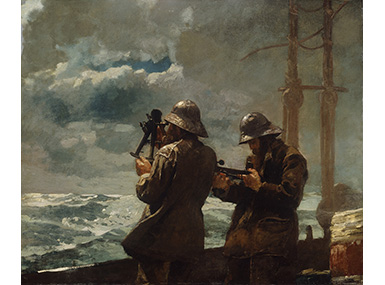

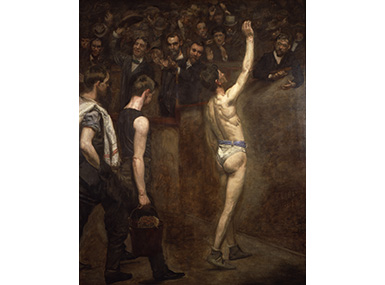

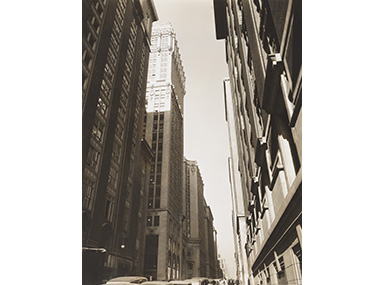
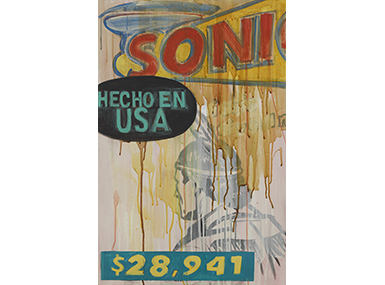
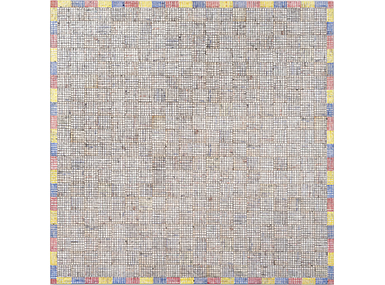









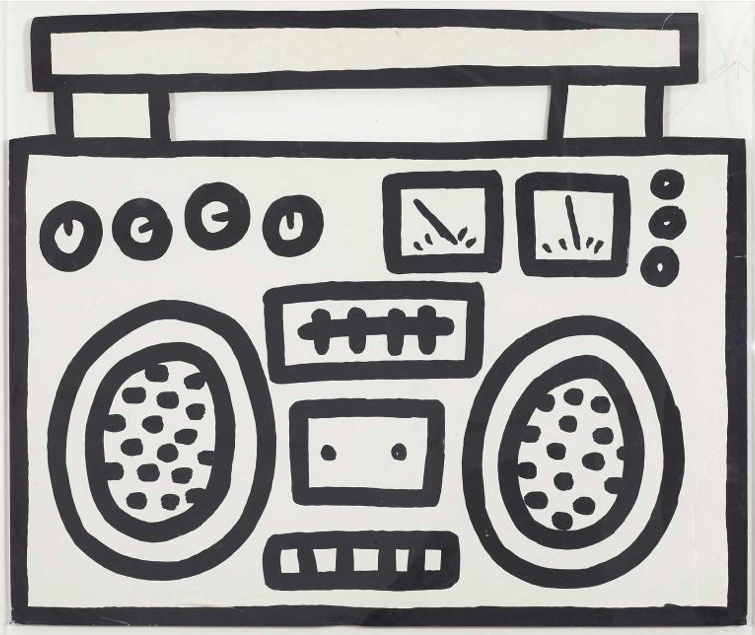
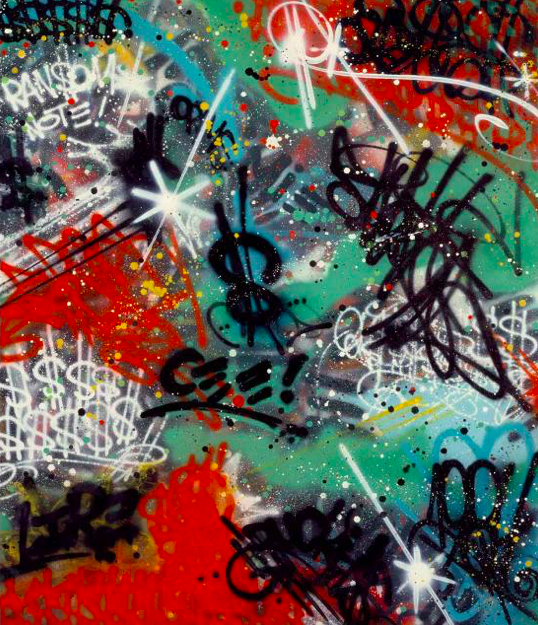





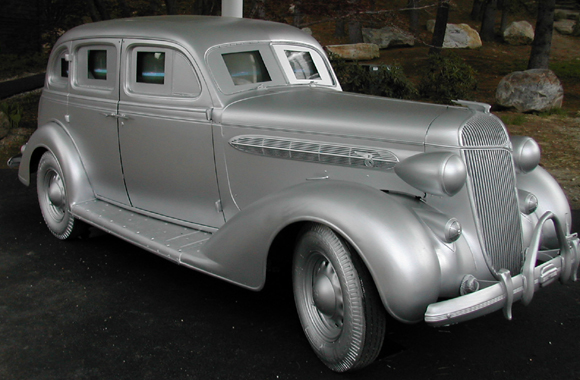



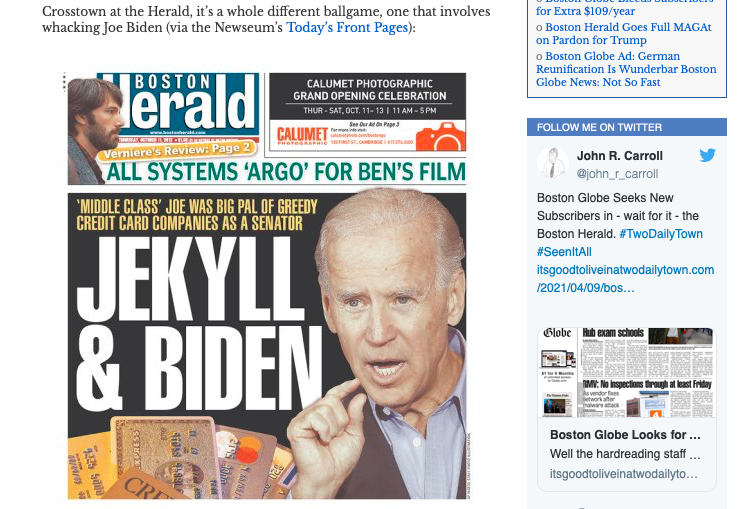
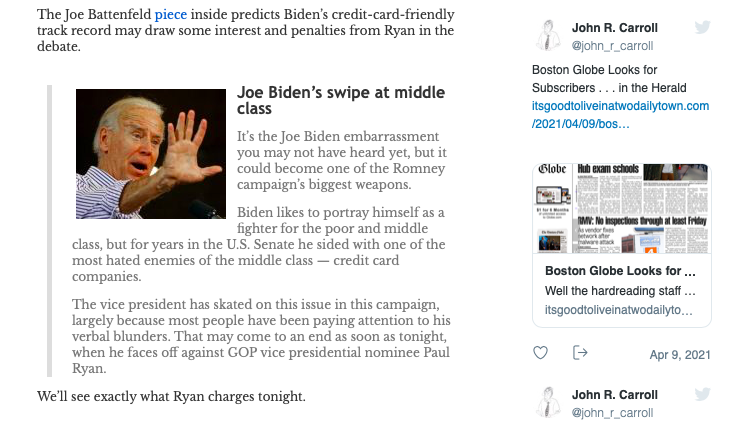
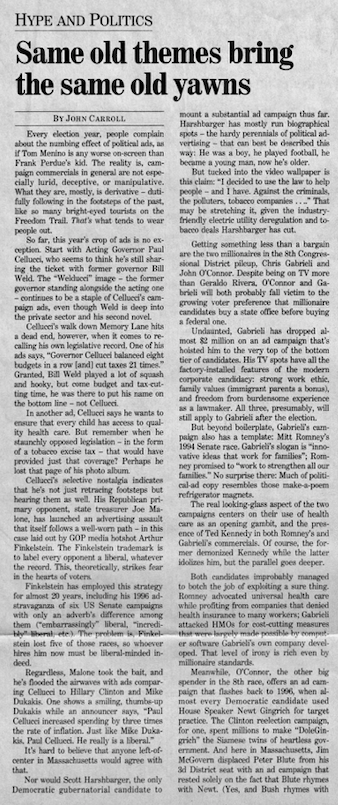
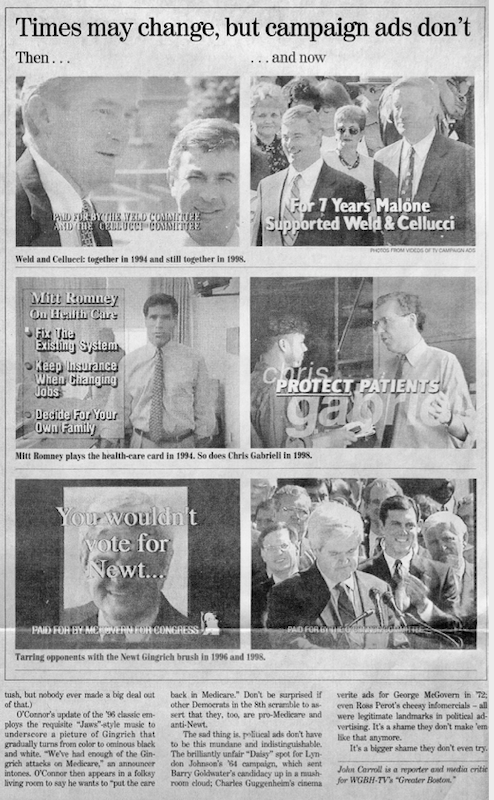
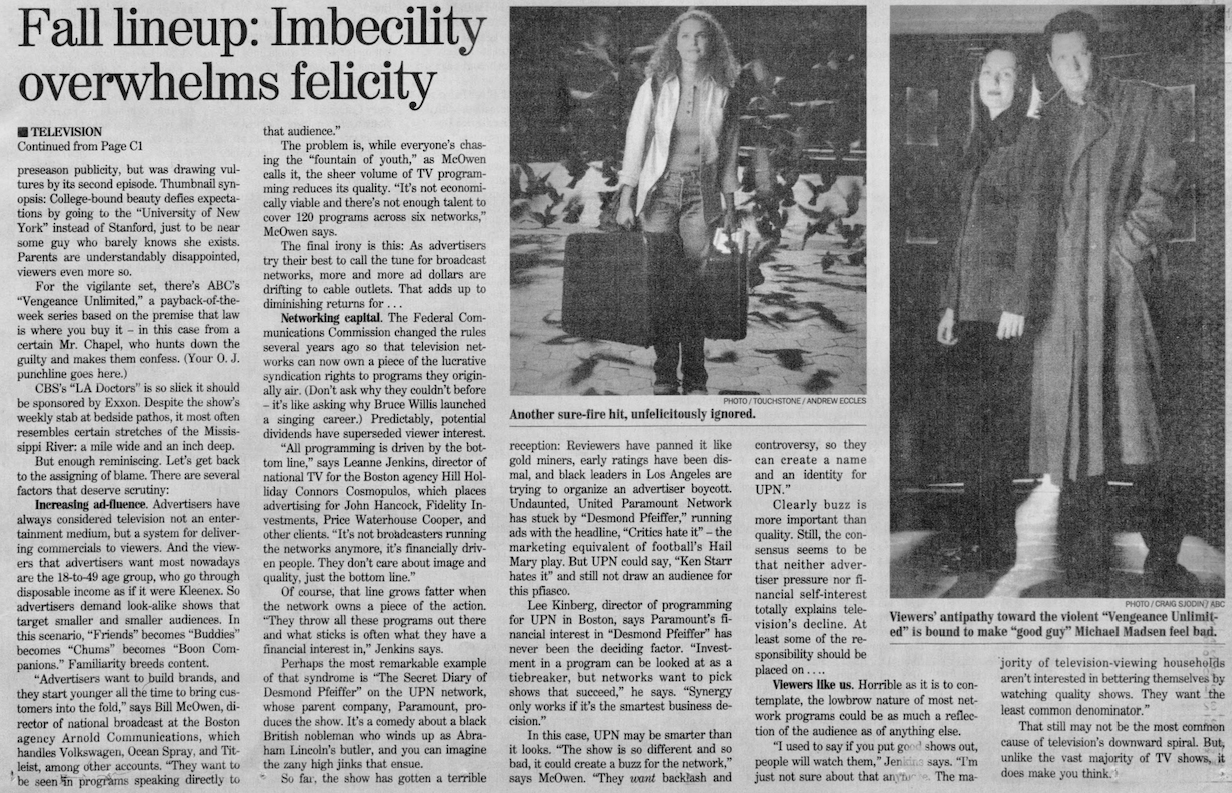
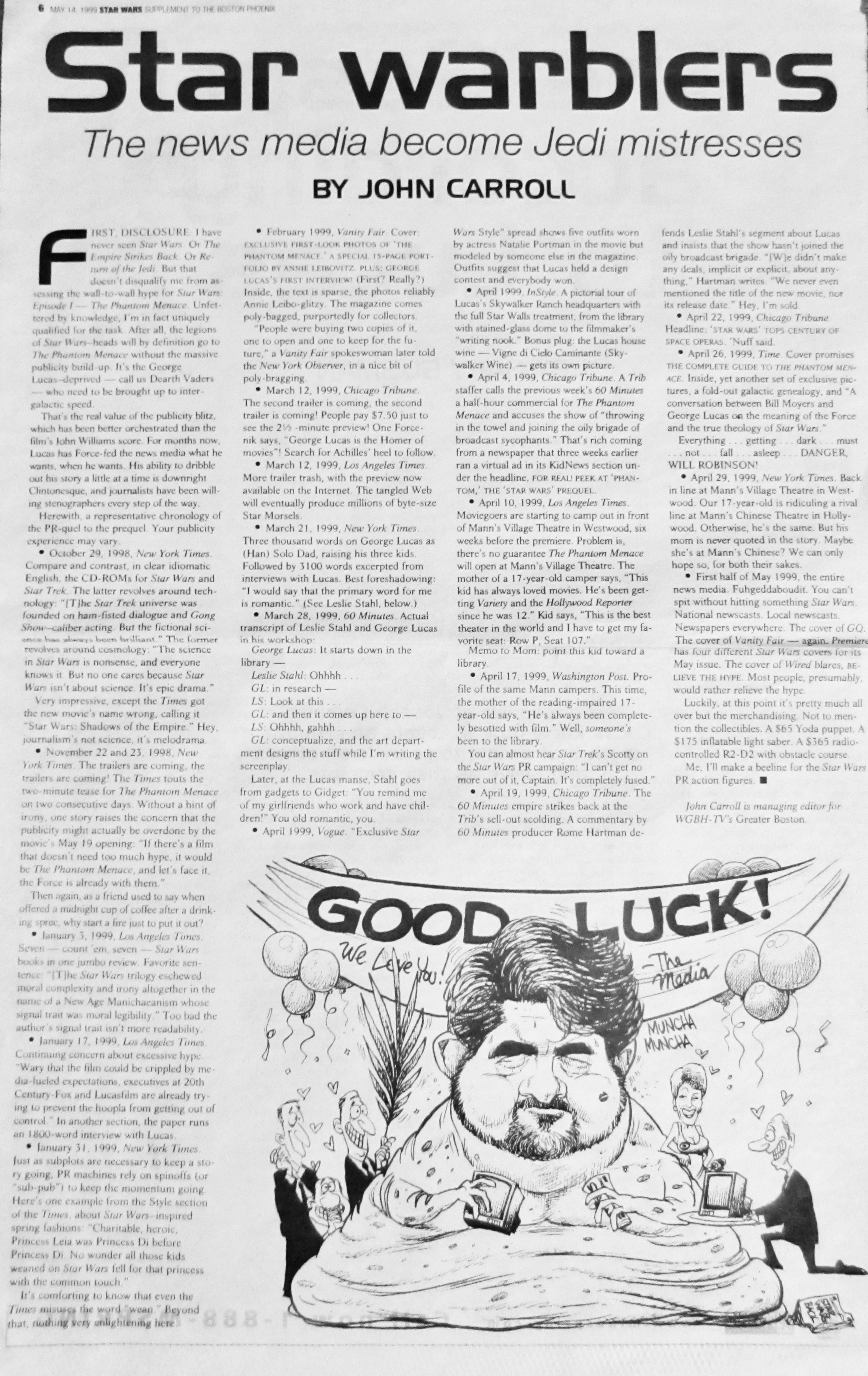
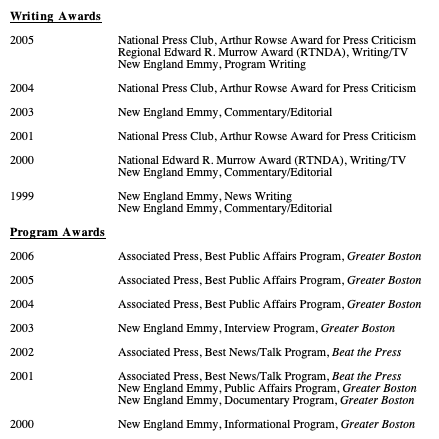
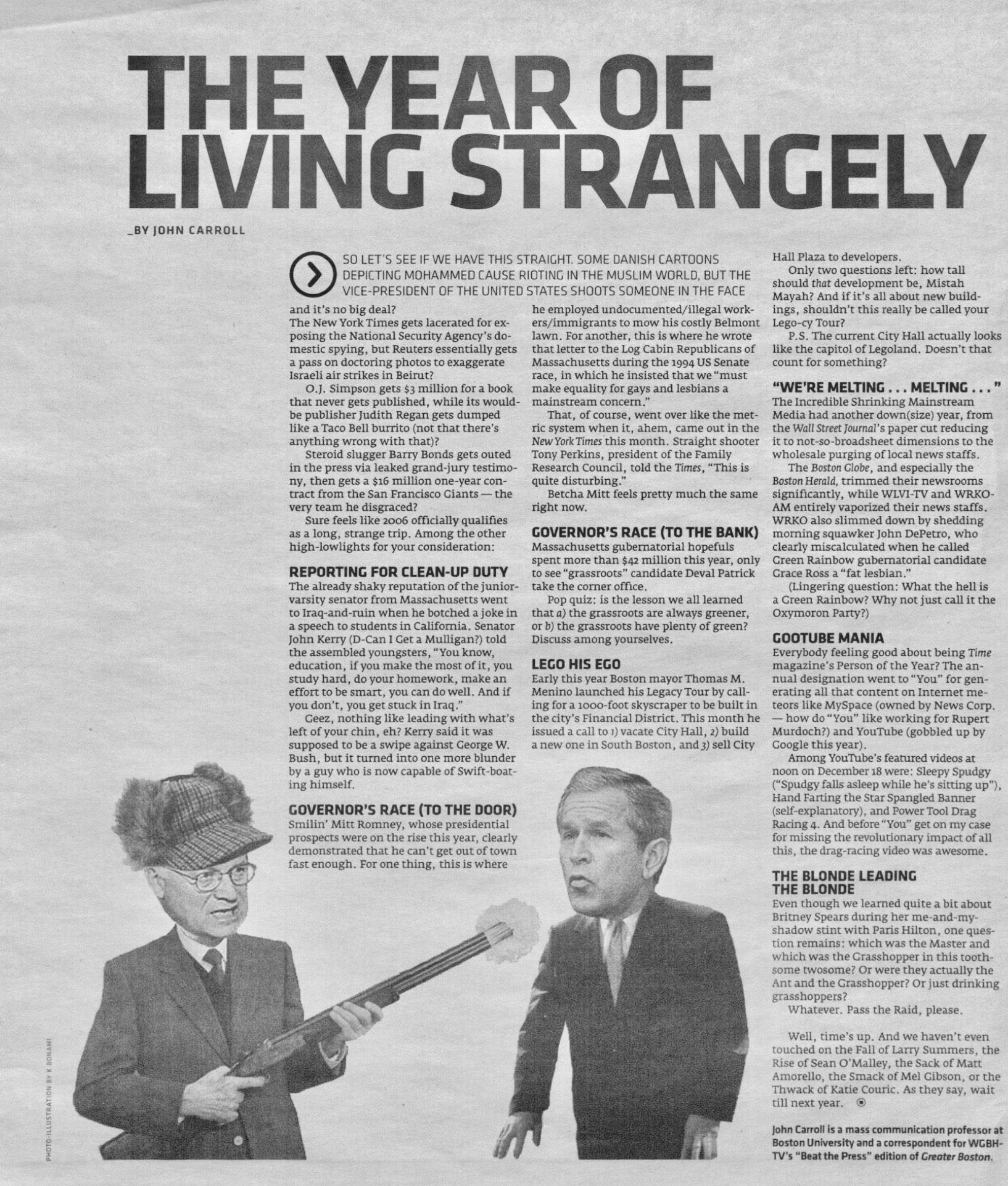

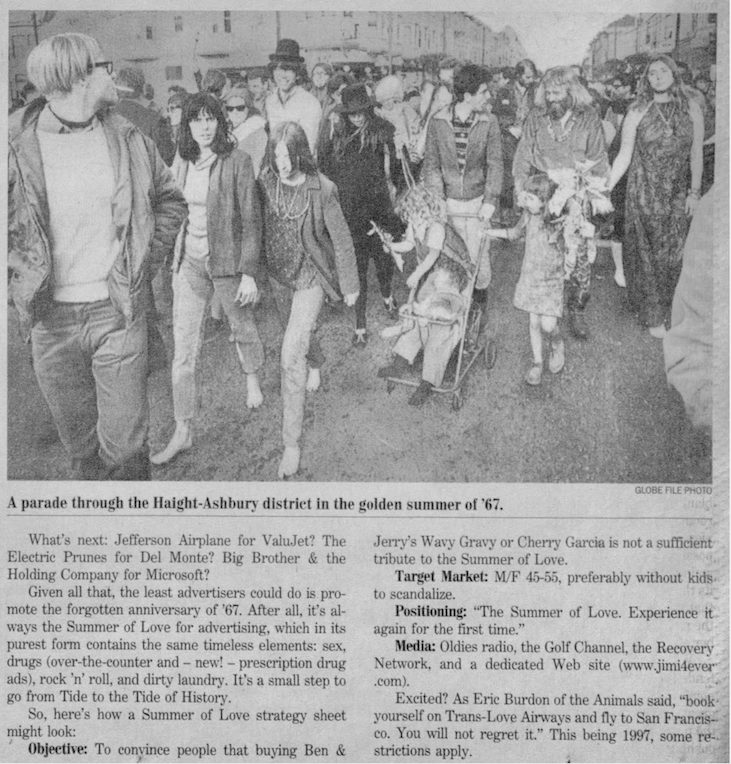
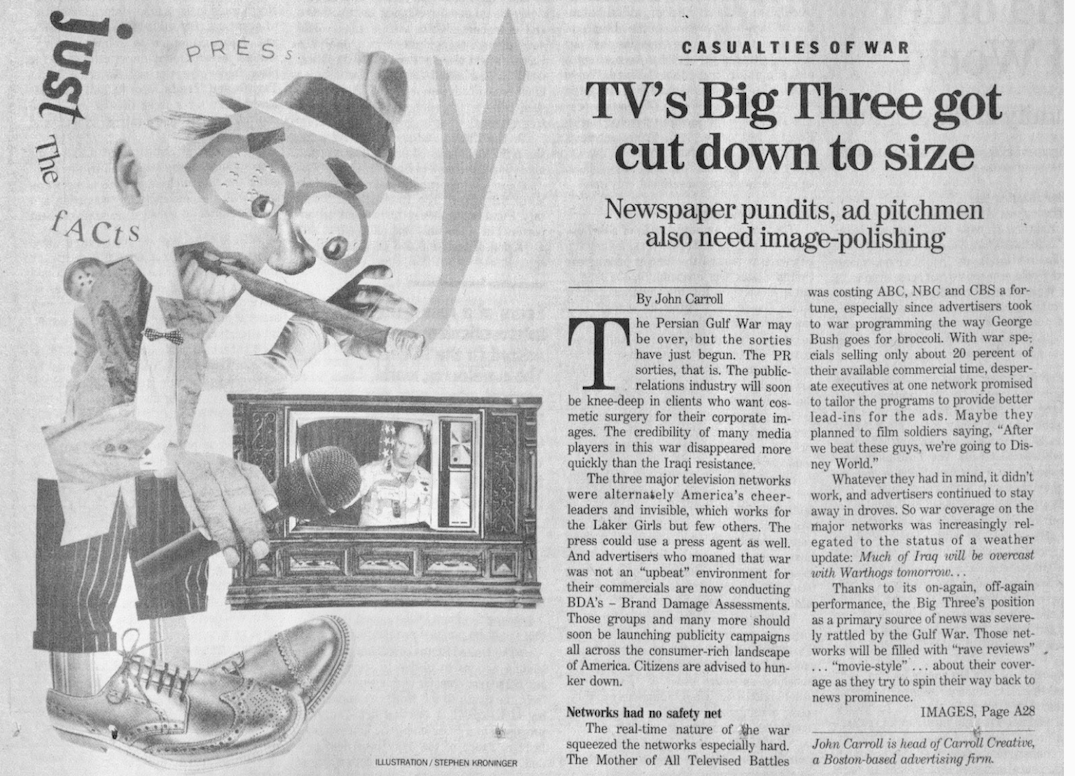
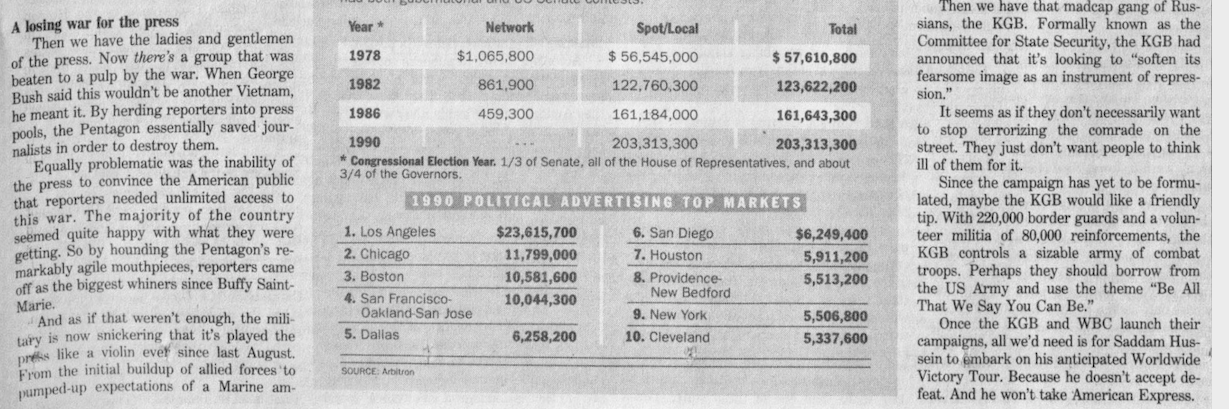
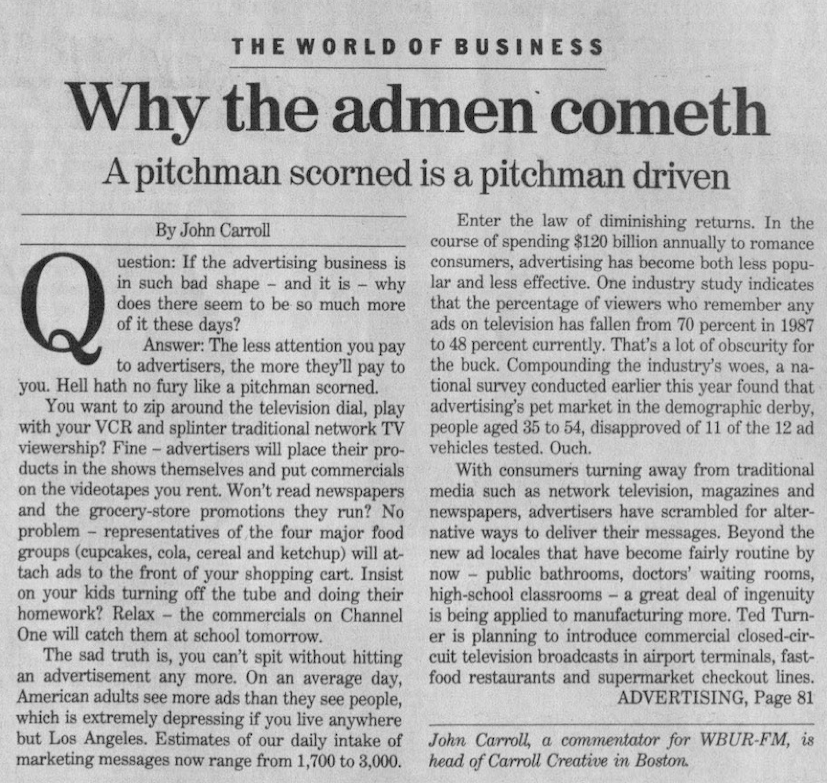
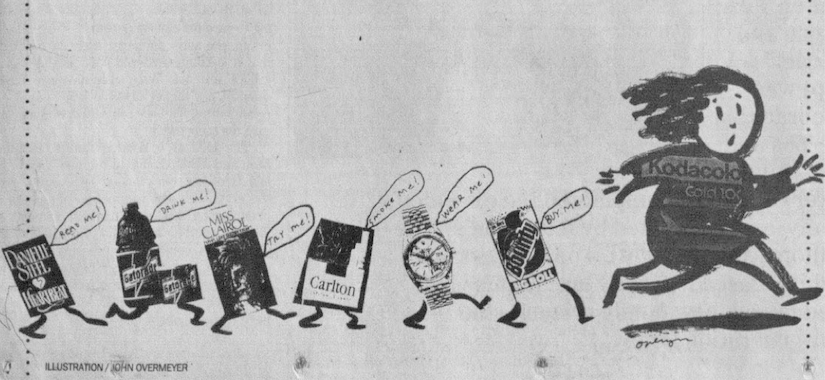
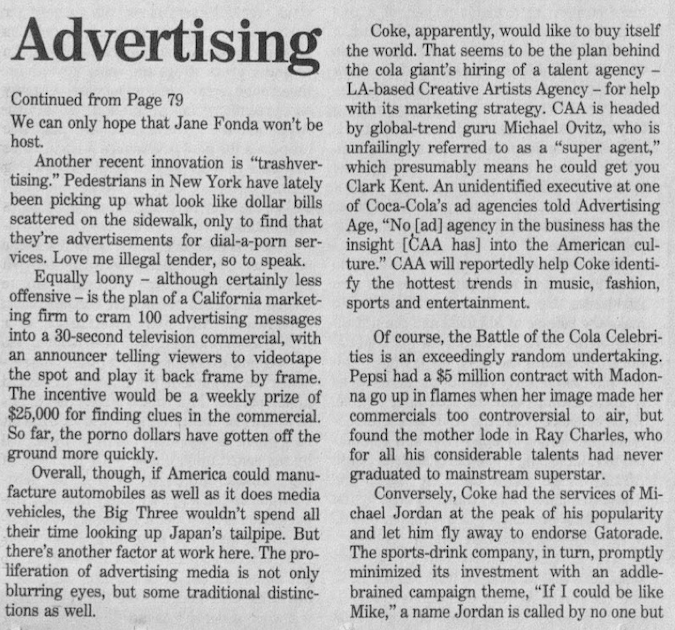
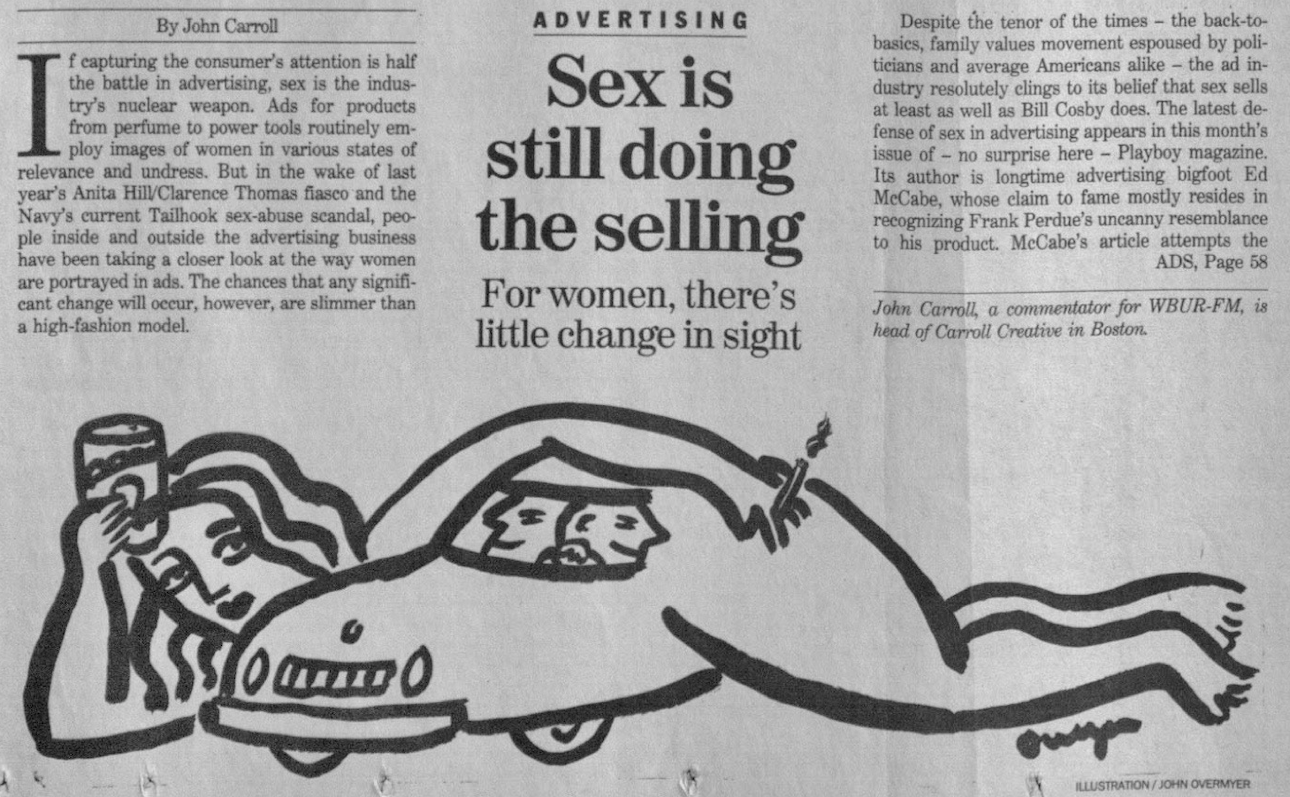
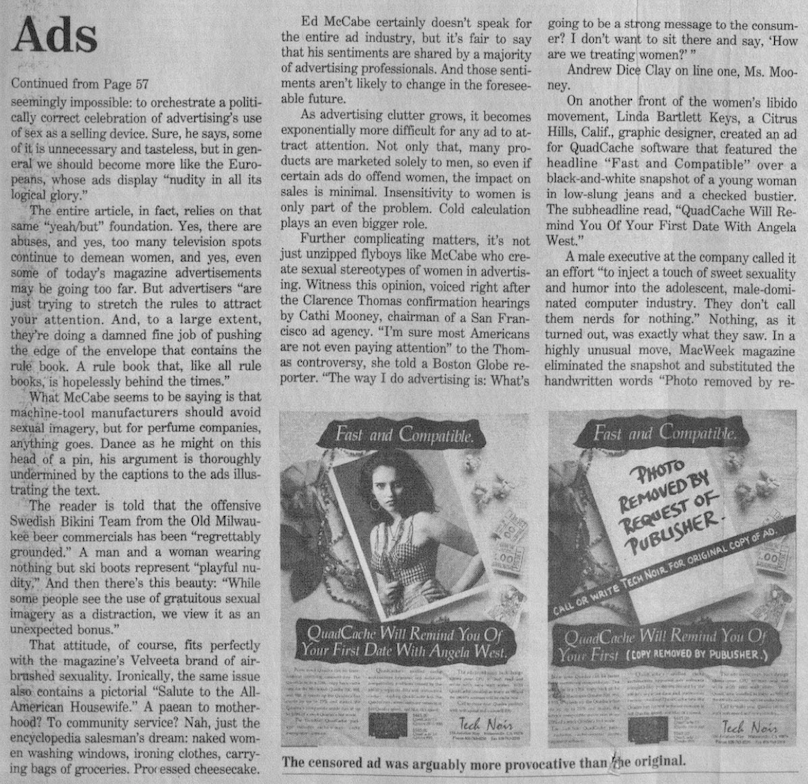
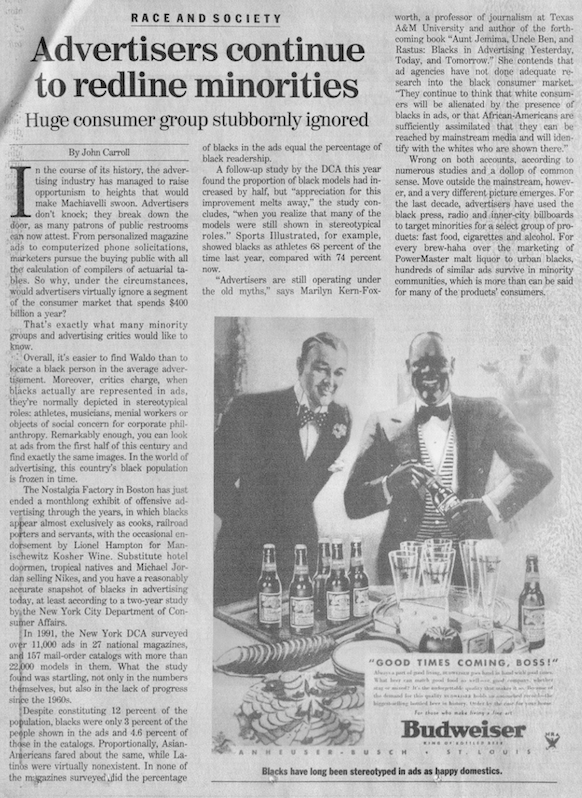
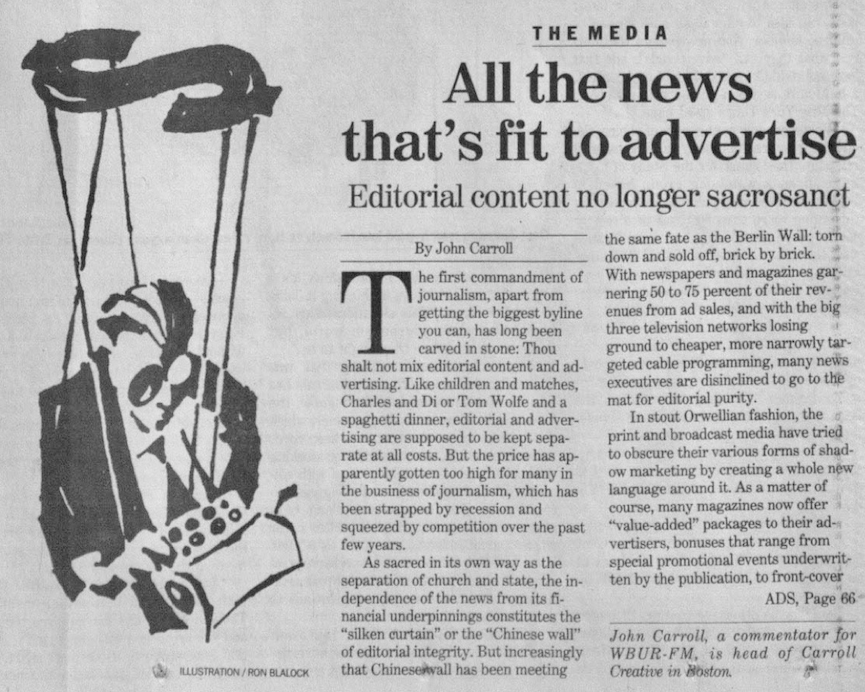
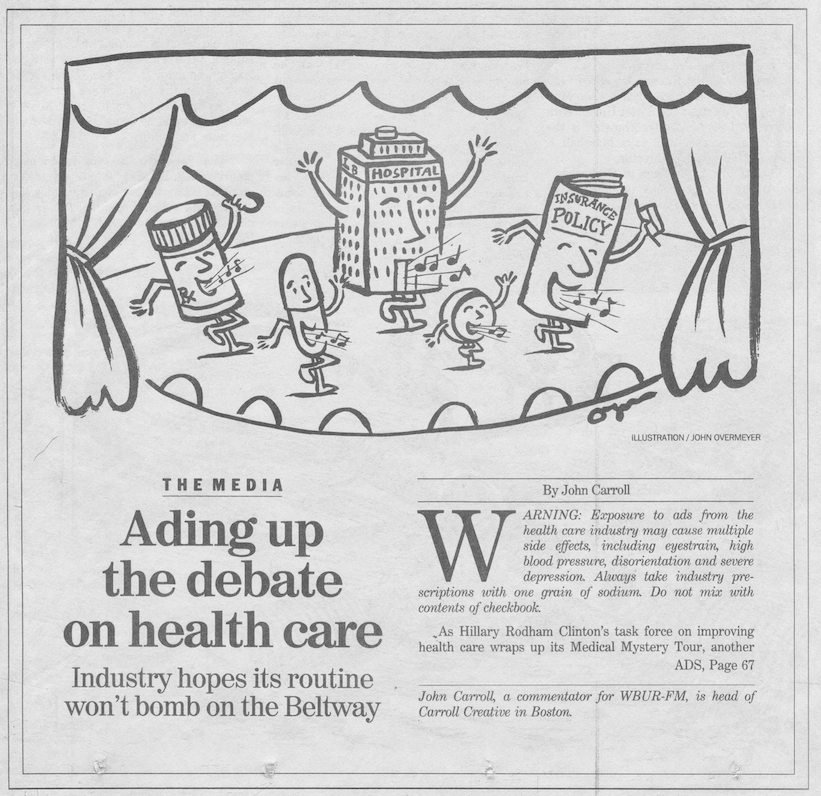
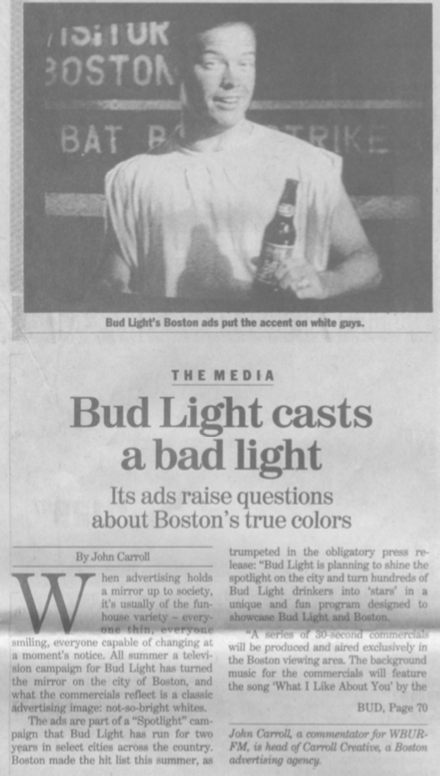
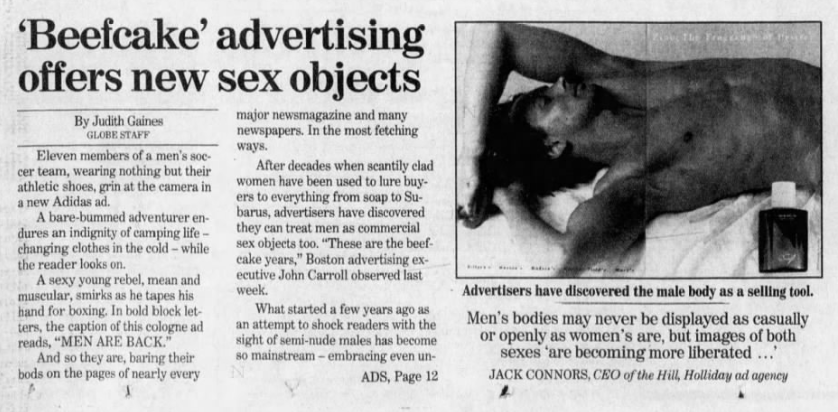
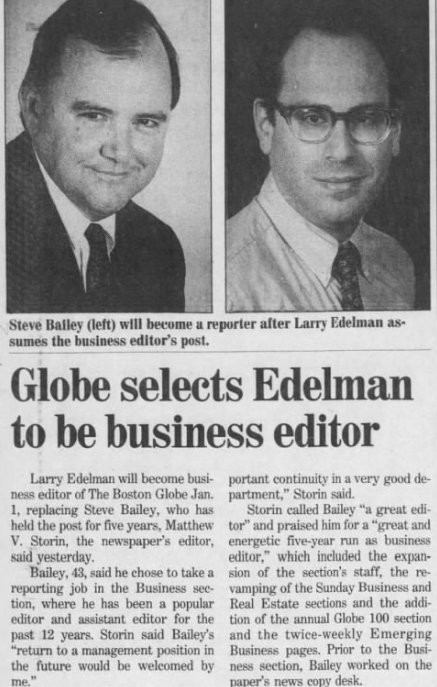
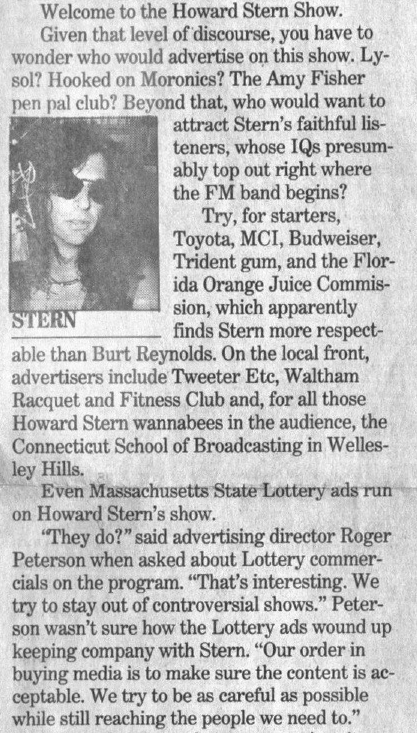
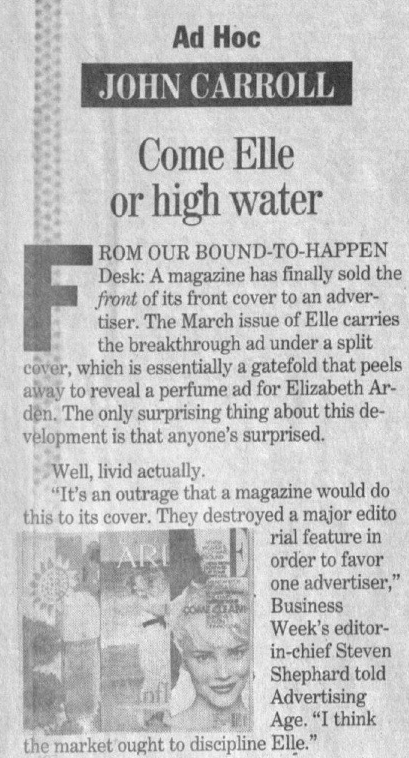
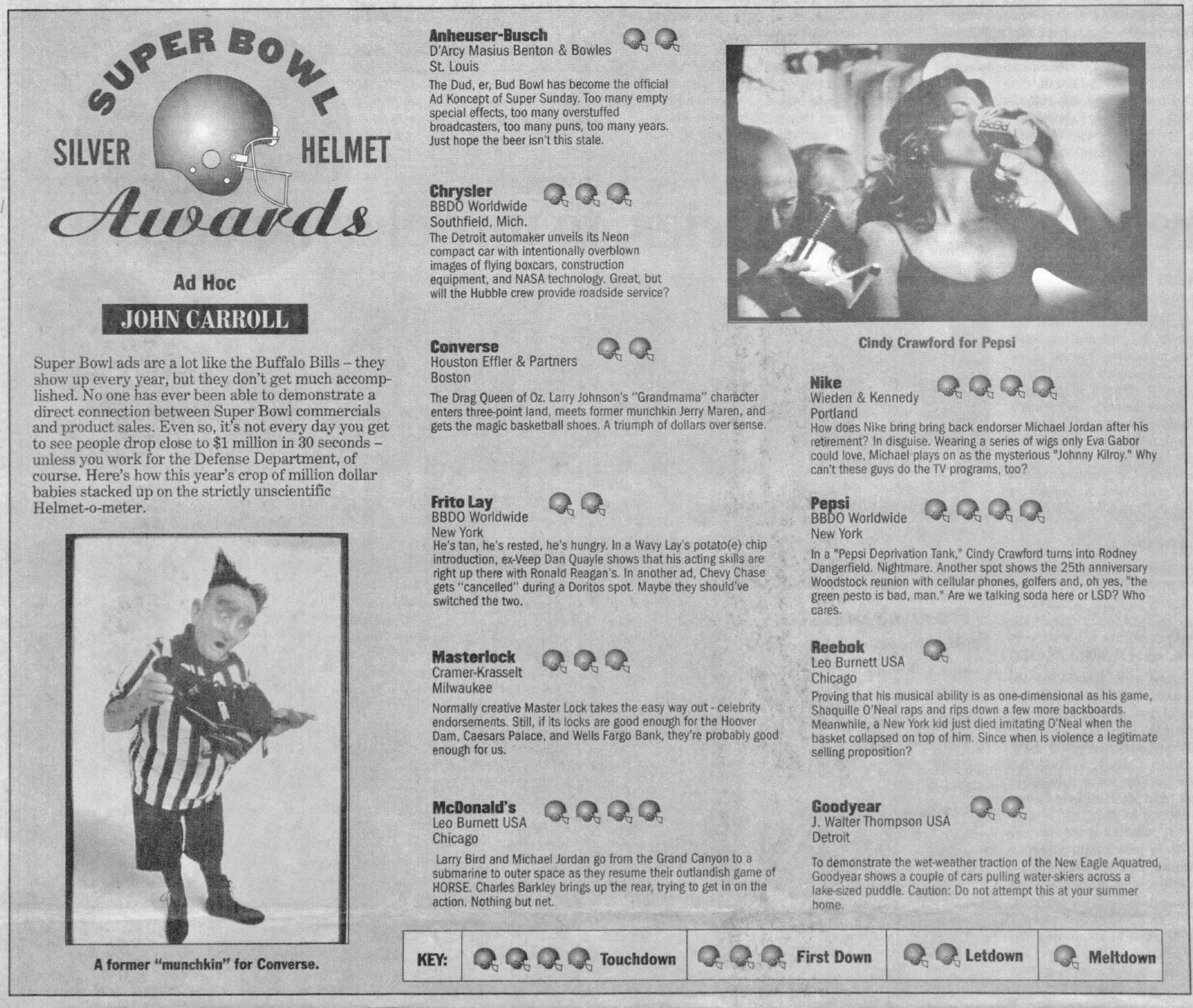




 Campaign Outsider