• He’s one of the big money GOP donors (along with casino mogul Sheldon Adelson and venture capitalist Ken Abramowitz) who are open to grubstaking multiple candidates, but not Rand Paul
Music maven Taylor Swift is getting all kinds of kudos for taking a bite out of Apple Music’s effort to strong-arm independent labels into getting no royalties for the new streaming service’s trial period.
Apple Signs Thousands of Independent Labels in Royalty Deal
The turning point in Apple’s talks with the music industry came late Sunday night, when — after a rebuke from Taylor Swift — the company reversed course on a proposal to not pay royalties during test drives of a new streaming music service.
But for thousands of small record companies for whom Apple is a crucial source of income, a crisis had already been in effect for two weeks, and was resolved only late Tuesday, when the independent groups agreed to licensing terms with the tech giant.
The Guardian’s Eamonn Forde is even more adamant about the independent labels exercising more pressure than Swift.
Taylor Swift: does Apple’s climbdown really demonstrate her power?
It’s possible that bowing to Swift was merely good PR for Apple – but its real fear was of losing the right to stream music from independent labels
The neat narrative would run that Taylor Swift, the planet’s biggest pop star, went toe to toe with Apple, the wealthiest company in corporate history, over its decision not to pay musicians and songwriters royalties for music its subscribers listened to during their three-month free trial to its streaming service Apple Music. She didn’t blink and Apple backed down. Taylor saved the day.
Except that the real story is far less simple. The Tumblr post in which Swift criticised “this historically progressive and generous company”did not happen in a vacuum. Last week, there had been rumblings among independent labels that quickly built to a thunderstorm. Record companies and trade bodies in the UK, the US, Germany, France and Australia piled in and said they were not doing deals with Apple until it agreed to pay them during the free trials. Collectively, the protesting labels – which included Beggars Group, home to Adele and Britain’s largest indie – represented about a quarter of the global market. Not to have Swift’s album 1989 on Apple Music, when it launches at the end of the month, is one thing; to be missing tens of millions of songs from independent acts is a whole other matter.
So, to recap:
Maybe Taylor Swift was the loss leader in Apple’s capitulation.
And maybe the independent labels were the real reason Apple folded.
Furniture mavens Bernie & Phyl are like baked beans & cod – New England traditions. For decades the couple – and their kids – have produced the most toe-curling commercials on Boston television.
Representative sample:
But now – what should we call the reconstituted couple? – Beryl! have gone all Gotham on us, hiring trendy New York ad agency DeVito Verdi (who also produce ads for Herb Chambers and Legal Sea Foods) and airing a new set of Bernie & Phyl commercials that are terminally hip.
Look – Bernie & Phyl have earned the right to do whatever they want. But naked guys? Thank goodness they hired an actor for the spot.
Meanwhile, DeVito Verdi’s Boston Massacre of local ad agencies continues, as the New York shop keeps snatching up local icons. From a recent Boston Globe piece:
The head-turning irreverence of the campaigns seems to appeal to Boston sensibilities. DeVito/Verdi now has more clients in Massachusetts than in New York. Besides Chambers and Suffolk [University], Fallon Health, Bernie and Phyl’s, Tribe Hummus, and City Sports have all signed on since last summer.
Of course, that head-turning irreverence doesn’t always work out: Suffolk pulled its ads shortly after they launched, and the Legal Sea Foods campaign has gotten the fisheye from numerous critics.
Still, say goodbye to Bernie & Phyl. And say Pharewell to yet another Boston institution.
News organizations are under no obligation to provide a platform to every narcissistic buffoon who declares himself a candidate for the White House. It’s probably futile to expect the networks hosting the Republican primary debates to exclude a ratings magnet like Trump, but they should. His presence on the stage will be degrading to everyone in the room. Even if the other contenders run rings around Trump on substance, his insults and idiocies will stain them all by association.
Do the GOP’s serious candidates really want to share the spotlight with a loudmouth who spent much of the last presidential election cycle trafficking in “birther” theories?
Then again, do serious journalists want to give the spotlight to a loudmouth who spent much of the last presidential election cycle trafficking in “birther” theories?
Ay, there’s the rub.
A suggestion for news outlets worldwide: Adopt the official Campaign Outsider Bill O’Really Policy™.
The hardworking staff once toiled at a local public broadcast station, and our single mandate to the newsroom was this: Nobody can mention Fox Newshound Bill O’Reilly unless 1) there is blood involved, or 2) he’s on a police blotter.
It worked great then. It could work even better now as the Donald Trumped-Up Policy (pat. pending).
Well the Missus and I trundled out to Watertown’s Arsenal Center for the Arts yesterday to catch the Flat Earth Theatre production of The Farnsworth Invention and say, it was swell.
From the website:
From screenwriter/playwright Aaron Sorkin, who brought us The West Wing and The Social Network, comes a whirlwind history of the controversial invention of the television. Philo Farnsworth, a child prodigy raised on a farm in rural Idaho, has overcome adversity to create a groundbreaking device never before achieved. Simultaneously, the self-made media mogul David Sarnoff has collected a team of geniuses to uncover Farnworth’s missing piece through any means necessary. The Farnsworth Invention moves fluidly from spell-binding to heart-breaking in this kinetic spectacle that confronts how history is remembered.
It’s a terrific – if factually challenged – production of the 2007 Aaron Sorkin play (and, yes, it’s predictably verbose and overlong). But it’s also appealing and moving – thanks to fine performances by Chris Larson as Farnsworth and Michael Fisher as Sarnoff.
The other cast members are adroit playing multiple roles, and director Sarah Gazdowicz reduces some highly technical material into intelligible theater.
Only bad news: The Missus tells me that the run, through June 27, is sold out.
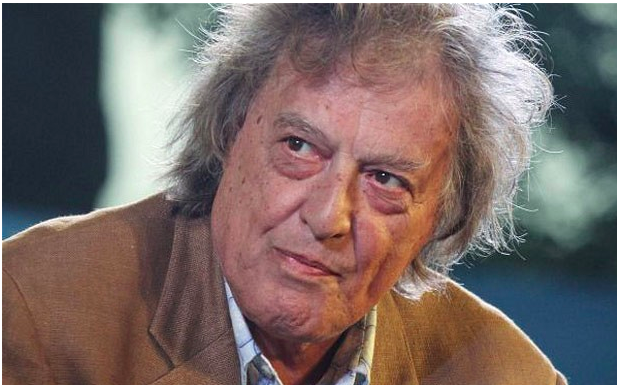
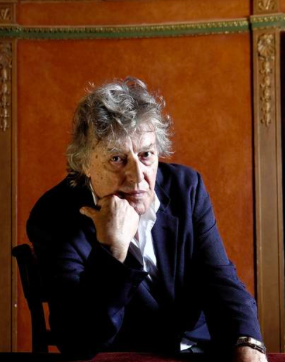
Several months ago British playwright Tom Stoppard created a tempest in a theaterpot with an interview he gave to the Telegraph.
Quiz: Are Tom Stoppard’s plays too clever for you?
As the playwright says he has to dumb down his jokes for today’s theatregoers, pit yourself against Tom Stoppard’s fearsome intellect with this quiz
The plays of Tom Stoppard are known as much for the scope of their themes and ideas as his dazzling wordplay and the uncompromising intellectual leaps required of the audience.
For The Hard Problem – the first play from theatreland’s philosopher king in almost a decade – he has tackled the mysteries of the mind and the nature of consciousness. But he claims to have “dumbed down” some lines, removing key historic, literary and scientific references in order that his play’s message is better understood by today’s theatregoers.
Tom Stoppard, the English-speaking world’s brainiest playwright, thinks that British audiences have grown too dumb to understand his plays. In a February interview with the Telegraph that was occasioned by the National Theatre’s London premiere of “The Hard Problem,” his latest play, Mr. Stoppard complained that he now has to water down his punch lines: “It’s very rare to connect an audience except on a level which is lower than you would want to connect them on….You could raise it a notch and you might lose an eighth of them….I really resent it.” By way of illustration, he mentioned a scene in “Travesties,” one of his earlier plays, that contains a joke which hinges on knowing the name of Goneril, King Lear’s oldest daughter. “In 1974,” he said, “everybody in the audience knew who Goneril was and laughed. In about 1990 when the play was revived, maybe half knew.”
But that’s okay, Teachout notes, according to some of this generation’s educators.
Just the other day, the Washington Post published a rant by Dana Dusbiber, who teaches English at an inner-city school in Sacramento, Calif. Not only does Ms. Dusbiber happily admit to “disliking” Shakespeare, but she wants to “leave Shakespeare out of the English curriculum entirely.” Her preferred replacement is “the oral tradition out of Africa, which includes an equally relevant commentary on human behavior.” She believes that Shakespeare’s plays are no longer relevant to the lives of the “students of color” whom she teaches: “Shakespeare lived in a pretty small world. It might now be appropriate for us to acknowledge him as chronicler of life as he saw it 450 years ago and leave it at that.”
Except, as Teachout writes,”[If] you’ve never seen or read, say, ‘Hamlet,’ then you will be utterly incapable of understanding ‘Rosencrantz and Guildenstern Are Dead,’ the 1966 philosophical comedy in which Mr. Stoppard placed two of the minor characters from ‘Hamlet’ at center stage and built a coruscatingly brilliant, endlessly thought-provoking masterpiece around their absurd follies. It will be a closed book to you, one whose covers you’ll find it impossible to pry apart.”
As it happens, Rosencrantz and Guildenstern Are Dead is the first stage play I ever saw, back in the ’70s. And it was a coruscatingly brilliant, endlessly thought-provoking masterpiece. Its inside-out version of “Hamlet” was a total revelation, opening up a whole new literary landscape.
And it’s not just Tom Stoppard who suffers from the defining down of the English curriculum. A dozen years ago Slings & Arrows debuted on Canadian television. The series, which chronicled the trials and tribulations of the New Burbage Festival, ran for three fabulous seasons – one revolving around the Festival’s staging of “Hamlet,” one revolving around “Macbeth,” the final around “King Lear.”
It was absolutely stunning – funny, smart, beautifully written, superbly acted – everything you could want from an artistic work.
From Season 2, when the director Jeffrey changes the opening-night staging on the fly to shake up the egomaniacal, mail-it-in actor playing Macbeth.
A total hoot. (The actor cold-cocks Jeffrey when the play ends.)
There are maybe 17 American high school seniors who would get that episode.
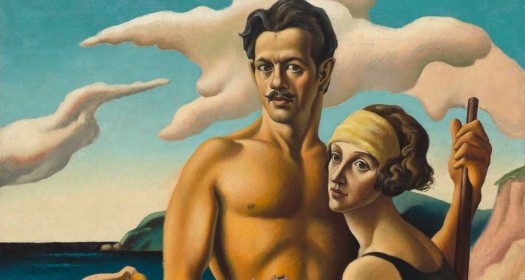
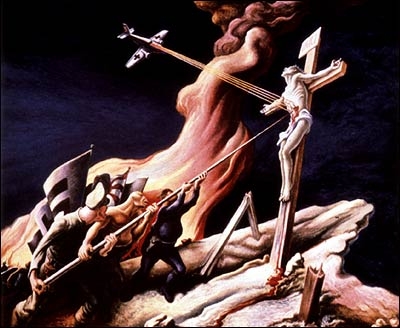
This is the first major exhibition on Thomas Hart Benton (1889-1975) in more than 25 years and the first to explore important connections between Benton’s art and the movies. After working briefly in the silent film industry, Benton became acutely aware of storytelling’s shift toward motion pictures and developed a cinematic style of painting that melded European art historical traditions and modern movie production techniques. In paintings, murals, drawings, prints and illustrated books, Benton reinvented national narratives for 20th-century America and captivated the public with his visual storytelling.
Yeah . . . except his visual storytelling was often hackneyed, according to critics, or overwrought, as in his World War II Year of Peril paintings.
Representative sample:
‘Nuf ced about that.
Benton was an odd – if celebrated – duck, and PEM’s show of his Hollywood-related work is an odd – if well-mounted – exhibit. (Through 9/7/15)
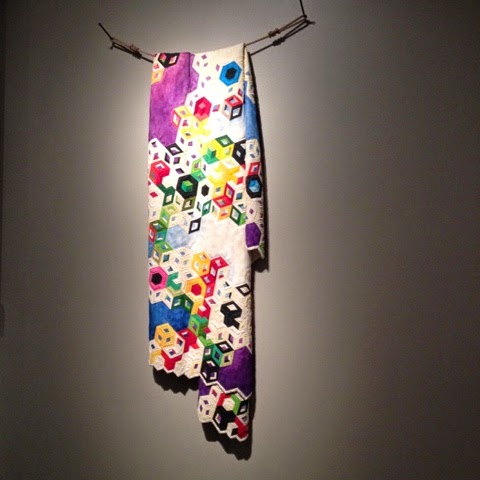
One of the most influential photographers of the 20th century, Duane Michals (b. 1932) is credited with pioneering new ways of considering and creating photographs. Running counter to the prevailing conventions of photography, Michals began working with sequences of images and multiple exposures, often overlaying hand-written messages and poems. Michals identifies himself a storyteller and through his work explores universal life experiences such as dreams, desire, love and mortality. He has noted: “I’m not interested in what something looks like, I want to know what it feels like … a realm beyond observation.” Organized by the Carnegie Museum of Art, this exhibition presents more than 200 works and provides a definitive retrospective of the artist’s career.
(To be honest graf goes here)
To be honest, the photographs of Duane Michals demand much more attention than I was willing to devote to them. Regardless, they’re largely interesting, and on display until tomorrow.
So . . . Milt Chamberlain, played by Josh Duhamel, is an FBI agent reassigned from the Detroit Field Office to the Battle Creek bureau, which is like David Ortiz being shipped off to the Cape Cod League.
Russ Agnew, played by Dean Winters, is the cynical local cop who gets teamed up with Chamberlain, and there’s just one thing Russ wants to know: What did Milt do to get himself sent to Battle Creek?
SPOILER ALERT!
You can either watch the final episode here, or you can read on.
Seems several years earlier Milt had used a kid he busted on pot charges as a confidential informant to bring down a drug kingpin, which subsequently got the kid killed. So it was off to Battle Creek with him.
And there’s the Brian Williams connection. Williams has been demoted to MSNBC (the Battle Creek of cable TV) because he used a bunch of lies to elevate his profile, which subsequently killed his credibility.
More bad news for Williams: He’s nowhere near as good-looking as Duhamel. (See here for details.)
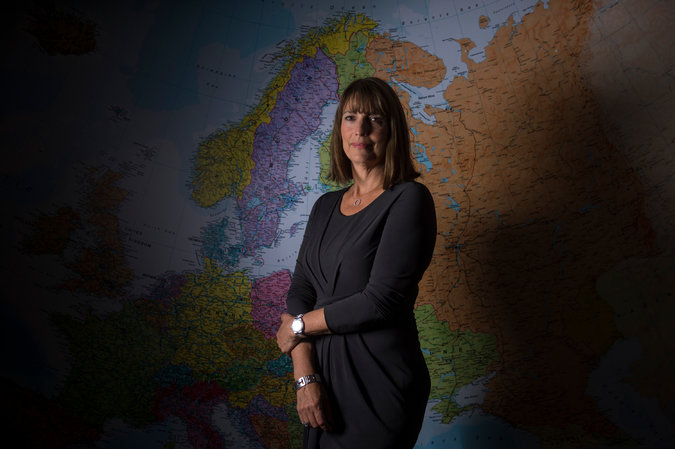
Yesterday’s New York Times Business section featured this Nicola Clark profile of easyJet chief executive Carolyn McCall.
EasyJet Chief Leads Airline Through Turnaround
LONDON — Early in a May conference call with journalists to discuss easyJet’s first-half results, Carolyn McCall, the low-cost airline’s chief executive, seemed puzzled to find herself being grilled about toilets.
Was it the case, several reporters were keen to know, that a planned shift of easyJet’s lavatories toward the tail section would make the ceilings too low for some male passengers to, you know, stand up?
“We don’t believe customers will notice it,” Ms. McCall said of the change in easyJet’s fleet of Airbus A320s, which had just been announced that morning as a way to make room for a row of passenger seats. “We’re not going to do something that reduces customer satisfaction.”
Interestingly, the Times piece never mentions the recent high-profile case of customer dissatisfaction with easyJet.
‘Disruptive’ Kate Moss ‘called pilot a basic b*tch’ while being escorted off easyJet plane by police
Supermodel Kate Moss reportedly called the pilot of an easyJet flight a “basic b*tch” as she was escorted off a plane by police this weekend for apparently being “disruptive”.
A passenger on board the flight told MailOnline they heard Moss making the comment as she was being escorted by police.
The passenger said Moss had not behaved aggressively towards any one on board and that the incident, in which Moss had been labelled “disruptive”, had instead been “funny”. They also claimed the cabin crew had acted out of proportion to the situation.
There are, of course, other perspectives on the supermodel’s behavior, but The Daily Beast’s Teo Bugbee did call Moss the least basic bitch.
Regardless, the Times didn’t call her anything in its easyJet piece.
Well the hardworking staff was cleaning up some of the piles of reading material scattered about the Global Worldwide Headquarters when we came across this recent piece by The Weekly Standard’s Matt Labash.
Transjennered America
Hero worship in our time.
For as long as I can remember, I’ve been ignoring Bruce Jenner. As a child of the ’70s, I ignored him in the cereal aisle, where his Olympic-champion mug couldn’t entice me to pick his terminally bland Wheaties over more healthful Sugar Smacks. I ignored him in the ’80s, during his star-turn in Can’t Stop the Music, a disco-tinged Village People biopic that saw him nominated for a Golden Raspberry Award for worst actor. In the ’90s, I don’t recall Jenner at all, as I was rather busy ignoring him.
By the mid-2000s, however, Jen-ner had become much more difficult to ignore. He’d plighted his troth to the Kardashian clan, America’s First Family of publicity tapeworms, who are as long on fame’n’money as they are short on talent, unless you consider leaked sex tapes and Instagram butt-selfies a talent.
And etc. Pretty much Standard-issue Labash. But it was the illustration (by Jason Seiler) that struck us as really, er, below the belt.
C’mon – was that necessary? Vanity Fair might have gone overboard with the photoshopping of its Caitlyn Jenner cover shot, but this just feels . . . gratuitous.
The hardworking staff has studiously avoided passing judgement on the highly choreographed rollout of the new – or real – Jenner, not to mention the overcaffeinated reaction to it. But we couldn’t pass this one over in silence.








 Campaign Outsider