When the hardworking staff went to grab this post to scale out on Twitter, we discovered this at the bottom:
No idea how it got there, no idea where it went (haven’t seen it again). Certainly haven’t seen any money for it.
What’s up with that?
When the hardworking staff went to grab this post to scale out on Twitter, we discovered this at the bottom:
No idea how it got there, no idea where it went (haven’t seen it again). Certainly haven’t seen any money for it.
What’s up with that?
New York Times stat-cat Nate Silver had a knee-Bucknering piece yesterday charting the Red Sox September collapse:
The Boston Red Sox odds of reaching the playoffs peaked on Sept. 3. Following a 12-7 win against the Texas Rangers, they held a 9-game lead over the Tampa Bay Rays with 24 games to play, giving them a 99.6 percent chance of making the post-season.
Even more knee-buckling:
And that is only part of the story. More unlikely still was the Rays’ comeback against the Yankees, without which the Red Sox would have had an opportunity to redeem themselves in a one-game playoff. Trailing 7-0 in the 8th inning, the Rays’ winning chances were all the way down to 0.3 percent — about 300-to-1 against — before they scored 6 runs in the bottom of the inning.
It just gets worse from there. Read it and reap.
The King James Bible – the bestselling book of all time and the most quoted book in the English language – is celebrating its 400th anniversary this year.
And the King James translation is hot.
Start with On Eagles’ Wings: The King James Bible Turns Four Hundred at New York’s Museum of Biblical Art (through October 16).
The exhibition [explores] the historic context in which the King James Bible was translated and published beginning with an examination of its predecessors, most notably the Bishop’s Bible sponsored by Queen Elizabeth I in 1568 and singled out as the model to which the translators commissioned by King James were to follow as closely as possible.
Then check out Manifold Greatness: The Creation and Afterlife of the King James Bible,
at the Folger Shakespeare Library in Washington, D.C., described by the New York Times this way:
[Y]ou will see not only manuscripts going back to the year 1000, an early translation from the 14th century, Queen Elizabeth I’s copy of the Bible, and imposingly bound versions of the King James; you will also sense the gradual birth of the modern English language and the subtle framing of a culture’s patterns of thought.
Sounds like fun, yes?
Ashton Kutcher is still not sweating the details.
Last month the newly minted “Two and a Half Men” star was called a massive media whore by Gawker (the massive media pimp) for conflicts of interest regarding a special online issue of Details that he edited, in which he promoted certain stocks without disclosing his investment in them.
Now comes this, via MediaPost:
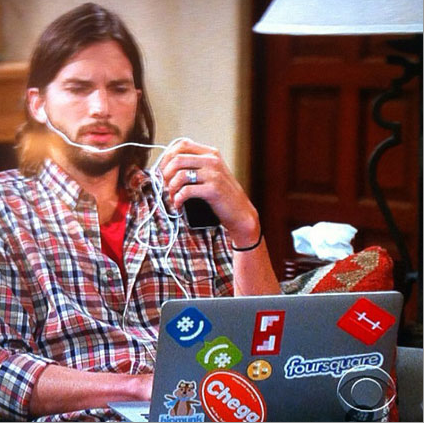
So this week on “Two and a Half Men,” when Ashton Kutcher’s new Internet billionaire character, Walden Schmidt opened his laptop, lo and behold we saw some stickers of real-life companies including FourSquare, Groupon, Chegg and Flipboard.
“Men” executive producer Chuck Lorre thought this was OK — even though CBS executives supposedly knew nothing about it. For a producer’s mindset it makes sense: Realistic computer brands add some credibility. Right?
But there are complications — seems that Kutcher has a financial interest (passive?) in those companies. No money was transferred (as far as we know) specifically for this product placement effort.
Nonetheless, CBS is still riled up about it, although “riled up” isn’t what it used to be.
Seems that CBS will have none of it — even if no money was exchanged specifically. It doesn’t want other producers getting the wrong idea. At least it wants knowledge ahead of time.
So, don’t do that. Or if you’re as big as Ashton Kutcher (so far), don’t do that without giving us advance notice.
Tough disclosure policy, eh? As for the viewers, CBS apparently believes they should fend for themselves.
Originally posted on Sneak ADtack
The Wall Street Journal devotes it A-Hed today to the legions of short-suffering Red Sox fans:
With Boston’s Historic Collapse, Red Sox Fans Are Back to Blue
After Team Fails to Win Playoff Spot, a City Mourns; ‘Like a Bad Hangover’
Now that the Sox have folded like origami, it’s all over but the finger-pointing, the Journal notes.
Start with blaming the fans . . .
People are disgusted by the historic choke, but no one can agree on who or what to blame.
Already an undercurrent was bubbling up that the team had become arrogant, drawing Johnny-come-lately fans who wear pink Sox caps and don’t care that much whether or not the team loses.
“The wine-and-cheese crowd,” said Vito DiGregoria, a 52-year-old Boston schoolteacher and lifelong Sox fan.
Toss in some hatin’ on Neil Diamond . . .
For many, a sign of lost passion is that every game, fans ignore any troubles on the field and jump up in the eighth inning to belt out Neil Diamond’s song “Sweet Caroline.”
Even when the Sox floundered this season, “the fans, they didn’t care, they were singing like nothing happened,” said Mr. DiGregoria, who added, “I hate that song. It’s stupid.”
And top it off with a shot to the head . . .
“Something happened psychologically to this team,” said Mark John Bowler, a golf caddie, as he tapped a finger to each temple.
Now you’re ready to begin. The Hot Stove League.
It pretty much got no play in the Boston media, but yesterday was the 35th anniversary of the John Hancock Tower’s opening in Copley Square.
Luckily, the Wall Street Journal ran a fascinating Cultural Conversation with Henry Cobb, the building’s architect.
Nothing about the project was easy, he told the Journal:
“The tower had to be an exception to everything—from afar and up close,” Mr. Cobb said. “The new design would stand alone in the skyline, meaning it needed a dramatic profile. But in the square, it had to honor Trinity Church.”
Mr. Cobb was given just two months in the fall of 1967 to conceive a solution. The model he proposed was a glass tower that ingeniously used several geometric optical illusions to avoid overshadowing the esteemed church.
For one, Mr. Cobb’s plans called for the tower to be clad in mirrored glass, to appear lighter. For another, it would be shaped like a parallelogram, allowing the tower’s wide expanse to be positioned on an angle, facing away from the square. And third, the tower’s rhomboid shape would enable the slender side facing the church to appear only two-dimensional—like a vertical infinity pool or full-length mirror.
“In Copley Square, you would see only the narrow plane and an eight-story base—not the tower’s massive front,” Mr. Cobb said. “The lightness allowed for a symbiosis to emerge between the church, tower and square.”
Mr. Cobb also added an all-important v-notch to the slender plane facing the square, giving it a sense of weightlessness while emphasizing the building’s nonrectangular geometry.
We all know the Plywood Palace aftermath, but Cobb was adamant about the solution:
“I knew the glass problem could be professionally life-threatening,” Mr. Cobb said. “We survived the crisis by acting responsibly. We didn’t run or hide. We didn’t point fingers. We tackled the problem head-on. As soon as we identified its source, we informed Hancock and city officials. The glass had to be replaced—all of it.”
Thirty-five years later, Cobb came to Boston with a Journal reporter to gaze upon what he had wrought:
At dusk, Mr. Cobb and the writer strolled to the far end of Copley Square. As he turned around for a last look, Mr. Cobb stood staring at the building for what seemed like a full minute. “It’s the closest I’ve ever come to poetry,” he said. “As you can see, the building refuses to say anything about itself—other than reflect on the rich formal qualities of Trinity Church below.”
Luckily, Henry Cobb has plenty to say about the building.
WSJ illustration by old friend Ken Fallin
There has been speculation previously that the New York Times might spin off its weekly Dealb%k section into a standalone business new operation.
Yesterday’s Dealb%k Special Section just might revive that talk.
It would certainly be a sm%th move in these parlous economic times.
In perhaps his final game with the New York Mets Wednesday night, vainglorious shortstop Jose Reyes made an inglorious exit.
From the New York Times:
Reyes, in Batting Race, Goes 1 for 1, Then Exits
If Jose Reyes indeed played his last game for the Mets on Wednesday afternoon, his final exit from Citi Field played out in curious fashion.
Reyes, who will be a free agent after the season ends, entered Wednesday locked in a tight race for the National League batting title with Ryan Braun of the Milwaukee Brewers. He started the day batting .336, just ahead of Braun, at .335.
And so Reyes batted – actually, bunted – once, got a hit, and departed, knowing that Braun would “[have] to go 3 for 3 or 3 for 4 to overtake Reyes in the race for the batting title.”
(For the record, Braun went 0 for 4, finishing at .332.)
Bad form by Reyes, and bad timing too: He pulled his disappearing act on the 70th anniversary of Ted Williams’ opposite choice.
Again from the Times:
A footnote: Wednesday was the 70th anniversary of Ted Williams’s decision to play a doubleheader on the final day of the 1941 season even though he could have sat out and finished with a .400 batting average. Williams was 6 for 8 in the two games and finished with a .406 average, the last time anyone has hit over .400.
Teddy Ballgame vs. Jose Bush League.
No contest.
From Dan Shaughnessy’s Boston Globe Page One finger-wagger:
“For me to say ‘fatigue’ would be an excuse and I’m not looking for excuses,’’ said [Jonathan] Papelbon, who threw 28 pitches to finish Tuesday’s win.
Sure sounds like an excuse, though, doesn’t it?
This Wall Street Journal piece on Wednesday morning very artistically anticipated the Boston Red Sox implosion Wednesday night.
The Fine Art of the Choke
The Boston Red Sox have had a grisly September. They’ve blown a nine-game lead in the American League wild-card race and stand on the verge of completing one of the most shameful collapses in baseball history. As any Boston fan knows, this isn’t the first time a Red Sox season has ended in carnage and woe. In fact, if you look closely at some of the great art works throughout history, you’ll see the occasional, subtle reference to the team’s struggles. Here are four examples: Paul Cezanne’s “The Smoker”; Caravaggio’s “Medusa”; Francisco Goya’s “Saturn Devouring His Son”; and Jacques-Louis David’s “The Death of Marat.”
Helpful Hurtful illustrations:
Who’s your Papi now, (Jacques-Louis) David?