Well the Missus and I trundled down to the Big Town last week and here’s some of what we saw.
For starters, a couple of galleries in Chelsea.
(Sign o’ the Times: A billboard for a storage facility that said, “Gay Marriage=Gay Registry=Gay Clutter.” Welcome to the Family Circus.)
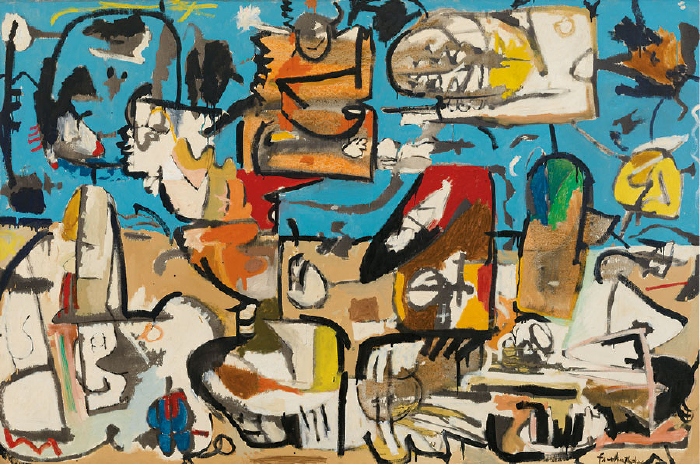
Painted on 21st Street: Helen Frankenthaler from 1950-1959
The Gagosian Gallery in Chelsea mounted “the first [exhibition] in thirty years – and the first in New York in fifty years – to offer a broad survey of this pivotal body of work” created by Helen Frankenthaler during the ’50s.
“The only rule is that there are no rules. Anything is possible … It’s all about risks, deliberate risks,” Frankenthaler said.
She sure took them, from the title composition (at right) to “the celebrated Mountains and Sea, of 1952; to key paintings of the later 1950s, among them The Museum of Modern Art’s Jacob’s Ladder (1957), and the UC Berkeley Art Museum’s expansive Before the Caves (1958). ” (View all here.)
Unfortunately, that’s the only place you’ll see them right now. The show closed over the weekend.
Duane Michals: The Painted Photograph
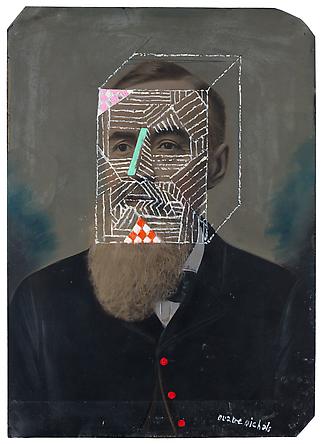
DC Moore Gallery, freshly relocated from Midtown to Chelsea, showcases the current series of hand-painted tintypes by Duane Michals.
From their website:
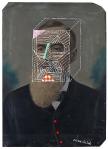 Using 19th-century collodion prints on brown or black lacquered iron as his surface, Michals enriches the original images with oil paint, altering but not entirely obscuring the sitters’ features. Drawing on the principals of early photography and modern painting, especially Surrealism, Michals unites the two disciplines and explores the uncharted territory he identifies between photography and painting. Each 19th-century image is playfully rejuvenated by the addition of vibrant color and the artist’s witty allusions to visionaries such as Picasso and Picabia. In this way, Michals draws our attention to the discrepancy between a popular medium that required little skill—the tintype—and the work of the most influential artists of the 20th century.
Closed-captioned for the artspeak impaired: It’s a hoot. And on exhibit until April 27.
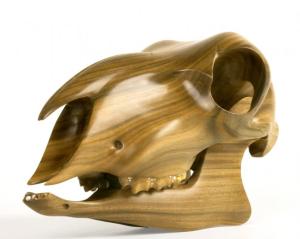
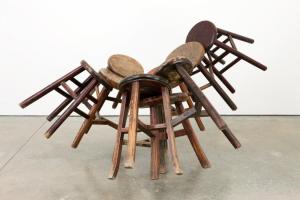
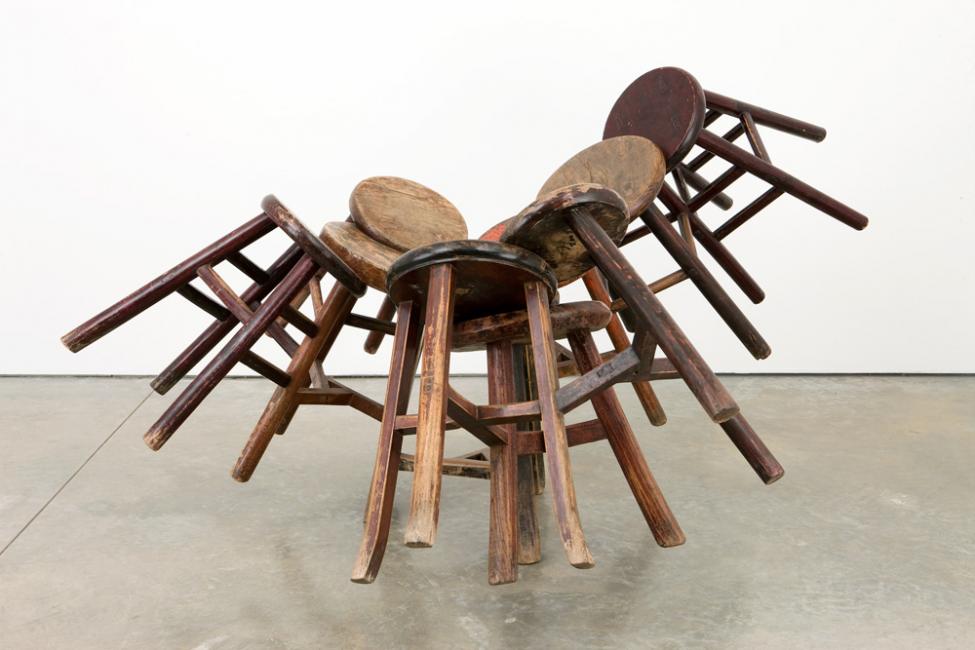
From there we moseyed uptown to the Museum of Art and Design, which features a terrific jewelry exhibit (Wear it or Not, through June 2) and Against the Grain: Wood in Contemporary Art, Craft and Design, which “[features] nearly 90 installations, sculptures, furniture, and objects [and] explores some of the most cutting-edge conceptual and technical trends in woodworking today.”
Some are striking, such as this work by Laura Roth:
And some are less so. See this by Ai Weewei:
Still, well worth the trip (through September 15).
Next day we started out at MOMA:
Claes Oldenburg: The Street and the Store
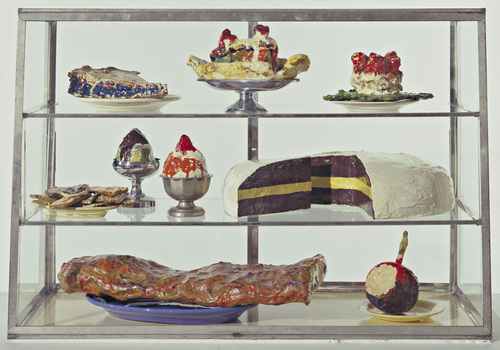
The exhibit (through August 5) is a revelation of sorts in that it features some very early – and very unusual – work by Mr. Puffy Food, Claes Oldenburg. From the website:
This exhibition examines the beginnings of Oldenburg’s extraordinary career with an in-depth look at his first two major bodies of work: The Street (1960) and The Store 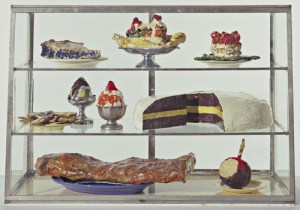 (1961–64). During this intensely productive period Oldenburg redefined the relationship between painting and sculpture and between subject and form. The Street comprises objects made from cardboard, burlap, and newspaper that together create an immersive panorama of a gritty and bustling city. The Store features brightly painted sculptures and sculptural reliefs shaped to evoke commercial products and comestibles. InThe Store, cigarettes, lingerie, and hamburgers all become viable subjects for art.
It’s an engaging show on many levels. Two special bonus treats from the 1970s: “Oldenburg’s Mouse Museum and Ray Gun Wing . . . two architectural structures [that] present careful arrangements of readymade objects alongside various tests and experiments from Oldenburg’s studio.”
Photo from New York Times review:

Fun!
Next stop:
German Expressionism 1900-1930: Masterpieces from the Neue Galerie Collection
Leonard Lauder, patron of the Met and the MFA alike (well, not exactly alike), has a brother Ron who’s taken a different fine art path, establishing his own museum rather endowing any.
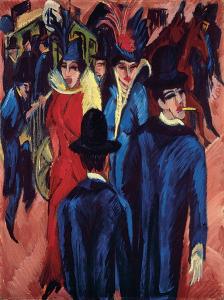
That said, the Neue Galerie’s a doozie, and this current basement-and-attic exhibit illustrates why. It “presents important works of German Expressionism from [the Neue Galerie’s] permanent collection. The exhibition examines themes of primitivism and modernity, two poles of Expressionism that artists employed to free themselves from the academic conventions of the nineteenth century.”
Representative sample #1 from Ernst Ludwig Kirchner:

Representative sample #2 from Karl Schmidt-Rottluff:

On view through April 22.
From there we strolled down Fifth to the Frick Collection to catch The Impressionist Line from Degas to Toulouse-Lautrec: Drawings and Prints from the Clark (through June 16). From the website:
This exhibition presents a selection of nineteenth-century French drawings and prints from the Sterling and Francine  Clark Art Institute in Williamstown, Massachusetts. Sheets by Millet, Courbet, Degas, Manet, Pissarro, Gauguin, Toulouse-Lautrec, and other masters are on view. Ranging widely in subject matter and technique and spanning the entire second half of the nineteenth century, these works represent the diverse interests of Realist, Impressionist, and Post-Impressionist artists in a rapidly changing world.
Terrific exhibit, and it’s always enjoyable just to wander around the Frick with the audioguide.
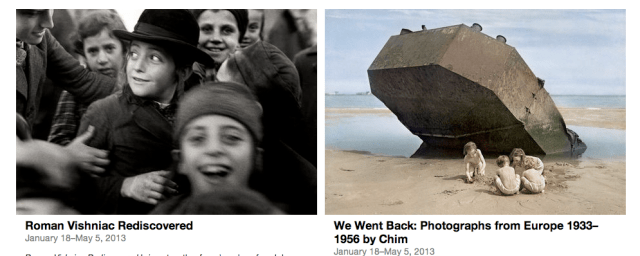
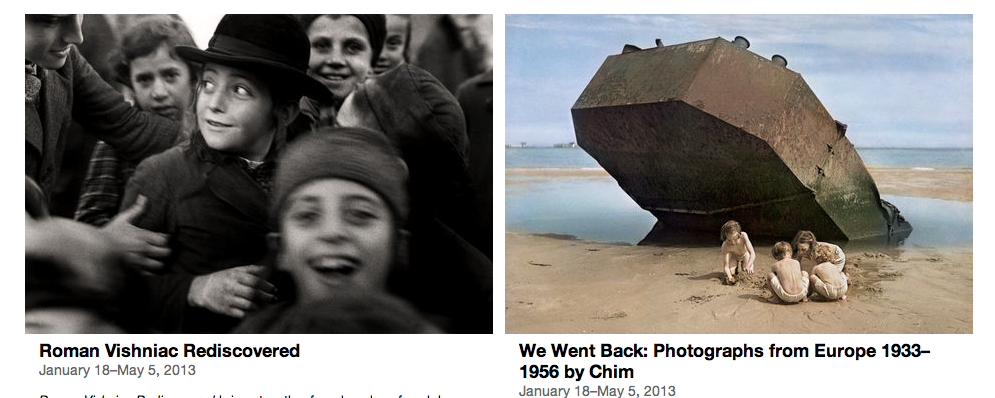
Last call: the International Center of Photography, which currently houses two excellent exhibits.
Next day on our way home, the Missus and I swung by New Haven to catch a couple of shows at the Yale museums.
Edwardian Opulence: British Art at the Dawn of the Twentieth Century
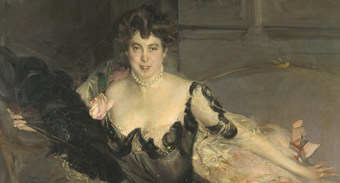
This exhibit at the Yale Center for British Art (through June 2) “is the first survey in  more than a generation of the full extent, breadth, and depth of the visual arts in Britain during the reign of King Edward VII (1901–10). Among other themes, the exhibition explores the pan-imperial, international, and transatlantic character of British art in that complex period, and considers the impact of new technologies—such as electrification, the motor car, recorded sound, and cinema—on painting, sculpture, photography, and the decorative arts.”
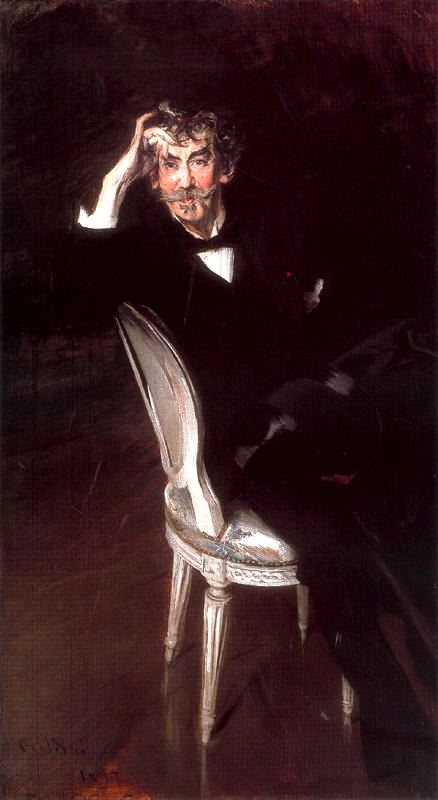
Personal favorite: Giovani Boldini’s portrait of James McNeill Whistler. (That’s a Boldini above, too.)

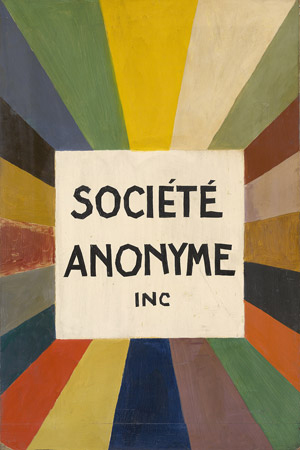
Last stop before home was a return visit to the Yale Art Gallery’s Société Anonyme: Modernism for America (through July 14). From the website:
The Société Anonyme Collection at the Yale University Art Gallery is an exceptional anthology of European and American art in the early 20th century. Founded in New York in 1920 by 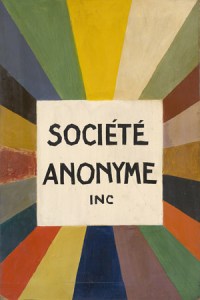 Katherine S. Dreier, Marcel Duchamp, and Man Ray to promote contemporary art among American audiences, Société Anonyme, Inc., was an experimental museum dedicated to the idea that the story of modern art should be told by artists.Société Anonyme: Modernism for America traces the transformation of this organization from an exhibition initiative to an extraordinary art collection. It features works by over 100 artists who made significant contributions to modernism, including Constantin Brancusi, Paul Klee, Piet Mondrian, and Joseph Stella, along with lesser-known artists, such as Marthe Donas, Louis Eilshemius, and Angelika Hoerle.
A fabulous exhibit, even on repeat viewing.
Then it’s home again home again jiggedy jig.











 Campaign Outsider