Via Mediaite:
Keith Olbermann Predicts Glenn Beck’s Descent Into Oblivion (In Homemade Video Clip)

This from a man who just migrated from MSNBC to Current TV.
(Raise your hand if you have any idea where Current TV can be found on your TV).
‘Nuf ced.
Via Mediaite:
This from a man who just migrated from MSNBC to Current TV.
(Raise your hand if you have any idea where Current TV can be found on your TV).
‘Nuf ced.
 The Catholic League for Religious and Civil Rights ran a full-page ad headlined “Straight Talk About The Catholic Church” in Monday’s New York Times that used the Boston Globe to further its clergy-abuse enabling efforts.
Lede:
When the Boston Globe exposed massive wrongdoing in the Boston Archdiocese in 2002, Catholics were understandably angry. And when more horror stories surfaced elsewhere, we were furious. But now our anger is turning on those who are distorting the truth about priestly sexual abuse. That some are exploiting this issue for ideological and financial profit seems plain.
Yeah – as plain as the Catholic League’s exploiting this issue for its own ideological and financial profit.
Regardless, the ad proceeds to say this:
The refrain that child rape is a reality in the Church is twice wrong: let’s get it straight—they weren’t children and they weren’t raped. We know from the John Jay study that most of the victims have been adolescents, and that the most common abuse has been inappropriate touching (inexcusable though this is, it is not rape). The Boston Globe correctly said of the John Jay report that “more than three-quarters of the victims were post pubescent, meaning the abuse did not meet the clinical definition of pedophilia.” In other words, the issue is homosexuality, not pedophilia.
In other other words, significant numbers of Catholic priests aren’t pedophiles. Just predators.
The hardworking staff looks forward to the Globe’s outraged response at being used this way by a sexual-abuse apologist.
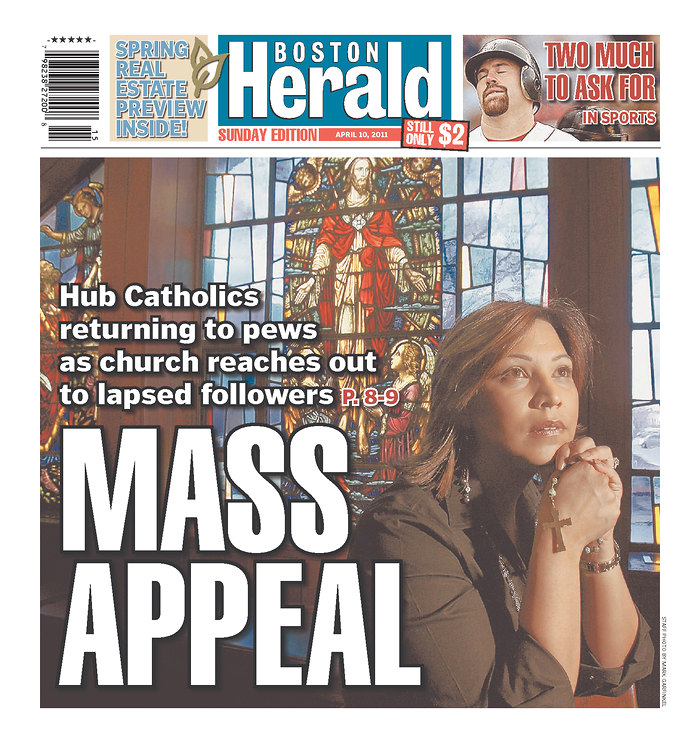
Sunday’s Boston Herald had local Catholics coming home.
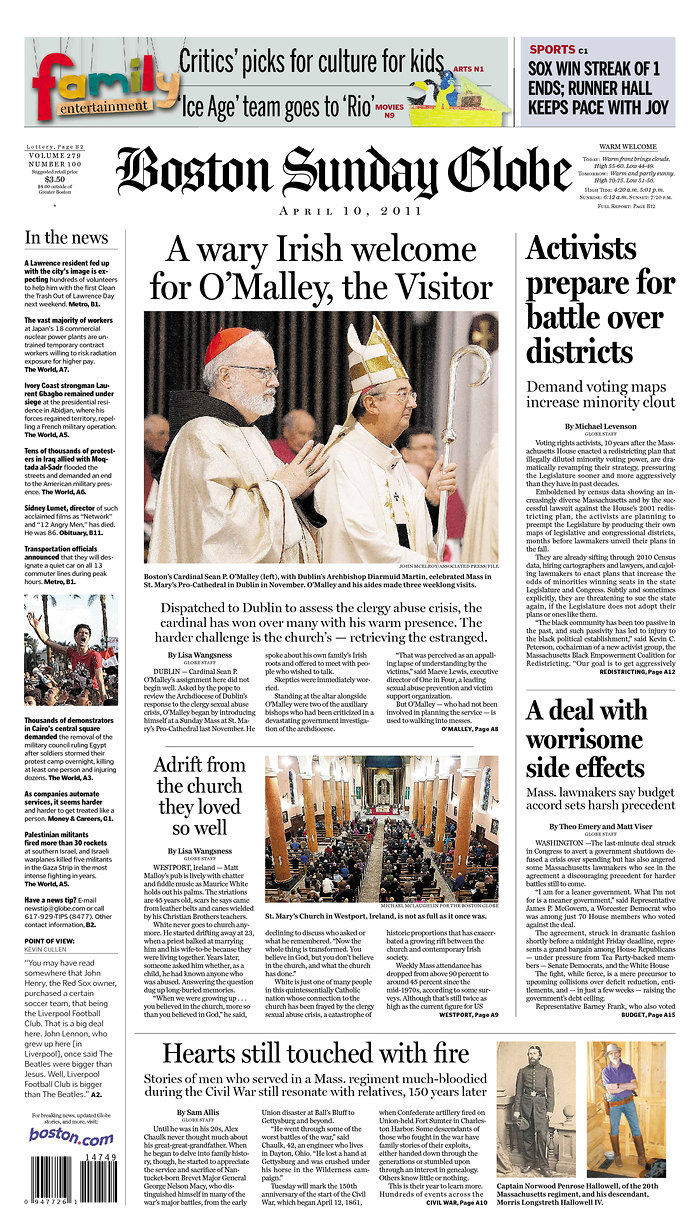
Sunday’s Boston Globe had them going away.
First, the Herald:
The story:
Prodigal parishioners return to church
Boston Archdiocese reaches out to halt plummeting Mass attendance
The Boston Archdiocese’s largest effort in a generation to reach lapsed Catholics is drawing wandering souls back to the church’s open arms, but the biggest obstacle could be keeping them, priests and parishioners say.The archdiocese, still suffering fallout from the clergy sex abuse crisis and parish closings, is hoping to bring back thousands of the formerly faithful through Catholics Come Home, a series of TV ads airing during Lent, coupled with a grass-roots push at parishes. Fewer than 20 percent of Catholics in the Boston area attend Mass each Sunday, down from nearly 80 percent in the 1960s.
With two weeks left to go in the media campaign, the Herald says, it seems to be working:
“I was doing laundry and that stopped me in my tracks, that made me cry,” said Jackeline Rolon, 36, who was so moved by one of the TV ads she started going to Mass at St. Stephen’s in Framingham. She stopped going to church when she was 15. But the ad drew a flood of memories of her grandma, who walked her to church every Sunday in her native Puerto Rico, and her late father, a devout Catholic.
Meanwhile, the Herald’s crosstown rival has gone out-of-town with Boston Cardinal Sean O’Malley on his recent trips to Ireland to review, at the Vatican’s request, the Archdiocese of Dublin’s response to its clergy sexual abuse crisis.
(O’Malley being such a hardened veteran of clergy-abuse damage control and all.)
The Sunday Globe’s Page One:
Your bitter recriminations go here.
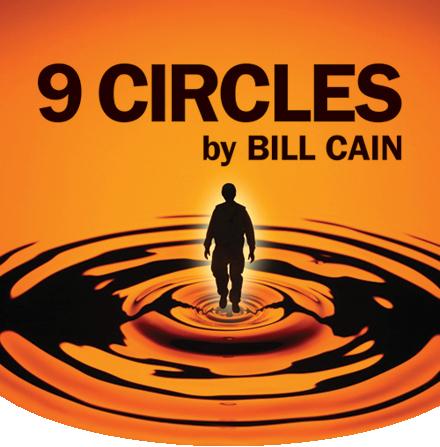 Useless because the play ended its run yesterday.
Regardless, I have to say something about Bill Cain’s 9 Circles, which Publick Theatre Boston has presented for the past three weeks at the South End’s Boston Centre for the Arts.
But first, here’s Cain talking about last year’s production at Marin Theatre Company:
Publick Theatre Boston mounted its own terrific production, with compelling performances by Amanda Collins and Will McGarrahan and an absolutely riveting one by Jimi Stanton, who plays the American soldier court-martialed and executed (in an unforgettable scene) for the rape and murder of a 14-year-old girl in Iraq.
I just wish I had seen it sooner so I could have told you sooner.
 (. . . is to laugh)
New York Times op-ed columnist is in a swell slapfight with short-sighted vulgarian and presidential wannabe Donald Trump (R-The World Is My Apprentice).
The current rumpus started last week with “Donald Trump Gets Weirder,” in which Collins wrote:
In a potential Republican field that includes Michele Bachmann, Sarah Palin and Newt Gingrich, it’s hard to come up with a line of attack loopy enough to stand out from the pack. But darned if Trump didn’t manage to find one.
“If [Barack Obama] wasn’t born in this country, it’s one of the greatest scams of all time,” Trump told Bill O’Reilly, who demurred: “I don’t think that’s the case.”
Vote for Donald Trump, the man who can make Bill O’Reilly look like the most sensible guy in the room.
That column led Trump to send this letter to the editor:
To the Editor:
Re “Donald Trump Gets Weirder,” by Gail Collins (column, April 2):
Even before Gail Collins was with the New York Times, she has written nasty and derogatory articles about me. Actually, I have great respect for Ms. Collins in that she has survived so long with so little talent. Her storytelling ability and word usage (coming from me, who has written many bestsellers), is not at a very high level. More importantly, her facts are wrong!
As far as her comments on the so-called “birther” issue, I don’t need Ms. Collins’s advice. There is a very large segment of our society who believe that Barack Obama, indeed, was not born in the United States. His grandmother from Kenya stated, on tape, that he was born in Kenya and she was there to watch the birth. His family in Honolulu is fighting over which hospital in Hawaii he was born in-they just don’t know.
He has not been able to produce a “birth certificate” but merely a totally unsigned “certificate of live birth”-which is totally different and of very little significance. Unlike a birth certificate, a certificate of live birth is very easy to obtain. Equally of importance, there are no records in Hawaii that a Barack Hussein Obama was born there-no bills, no doctors names, no nurses names, no registrations, no payments, etc. As far as the two notices placed in newspapers, many things could have happened, but some feel the grandparents put an ad in order to show that he was a citizen of the U.S. with all of the benefits thereto. Everybody, after all, and especially then, wanted to be a United States citizen.
The term used by Ms. Collins-“birther”-is very derogatory and is meant in a derogatory way. Had this been George Bush or almost any other President or Presidential aspirant, they would never have been allowed to attain office, or would have been thrown out of office very quickly.
For some reason, the press protects President Obama beyond anything or anyone I have ever seen. What they don’t realize is that if he was not born in the United States, they would have uncovered the greatest “scam” in the history of our country. In other words, they would become the hottest writer since Watergate, or beyond.
Open your eyes, Gail, there’s at least a good chance that Barack Hussein Obama has made mincemeat out of our great and cherished Constitution!
DONALD J. TRUMP
New York, April 7, 2011
The letter, in turn, led Collins to trot out more of her “word usage”:
Donald Trump has written a letter complaining about me.
“Her storytelling ability and word usage (coming from me, who has written many bestsellers), is not at a very high level,” he penned.
Although Trump and I have had our differences in the past, I never felt it was personal. In fact, until now, I have refrained from noting that I once got an aggrieved message from him in which he misspelled the word “too.”
The rest of the column generally dismantles Trumps’ Birther of a Nation shtick without breaking a sweat. But this isn’t really about facts, is it? It’s about the fiction that Donald Trump has anything to say that’s worth hearing.
 Hard on the heels of Boston Globe columnist Joan Vennochi’s undressing of local macher and new BRA chief Peter Meade comes Boston Herald columnist Christine McConville’s dismantling of Michael Widmer (Massachusetts Taxpayer Foundation) and Paul Grogan (Boston Foundation):
Crusaders mum on own plans
AFL-CIO boss Robert “Bobby” Haynes is furious.
Why, he asks, are Paul Grogan and Michael Widmer — the well-paid nonprofit titans who seem to have opinions about everyone else’s medical insurance — so quiet about their own health plans?
Days after Widmer’s Massachusetts Taxpayer Foundation and Grogan’s Boston Foundation released a report about the crushing costs of municipal unions’ health insurance, the two men were mum about their own plans.
More:
Recently, Grogan and Widmer launched a spirited jihad against municipal health plans of cops, firefighters and teachers because they’re more costly than the state’s plan and put too much strain on property taxpayers.
That’s what’s got Haynes’ blood up.
“This is an all-out public relations assault on the working class by big, shadowy, selfish business interests, and it’s being waged by their shameless mouthpieces like Widmer and Grogan, who masquerade as some kind of defenders of the public interest,” he said.
McConville also points out that Haynes received $70,000 per annum as a member of the Blue Cross Blue Shield board of directors in addition to his $130,000 annual salary from the AFL-CIO.
But that pales in comparison with Widmer’s yearly take of $385,946, not to mention Grogan’s $544,288.
So . . .
Given Vennochi’s and McConville’s pieces, is this a come-to-Jesus moment for Boston’s movers and shakers?
We can only hope so.
 Last night the Missus and I dropped by AD20/21, the Art & Design of the 20th & 21st Centuries exhibition currently at the South End’s Cyclorama, where celebrated designers Massimo and Lella Vignelli received a Lifetime Achievement Award.
At which Massimo delivered a talk/slide show detailing his (and his wife’s) illustrious career. He began his presentation with this:
And he proceeded to provide exactly that (for examples, see here), along with these observations:
• Designers should create what clients (and people) need, not what they want
• Bad design is “poisoning” America
• Marketers are the enemy of good design
• The one thing he still hopes to do: “Redesign the Vatican. [He makes a cross with two fingers.] I’d say, ‘Your Excellency, the logo is okay, but everything else has to go.'”
His designs, on the other hand, are here to stay.
 New York Times metro columnist Clyde Haberman is gone like a cool breeze. His Friday swan song signaled the end of the NYC feature “after 16 years and something on the order of 1,500 columns.”
Headline/lede:
Before Going Dark, One Last Attempt at Explaining New York City
Eons ago, the student newspaper that I wrote for and edited at City College of New York had a tradition for former editors who were graduating. It gave them a final crack at the typewriter to produce what we called a Thirty column.
Literally, they had 30 column inches to say their piece. The title was also a nod to a newspaper custom in precomputer days. The number 30 at the bottom of a reporter’s story (typically rendered between hyphens: -30-) signaled to the editor that nothing more was coming. Why 30? Various theories have been offered, none that would seem proof positive.
This is my Thirty column.
Haberman had an interesting career at the Times: He was fired in 1966 when, as the paper’s campus correspondent at City College of New York, he fabricated material for a Times report. (Haberman chronicled the incident in a 2006 NYC column upon the death of Abe Rosenthal, the editor who fired him.)
Haberman, obviously, worked himself back into the good graces of the Good Grey Lady. But now he’s gone. The reason?
Decisions were made. Let’s leave it at that.
Too bad. His NYC column was a lively take on city life and will be missed, at least by the hardworking staff.
 So daffy Muammar el-Qaddafi has written another letter to Barack Obama according to this Thursday New York Times report:
TRIPOLI, Libya — Col. Muammar el-Qaddafi of Libya sent another strikingly personal letter to President Obama on Wednesday, urging him to stop NATO’s airstrikes but drawing a swift rejection in response.
“You will always remain our son whatever happened,” Colonel Qaddafi wrote. “We Endeavour and hope that you will gain victory in the new election campaigne. You are a man who has enough courage to annul a wrong and mistaken action,” he added, in idiosyncratic spelling and capitalization.
Mr. Obama, who since his inauguration has received at least three letters full of fatherly affection from the Libyan leader, did not respond.
What a surprise.
The full text of the letter (via Business Insider via AP):
Our son, Excellency,
President Obama
U.S.AWe have been hurt more morally that physically because of what had happened against us in both deeds and words by you. Despite all this you will always remain our son whatever happened. We still pray that you continue to be president of the U.S.A. We Endeavour and hope that you will gain victory in the new election campaigne. You are a man who has enough courage to annul a wrong and mistaken action. I am sure that you are able to shoulder the responsibility for that.
Enough evidence is available, Bearing in mind that you are the president of the strongest power in the world nowadays, and since Nato is waging an unjust war against a small people of a developing country. This country had already been subjected to embargo and sanctions, furthermore it also suffered a direct military armed aggression during Reagan’s time. This country is Libya.
Hence, to serving world peace … Friendship between our peoples … and for the sake of economic, and security cooperation against terror, you are in a position to keep Nato off the Libyan affair for good. As you know too well democracy and building of civil society cannot be achieved by means of missiles and aircraft, or by backing armed member of AlQuaeda in Benghazi.
You, yourself, said on many occasions, one of them in the UN General Assembly, I was witness to that personally, that America is not responsible for the security of other peoples. That America helps only. This is the right logic.
Our dear son, Excellency, Baraka Hussein Abu oumama, your intervention is the name of the U.S.A. is a must, so that Nato would withdraw finally from the Libyan affair. Libya should be left to Libyans within the African union frame.
The problem now stands as follows:-
1. There is Nato intervention politically as well as military.
2. Terror conducted by AlQaueda gangs that have been armed in some cities, and by force refused to allow people to go back to their normal life, and carry on with exercising their social people’s power as usual.
Mu’aumer Qaddaffi
Leader of the Revolution
Tripoli 5.4.2011
That’s some crazy pen pal, yeah?
Coming soon . . .
Dear son, Excellency, Baraka Hussein Abu oumama,
We have been hurt more morally that physically because of what had happened against us in both deeds and words by you. Despite all this you will always remain our son whatever happened. We still pray that you continue to be president of the U.S.A.
We Endeavour and hope that you will lend us Air Force One and let us crash at Camp David.
C’mon, B.
Be a pal.
Mu’aumer Qaddaffi
Leader of the Revolution
Tripoli 5.4.2011
Your reality goes here.
 Boston Globe op-ed columnist Joan Vennochi is always a good read.
But often she’s a required read.
As in her Thursday column on the wired-like-Con-Ed Peter Meade, who was just appointed head of the Boston Redevelopment Authority, a municipal agency that essentially develops two things: 1) Opportunity for friends of Boston mayor Tom Menino; and 2) Heartache for enemies of Boston mayor Tom Menino.
Vennochi:
To understand what Meade’s newest job title really means, consider this account of the press conference called to announce his nomination. When Meade was asked why he would return to Boston City Hall — where he worked 34 years ago for another mayor — his new boss interrupted and answered the question. “Me,’’ Menino said.
“He’s right,’’ Meade quickly replied.
He’ll be saying that a lot as BRA director.
For better or worse, Boston development is all about “Me,’’ the mayor who is well into his fifth term. As defined by “Mayor Me,’’ the development director’s job means carrying out his wishes.
The only thing Vennochi missed was the chance to coin the term “Mayor Me(nino).”
Thanks for leaving something for the rest of us, Joan.
 Click to subscribe to RSS