
Just thanks.
That’s all.
The local dailies make a mountain out of a Cahill, Day Two.
Start with this Boston Globe front-page thumbsucker:
Cahill faced fine line on government advertising
In politics, all the world’s a campaign stage, particularly for incumbents. Officeholders enjoy the unique advantage of regularly hitching their names to good works in newspaper and television ads, in government printings, at public events, all in the name of informing the public and all paid for with public dollars.
Think Mayor Thomas M. Menino’s name on construction project signs, Secretary of State William F. Galvin’s name and picture on voter guides, and Governor Deval Patrick’s name on Massachusetts highway signs, among many others.
Now, with the indictment of former state treasurer Timothy P. Cahill on charges of misusing state lottery advertising to benefit his failed 2010 gubernatorial campaign, the question of what constitutes illegal campaigning and what constitutes legitimate promotion for the larger good is up for debate.
Legal specialists say that Cahill’s case could prove to be a particularly well-documented line-crossing. Prosecutors allege that e-mails and text messages show there was explicit coordination between Cahill and his campaign in planning ads that promoted the lottery, which Cahill oversaw as treasurer.
Then again, it’s all pretty clear-cut to Globe op-ed columnist Scot Lehigh:
The corruption charges against Cahill all grow out of accusations that he used the Massachusetts State Lottery’s advertising budget to benefit his 2010 gubernatorial campaign. And what can a longtime Cahill observer say, really, except this: No big surprise there. And this: It looks like a solid case to me.
But not so much to Globe Metro columnist Brian McGrory, who ledes his latest column this way: “As I watched Martha Coakley announce criminal indictments against Tim Cahill this week, one simple thought kept banging around my head: This doesn’t feel right.”
Furthermore:
At Monday’s news conference, Coakley was flanked by four grim-faced men, lawyers and a detective, who spent what Coakley herself described as “enormous amounts of time’’ on a 17-month investigation. They dedicated untold state resources to prove what anyone with a TV and a Barcalounger already knew: That some two-bit politician tried capitalizing on his office to win another election.
Was there really not a way to sanction Cahill civilly in a month-and-a-half, rather than criminally after a year-and-a-half? Are these charges worth all this time?
For Globe columnist Joan Vennochi, it isn’t that the case against Cahill doesn’t feel right. It’s that it doesn’t feel righteous.
The case against the ex-treasurer is a test for a vaguely worded law that turns what used to be civil infractions into criminal activities. Tom Dwyer, a criminal defense lawyer and ex-prosecutor who specializes in white collar cases, argues that two sections of the ethics law used against Cahill were “never meant to apply to the conduct alleged in this case . . . I predict these charges will be dismissed without a trial.’’
It’s also a test for Coakley and what kind of crimes she brings to trial.
To wit: Coakley passed on prosecuting Big Dig contractors “for shoddy workmanship that resulted in a woman’s death,” and left prosecution of corrupt former Massachusetts House Speaker Sal DiMasi to the feds.
But Cahill Coakley drops the hammer on.
If, as charged, Cahill abused his office by using taxpayer money to coordinate ads, he should be held accountable. But when Massachusetts voters think of rooting out political corruption, are the charges against him what they have in mind?
This is a strong case of going after the weak. It’s harder to go after the powerful.
Crosstown at the Boston Herald, there’s nothing weak about the response to Coakley’s power play. Dan Small, a trial lawyer and former federal prosecutor, asks in an op-ed piece whether Coakley isn’t guilty of infractions similar to Cahill’s in her relentless promotion of the indictment.
And op-ed columnist Michael Graham says Coakley is just a bully.
(No links, because the Herald website sucks.)
Let’s end on a high note, with editorial cartoons from the two dailies.
The Globe’s Dan Wasserman:

The Herald’s Jerry Holbert:

It’s good to live in a two-editorial-cartoon town.
Of which there are far too few.
(Another in a series)
From Politico’s Morning Score:
MASSACHUSETTS SENATE SNEAK PEEK – “ROMNEY + BROWN = BFF”: The Massachusetts Democratic Party will blast out a 60-second web video later this morning that links Romney with Sen. Scott Brown (lots of footage of them being chummy). The goal is to bracket Brown’s White House visits for bill signings. The vulnerable freshman has distanced himself from national Republicans and cozied up more to Obama than perhaps any other Senate Republican running for reelection, but he faces a very difficult balancing act dealing with his former governor (especially since several advisers overlap). Romney is almost certainly going to get trounced in the Bay State this November. Watch: http://bit.ly/HflC54.
The video:
Bromance, bro!
But at what cost? The other day Brown ponied up $35,000 in People’s Pledgebucks in the wake of an American Petroleum Institute ad campaign supporting his support for Big Oil subsidies.
According to ABC News:
After an oil lobbying group ran radio ads on his behalf, Brown was required to donate half the dollar amount spent on the ads to the charity of [Elizabeth] Warren’s choice under the stipulations of a pledge the two signed banning funding or advertisements from outside groups in their Senate race.
So is it now Warren’s turn to pony up?
What say ye, ElizaScott?
The hardworking staff got really confused on Sunday when the Mad Men character Henry Francis told a phone caller that New York Mayor John Lindsay would not do a joint appearance with Michigan Gov. George Romney “because Romney’s a clown and I don’t want [Lindsay] standing next to him.”
(Video at Mediaite.)
Wait a second, the hardviewing staff thought: Isn’t Henry an aide to New York Gov. Nelson Rockefeller?
We decided to investigate.
Let’s go to the Googletron first. Here’s what you get when you plug in Henry Francis AND Nelson Rockefeller:
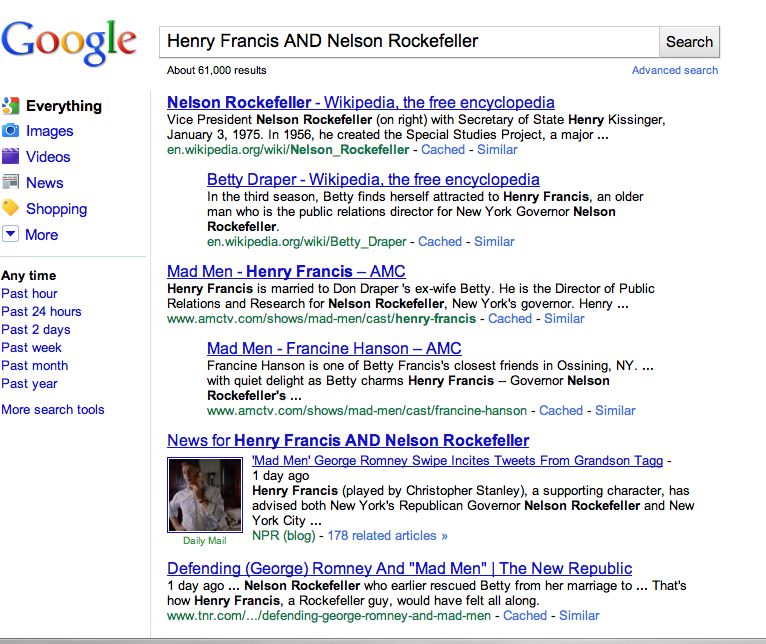
And etc.
Then again, here’s what you get when you plug Henry Francis AND John Lindsay into the Googletron:
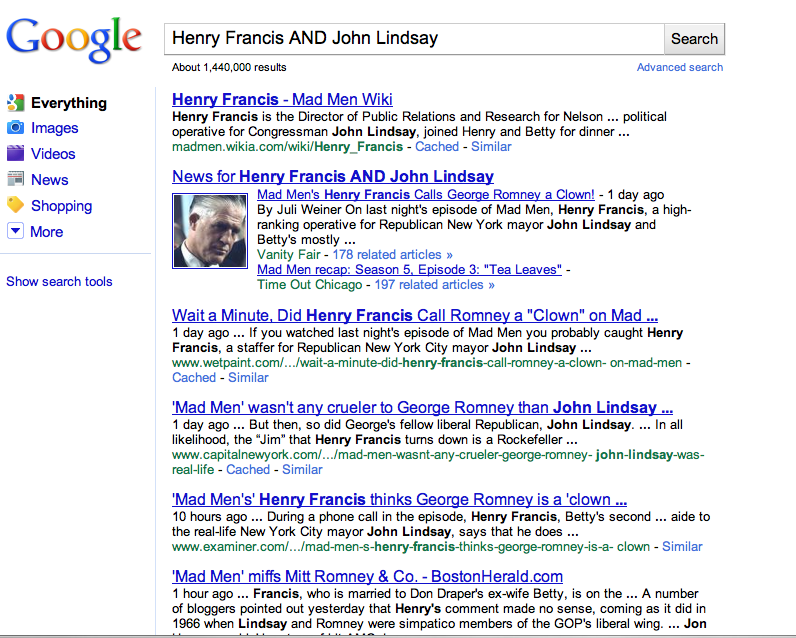
And etc.
So, to recap:
Henry Francis AND John Lindsay generates about 1,440,000 search results.
But Henry Francis AND Nelson Rockefeller generates about 61,000 serach results.
Hey, Matthew Weiner: What gives?
From ABC’s The Note:
DEMOCRATIC SUPER PAC LINKS ROMNEY TO BIG OIL.“Priorities USA Action today released a television ad ‘Romney’s Big Oil Trail’ to expose the true motivations of big oil’s attacks on President Obama — to elect Mitt Romney who stands to protect big oil’s profits at the expense of middle class Americans. ‘While President Obama is taking serious action to make America less dependent on dirty and dangerous sources of Middle East oil and create clean energy jobs here at home, Mitt Romney and the oil companies bankrolling his campaign are profiting from high gas prices politically and financially,’ said Paul Begala, Senior Advisor for Priorities USA Action. The ad will run both on television and online in Colorado, Florida, Iowa, Michigan, New Mexico, Nevada, Ohio and Virginia.” WATCH:http://bit.ly/HgxiOW
The spot:
Truth is, all this gas price talk is just gasbaggery.
See Politifact for further details.
Not to get technical about it.
So the hardworking staff was catching up with its magazine backlog when we encountered this piece in the March 12th edition of Advertising Age:
Could Super PACs Actually Be Good for Democracy?
There’s been one clear bugaboo in this year’s presidential election: the super PAC. But with Super Tuesday in the rearview mirror, it’s not exactly clear that the fundraising beasts that accept unlimited individual and corporate donations and run negative ads with impunity turned out to be the scary monsters that gobbled up democracy.
In fact, in the specific case of the Republican primary battle, it could be argued that they’ve actually made the race more democratic.
Two things are certain about super PACs at this point. First, they will increase aggregate spending on political advertising to levels previously unseen. Borrell Associates estimated last week that ad spending for the 2012 elections could reach $9.8 billion, vs. $7 billion in 2008. Second, they’ll help increase the amount of negative advertising. Example: The lion’s share of spending by the pro-Mitt Romney Super PAC has been on negative advertising, mainly against Newt Gingrich and Rick Santorum.
Yikes! And all this time we thought $4 billion was the ceiling.
Go figure.
See the Ad Age piece for the Good for Democracy part.
The other day the hardworking staff noted that the Republican National Committee had, according to Bloomberg News, “altered the audio of U.S. Supreme Court (1000L) oral arguments in an attack on President Barack Obama’s health-care law.”
In a web ad circulated this week, the Republican National Committee excerpts the opening seconds of the March 27 presentation by Obama’s top Supreme Court lawyer, Solicitor General Donald Verrilli. In the ad, he is heard struggling for words and twice stopping to drink water.
“Obamacare,” the ad concludes, in words shown against a photograph of the high court. “It’s a tough sell.”
A review of a transcript and recordings of those moments shows that Verrilli took a sip of water just once, paused for a much briefer period and completed his thought — rather than stuttering and trailing off as heard in the edited version.
The web ad:
But according to NPR’s Wait Wait . . . Don’t Tell Me! Verrilli had this actual brainfreeze (from 3:05 to 3:45), as related by host Peter Sagal:
This was the case of a lifetime for Solicitor General Donald Verrilli and he choked – I mean he literally choked. Listen to him as he begins presenting his case:
“Insurance has become the predominant means of paying for healthcare in this country [cough, cough] insurance has become the predominant means of paying for healthcare in this country because it, because the and eh, because this is market in which, in which eh . . . ”
That will be the last time that Donald Verrilli takes the Cinnamon Challenge right before [laughter, applause] oral argument.
So why didn’t the RNC have the real goods on Verrilli?
Wait wait . . . don’t tell me!
From Saturday’s New York Times:
Primary Turnout Could Signal Trouble for G.O.P.
After presidential primaries or caucuses in 28 states, voters are sending a potentially troubling message to the Republican Party: We aren’t necessarily as excited about the campaign as you think.
By some important measures, voting analysts say, turnout is down in the Republican nominating contests compared with 2008, defying the widespread assumption that Republicans would line up in huge numbers for a chance to evict President Obama from the White House.
That spells trouble for likely presidential nominee Mitt Romney (R-Is Rick Santorum Gone Yet?), who “has had particular trouble energizing urban and suburban voters — typically moderates and swing voters — who would be vital to him against Mr. Obama.”
Turnout was down among independents in Florida and Michigan, but Romney’s numbers in Massachusetts might be the most alarming for the Mittniks.
Helpful chart from the Times piece:
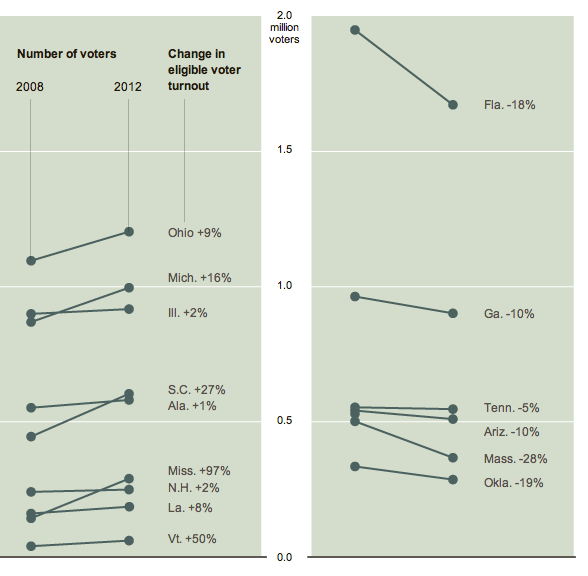
See that? Massachusetts turnout was down 28% – the biggest decline in the GOP primaries so far.
Not a good sign for Mitt.
Undaunted, here’s Eric (A Sketch) Fehrnstrom in the Times piece:
“There will be no enthusiasm gap for Mitt Romney in the general,” said Eric Fehrnstrom, a Romney senior adviser. “Barack Obama will be the single biggest unifier the Republican Party has ever seen.”
File under: Whistling past the graveyard.
 Click to subscribe to RSS

 Campaign Outsider
It’s Good To Live In A Two-Daily Town (Tim Cahill Indictment Edition)
When we last left Tim Cahill, he was the delusional Massachusetts Treasurer who seemed to think he could run for governor as an independent and actually win.
Now he’s just indicted.
From Tuesday’s Boston Globe:
A Globe editorial, not surprisingly, applauded the indictment:
But trundle over to Globe crosstown rival Boston Herald, and you get a very different take.
Howie Carr’s column:
Joe Battenfeld’s column:
Interestingly, in full Sybil mode, the Herald’s editorial page disagrees:
Questions? Comments? Bitter recriminations?
Share this: