That’s Just So Awkward! (NYT CEO Snubs NYT Edition)

(Tip o’ the pixel to the Missus)

Thursday’s New York Times featured this piece on page A8:

beeb-articleInlineBritain Will Look at Why BBC Severance Payments Exceeded Contract Terms

LONDON — When it comes to the BBC and funding that is mostly provided by Britons who pay a fee to watch television, there is no end to the argument, or the accounting.

Next Monday, the fight will continue when the House of Commons Public Accounts Committee will hold new hearings on the way the British Broadcasting Corporation gave large severance payments to senior editors in an effort to reduce its budget.

The payments were made largely when Mark Thompson, now the president and chief executive of The New York Times Company, was the director general of the BBC. Mr. Thompson ran the BBC from 2004 to 2012.

 The piece goes on to say that Mr. Thompson “will testify at the hearings, which follow a June report and a report published Wednesday by the National Audit Office. The auditors found that between 2009 and December 2012, the BBC paid more severance than it was contractually obliged to give to 22 senior managers out of 150 who left, at a total extra cost of £1.4 million, or about $2.2 million.”

But, via the Times:

Mr. Thompson, who declined to be interviewed, said in a statement in July that he had received approval for the key severance payments from an executive remuneration committee and the BBC Trust, an oversight panel, which had been “fully informed in advance.”

So, to recap:

The New York Times is reporting on an investigation of the BBC (which Mr. Thompson ran at the time) by the House of Commons Public Accounts Committee (before which Mr. Thompson will testify), but, as the current CEO of the New York Times, Mr. Thompson will not give an interview to the New York Times.

Escher! thou shouldst be living at this hour: the Times hath need of thee . . . 


Posted in Uncategorized | Tagged , , , , , , , , , , | 1 Comment

Twenty Years After: The 1993 Boston Mayoral Ads

Several weeks ago the hardtalking staff did a segment on WBUR’s Radio Boston about the TV spots in the 1993 Boston mayoral race.

That segment came about because we’ve still got a dozen VHS tapes of the ’93 ads, having forgotten to throw them out for the past 20 years. (The hardsaving staff is working on digitizing them and will keep you posted.)

But there was a bunch of stuff we never got around to talking about on Radio Boston, so consider this an addendum.

First, to review:

In the spring of 1993, Pres. Bill Clinton nominated Boston mayor Ray Flynn to be Ambassador to the Vatican, which Flynn subsequently became. That made Boston City Council president Tom Menino acting mayor (or “action mayor,” as he styled himself) and triggered a Boston mayoral election.

The candidates: Menino, of course; Suffolk County Sheriff Bob Rufo; Dorchester State Rep. Jim Brett; City Councilor Rosaria Salerno; media gadfly Chris Lydon; City Councilor Bruce Bolling; Boston Police Commissioner and Flynn’s Sancho Panza, Francis “Mickey” Roache; and lone Republican Diane Moriarty, a Boston lawyer. Most people saw the preliminary as a bakeoff for second place involving Rufo, Brett, and Salerno.

The Boston of 1993 was very different from Boston today, as these Boston Redevelopment Authority charts reveal.

Population change:

Picture 2

Ethnicity change:

Picture 4


It was the Olde Boston that hosted the 1993 race – less populated, less educated, less diverse. That was very much reflected in the TV spots the mayoral candidates ran that year, which were largely the standard big-city boilerplate (crime, schools, yack yack yack), except for Lydon’s ads, which were both eccentric and entertaining, albeit largely ineffective.

Start with the TV commercials for Bob Rufo, mocked as “Blue Light Bobby Rufo” throughout the campaign by Lydon. A spot called “Track Down” began with what looked like security-camera footage of a woman walking into a convenience store at night while an announcer said “in a situation like this you could get carried out [because] the city does a bad job of tracking down fugitives from warrants, so they’re free to rob and rape again and again.”

Then Rufo came on camera: “Violate a person and you can go free – but violate [a parking meter] and the city tracks you down to the ends of the earth. That’s crazy. When I’m mayor, we’re gonna go after the real criminals.”

Dan Payne, who created the Rufo ads (slogan: “Safety First”), told the hardquizzing staff that the ’93 campaign came down to “ads, press, and base turnout.” And even though Rufo by far spent the most on TV spots in the preliminary and was endorsed by the Boston Herald and co-endorsed (with Menino) by the Boston Globe, he got out-organized by Brett, who finished second, seemingly with a boost from former mayor Kevin White, in Payne’s telling.

Mike Shea did the ads for Brett, “a white guy from Dorchester – the question was, could he represent the whole city?” Shea set out to dispel those concerns with a testimonial ad featuring Pat Copney, whose son Charles was killed in a drive-by shooting by a 15-year-old who got five years in jail. But “Jim Brett changed the law,” Ms. Copney said in the spot, so that others wouldn’t get off so easy.

Other notable ads came from the Salerno and Lydon camps. Salerno’s ads showed her pressing the flesh all through the North End like it was the Feast of St. Rosaria. (One Boston voter told the Globe the ad looked like she was opening a new restaurant there.)

The voiceover called her by just her first name – like Cher – warning that “when it comes to fighting crime in Boston – roses have thorns” and telling voters they can “trust Rosaria to do what’s right.”

Ken Swope was Salerno’s admaker. He said the Salerno camp thought her major opponent would be Rufo and that “Menino wouldn’t be strong outside his own district.” (Around this time in our conversation the hardworking staff distinctly heard the term “dim bulb.”)

Swope said “Salerno being female was a double-edged sword.” She stood out in the field, but Swope thought it was a  mistake for her to keep saying “I’m not just one of the boys.”  That was obvious. The bigger problem was that “women were making gains in legislatures, but not in corner offices.” (That Salerno was a former nun also proved to be a two-edged sword, for reasons you no doubt can imagine.)

Overall, Swope said, “ads were not a major factor – Menino had the bully pulpit and Hyde Park.” Plus, he said, Menino was seen as a continuation of the Flynn administration, which was highly regarded for putting the neighborhoods first, as opposed to Kevin White’s downtown focus.

Finally in the preliminary ad-o-rama, there were the Lydon commercials, which were a total hoot.  The spots didn’t run very often (if at all), but they were cherce. Each ad had Lydon standing outside a different area of Boston and addressing the camera directly.

One spot showed him in front of an ambulance talking about “another sickening story of an innocent victim, often a child, shot to death in the streets. In an emergency,” Lydon said,  “you stop the bleeding first.”

He then proceeded to make this ear-popping pronouncement:

We felt good about breaking gang rule in Somalia, and we can use the same humane, tough-minded skills, the same technology to take guns out of the hands of our children.

Gang rule in Somalia? In a Boston mayoral race?

Excellent!

As ineffective as Lydon’s ad might have been, the other candidates didn’t do much better.

In the run-up to the prelim, Jordana Hart wrote this in the Globe:

Few city voters find TV ads memorable

Despite nearly $1 million in televised campaign advertising, the Boston mayor’s race has contained few memorable moments in the war of the airwaves, according to a group of still-undecided voters gathered by the Globe to assess the campaign. Most said they could recall only two out of the dozen ads that have aired since early August.

Overall, the voters said they felt many of the ads brought them closer to the candidates as flesh-and-blood individuals. But they lamented not learning more about each candidate in the 30-second spots, particularly substantive details about their important issues and past successes — in effect, information that might have set one apart from the other.

Others said they were reluctant to admit television ads could affect such an important decision.

Right. And they all watch a lot of PBS too.

In the general election, Brett ran up against the same wall Menino’s opponents would for the next 20 years: He couldn’t raise enough money to be competitive.

Meanwhile, Menino ran ads that had him saying, according to Shea’s recollection, “I’m not a fancy talker but when I speak, I speak for the people of Boston.”

(The hardsaving staff doesn’t have any Menino ads because, as best we can recall, his campaign wouldn’t give them to us. Our relations with Mistah Mayah went steadily downhill from there over the next two decades.)

Fun fact to know and tell: Rufo, Brett, and Salerno used Boston’s Big Three of political admakers – Payne, Shea, and Swope – to produce their spots. Menino hired a Hollywood guy – Bill Carrick – to produce his.

Menino also had a secret weapon: phone banks.

“Menino used phone banks early,” Shea said, “and he depicted Brett as Catholic, as anti-choice, and as someone who would stop abortions at city hospitals.”

Menino also tied Brett to toxic Massachusetts Senate president William Bulger.

“Brett’s wife worked for Bulger,” Shea recalled. “That hurt.”

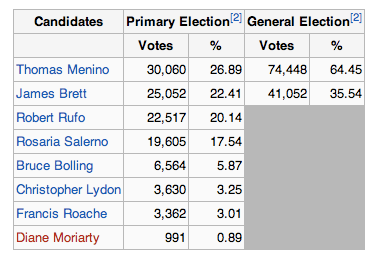
In the end, Menino put the Big Hurt on Brett two-to-one (just like every other Boston mayoral election for the next 20 years).

“Menino was a known commodity,” Shea said.

Payne said much the same thing: “Boston wants an experienced hand versus fresh ideas.”

The final results (via, God forgive us, Wikipedia):
Picture 3

Twenty years after, we finally have another scrum for mayor. And Boston is no longer Mayberry, USA.

Praise the Lord and pass the ballots.


Posted in Uncategorized | Tagged , , , , , , , , , , , , , , , , | 8 Comments

Seriously? FOURTH Day With No Herald Heaney Obit?

This is really disgraceful: For the fourth straight day the Boston Herald has ignored the death of Seamus Heaney, a major literary and local figure who graced Harvard University with his presence for many years.

Here’s who aced out the great Irish poet today:

Picture 1

We know what you’re thinking: How long will the hardflogging staff keep this up . . .

Read the rest at It’s Good to Live in a Two-Daily Town.


Posted in Uncategorized | Tagged , , , , , , , , , , | 2 Comments

R.I.P. Manson Whitlock, Titan Of Typewriter Repair

While the hardwaiting staff continues to monitor the Boston Herald for a Seamus Heaney obituary, we came across this excellent Washington Post obit of the redoubtable Manson Whitlock (via Monday’s Boston Globe):

Manson Whitlock; kept typewriters clacking

AP4723726088301377979321

WASHINGTON — Manson H. Whitlock, one of the country’s longest-serving repairmen of the clattering keyboard contraptions known as typewriters, died Aug. 28 at his home in Bethany, Conn. He was 96.

The New Haven Register first reported his death. The cause was not disclosed, but Mr. Whitlock closed his shop in June, when he was hospitalized with a kidney ailment.

Once ubiquitous in offices and on the dorm-room desks of college students, typewriters have all but fallen silent in recent years, as they have been replaced by computers. But Mr. Whitlock kept plugging along, as a dwindling number of customers hunted the streets of New Haven and knocked on the door of his second-floor shop near the campus of Yale University.

He had been on the job since 1930, when he began working at his father’s bookstore. Before long, he took charge of the typewriter department. He sold thousands over the years, and customers returned to him for replacement parts and for repairs when the keys became stuck or the carriages wouldn’t return on their Royals, Remingtons, Smith Coronas, and Underwoods.

Money quote:

He drew the line at computers, which he never learned to use. As he told the Christian Science Monitor in 2007, ‘‘You work a typewriter, a computer works you.’’

Think about it:

A typewriter is physical – a dance you engage in with the keys . . . the carriage return . . . the bing.

A typewriter is personal – the typed page reveals your writing process: strong keystrokes show conviction, weak keystrokes show tentativeness.

A typewriter is page-by-page – the typed page reveals your writing progress.

(For a much smarter take, check out The Typing Life in The New Yorker and Iron Whim in the New York Times.)

Don’t forget: cut & paste used to be something you did with scissors and tape.

Typewriting made your work more considered, more concise, more concrete.

Long live the Olivetti Lettera 22!

Stop by the hardtyping staff’s office anytime to get at look at ours.


Posted in Uncategorized | Tagged , , , , , , , , , , , , , , | 5 Comments

Seamus On The Boston Herald! STILL No Heaney Obit

Today marks the third edition of the Boston Herald to ignore the death of the great Seamus Heaney.

It’s not like anyone at the dicey local tabloid would have to actually read some of Heaney’s poetry. They could just run a wire story, they way they did today with David Frost’s obituary.

Picture 1

Better yet, they could pick up this appreciation by Roy Foster in The Guardian . . .

Read the rest at It’s Good to Live in a Two-Daily Town.


Posted in Uncategorized | Tagged , , , , , , , , , | Leave a comment

No Sendoff For Seamus Heaney In Boston Herald

The great Seamus Heaney, considered by Robert Lowell the finest Irish poet since William Butler Yeats, died this week at age 74.

The Boston Globe gave him a front-page below-the-fold appreciation by Kevin Cullen . . .

Screen Shot 2013-09-01 at 12.44.29 AM

. . . and a major obituary by Joseph P. Kahn . . .

Read the rest at It’s Good to Live in a Two-Daily Town.

Posted in Uncategorized | Tagged , , , , , , , , , | Leave a comment

How Tom Menino Became Champion Of Boston Teen Summer Jobs

Boston Globe columnist Shirley Leung filed a piece on Friday that sang the praises of Boston Mayor Tom Menino as Mr. Summer Jobs.

Nut graf:

Most major American cities abandoned their summer jobs programs after the federal funds that fueled them dried up more8739a4cb56cc41ce8f9e5d8f1271f6ca-8739a4cb56cc41ce8f9e5d8f1271f6ca-0 than a decade ago. But that didn’t happen here, not in Boston, not under Menino.

From the very beginning, he has been a champion of giving teens an opportunity to work, and every year he makes sure the city sets aside several million dollars for summer jobs.

But what Leung forgot to mention is that Menino began that history during his 69 days as acting mayor in 1993, when, according to the New York Times, “he spent $500,000 of the city’s emergency fund to create summer jobs for teen-agers.”

As he said back then, he wasn’t the actin’ mayah – he was the action mayah.

And the emergency was getting him elected in his own right.


Posted in Uncategorized | Tagged , , , , , , | Leave a comment

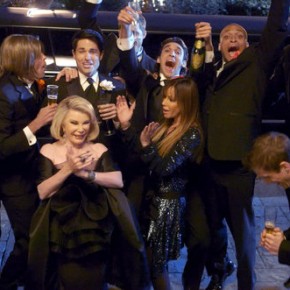
Renuzit Sprays Branded Content: ‘Romancing The Joan’

New York Times ad critic Stuart (Stockholm Syndrome) Elliott gave yet another pass to a stealth marketing campaign, this time in Tuesday’s edition of the paper.

Adco-articleLarge2-290x290A Soft Sell for Air Fresheners, With Joan Rivers in Reality Show Spoofs

CAN a frank, bawdy comedian and her equally outspoken daughter find happiness selling air fresheners? And can a maker of air fresheners find happiness with such seemingly unlikely pitchwomen? When the product-peddling aspects of the advertising can be soft-pedaled — as now occurs increasingly on Madison Avenue, in a trend known as content marketing — the answer may be “yes.”

The comedian is Joan Rivers, who, with her daughter, Melissa Rivers, are to appear in a series of humorous online video clips that promote the Renuzit line of air fresheners sold by Henkel. The seven planned episodes of the Web series will spoof “The Bachelorette” and other romance-centric reality competition shows on television by presenting 18 hunky young men competing for a chance to date Joan Rivers, who is advised during her “journey” — the Web series mockingly appropriates the trappings of its target — by her daughter.

Renuzit spent $1.5 million on the seven-webisode series (there’s supposed to be a teaser clip here, but it doesn’t seem to load), which will debut next week and unfold throughout the month . . .

Read the rest at Sneak Adtack.


Posted in Uncategorized | Tagged , , , , , , , , , , | Leave a comment

Globe’s RadioBDC Dives Into Talk

As the hardreading staff noted recently, the local dailies’ foray into Internet radio was bound to create some drama and conflict, even though Boston Herald Radio does talk (mostly to themselves) and RadioBDC does music. I wrote last month: “Be interesting to see if some news/talk shows start turning up on the indie rockstream.”

Lo and behold, from today’s Boston Globe . . .

Read the rest at It’s Good to Live in a Two-Daily Town.


Posted in Uncategorized | Tagged , , , , , , | 1 Comment

That’s Just So Wrong! (Monfils! Monfils! U.S. Open Edition)

Last night’s U.S. Open featured something truly amazing:

American tennis fans rooting against an American tennis player.

Specifically, the match between 13th-seeded American John Isner and unseeded Gael 2013 US Open - Day 4Monfils in which the (most certainly drunk) New York crowd was solidly behind the Frenchman.

No question – with Isner up two sets to none, the French-fried spectators just wanted more tennis.

But really (see around 2:00).


AP story via ABC News:

Isner ‘Disappointed’ by Fans’ Support for Open Foe

An American man playing at the American Grand Slam tournament, John Isner found it hard to believe so many U.S. Open spectators were cheering so vigorously for his French opponent, Gael Monfils.

They clapped rhythmically while chanting, “Let’s go, Monfils!” They loudly sang his last name between points. They rose to their feet and raucously saluted Monfils’ best shots. They applauded faults and other miscues by the 13th-seeded Isner, the highest-ranked U.S. man, who eventually pulled out a 7-5, 6-2, 4-6, 7-6 (4) victory Thursday night.

“I was a little bit disappointed in that, actually. Not going to sugarcoat it,” said Isner, who reached the third round at Flushing Meadows for the fifth consecutive year. “If I was playing in France, it certainly wouldn’t be like that.”

(Not for nothing, but Monfils looks more like a Dr. Seuss character every year. “He should tour in Monfilsical the Musical when he retires,” a Boston wag of our acquaintance noted.)

Isner now faces No. 22 Philipp Kohlschreiber in the third round. Let’s hope the drunken New Yorkers don’t go all Germanic on him.

Posted in Uncategorized | Tagged , , , , , , , , | 4 Comments