Boston Globe Is Assignment Desk for NYT (Instead of Vice-Versa)

Normally, the Boston Globe is a lively index to the New York Times, given all the wire-service pieces the stately local broadsheet picks up from the Times.

But Saturday’s Gray Lady featured a total Globe caboose by Jess Bidgood.

Efforts to Mark Turf When Snowstorms Hit Endure Despite Critics

BOSTON — It is a time-honored winter tradition here: Shovel out your car, and guard your newly cleared parking spot with 20130215-BOSTON-slide-L7C8-master180whatever you have handy — a traffic cone, a potted plant, a bust of Elvis.

And so it was on Thursday, after the snowstorm that paralyzed parts of the South had found its way to Boston, that the cones and more personal items, known as space savers, began to appear.

“It’s a very simple rule — if you clean it, it’s yours,” said David Skirkey, 56, a guard at the Museum of Fine Arts, who cleared his wife’s parking spot in South Boston on Thursday afternoon, leaving buckets as his marker.

And while the practice appears to be alive and well in South Boston, which is believed to be the cradle of space saving in the city, another neighborhood, the historic South End, this week moved to ban it . . .

That’s all well and good, but the Times piece never credits its likely source: Billy Baker’s Globe story earlier this month.

A space-saver hero in South Boston

One resident has taken the parking situation during snowstorms into his own hands, to a hero’s welcome

Early on Thursday morning, on the drive into work, David parking-big-9511Ivaska rammed a couple barrels in South Boston. He did this because they’re the only thing people put out as space savers that you can really punt with a bumper. Cones just get stuck under your car.

More than a day had passed since the neighborhood received a laces-high dusting of snow, but on his way home the streets of Southie were still 100 percent in on the space-saver game. So Captain Cone went on a tear. For whole blocks, Ivaska, who is 40 and lives in the three-decker he grew up in, chucked every space saver he could find, except for the cones, which he stacked in his trunk until it wouldn’t close. When he posted the photo of his trunk online — Ivaska became a Facebook folk hero as a space-saver vigilante — he did so to a hero’s welcome.
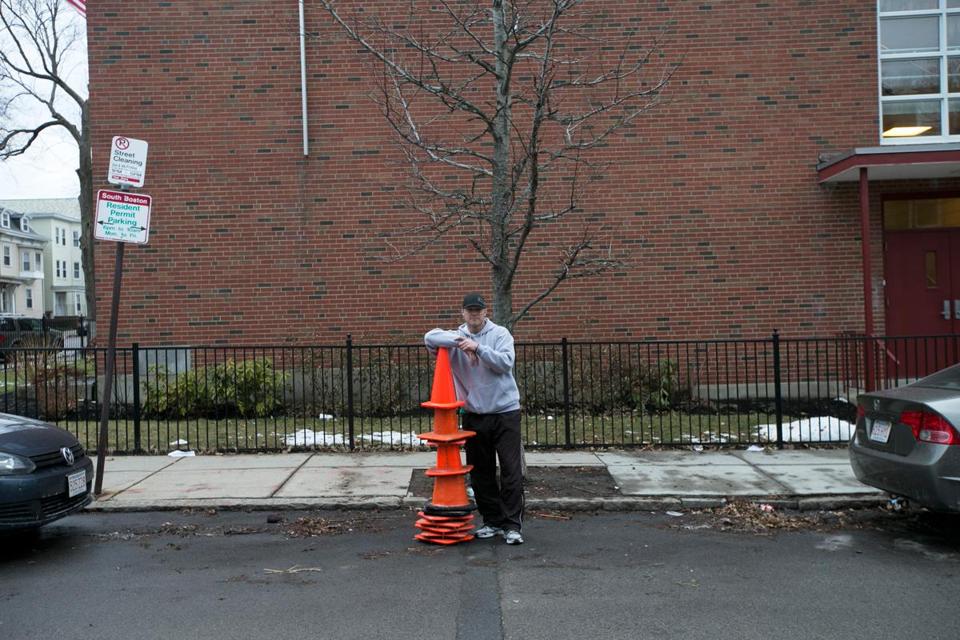
David Ivaska does turn up in the Times piece, but the Globe and Billy Baker do not.

Hey, Timesniks: Wanna weigh in here?
 

Posted in Uncategorized | Tagged , , , , , , , , , , | 2 Comments

Dead Blogging ‘Red-Eye to Havre de Grace’ at ArtsEmerson

Well the Missus and I trundled downtown last night to catch Red-Eye to Havre de Grace at the Paramount Theater and, say, it was totally swell.

The ArtsEmerson production comes compliments of Lucidity Suitcase International, which first staged the play at Philadelphia’s Live Arts Festival in September, 2012.

The basic plot:

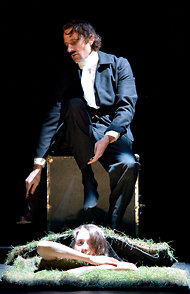
On September 27, 1849, Edgar Allan Poe set out on a lecture tour from Virginia to New York. Days later a train conductor saw Poe in Havre de Grace, Maryland, wearing a stranger’s clothing and heading south to Baltimore where he died on October 7.

What follows is a brilliant, inventive staging of Poe-etry, with Ean Sheehy as the tortured genius, Sophie Bortolussi as his dead wife Virginia (who also choreographed the eye-popping action), and Jeremy Wilhelm as tour guide Ranger Steve, who sings beautifully and plays soprano saxophone soulfully.

It’s an absolute tour de force.

Trailer:


But don’t take our word for it. Consider Charles Isherwood’s 2012 New York Times review .

Suddenly There Came a Clapping

‘Red-Eye to Havre de Grace,’ a Musical About Edgar Allan PoePHILLY-articleInline

The last, distraught days of Edgar Allan Poe are charted with spellbinding vitality in “Red-Eye to Havre de Grace,” a highlight of the theatrical offerings at this year’s Live Arts Festival here. At times funny, at times heartbreaking, and from quirky start to haunting finish a feast of entrancing visual allurements, this exquisite show is among the most original musical theater works I’ve seen in years.

You have tonight and tomorrow night to catch this stunning production.

You’re well-advised to do just that.


Posted in Uncategorized | Tagged , , , , , , , , , , , , | Leave a comment

Why the WSJ Is a Great Read (‘Yammer & Sickle’ Edition)

The Wall Street Journal, as is its wont, has featured some truly asymmetrical coverage of the Sochi Olympics this past week, largely compliments of its Yammer & Sickle microsite.

Representative sample:

Americans vs. Russian Doors: A Cold War That’s Heating Up

A Cold War Heats Up Between American Johnny Quinn and Russian Doors, and Other Dispatches From Sochi

The budding rivalry between Johnny Quinn and Russian doors Screen Shot 2014-02-12 at 12.56.22 AMtook a turn for the unhinged Monday when the U.S. bobsledder found himself stuck behind another one. And this time, it appears even he couldn’t break through it.

Two days after he smashed his way through a jammed bathroom door in the athletes’ village, Quinn tweeted a photo of himself stuck in an elevator, trying to pry the doors apart to no avail.

“No one is going to believe this,” the post said, “but we just got stuck in an elevator.” Quinn said he was with teammate Nick Cunningham and USA Bobsled technical director David Cripps. “Now we’re stuck in the elevator!” Cripps tweeted. “Can [Quinn] get us out?”

There was no immediate word on whether they got out or how long they were stuck. Quinn didn’t immediately respond to an email . . .

Things just get stranger from there.

It’s a hoot, as the Journal so often is.


Posted in Uncategorized | Tagged , , , , , , , | 2 Comments

NYT’s Boston Hemingway Piece Features Wrong Wife

Ernest Hemingway is the Moveable Feast of American literature.

And the latest entrée comes from Tuesday’s New York Times.

A Mutable Feast

Batch of Hemingway Ephemera From Cuba Is Digitized

BOSTON — Ernest Hemingway was a hoarder. His own prose style may have been spare and economical, but he was unable to part with the words, printed or written, of just about anyone else. According to his fourth wife, Mary, he was incapable of 11hemingway-sub-master180-v3throwing away “anything but magazine wrappers and three-year old newspapers.” A trove of some 2,500 documents collected and preserved at Finca Vigía, Hemingway’s farm outside Havana, and now digitized and newly available at the Hemingway Collection in the John F. Kennedy Presidential Library and Museum here, includes diaries, letters, lists, telegrams, insurance policies, bank statements, passports, tickets to bullfights and the Longchamp racecourse in Paris, a brochure from a swimming pool filter company, a page of his son Patrick’s homework and seemingly every Christmas card Hemingway ever received.

The Times piece, by Charles McGrath, has all kinds of material from Mary Hemingway, but nothing from Martha Gellhorn, the great war correspondent who was Hemingway’s third wife and lived with him in Cuba before he divorced her and married Mary (née Welch), yet another war correspondent.

Coincidentally, Gellhorn’s ephemera is also housed in Boston – at Boston University’s Howard Gotlieb Archival Research Center.

(Full disclosure: The hardworking staff moonlights at BU, and the Missus wrote Gellhorn’s bio for the Gotlieb Center’s website.)

Campaign Outsider Official Suggestion®: The JFK Library should contact the Gotlieb Center’s irrepressible Vita Paladino and mount a co-curated exhibit.

The matchmaking staff would be glad to provide commentary.


Posted in Uncategorized | Tagged , , , , , , , , , | Leave a comment

‘Would He’ Allen? WSJ’s Rabinowitz Says No

The hardreading staff over at Two-Daily Town has dutifully recorded Boston Herald columnist Margery Eagan’s sandblasting of Woody Allen’s defense against allegations by his adoptive daughter, Dylan Farrow, that he sexually molested her as a child.

Now comes Wall Street Journal columnist Dorothy Rabinowitz, a staunch believer that the sex-abuse cases in the ’80s and ’90s were overblown.

On Woody Allen and Echoes of the Past

Those who are falsely accused often naively believe that their innocence is obvious, that the allegations will be dropped.

It’s impossible to read Woody Allen’s reply to charges that in 1992 he molested his and Mia Farrow’s 7-year-old adopted BN-BL076_rabino_D_20140209160236daughter, Dylan, without being struck by its haunting echoes of the words of countless people accused of such crimes. He had thought that the charges were so ludicrous he didn’t think of hiring a lawyer, he reported in an op-ed for the New York Times on Sunday. He had believed that “common sense would prevail.” He had “naïvely thought the accusation would be dismissed out of hand.”

It was a kind of naïveté evident in virtually every person known to me who had been falsely charged in the high-profile sex-abuse cases that had swept the country in the 1980s and early 1990s—people convicted and sentenced to long prison terms on the basis of testimony from children coaxed into making accusations. Accusations made, at ages 5, 6 or 7, that many of them would continue to believe fervently were true, into adulthood.

Rabinowitz proceeds to recap the high-profile  ’80s/’90s sex-abuse cases – the Amiraults, Kelly Michaels – and comes to this conclusion:

For no one, perhaps, is the importance of keeping alive the charge of guilt greater than the person who was, as a child, part of a famous child sex-abuse case built on false charges. These children, reinforced again and again in the truth of the accusation, would believe as adults that their horrific victimization early in life has caused them psychic injury of untold depths.

Well, someone’s getting injured here. You decide, yeah?


Posted in Uncategorized | Tagged , , , , , , , , , | 5 Comments

NYT Needs a Subscription to TNR

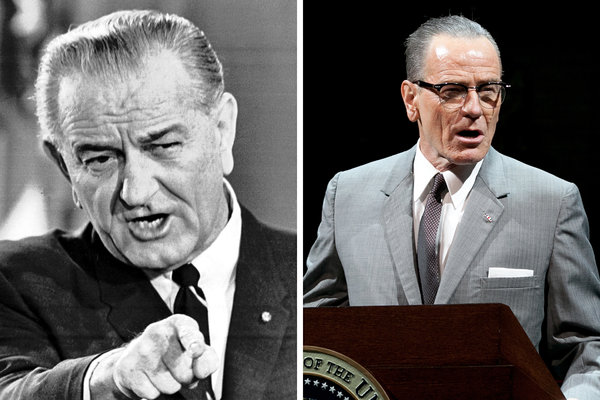
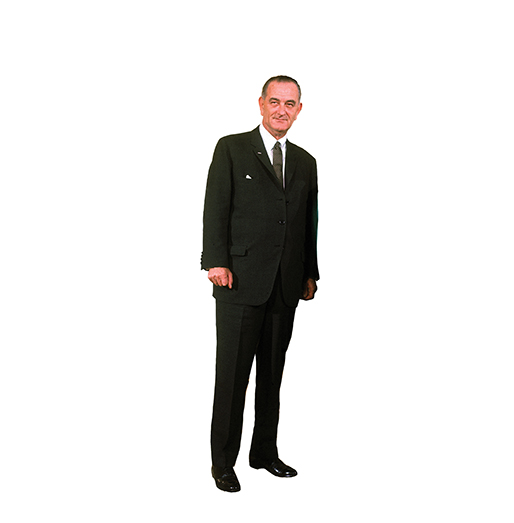
Yesterday’s New York Times featured Sam Tanenhaus’ fulsome preview of the new Broadway production of “All the Way,” Robert Schenkkan’s play about Lyndon Johnson’s push for the 1964 Civil Rights Act. The Times piece calls it “[t]he story of a ruthless 09JPLBJ2-articleLargepresident who got things done — without blinking at the costs and compromises . . . ”

The production stars Bryan Cranston, late of “Breaking Bad,” who read Doris Kearns Goodwin’s “Lyndon Johnson and the American Dream” in preparation for the role. But, the Times piece says, he didn’t get to do all the research he wanted.

An authority he has yet to consult, though not for want of trying, is Robert Caro, the biographer who has spent nearly 40 years chronicling Johnson’s life. Mr. Cranston read “Master of the Senate,” the third volume in Mr. Caro’s monumental cycle, for clues to his legislative prowess.

Except, according to this piece in the current issue of The New Republic, Johnson largely didn’t exercise that prowess in the passage of the bill.

The Shrinking of Lyndon Johnson

He wasn’t the arm-twisting, indomitable genius of Robert Caro’s imagination

A few minutes after he signed the Civil Rights Act on July 2, 1964, President Lyndon B. Johnson presented Hubert LBJ & Lady BirdHumphrey, who had led the fight for its passage in the Senate, with a copy of his signing speech. On it, the president wrote, “without whom it couldn’t have happened.”

Johnson wasn’t one to share credit easily, but he understood a simple fact about Washington: Humphrey—and the dozens of other people who made the bill happen—would be relegated to a footnote, and history would give credit to the man who signed it. And he was right. Three days later, The New York Times credited Johnson as “the man who pushed [the bill] through Congress.”

But that, Clay Risen writes, is largely myth. (Risen, by the way, is an editor at  – wait for it – The New York Times and the author of the forthcoming The Bill of the Century: The Epic Battle for the Civil Rights Act. We’re guessing he did not edit Tanenhaus’ piece.)

This is the reality, according to Risen:

Johnson had many legislative achievements during his pres­idency, but on the Civil Rights Act, he was largely ignored by his Senate allies and rebuffed by the recipients of his bear-hugging affection. The real work was performed by a long list of senators and representatives, their staffers, and a dream team of Department of Justice men who included Robert Kennedy, Nicholas Katzenbach, and Burke Marshall—not to mention civil rights leaders like Martin Luther King Jr., who built immense moral momentum behind the bill.

Not exactly “All the Way” with LBJ, eh? As we said, somebody at the Times should do more reading.


Posted in Uncategorized | Tagged , , , , , , , , , , , , , | 2 Comments

Where in The Times Is Brian McFadden?

Granted, the hardworking staff has run cold and hot with New York Times cartoonist Brian McFadden. But we were dismayed to see not McFadden’s work, but this cartoon by Michael Kupperman and David Rees in yesterday’s Sunday Review.


0209see-something-jumbo


There’s no “Brian McFadden is not drawing today” below the strip. No “Brian McFadden is on book leave” either.

So the hard tweeting staff hied us to McFadden’s Twitter feed, which features . . . absolutely nothing about this omission.

Whiskey Tango Foxtrot, yeah?


Posted in Uncategorized | Tagged , , , , , , , | 3 Comments

Good Shepherd for 1965 Beatles Playboy Interview

The Golden Anniversary of the Beatles’ inaugural appearance on the Ed Sullivan Show – go nuts! – is set to culminate in tonight’s Grammys salute.

From the 1964 really big shew:


The hardBeatling staff also recommends this 1965 Playboy interview of the Fab Four conducted by the great Jean Shepherd, a radio legend in his own time who “traveled and lived with” the Beatles for three days “in the midst of a wild, swinging personal-appearance tour they were making throughout the British Isles.”

Shepherd’s introduction is just as interesting as the interview itself.

Representative sample:

It became impossible to tell one town from another, since to us ku-xlargethey were just a succession of dressing rooms and hotel suites. The screams were the same. The music was the same. It all assumed the ritual quality of a fertility rite. Latter-day Druids, the Beatles sat in their dressing room—a plywood Stonehenge—surrounded by sweaty T-shirts, trays of French fries, steak, pots of tea, and the inevitable TV set; while from somewhere off beyond the walls of the theater came the faint, eerie wailing of their worshipers, like the sea or the wind. But the Beatles no more heard it than a New York cop hears traffic . . .

It’s a great read.

Supplemental reading: This Jim Fusilli piece in Thursday’s Wall Street Journal, which asks the musical question, “In February 1964, were the Beatles any good?”

Answer: “Oh yes. And they were going to get better.”


Posted in Uncategorized | Tagged , , , , , , , , , , | Leave a comment

Worst. Olympic. Outfits. Ever.

For the past 12 years Ralph Lauren has designed the outfits for the U.S. Olympics team, and this year’s model is absolutely the worst.

Two-page spread in Friday’s New York Times.

Screen Shot 2014-02-08 at 12.11.48 AM

Screen Shot 2014-02-08 at 12.12.52 AM

That’s just sad.

Coincidentally, Friday’s Times also featured this piece by John Branch in the Sports section.

Designers Carve a Fashion Runway at the Games

Beyond the thrilling victories and agonizing defeats, the Olympics are a 16-day fashion show, even for fans blithely unaware that the United States Alpine skiing uniforms are meant to evoke the nation’s flag reflected in the water off Fort McHenry the morning after the British bombardment, 200 years ago, that inspired “The Star-Spangled Banner.”

To some, it might just look like a super-tight ski uniform.

But dressing the athletes is more complicated than that, an Olympic sport in itself.

In that case, Ralph Lauren just won himself an Aluminum Foil Medal.

Posted in Uncategorized | Tagged , , , , , , | 1 Comment

Why the WSJ Is a Great Newspaper (California PG&E Terrorist Attack Edition)

Rebecca Smith’s front-page Wall Street Journal piece yesterday about the attempt last year to knock out a California power station is a knockout.

Assault on California Power Station Raises Alarm on Potential for Terrorism

April Sniper Attack Knocked Out Substation, Raises Concern for Country’s Power Grid

SAN JOSE, Calif.—The attack began just before 1 a.m. on April 16 last year, when someone slipped into an underground vault not far from a busy freeway and cut telephone cables.

Within half an hour, snipers opened fire on a nearby electrical substation. Shooting for 19 minutes, they surgically knocked out 17 giant transformers that funnel power to Silicon Valley. A minute before a police car arrived, the shooters disappeared into the night.

So what, you say?

Here’s what:

The attack was “the most significant incident of domestic terrorism involving the grid that has ever occurred” in the U.S., said Jon Wellinghoff, who was chairman of the Federal Energy Regulatory Commission at the time.

Helpful graphic:


OG-AA794_GRIDAT_NS_20140204171308


You really should read it.

P.S. The New York Times rides caboose in this piece today, which credits – in a backhanded way – the Journal in paragraph eight.

Debate over the attack was prompted by a Wall Street Journal article published Wednesday that took an in-depth look at the episode, which was a topic of discussion at a congressional hearing in December and was examined by Foreign Policy magazine the same month.

What – the Journal was late to the party? Hey, Timesniks: You’re later.


Posted in Uncategorized | Tagged , , , , , , , , , , , , , | Leave a comment