Marina Abramovic Blushathon (IV)

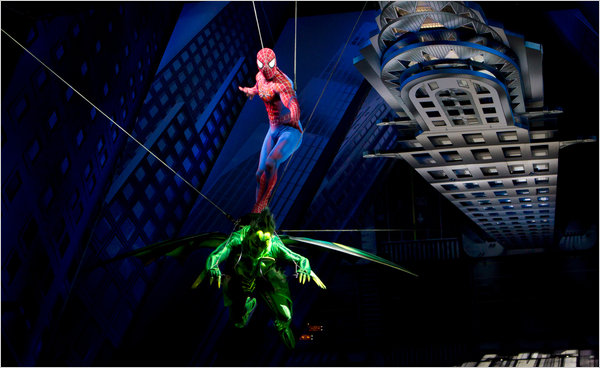
The New York Times did its “The Arts in 2010” review on Tuesday, and smackdab below the predictable “Spider-Man: Turn Off the Dark” action photo was this:

With its costs and its casualties (including Christopher Tierney, standing above), “Spider-Man: Turn Off the Dark” became the most scrutinized new show on Broadway this year, though it’s still in previews.

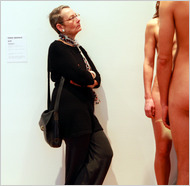
But it wasn’t the only endeavor to attract attention: visitors to the retrospective of the performance pioneer Marina Abramovic at the Museum of Modern Art entered between nude performers standing at attention.

Helpful visual:

Once again:

Yikes.

Here’s the rest of the Times, er, coverage of MOMA’s Abramovic retrospective.

And here’s the hardworking staff’s coverage of the, er, coverage.

All we can say is:

O the Times! O the customs!

Posted in Uncategorized | Tagged , , , , | 3 Comments

The Tizzard Of Twenty-Ten

As in, all in a tizzy.

The local weathernerds shifted into Snowpocalypse/Snowmageddon/Brrrricane gear, the NFL spiked the Philadelphia Eagles game, and Universal Hub’s French Toast Alert blinked orange.

All for a measly 18 inches of snow.

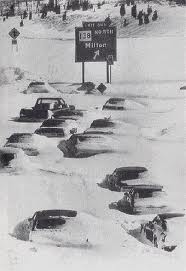
Regardless, there were plenty of local references to the Blizzard of ’78, which dropped a knee-buckling two to four feet of snow on the region. One of the least hackneyed came from Kevin Cullen’s column in Monday’s Boston Globe:

I was away at college, far beyond Route 128, when the Blizzard of 1978 hit, and being absent for that iconic, culturally defining event came at a price. Neighbors and friends treat you like a blow-in, like you’re not really a Bostonian, if you weren’t around for the Blizzard of ’78.

I was around for the big one, and it went something like this:

I was living in Brookline Village and managing A Wine for All Reasons (stupidest name ever) in Harvard Square. The snow started on Monday, February 6th, and didn’t stop until the next day, at which point my bosses informed me that they fully expected the shop to be open on Wednesday.

So I walked to Harvard Square on Wednesday morning, which took roughly my entire life, and proceeded to dig out the (of course) basement store and open for business.

Typical phone conversation:

Good afternoon, A Wine for All Reasons.

Hey – I can’t believe you’re open.

So why’d you call?

As I remember it, a couple of days later the MBTA kickstarted service from Kenmore Square, so I only had to walk half my life to get to work.

But I sold a helluva lot of wine that week.

Posted in Uncategorized | Tagged , , , | 2 Comments

NYT David Barstow Is Not The Son Of Robbins Barstow

Splendid reader Brendan Myers solved the Barstow question at the end of our previous post :

If WikiPedia is to be believed, the New York Times David Barstow was born in 1963, making it impossible for him to have gone to Disneyland with his family in 1957.

Many thanks from the (not) hardworking (enough) staff, Brendan, and best for the new year.

Posted in Uncategorized | 1 Comment

Times Three

A trio of notable pieces from Sunday’s New York Times:

1) The devastatingly vivid report by David Barstow, David Rohde, and Stephanie Saul about the Deepwater Horizon blowout disaster in the Gulf of Mexico.

Nut graf:

On paper, experts and investigators agree, the Deepwater Horizon should have weathered this blowout.

This is the story of how and why it didn’t.

It is based on interviews with 21 Horizon crew members and on sworn testimony and written statements from nearly all of the other 94 people who escaped the rig. Their accounts, along with thousands of documents obtained by The New York Times describing the rig’s maintenance and operations, make it possible to finally piece together the Horizon’s last hours.

What emerges is a stark and singular fact: crew members died and suffered terrible injuries because every one of the Horizon’s defenses failed on April 20. Some were deployed but did not work. Some were activated too late, after they had almost certainly been damaged by fire or explosions. Some were never deployed at all.

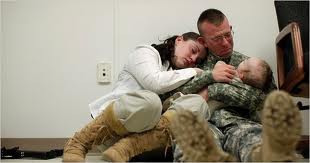
Equally vivid are the photographs of the burning rig “provided to the New York Times by a worker on a nearby boat who asked not to be identified.”

Representative sample:

Devastating, all the way around the course.

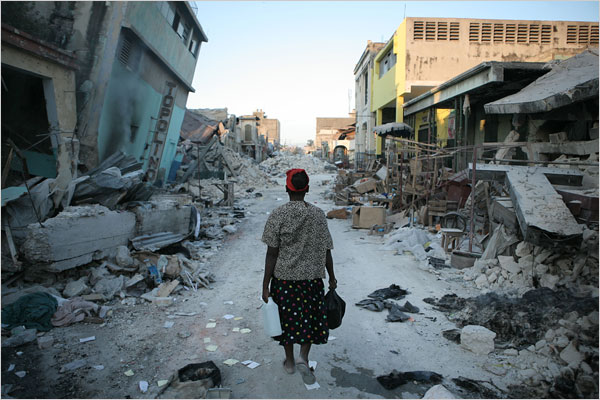
2) The Year in Pictures in the Times is dominated by Damon Winter, who captured everything from the devastating earthquake in Haiti . . .

. . . to a devastating deployment to Afghanistan . . .

That’s just heartbreaking.

3) The latest submission from columnist Frank Rich (NYT-Pulitzer Prize Candidate?):

Who Killed the Disneyland Dream?

Lede:

OF the many notable Americans we lost in 2010, three leap out as paragons of a certain optimistic American spirit that we also seemed to lose this year. Two you know: Theodore Sorensen, the speechwriter present at the creation of J.F.K.’s clarion call to “ask what you can do for your country,” and Richard Holbrooke, the diplomat who brought peace to the killing fields of Bosnia in the 1990s. Holbrooke, who was my friend, came of age in the Kennedy years and exemplified its can-do idealism. He gave his life to the proposition that there was nothing an American couldn’t accomplish if he marshaled his energy and talents. His premature death — while heroically bearing the crushing burdens of Afghanistan and Pakistan — is tragic in more ways than many Americans yet realize.

But a third representative American optimist who died this year, at age 91, is a Connecticut man who was not a player in great events and whom I’d never heard of until I read his Times obituary: Robbins Barstow, an amateur filmmaker who for decades recorded his family’s doings in home movies of such novelty and quality that one of them, the 30-minute “Disneyland Dream,” was admitted to the National Film Registry of the Library of Congress two years ago. That rare honor elevates Barstow’s filmmaking to a pantheon otherwise restricted mostly to Hollywood classics, from “Citizen Kane” to “Star Wars.”

Video:

That sky-is-the-limit-if-I-work-hard-enough era is over, Rich concludes. So what now?

The Barstows of 1956 could not have fathomed the outrageous gap between this country’s upper class and the rest of us. America can’t move forward until we once again believe, as they did, that everyone can enter Frontierland if they try hard enough, and that no one will be denied a dream because a private party has rented out Tomorrowland.

Sounds like Fantasyland to us.

But devastating in its own way.

P.S. According to at least one source, the NYT’s David Barstow is the son of Robbins Barstow – which, if true, Frank Rich might have mentioned. The hardworking staff is currently investigating.

Posted in Uncategorized | Tagged , , , , , , , | 3 Comments

Gecko v. Flo: Worst Media Smackdown Ever?

The folks at left-wingnut website AlterNet are all lathered up about the ongoing slapfight between the Geico gecko and Progressive Insurance spokesgal Flo, who’s annoying enough to be the 21st century Mr. Wipple

Curent AlterNet headline:

Cutesy GEICO Gecko’s Ad Fight Is a Deeply Disturbing Symbol of Our Economic Decline

(Hate those disturbing symbols.)

Lede:

If you’ve turned on the tube these last few weeks, you’ve probably been a collateral casualty of the biggest televisual war of attrition in recent memory. No, I’m not talking about the scripted skirmishes between cable channels, nor am I referring to the Battle of Zombie Talking Points that ate most of our brains during the election. I’m talking about the now never-ending throwdown between two of the most in-your-face salespeople our mediascape has ever manufactured: Geico’s unnamed gecko and Progressive Insurance’s chipper saleswoman, Flo.

It’s not just that the lizard and the pitchgal are ubiquitous. It’s that they’re iniquitous, since auto insurance is a) government-mandated; b) government-subsidized; and c) government-unregulated.

Rather than building real wealth for society, unregulated competition between the geckos and the Flos in the insurance and finance sector has often meant fine-print terms like “recission,” esoteric maneuvers like “securitization” and acronym-cloaked schemes like CDOs — that is, ever-more complex “innovations” to reduce customer payouts, increase fees, maximize private profit and limit executive liability, all under the TV-commercial guise of allegedly lower prices and better consumer returns.

So the gecko is picking your pocket. That’s even more impressive than the cellphone and wallet he keeps in his pocket.

AlterNet, eat your heart out.

Posted in Uncategorized | Tagged , , , , | 2 Comments

The Prevalence Of Humbug

In his latest piece, The Humbug Express, New York Times columnist Paul Krugman addresses the imbalance between the right-wing media’s propaganda machine and that of the left wing.

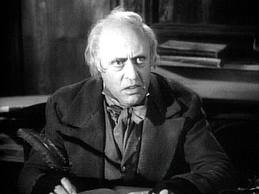
He starts out by recalling the original humbugger, Charles Dickens’ immortal Ebenezer Scrooge.

I mean, consider the scene, early in the book, where Ebenezer Scrooge rightly refuses to contribute to a poverty relief fund. “I’m opposed to giving people money for doing nothing,” he declares. Oh, wait. That wasn’t Scrooge. That was Newt Gingrich — last week. What Scrooge actually says is, “Are there no prisons?” But it’s pretty much the same thing.

Anyway, instead of praising Scrooge for his principled stand against the welfare state, Charles Dickens makes him out to be some kind of bad guy. How leftist is that?

As you can see, the fundamental issues of public policy haven’t changed since Victorian times. Still, some things are different. In particular, the production of humbug — which was still a somewhat amateurish craft when Dickens wrote — has now become a systematic, even industrial, process.

In particular, Krugman points to the widespread belief that a) government jobs have soared while private-sector jobs have shrunk, and b) there’s been an explosion in the number of federal regulators.

Krugman contends that both are wrong but rampant, the latter thanks to their continual reinforcement by politicians and think tanks. Then he asks:

[W]hy does it matter what some politicians and think tanks say? The answer is that there’s a well-developed right-wing media infrastructure in place to catapult the propaganda, as former President George W. Bush put it, to rapidly disseminate bogus analysis to a wide audience where it becomes part of what “everyone knows.” (There’s nothing comparable on the left, which has fallen far behind in the humbug race.)

Krugman concludes that, “Scrooge was right about the prevalence of humbug.”

Which got the hardworking staff to thinking about the essay with that name – The Prevalence of Humbug – by American philosopher Max Black. His definition:

HUMBUG: deceptive misrepresentation, short of lying, especially by pretentious word or deed, of somebody’s own thoughts, feelings, or attitudes.

In other words, it’s about what the speaker wants the listener to believe, not what the speaker actually believes himself.

Black concedes that humbug will always be with us, but we should try to call it out whenever possible, since it slowly erodes the good-faith assumption people reflexively bring to communication (i.e., that the speaker’s words reflect his true “thoughts, feelings, or attitudes”).

Max Black wrote his essay in 1980. Thirty years later, public discourse is all about bad-faith assumptions. Much to our detriment.

Posted in Uncategorized | Tagged , , , | Leave a comment

Free The Daniel Chester French One!

The artist who sculpted the Minuteman statue in Concord, Mass., and the statue of Abraham Lincoln at the Lincoln Memorial in Washington is losing the Stockbridge Smackdown to America’s Imagemaker.

Friday’s Wall Street Journal A-Hed headline:

It’s a Norman Rockwell Christmas, and Dan French Is Out in the Cold

Subhead:

In Stockbridge, the Illustrator’s Name Outguns The Sculptor’s; ‘It’s All About Branding’

That would be sculptor Daniel Chester French, whose Chesterwood summer home can barely attract flies, while the Norman Rockwell Museum is routinely packed.

The compound, including a big house and sculpted gardens, attracts 10,000 visitors seasonally, compared with 130,000 annually at the Rockwell museum.

By contrast:

Mr. French’s statue of Lincoln is one of the best known and most visited sculptures in the country—about 4 million people visit the memorial each year, the National Park Service says. But few realize Mr. French made it. If the National Park Service could only give more credit to the creator, Chesterwood loyalists say, it would help burnish his reputation.

Well, this is Campaign Outsider’s effort to do the same.

Posted in Uncategorized | Tagged , , , | Leave a comment

You’re On Deadspin? You’re Dead, Period.

Headline o’ the Week, via Deadspin:

This May Or May Not Be Rex Ryan’s Wife Making Foot-Fetish Videos (UPDATE)

Relevant video (one of many truncated versions on YouTube):

From Deadspin:

There’s a celebrity in the foot-fetish world who posts videos with titles like “Hot Mature Sexy Feet.” The videos feature a woman who looks like Jets coach Rex Ryan’s wife, Michelle — and, in one, a man offscreen who sounds like Rex.

What Rex sounds like now is a dying man (CBS video):

This comes in the wake of Deadspin’s takedown of quarterbuck Brett Favre, who allegedly sent cellphotos of his penis to C-list sports squawker Jenn Sterger:

In the video here (parts of which are NSFW due to penis photos at 2:08 mark), you’ll see and hear all the strange messages Jenn Sterger received from someone she was led to believe was Brett Favre.

Deadspin is potentially the second graf of every sports obit in the foreseeable future. Memo to Tom Brady: Avoid it at all costs.

Posted in Uncategorized | Tagged , , , , , , , | 4 Comments

WSJ Wants Not Neutrality

The Wall Street Journal’s campaign against net neutrality started in earnest last April with a question from op-ed columnist Holman W. Jenkins, Jr.:

End of the Net Neut Fetish?

Hooray. We live in a nation of laws and elected leaders, not a nation of unelected leaders making up rules for the rest of us as they go along, whether in response to besieging lobbyists or the latest bandwagon circling the block hauled by Washington’s permanent “public interest” community.

This was the reassuring message yesterday from the D.C. Circuit Court of Appeals aimed at the Federal Communications Commission. Bottom line: The FCC can abandon its ideological pursuit of the “net neutrality” bogeyman, and get on with making the world safe for the iPad.

Of course, the D.C. Circuit Court of Appeals is hardly the last word on anything. Regardless, four months later, Jenkins answered his own question after Google and Verizon cut a deal to end-run net neutrality:

End of the Net Neut Fetish

Historians, if any are interested, will conclude that the unraveling of the net neutrality movement began when the iPhone appeared, instigating a tsunami of demand for mobile Web access.

They will conclude that an ancillary role was played when carriers (even some non-wireless) began talking about metered pricing to meet the deluge of Internet video.

Bottom line: Google and Verizon made a deal that net neutrality can be tolerated for the Net, but not for wireless users.

Of course, the two companies needed the cooperation of the Federal Communications Commission, and that arrived this week. But first the Journal had to pull the fire alarm, thoughtfully provided on Monday by FCC commissioner Robert M. McDowell:

The FCC’s Threat to Internet Freedom

The pull quote says it all:

‘Net neutrality’ sounds nice, but the Web is working fine now. The new rules will inhibit investment, deter innovation and create a billable-hours bonanza for lawyers.

Heaven forfend!

Cut to Wednesday’s Journal, where John Fund positions the FCC decision as a coup for liberal anti-corporatists:

The Net Neutrality Coup

The Federal Communications Commission’s new “net neutrality” rules, passed on a partisan 3-2 vote yesterday, represent a huge win for a slick lobbying campaign run by liberal activist groups and foundations. The losers are likely to be consumers who will see innovation and investment chilled by regulations that treat the Internet like a public utility.

Of course, you can also make the opposite case, as Gawker noted in this post:

Net Neutrality Passes, Immediately Pisses Everyone Off

The Federal Communications Commission today approved rules discouraging internet access providers from charging websites for favorable treatment. That might sound like a good thing, but it’s actually a terrible surrender to big business, or alternatively a communist plot.

The ACLU said “the FCC has failed to protect free speech” while a Republican FCC commissioner called the vote one of the “darkest days in recent FCC history” and an act of vigilantism. What actually happened is that the commission forbade internet service providers from blocking content; required them to disclose how they filter traffic, for example by slowing down BitTorrent connections; and forbade them from “unreasonable” discrimination against websites, for example by giving some sites more bandwidth. Wireless service providers are exempt from the discrimination ban, however.

Stay tuned for further developments.

Posted in Uncategorized | Tagged , , , , , | Leave a comment

Maureen Dowd: Religion Is A Crèche

New York Times Op-It Girl Maureen Dowd doesn’t seem to have much use for religion in spite (because?) of her good Catholic upbringing. When she does talk about matters of faith, it’s often related to her family, as today’s column is.

Lede:

Last Christmas I got a jolt.

I learned that my brother Kevin collects crèches. They were all over his house, crammed onto every mantle, table, counter, lawn and closet — 17 in all, including the modest plastic stable our mom put over the fireplace when we were little.

Dowd was perturbed, but also intrigued:

I was curious enough about the manger mania that when he told me he’d been invited to the Friends of the Creche annual convention in New Haven one weekend in November, I asked if I could go, too.

What transpires after that is a sort of Marlon Perkins Wild-Kingdom-of-God episode, with Dowd observing the crècheniks in their natural habitat. It’s standard-issue MoDo, mildly irreverent, mildly irrelevant.

What was surprising – how mild the reader reaction was. Virtually all of the comments I saw were positive or benign.

Dowd must be losing her fastball.

Or maybe it’s just the Christmas spirit.

Posted in Uncategorized | Tagged , , , , , | 1 Comment