Boston Ad (Wo)Men Recreate “Mad Men” Era

From our Everything “Mad Men” Is New Again desk

The New York Times reports that the fifth season premiere of AMC’s Mad Men is the real March Madness.

After ‘Mad Men’ Drought, Hoping to Slake a Thirst

The fifth season of “Mad Men,” the drama series about advertising and America in the 1960s, is to begin on the AMC cable channel on Sunday. It has been 17 months since the final episode of Season 4, and that hiatus — twice as long as usual — has whetted the appetites of fans and those hoping to entice them to buy magazines, books, clothing, cosmetics, jewelry and other merchandise.

Among the enticers:

Perhaps the most ambitious effort is being made by Newsweek and its online partner, The Daily Beast, part of IAC/InterActiveCorp, which will bring out on Monday a double issue of the print and tablet editions of the magazine that are designed to mirror the Newsweek graphics of the ’60s.

The “special retro-modern issue” of Newsweek:

The Boston connection:

Hill, Holliday, Connors, Cosmopulos, an agency in Boston that is part of the Interpublic Group of Companies, worked with the Newsweek Daily Beast executives to bring the project to fruition.

“We positioned the sales pitch, the idea of creating custom ads, and we even sold a few to our clients,” said Karen Kaplan, president at Hill, Holliday, referring to Dunkin’ Donuts, whose ad carries the headline “Say ‘Yup!’ to America’s favorite cup,” and John Hancock, whose ad, in black and white, carries the headline “Pessimism is a darn lousy investment strategy.”

Newsweek is getting “a lot of new advertisers” who were “specifically interested in being in this issue because of the content,” Ms. Kaplan said. Of the 30 ad pages, Mr. Gregory said, 25 or 26 were created for the issue.

Boston Business Journal helpfully adds “3 Reasons Mad Men’s Return Is Good For Boston:”

1. “Mad Men” serves as a potent reminder that the advertising business is cool. Local ad executives have said the show, which is set in the 1960s, has elevated the profile of the ad industry and also made it mysterious again.

2. The launch of the new season also will provide ample water cooler chatter (excuse me, Twitter chatter) for the next several months. People, especially ad types, love to blog about the show. And they love to tweet about it. Here are two written by Boston execs: “Mad Men, Trust Me, and now, Soul for Sale”; and a Hill Holliday    blog post, “Pictures from the Edge of the Mad Men era.”

3. Lastly, “Mad Men” allows Boston ad veterans to live vicariously through Draper, who still exists in a simple world where your boss might offer you a tumbler of whiskey at 10 a.m. and a focus group of a dozen women was still the main way to generate real-world research for an ad campaign about pantyhose or face cream.

Let the Mad rumpus begin!

Posted in Uncategorized | Tagged , , , , , , | Leave a comment

Apple, Schmapple: “The iPad of 1935”

From Smithsonian’s Paleofuture (via the Missus):

The April, 1935 issue of Everyday Science and Mechanics included this nifty invention which was to be the next logical step in the world of publishing. Basically a microfilm reader mounted on a large pole, the media device was supposed to let you sit back in your favorite chair while reading your latest tome of choice.

It has proved possible to photograph books, and throw them on a screen for examination, as illustrated long ago in this magazine. At the left is a device for applying this for home use and instruction; it is practically automatic.

Said device:

Looks like fun, yes?

In a 1935’s sort of way.

Posted in Uncategorized | Tagged , , , , | 3 Comments

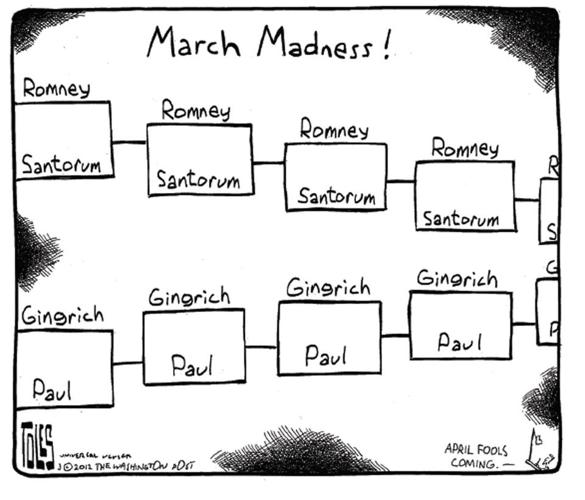
Editorial Cartoon o’ the Day (March Madness Edition)

From the great Tom Toles (via the Boston Globe):

File under: Bracket racket.

Posted in Uncategorized | Tagged , , , , , , , | Leave a comment

Daisey Chain Entangles David Sedaris

The Mike Daisey rumpus over his fabrications about Apple’s manufacturing practices has put formerly bulletproof David Sedaris in the crosshairs.

But not with everyone.

From David Carr’s New York Times column today:

Mr. Daisey’s one-man show, “The Agony and the Ecstasy of Steve Jobs,” closed its very successful run at the Public Theater in New York on Sunday. The show played a significant role in raising public consciousness, not just about the ethics of offshore manufacturing, but about whether those of us who fondle those shiny new iPads every day are implicated as well.

It was a fine bit of theater. It worked less well as a piece of journalism, which is how it was represented when it was broadcast on “This American Life.” The episode was a huge hit, downloaded as a podcast more than any other in the history of the program. But it fell apart after Rob Schmitz, a reporter from “Marketplace,” another public radio show, fact-checked the specifics.

Inexplicably, Carr gives Sedaris a pass on his similar approach to storytelling:

I am a longtime fan of “This American Life,” but I have never assumed that every story I heard was literally true. The writer and monologist David Sedaris frequently tells wonderful personal yarns on the show that may not be precisely true in every detail, but this was not a story about a family car trip gone bad.

So there’s a two-tier standard for truth? It’s okay to fabricate stories about yourself, but not okay to fabricate stories about others?

Sounds like a slippery slope to the hardworking staff.

Posted in Uncategorized | Tagged , , , , , , , , | 9 Comments

Xavier University: Sweet Sixteen But Never Been Kissed

As an intermittently proud Xavier University alum, the hardworking staff is of course delighted that the Musketeers vanquished the Lehigh Mountain Hawks 7o-58 in last night’s NCAA bakeoff.

As Lehigh Valley Live reported:

Xavier University men’s basketball coach Chris Mack brought up an interesting statistic to his team during a timeout late in the first half.

The third-year head coach told his players they had just four defensive stops in the game’s first 16 minutes.

The 10th seeded Musketeers certainly changed their tune in the second half as their stifling defense propelled them to a 70-58 victory over 15th seed Lehigh University in the third round of the NCAA tournament’s South Region at the Greensboro Coliseum.

“It was a tale of two halves, certainly,” Mack said. “I thought the final push we made before half helped our team. We were able to get stops in part because (C.J.) McCollum was on the bench, but we were also able to make some shots.”

“For them to shoot 14 percent (5-for-34) in the second half … I don’t know if I’ve ever seen that.”

We have, however, seen Xavier in the Sweet Sixteen before – four times in the past five years, to be exact (and once in that time to the Elite Eight).

But never to the Final Four.

Probably not this time either.

Regardless, Go Muskies!

Posted in Uncategorized | Tagged , , , , , , , , , , | Leave a comment

Did The WSJ Scoop Boston Media On A Major MFA Acquisition?

From the Weekend Wall Street Journal:

A New Bostonian, Size XL, Age 1,900

A Roman goddess is making Boston’s Museum of Fine Arts her new home on Tuesday. But it won’t be easy.

A flatbed truck will pull up with the 13-foot-tall, almost two-millennia-old statue of Juno resting on her back in a steel cage—and without her head. (The museum decided decapitation would allow a more-secure move, since the head was precariously attached.)

A crane will raise Juno 80 feet in the air and lower her into the museum through a skylight. Once the sculpture lands, movers will push it through a doorway expanded by 18 inches to accommodate Juno’s girth and then use a chain hoist to lift her upright. The colossus will be the centerpiece of a new classical gallery.

According to the Journal piece, “[the] 13,000-pound marble statue was shipped from Rome to a wealthy Boston couple in the late 19th century and until recently lived on the manicured gardens of a historic property in Brookline, a western Boston suburb.”

That was news to the hardworking staff, which wondered how it had missed the story in the local press.

So we checked.

First, the Googletron:

That would be the MFA’s own promotion of the conservation effort.

So how about local news organizations?

NECN: Nothing.

WGBH’s Greater Boston: Nothing.

WBUR: Nothing.

The Boston Globe: Next to nothing.

The Globe’s fleeting mention of the acquisition:

[A] recently acquired Roman work, the so-called “Brandegee Juno,’’ billed as the largest classical statue in the United States, will be installed in a second-floor gallery in March. It will eventually be the centerpiece of a planned “Gods, Goddesses, and Heroes’’ gallery in the George D. and Margo Behrakis Wing for Art of the Ancient World.

But apparently the centerpiece of no Boston news stories.

Granted, the hardsearching staff might have missed something.

But it’s more likely the Boston news media has.

Posted in Uncategorized | Tagged , , , , , , , | Leave a comment

The Biggest Loser: Romney Or Santorum?

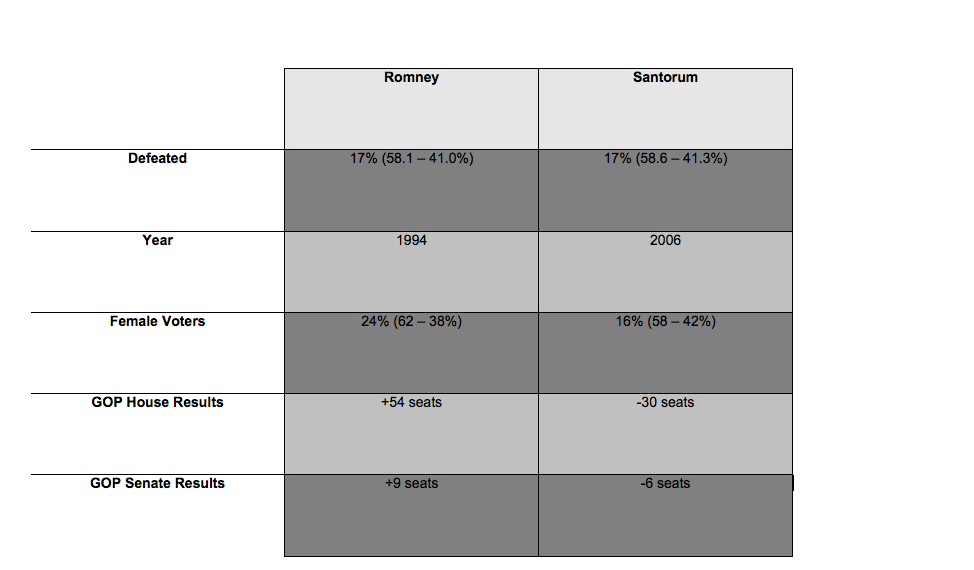
As Buzzfeed notes, Mitt Romney (R-Am I the Nominee Yet?) is running radio spots (via Talking Points Memo) in Illinois that say this:

Is Rick Santorum electable? Remember his last Senate race? … By historic margins, Pennsylvania voters rejected Rick Santorum.

But, as Buzzfeed points out, Massachusetts voters rejected Mitt Romney by virtually identical margins.

Worse, “Romney . . . lost big in a historically good year for Republicans, while Santorum lost big in a historically bad year for Republicans.”

Helpful Buzzfeed chart:

Not to get technical about it.

Posted in Uncategorized | Tagged , , , , | 1 Comment

Notre Doom

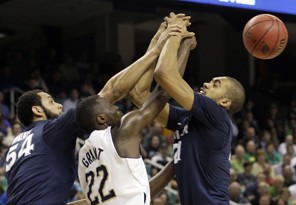
The (can we still call them Fighting?) Irish improbably fell to the Xavier University Musketeers (full disclosure: the hardworking staff’s alma mater) last night in the NCAA basketball bakeoff.

So in the spirit of good sportsmanship we just want to say to our brother Bob and niece Emily:

Ha!

I love you guys, so get all March Madness you want at me.

Posted in Uncategorized | Tagged , , , , | 2 Comments

The Lack Of The Irish

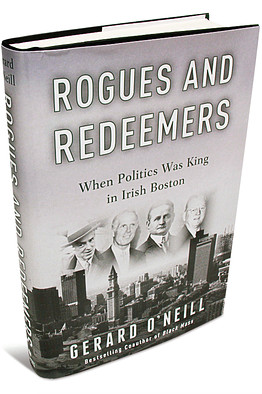
Former Boston Globe reporter Gerard O’Neill has a new book out – Rogues and Redeemers – that the Wall Street Journal reviewer didn’t much like.

There is something faintly ridiculous about [the St. Patrick’s Day] Boston celebrations of Irishness, the wistful talk of a country that most have never visited. Southie, once the center of Boston’s Irish community—and now a semi-gentrified neighborhood of both housing projects and luxury condos—was in the 1970s the only place outside of Northern Ireland where one could find murals celebrating the IRA.

Boston is obsessive about its Irish tribalism. And while bookstore shelves heave with studies of the Irish diaspora in America, there are few books—discounting the countless paeans to the Kennedy clan—that specifically cover the Irish influence on Massachusetts politics. In “Rogues and Redeemers: When Politics Was King in Irish Boston,” Gerard O’Neill, a former reporter for the Boston Globe and co-author of a biography of the mobster James “Whitey” Bulger, attempts to fill that gap. According to the publisher, the book offers a “hidden history” of the city’s Irish-American political machine.

Unfortunately, Mr. O’Neill has produced a rather straightforward recapitulation of Irish politics in the Hub, sticking to the well-established narrative of mustache-twisting Brahmins (or “Yankee overlords,” in Mr. O’Neill’s phrasing) doing battle against spirited, rascally Irish politicians. Indeed, “Rogues and Redeemers” doesn’t so much upend myths as reinforce them.

Exhibit A: The “No Irish need apply” warning that O’Neill says was “commonly found in newspapers [and became] so commonplace that it soon had an acronym: NINA.”

Not so fast, the Journal review says:

[A]ccording to historian Richard Jensen, there is almost no proof to support the claim that NINA was a common hiring policy in America. Mr. Jensen reported in the Journal of Social History in 2002 that “the overwhelming evidence is that such signs never existed” and “evidence from the job market shows no significant discrimination against the Irish.” The tale has been so thoroughly discredited that, in 2010, the humor magazine Cracked ranked it No. 2 on a list of “6 Ridiculous History Myths (You Probably Think Are True).” Mr. O’Neill doesn’t inspire confidence by faithfully accepting NINA as fact.

Another quibble in the WSJ review:

“Rogues and Redeemers” wisely avoids retelling, for the umpteenth time, the story of the Kennedy machine. But curiously absent are figures like Albert “Dapper” O’Neil, the thunderbolt-throwing conservative Democrat who was a fixture of local Massachusetts politics, and former state-senate president and political kingmaker Billy Bulger, who, like O’Neil, modeled his political career on the “rascal king” James Michael Curley.

We eagerly await Gerard O’Neill’s rebuttal.

Meanwhile, let it be noted that the hardworking staff is a proud Irish citizen (since 2006) who hates the U.S. celebration of St. Patrick’s Day.

Just for the record.

Posted in Uncategorized | Tagged , , , , , , , , , | 2 Comments

Let The $4 Billion Rumpus Begin! (Chicago Deep Dish Edition)

So the GOP Crazy Train pulls into Chicago for its next presidential primary spasm, and here’s the Illinois spending spree according to Politico’s Morning Score:

ILLINOIS IS TUESDAY – ROMNEY OUTSPENDING SANTORUM 5-1: “Santorum’s campaign is up with $207,231 in ads, including his first broadcast ads in the Champaign/Springfield market. The super PAC buy is up to $306,750, according to a media-tracking source,” Alex Burns writes. “That’s not peanuts from the pro-Santorum camp…But Romney’s campaign alone doubles that spending: including some additional broadcast buys today, they’re up to $1,075,965 on the air in Illinois between March 14 and 20. And on top of that, the super PAC Restore Our Future is running $1,499,698 in TV and radio ads for the final week of the Illinois race…Add it all up and the air war is tilted toward Romney at this moment in time by a factor of about 5 to 1. In dollar terms, Romney is outspending Santorum approximately $2.6 million to $510,000.” Wall Street Journal on Illinois spending: http://on.wsj.com/Acfv2iWatch the 30-second contrast spot that Santorum’s Super PAC is running in the state:http://bit.ly/yALDIK.

That Santorum spot:


Nut graf:

Mitt Romney: More debt and taxes, less jobs, more of the same.

The hardworking staff thinks they meant “fewer” jobs, but why get technical about it?

Meanwhile, here’s Romney’s counterpunch:


Nut graf:

Rick Santorum: Another economic lightweight.

So what’s all this money buying the candidates?

Delegates, of course. But at what cost?

Glad you asked – here’s a helpful Wall Street Journal tally detailing the cost-per-delegate expenditures of each GOP presidential candidate (and their, ahem, non-coordinating Super PACs).

Think the Romneyites have spent the most per delegate?

Think again: The Ron Paulniks have spent $686,000 per delegate vs. Newt Gingrich’s $248,000, Romney’s $187,000, and Santorum’s $52,000.

Penurious as Romney might seem, he’s still burning through his money like John Carter at the multiplex. Friday’s Boston Globe even speculated that Romney might have to dip into his own pocket to keep his Sisyphean campaign afloat.

Rock and roll, Mitt.

Posted in Uncategorized | Tagged , , , , , , , , , , , | Leave a comment