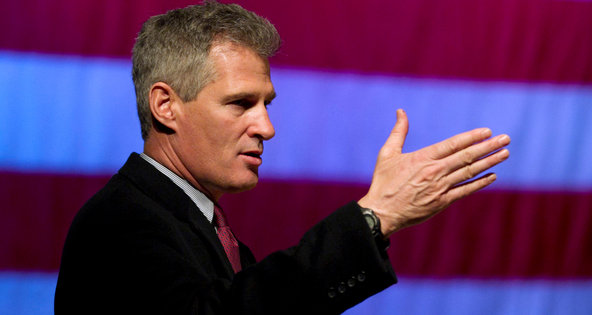
The Native American issue is at issue again in the Massachusetts Senate race, with the local dailies taking different angles, as usual. Details at IGTLTDT.
The Native American issue is at issue again in the Massachusetts Senate race, with the local dailies taking different angles, as usual. Details at IGTLTDT.
Some of you splendid readers might remember the hardworking staff’s tsk-tsking of Legal Sea Foods’ latest ad campaign a couple of weeks ago, especially this ad that ran adjacent to the Boston Globe’s obituary pages.
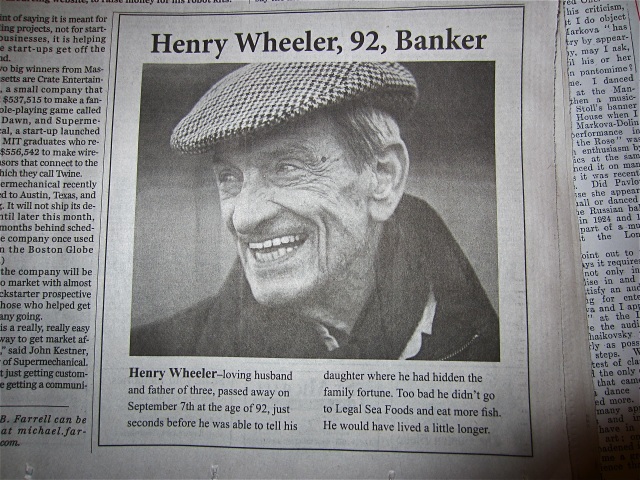
Turns out, Henry Wheeler was a real person, as this commenter points out:
As odd as it may seem, I know a father of 3 named Henry Wheeler who is about that age. Picture was not of him but his family found it offensive and i don’t blame them.
Us neither.
The Barack Insane Obama crew is at full (throated) throttle right now, thanks to the schlockumentary 2016: Obama’s America.
Full-page ad in Sunday’s New York Times:

Movie trailer:
Nut (no pun intended) graf:
Obama has a dream. A dream from his father. That the sins of colonialism be set right, and America be downsized.
It’s easy to dismiss this as more nonsense from the lunatic fringe, but this movie is gaining serious critical mass.
From the Alt Film Guide last Thursday:
2016 Obama’s America, Dinesh D’Souza and John Sullivan’s anti-Obama documentary that has been embraced by the American Right, lambasted by the White House, and criticized for its factual inaccuracies and flights of fancy, is 2012′s top non-fiction film at the North American box office.
With a domestic cume of $30.6m as of Tuesday, Sept. 18 (source: Box Office Mojo), D’Souza and Sullivan’s 2016movie has also surpassed the inflation-adjusted take of recent documentaries directed by liberals: Michael Moore’s Sicko (inflation-adjusted $28.6m) andBowling for Columbine ($29.44m), and Davis Guggenheim’s Oscar-winning, Al Gore-inspired An Inconvenient Truth ($29.56m).
The box-office gross has since dropped sharply, but that doesn’t lessen the overall impact of the film. And with full-page ads in the New York Times, who knows where it will go from here?
Mostly downhill, we’re guessing.
The local dailies are all over the debate beat. Details at IGTLTDT.
From Politico’s Morning Score:
NOTABLE: It looks increasingly likely that Romney and Ryan will be the first ticket since 1972 to lose both their home states: http://goo.gl/IuG3O.
Said Huffington Post piece:
Romney-Ryan Ticket Could Be First To Lose Home States Since 1972
As new polls show President Barack Obama widening his margin in Paul Ryan’s home state of Wisconsin and Mitt Romney’s stomping ground of Massachusetts sitting safely in the Democratic column, the GOP presidential nominee might want to embrace his innerWoodrow Wilson.
What can the all-business Republican standard-bearer just off his worst week ever learn from the 28th president, a former college president and progressivefrom a time when the latter word was spelled with a capital P? Maybe his secret path to the White House.
That’s because President Wilson, a former governor of New Jersey, and Vice President Thomas Marshall, a former governor of Indiana, both failed to hold their home states yet prevailed nationally to win reelection. The year was 1916.
As the HuffPost post notes, “Never before and never since has a major party presidential ticket been elected when both candidates lost their home states.”
Then again, see the 2004 Boston Red Sox.
The Boston Herald is all over Elizabeth Warren’s asbestos cleanup for Travelers Insurance. All over one side, anyway. Details at IGTLTDT.
Massachusetts junior Sen. Scott Brown (R-Not R) has been a leading opponent in the tug of war over the Volcker rule, which keeps banks from investing in risky hedge funds.
New York Times report:
Behind the Scenes, Some Lawmakers Lobby to Change the Volcker Rule
As regulators put the finishing touches on new rules for Wall Street, they remain entangled in a partisan fight over the overhaul.
In public letters and closed-door meetings, more than 100 lawmakers have lobbied the Federal Reserve and other authorities over the Volcker Rule, records show. The rule, intended to restrict banks from placing risky trades and investing with hedge funds, has drawn an outcry from Republicans who want to mute its effect and some Democrats who want to strengthen it.
Among those most interested in muting it, our own Downtown Scotty Brown:
Internal government documents provide a glimpse of one such lobbying effort last year, when an aide to Senator Scott Brown, Republican of Massachusetts, appealed to the Treasury Department and the Federal Reserve.
The documents show a back-and-forth between the Fed’s top lawyer and Mr. Brown’s staff. “I have a very urgent request,” Nathaniel Hoopes, Mr. Brown’s aide, wrote in an April 2011 e-mail. Seeking to fine-tune an exemption, he argued that a broad range of bank customers should be allowed to invest with hedge funds under the Volcker Rule. “My boss has been hearing it from constituents,” he added, referring to the rule’s impact on Massachusetts-based financial firms.
Those constituents, of course, include high-rolling investment moguls in the Bay State. And, of course, Brown is trying to have it both ways:
Mr. Brown, whose donors include major mutual funds like Fidelity, has been particularly vocal.
He supported the Volcker Rule after chipping away at one of its core tenets. During the debate on Capitol Hill, Mr. Brown championed an exemption that allowed banks to invest up to a 3 percent stake in hedge funds. Banks can also offer hedge fund investments to outside investors like pension funds.
Now, Mr. Brown is fighting over the details of the exemption. While Democrats want to restrict access to customers who already have an account with the bank, Mr. Brown wants to expand the definition of “qualified investors.”
A spokeswoman for Mr. Brown said he was “proud to cast the deciding vote” for Dodd-Frank and that he worked “to protect Massachusetts jobs.”
Or maybe just his job.
Professor Warren, take good notes.
Fun fact to know and tell: The last Major League baseball player to win the Triple Crown (highest batting average, most home runs, most RBIs – for those of you keeping score at home) was Red Sox icon Carl Yastrzemski in 1967, when he batted .326, hit 44 home runs (tied with Minnesota Twins slugger Harmon Killebrew, which brewed up some controversy), and knocked in 121 runs.
But Yaz might be pazzed this year by Detroit Tigers third baseman Miguel Cabrera, as the New York Times reports:
Cabrera Within Reach of a Rare Baseball Feat
The last time a batter won baseball’s triple crown, Neil Armstrong had not yet walked on the moon. The Beatles were still together, the Vietnam War was raging and baseball was the undisputed king of American sports.
Times have changed, as have baseball statistics, but the romantic notion of a player leading his league in batting average, home runs and runs batted in is likely to stir the hearts of even the most sabermetrically inclined fans.
And this is the year it could happen. With his 41st home run of the season Wednesday, Miguel Cabrera of the Detroit Tigers pulled within one of Josh Hamilton for the American League lead to go along with his No. 1 rank in batting average (.333) and R.B.I. (130). Hamilton’s second-half struggles have brought the rare feat to within Cabrera’s grasp.
The hardclicking staff couldn’t find any comment by Yaz about the potential eclipsing of his 45-year Triple Crown reign, but we’re guessing – given his Paz history – he’s not all that happy about it.
Rep. John Tierney has a gambling problem (his wife and brothers-in-law). He’d like to make it go away, at least in his debates with challenger Richard Tisei. Details at IGTLTDT.
The hardworking staff is begging the organizers of the next Massachusetts U.S. Senate debate between Scott Brown and Elizabeth Warren to implement this rule:
The candidates can only utter the same sentence or statistic twice in the course of the debate. If either candidate violates the rule, he or she doesn’t get to talk for five minutes.
(Shut up!)
That was the Verbal Groundhog Day debate last night on WBZ-TV/AM/Webstream. Warren and Brown had two things to say on every issue, and that’s all they said.
(Shut up!)
Official Campaign Outsider summary:
• If you picked “bipartisan” for your drinking game, you were knee-walking by 7:13.
• Scott Brown bordered on the thuggish in his attacks on Warren, no more so than during his opening volley on her soi-disant Native American heritage.
Memo to Sen. Brown: Leave that to your in-house organ Boston Herald.
Bonus helpful hint: Don’t refer to Professor Warren as “she.” Like the hardworking staff’s old man used to say, “Who’s she? The cat’s mother?”
(Yeah – we have no idea what that means either.)
• Brown totally kicked ass on the Travelers Insurance exchange.
• How many viewers/listeners/streamers knew what “sequestration” is?
• Raise your hand if you’re voting on who gets to approve Supreme Courts nominees in the next four years.
Yeah – us neither.
Up to now, most Massachusetts voters have only known the candidates through their television commercials.
Scott Brown wasn’t as good last night as his TV spots (Brian McGrory notwithstanding).
Elizabeth Warren was better than hers (except for this one).
Regardless, Scott Brown won last night’s debate.
 Click to subscribe to RSS