
The Boston papers play Page One Derby today, with both trumpeting a trio of crime stories.
Boston Globe, front page above the fold:

Boston Herald Page One . . .
Read the rest at It’s Good to Live in a Two-Daily Town.
The Boston papers play Page One Derby today, with both trumpeting a trio of crime stories.
Boston Globe, front page above the fold:
Boston Herald Page One . . .
Read the rest at It’s Good to Live in a Two-Daily Town.
 From our Late to the (Engagement?) Party desk
Well the Missus and I dipped into the DVR last night and watched The Ramblin’ Boy episode of PBS’s Masterpiece Mystery.
And finally Robbie Lewis and Oxford ME Laura Hobson – spoiler alert! – got together.
Watch here.
Geez, Robbie – it’s about time, yeah?
 After years of being a whipping boy for its Deepwater Horizon debacle, British petroleum giant BP is starting to get some love from the news media.
Start with this piece in Bloomberg Businessweek headlined Spillapalooza: How BP Got Screwed in the Gulf.
Nut graf:
Even as it continues a cheerful quarter-billion-dollar print and television ad campaign about how the Gulf has returned to normal, BP is crying foul. “It was never our intention for the company to become an open cash register for every claim or project anyone could dream up,” says spokesman Geoff Morrell. Locals say BP may have been naive. “This is Louisiana, after all,” says Danny Abel, a longtime New Orleans plaintiffs’ lawyer not involved in the case. “A big foreign company with deep pockets and you’re surprised there’s a feeding frenzy? Come on, man.”
Now comes Joe Nocera’s Tuesday New York Times op-ed column:
Justice, Louisiana Style
You can actually pinpoint the moment when the oil company BP began to get hosed in Louisiana: March 2012.
By then, BP had paid out around $6.3 billion to some 220,000 people and businesses in the Gulf Coast region for damages suffered as a result of the 2010 oil spill. The money was distributed by Kenneth Feinberg, who had parceled out the 9/11 fund, and subsequently managed other victim compensation schemes.
In return for the payouts, however, Feinberg had insisted that the victims sign documents agreeing not to sue BP . . .
But Louisiana lawyers found that agreement “offensive,” Nocera wrote, and so:
[A] group of lawyers — known as the Plaintiffs’ Steering Committee — persuaded their clients to skip the Feinberg process and sue BP. And in March 2012, BP settled with those lawyers. As a condition for settling, the plaintiffs’ lawyers insisted that Feinberg be replaced by Patrick Juneau, a good-ol’-boy plaintiffs’ lawyer himself. BP also agreed to expand the potential universe of claimants, knowing full well that this would likely mean that people whose economic losses had no connection to the spill would receive “compensation.” It estimated that the settlement would cost it an additional $7.8 billion.
BP has finally said genug, and appealed to a federal court in New Orleans for relief.
Don’t hold your breath, though, waiting for BP sympathy from, well, anyone.
Especially in Louisiana.
As the hardworking staff just noted, there are dueling TV spots out now in the battle of the budget-busting Obamacare. One is for the Obama front Organizing for Action, the other for the Koch brothers front Americans for Prosperity.
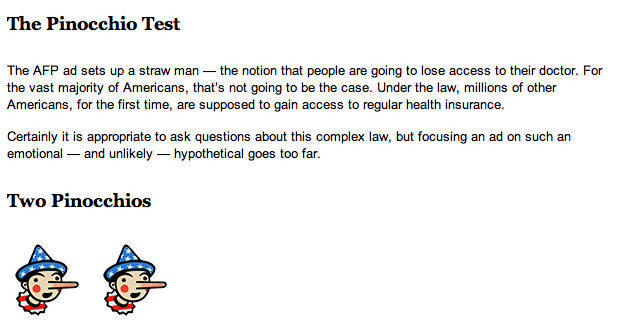
Glenn Kessler, the Washington Post’s Fact Checker, has weighed in on the AFP ad.
First the spot:
And then Kessler’s conclusion:
Now you’re ready to begin.
The air war over Obamacare has officially begun, with TV spots pro and con popping up all over the place.
Via Monday’s MSNBC First Read:
The fight to define health care’s implementation: After the Supreme Court upheld the health-care law and after Obama won re-election, the White House assumed — as did most everyone else — that it wouldn’t have to fight again over the law’s legitimacy. Well, so much for that assumption. As Republicans fight implementation of the law and as the Koch Brothers’ Americans for Prosperity is planning to air TV ads attacking the law, Obama’s Organizing for Action is up with its second TV advertisement touting its benefits.
First the pros – Organizing for Action‘s new TV spot:
Voiceover:
“My daughter Zoe had her first open-heart surgery when she was only 15 hours old. Before Obamacare, insurance companies could put lifetime caps on your health insurance… Zoe was halfway to her cap before her first birthday… Thanks to Obamacare, we can now afford the healthcare that Zoe needs. And for her, that’s a lifesaver.”
Now the cons, from Americans for Prosperity (also via First Read):
The New York Times: “Though many of its rules will not take effect for months, President Obama’s health care law is already the subject of an aggressive advertising campaign by Republicans to sow doubts about how it will work. In one of the largest campaigns of its kind, Americans for Prosperity, a conservative advocacy group financed in part by Charles and David Koch, will begin running television commercials this week asserting that the law will limit Americans’ health care choices. The group is spending more than $1 million on the campaign, which will initially include television advertising in Ohio and Virginia, along with online ads asking people to test their ‘Obamacare risk factors.’”
The spot:
It’s all about the Moms, yeah?
Also of interest: this front-page piece in Monday’s New York Times:
Campaign Ad Cash Lures Buyers to Swing-State TV Stations
When Allbritton, the media company that owns Politico, put its seven television stations up for sale this spring, analysts quickly singled out one as the most attractive: WJLA, the company’s ABC-affiliated station in Washington, D.C. It is the biggest of the bunch, the best known and, perhaps most important, a magnet for political spending.
WJLA took in $33 million in election-related and issue advocacy advertising last year. Only three stations in the United States earned more for political ads, and two of those were also in Washington. That’s because the stations’ signals reach citizens in a crucial battleground state, Virginia, as well as the political power brokers in the nation’s capital. If Allbritton were to sell WJLA by itself, it could fetch $300 million.
Not to mention Ohio:
For stations blessed to be in swing states, political ads routinely represent a third of their overall ad revenue in election years.
For instance, WBNS, the highest-rated station in Columbus, Ohio, grossed about $50 million in advertising last year, of which at least $20 million was attributed to campaign spending. Columbus is the nation’s 32nd largest TV market.
Let the wild Obamacare spending spree begin!
Ohio and Virginia, count your mixed blessings.
Last time now-former Boston Bruin Tyler Seguin got all homophobic on his Twitter feed, the Boston Herald beat the Globe on the story. This time it’s the other way around.
From Christopher Gasper’s column today:
Bruins gave up on Tyler Seguin too soon
If Tyler Seguin is as good at shutting down his Twitter account as he was at getting shut out on the scoresheet in the playoffs then his days of 140-character missives are — like his days donning the Spoked-B — done.
Both the Bruins and Twitter being Seguin-free seem like good ideas right now, quick fixes to aggravating problems. But they might prove rash overreactions in the end. Professional athletes have to learn how to deal with the consequences of celebrity in the social media age and patience has to be shown with a potential franchise player whose talent level far exceeds his maturity level.
The Bruins gave up on Seguin too soon, trading him July 4 to the Dallas Stars and confining him to the dustbin of failed face-of-the-franchise forwards along with Joe Thornton and Phil Kessel after just three seasons . . .
And then, this . . .
Read the rest at It’s Good to Live in a Two-Daily Town.
A few days ago the hardworking staff noted the New York Times full-page ad offering new print subscribers a 50% discount for a limited time.
Yesterday the Times got even more plaintive:

On one hand, it’s sad to see the Good Grey Lady rattling the tin cup. On the other, the results will determine the fate of reporting like N.R. Kleinfield’s wrenching report from the Times Sunday edition:
The Girls Who Haven’t Come Home
The last time they took Vernice Hill’s children away, the time they didn’t give them all back, was the afternoon she went to see her neighbor. Ms. Hill lives in a hulking building on East 188th Street, in a frayed neighborhood in the Bronx. It was May 1, 2005.
Inside her apartment, her two little girls, 3 and 6, were napping. Her two teenage boys, Jmapie, 13, and Matthew, 15, were supposed to be tidying up their room. Around noon, Ms. Hill went to catch up with a frail woman she gossiped with. First, she had some beers. A pot of neck bones and kidney beans simmered on the stove.
Ms. Hill figures she was gone at best an hour. (The police report suggested several hours.) Her keys lay inside. When she returned, she banged on the door and got no response. Rather than clean their room, the boys had gone out — Matthew to the park to play basketball and Jmapie downstairs to a friend’s.
Ms. Hill asked her neighbor to call 911. Firefighters and the police came and pried open the door.
When the officers wouldn’t let Ms. Hill in, she got cross. The police report quoted her as saying, “If you want my kids, take them,” and then punctuating that with a vulgarity.
The rest is just totally sad.
People, you need to pay for that kind of coverage.
 Hey – Murray can beat this guy at Wimbledon.
Yesterday Andy Murray, the Great UK Hope (Scotland Division), channeled Fred Perry, defeated Novak Djokovic, won the Wimbledon Championship – the first time a Brit has done so since 1936.
From our background desk (via the Boston Globe):
Djokovic beat Murray at the Australian Open in 2011. Murray beat Djokovic at the US Open last September. Djokovic beat Murray at the Australian Open this January.
More important, perhaps: Murray lost the Wimbledon final to Roger Federer last year.
Murray was asked how his mind-set might be different in his second Wimbledon final than it was 12 months ago.
‘‘I’ll be probably in a better place mentally. I would hope so, just because I’ve been there before. I won a Grand Slam. I would hope I would be a little bit calmer going into Sunday,’’ Murray said.
He certainly was, especially at 5-4 in the third set against Djokovic, when the Serb overcame a 0-40 deficit and had two chances to break, which could have triggered a classic Novakian comeback.
The final two points:
Murray not only dumped Djokovic. He dumped the albatross around Great Britain’s neck.
Good for both of them.
Well the Missus and I trundled down to Boston’s Institute of Contemporary Art and it was, well, headscratching.
Mostly we were there to see the Barry McGee exhibit, described this way on the ICA website:
“It’s pure chaos, claiming a territory that doesn’t belong to you to state your own identity. It’s like saying, ‘I’ve got no other way to say I exist.”
—BARRY McGEE
Barry McGee began exhibiting his art in the late 1980s, not in a museum or gallery, but on his home streets of San Francisco. At that time the city was reeling from a lackluster economy and the scourge of the AIDS crisis, and citizens often took to the streets in protest and to raise awareness of societal woes. Inspired by this activism and the more politicized forms of protest graffiti and signage perpetrated by politically minded groups, as well as a tight-knit community of fellow taggers and the burgeoning hardcore music scene in San Francisco.
McGee developed as a graffiti artist, often under the tag name “Twist.” Deploying a visual vocabulary that borrows elements from graffiti, comics, hobo art, sign painting, and other sources, McGee’s imagery simultaneously celebrates and critiques his diverse Mission District neighborhood. He has long viewed the city a vital site for art and activism, but his more recent work brings the urban condition into art spaces with installed environments that express the anarchic vitality of inner-city street life.
Representative samples of his graffiti work (for lots of other artwork, see this slideshow):

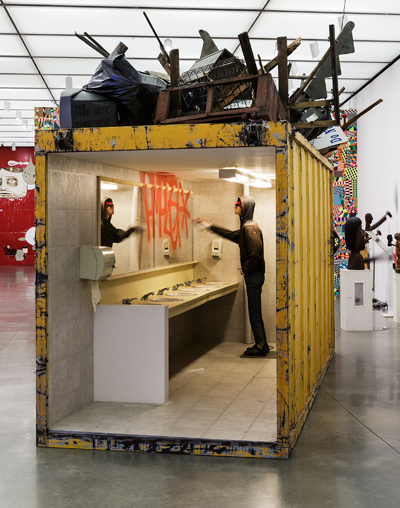
That seems to reside at the intersection of art, craft, and vandalism.
The rest of McGee’s work, meanwhile, seems to reside at the intersection of art, craft, and whatever.
Then again, maybe I’m just not smart enough to get it.
Which is how I also felt in most of the other mishmash of ICA exhibits.
Call me shallow but ICA = I Can’t Apprehend.
 Click to subscribe to RSS


 Campaign Outsider