Business Insider Gives Advertiser Veto Power Over ‘Future of Business’ Edit Mix
To Start, Newsroom Stories in Sponsored Section Won’t Include Competitors of SAP
When Business Insider introduced a sponsored section last November called “The Future of Business,” it promised to give its take on the subject alongside stories about the underwriter, SAP.
“We’ll show you how technology — and the dynamic companies using it — are changing many facets of business as we know it, empowering our mobile lives, harnessing the power of big data, and creating a more sustainable future,” its announcement said.
The announcement did not mention that the “dynamic companies” in ‘The Future of Business” would not include SAP competitors, or that the selection of Business Insider articles running there would be subject to SAP approval.
(Sorry no link to The Future of Business. It has now crashed Safari three four times – the legal limit for linkitude) . . .
Day Four of the Boston Herald’s ridiculous/embarrassing newsvertising campaign for its Internet radio launch features the usual abuse of its news pages, starting with Page One.
Then there’s the mandatory two-page spread inside . . .
The hardviewing staff noted yesterday that our foray to the Big Town last weekend included a visit to the Le Corbusier exhibit at the Museum of Modern Art.
Now comes this review in the Wall Street Journal, which details Le Corbusier’s desire to modernize the City of Light Service:
Today we can appreciate but no longer embrace Corbu’s vantage point in 1925 when he proposed his Plan Voisin calling for the demolition of all but a few key monuments in the center of Paris in order to make way for his super slab towers. From grim experience with Robert Moses and through the eyes of Jane Jacobs, we are appalled by the lack of sensitivity to context. But clearly he thrilled to the promise of a future full of air and light, and an escape from still-lingering 19th-century fustiness.
As the Journal piece points out, “His march toward modernity, unchecked, would have wiped out the center of Paris.”
The hardworking staff will be on NPR’s Here & Now around 12:45 today to discuss the marketing of electronic cigarettes. For extra credit, check out Thank You for Not Vaping, which appears in the current issue of The Weekly Standard.
MLB prepared to ban A-Rod for life, suspend eight others
Commissioner Bud Selig is prepared to levy a lifetime suspension on New York Yankees third baseman Alex Rodriguez, while suspending about eight others before the weekend, two people with knowledge of the negotiations told USA TODAY Sports.
The people were unauthorized to speak publicly because no announcement is expected until Thursday or Friday.
“I hope he does it,” former Commissioner Fay Vincent told USA TODAY Sports.
Organized in honor of the 150th anniversary of Munch’s birth in 1863, the exhibition closely examines four graphic motifs produced by Munch at the turn of the century — The Scream, Madonna, The Brooch. Eva Mudocci, and Self-Portrait with Skeleton Arm — and later revisited by Andy Warhol in a little-known, but extraordinary, series of prints from 1984. Comprising over 30 original works from private and museum collections — some of which will be seen for the first time — the exhibition reveals remarkable affinities between the two artists.
It’s true, especially the part about both artists maximizing the financial value of their art by producing multicolored versions of it.
This wonderful exhibit at the American Folk Art Museum features “approximately 63 drawings and paintings by self-taught Alabama artist Bill Traylor. Traylor began making art near the end of his life, and his works are notable for their flat, simply defined shapes and vibrant compositions in which memories and observations relating to African American life are merged. Traylor is recognized as one of the finest American artists of the 20th century.”
Representative sample:
It’s there through September 22 and well worth your time.
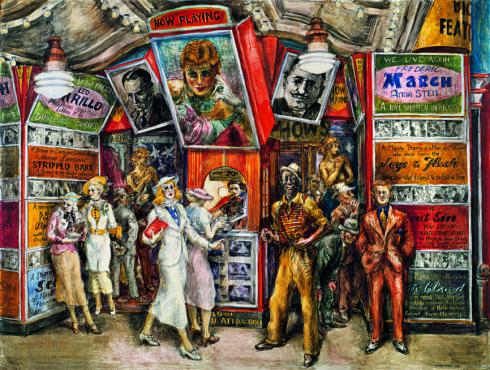
This exhibit at the New-York Historical Society (through September 1st) is a roller-coaster ride through New York in the 1930s. From the NYHS website:
With his calligraphic brushstrokes and densely cluttered, multi-figured compositions, Reginald Marsh recorded the vibrancy and energetic pulse of New York City. In paintings, prints, watercolors and photographs, he captured the animation and visual turbulence that made urban New York life an exhilarating spectacle. His work depicted the visual energy the city, its helter-skelter signs, newspaper and magazine headlines and the crowded conditions of its street life and recreational pastimes.
His subjects were not glamorous or affluent New Yorkers, but those in the middle and lower class—Bowery bums, burlesque queens, Coney Island musclemen, park denizens, subway riders and post-flapper era sirens. Marsh was fascinated by the crass glamour, gaudiness and sexuality these city inhabitants exhibited in public, as well as by the humanity expressed by those living under severe economic and social duress.
There are also references to “his technical combination of choppy brushwork and thinly applied tempera [that] created the effect of a continual surface flickering, which causes the eye to move without rest from place to place across the painting.”
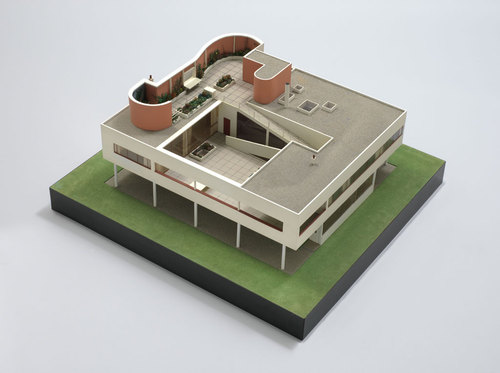
MoMA presents its first major exhibition on the work of Le Corbusier (Charles-Édouard Jeanneret, 1887–1965), encompassing his work as an architect, interior designer, artist, city planner, writer, and photographer. Conceived by guest curator Jean-Louis Cohen, the exhibition reveals the ways in which Le Corbusier observed and imagined landscapes throughout his career, using all the artistic techniques at his disposal, from his early watercolors of Italy, Greece, and Turkey, to his sketches of India, and from the photographs of his formative journeys to the models of his large-scale projects. His paintings and drawings also incorporate many views of sites and cities. All of these dimensions are present in the largest exhibition ever produced in New York of his prodigious oeuvre.
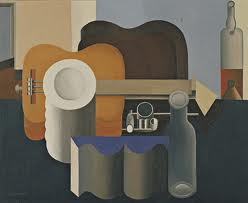
Jeanneret was a champion of Purism, which “rejected . . . complex abstractions for the study of the pure geometric forms of everyday objects.”
Actually, the Missus and I found the most interesting part of the exhibit Jeanneret’s early paintings (“landscapes of objects”) with their echoes of Francis Picabia and Fernand Léger.
Representative sample:
Most notable about the exhibit (through September 23): People kept touching stuff (WTF?) and taking selfies in front of the artworks.
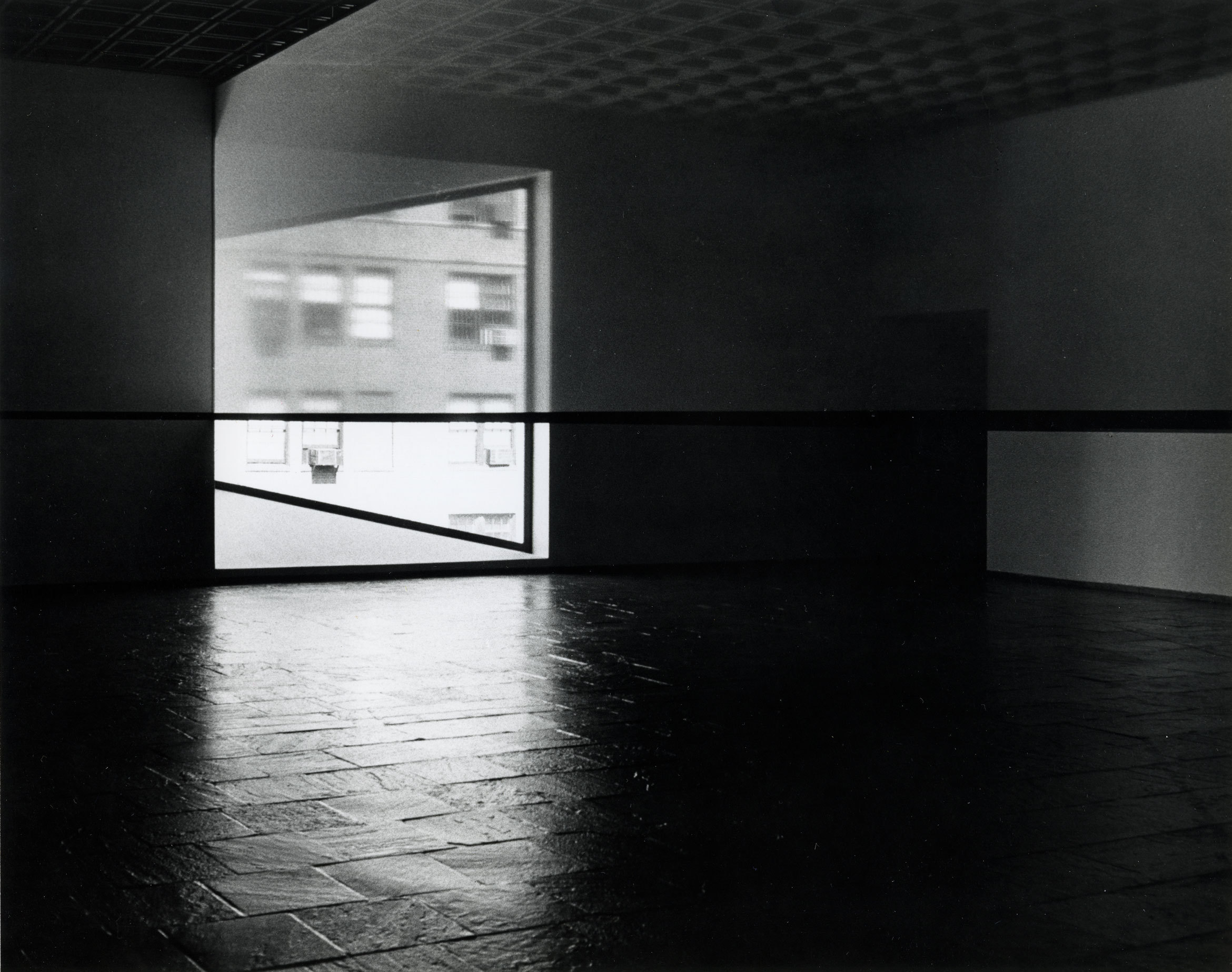
Scrim veil—Black rectangle—Natural light, Whitney Museum of American Art, New York(1977), by California Light and Space artist Robert Irwin, is a large-scale installation that uniquely engages the Whitney’s iconic Breuer building and the natural light that emanates from the large window in the fourth floor gallery space. Part of the Whitney’s collection, the work was made specifically for the Museum’s fourth floor. It has not been exhibited since its 1977 debut, a pivotal moment that would set the course for Irwin’s subsequent artistic practice.
You gotta see this to believe it (through September 1).
This exhibition marks the U.S. premiere of David Hockney’s first video installation: The Jugglers, June 24th 2012 (2012). Filmed using eighteen fixed cameras, this multiscreen tableau shows a group of jugglers as they move in a procession across a grid of eighteen screens. The figures, dressed in black and juggling brightly colored objects, perform in front of a pink wall and on a blue floor, creating a vibrant, colorful composition whose energy is echoed by a lively musical soundtrack. Hockney’s creation of a composite image from multiple perspectives places the choice of where to look with the viewer, demonstrating his ongoing interest in how technologies can open up new ways of looking at, and making, images.
Judith Light scored her second Tony (she won for Other Desert Cities in 2011) for her performance in The Assembled Parties (Jessica Hecht was also terrific), and we’re just happy we caught it.
On the other hand, some exhibits to avoid: FIT’s Retrospective and MAD’s Fashion Jewelry, both of which fall far below the standards previously set by those institutions.
Tuesday’s New York Times featured this piece by Jane Perlez:
Six Decades Later, a Second Rescue Attempt
Ex-Navy Pilot Visits North Korea to Seek Colleague’s Remains
BEIJING — As more than 100,000 Chinese soldiers swarmed over far fewer American Marines and soldiers in subzero temperatures on treacherous terrain in one of the fiercest battles of the Korean War, two United States Navy pilots took off from an aircraft carrier to provide cover for their comrades on the ground.
One of the airmen, Ensign Jesse L. Brown, was the son of an African-American sharecropper from Mississippi. The other, Lt. Thomas J. Hudner Jr., was the son of a white patrician merchant family from Massachusetts.
An hour into the flight, Ensign Brown’s plane was hit by enemy fire, forcing him to crash land on the side of a mountain at Chosin, north of Pyongyang. Lieutenant Hudner brought his plane down nearby and found Ensign Brown, but could not rescue him.
On Monday, nearly 63 years after the Battle of Chosin Reservoir, Mr. Hudner, 88, arrived in Beijing after a 10-day visit to North Korea aimed at finding his friend’s remains.
Tuesday’s New York Times also featured this correction (tip o’ the pixel to @MickeyBPowerPop):
This article has been revised to reflect the following correction:
Correction: July 31, 2013
An article on Tuesday about the visit of a former Navy pilot, Lt. Thomas J. Hudner Jr., to North Korea to seek the remains of a fellow airman, Ensign Jesse L. Brown, whom he had tried to rescue when Ensign Brown’s plane was shot down in the Korean War, misspelled the given name of North Korea’s current leader. He is Kim Jong-un, not Jung-un. The article also referred incorrectly to a desegregation order that occurred two years before Lieutenant Hudner met Ensign Brown, who was the first black aviator in the Navy. It applied to the entire military, not just to the Army. In addition, the article misstated the month in which the former basketball star Dennis Rodman visited Mr. Kim, the first American to do so since the North’s young leader took over from his father in 2011. It was February, not April. And because of an editing error, the article misstated the given name of Ensign Brown’s widow. She is Daisy Brown Thorne, not Daily.
But wait – there’s more correction:
This article has been revised to reflect the following correction:
Correction: July 30, 2013
An earlier version of a picture caption with this article referred incorrectly to Ensign Brown. He was first black aviator in the the Navy, not in the United States military.
As the hardreading staff noted yesterday, the Boston Herald devoted two full pages of Monday’s edition to the gala announcement of an Internet radio stream that will debut next week. What we neglected to mention, however, was that one-half of Monday’s Page One was devoted to the glad tidings.
Say, that’s some big news about the feisty local tabloid launching Boston Herald Radio, yeah?
All the details were, well, detailed in the Herald Radio Countdown that ran in Monday’s edition:
Herald internet radio to get Boston connected
The Herald is poised to take a dramatic step toward a richer experience for its online audience as it launches a new Internet radio station.
The countdown has begun for 6 a.m. next Monday, Aug. 5, when Boston Herald Radio goes live.
Veteran talk show host Jeff Katz will launch a morning drive news talk show that will lead into 12 hours of live broadcasting each weekday.
There will be four shows in all, including “Live from the Newsroom with Jeff Katz,” “Morning Meeting with Jaclyn Cashman and Hillary Chabot,” “The Michael Graham Show” and “Sports Town with Jon Meterparel and Jen Royle.”










 Campaign Outsider