The Romney campaign has posted this web video that purports to summarize his address last week at the NAACP convention in Houston:
The video has been widely panned (see here and here for representative samples) as a fantasy film with virtually no connection to reality.
But that shouldn’t be surprising, at least according to twin op-eds in Saturday’s Boston Globe – one from Neal Gabler, the other from Cathy Young – that say both the left and the right are creating their own realities, facts be damned.
The Boston Herald has been so busy clucking about the Chick-fil-A rumpus in the Hub, it failed to fail Mitt Romney for his London Olympics five-ring circus.
Ray Flynn, the former Democratic mayor of Boston, explains why he is breaking from his party to support Scott Brown in a new 30-second ad that will begin airing statewide today. “Scott Brown is a person that I have great admiration for,” he says. “I have found him to be a regular guy, honest, hardworking. He’s also an independent voice. I’m a Democrat but I’m tired of all the polarization, the pettiness, the bickering. Scott Brown is a person that you can work with. I mean, I’ve been involved in politics for almost 50 years. That’s the name of the game — electing people you can trust.” Flynn’s a South Boston guy, and this ad is a reminder that Elizabeth Warren has a problem with the blue-collar Catholics that constituted Flynn’s base. He was mayor from 1984 until 1993, when he resigned to become Bill Clinton’s ambassador to the Vatican. This spot will run in each of the state’s markets (Boston, Springfield, Providence and Albany), as well as on statewide cable.
The spot:
The question:
Does Ray Flynn actually have a constituency anymore? God (or the Vatican) only knows.
One of the more absurd claims in consumer product history — the notion that a baby as young as three months old can be taught to read — appears, thankfully, to be history itself. Last week, the company behind “Your Baby Can Read” announced that it was ceasing operations, because it had become too costly to fight the litany of formal complaints against it. The company, led by a man named Robert Titzer with a PhD in “human performance,” widely advertised a $200 set of flash cards, books, and DVDs, promising that babies and toddlers could take advantage of a “small window of opportunity” to read fluently and gain confidence.
Hundreds of thousands of people bought in. Then came the backlash, including a “Today Show” investigation that debunked the pledge with the help of leading child development experts. The Boston-based Campaign for a Commercial-Free Childhood also filed a complaint with the Federal Trade Commission, charging that the company’s marketing claims were false.
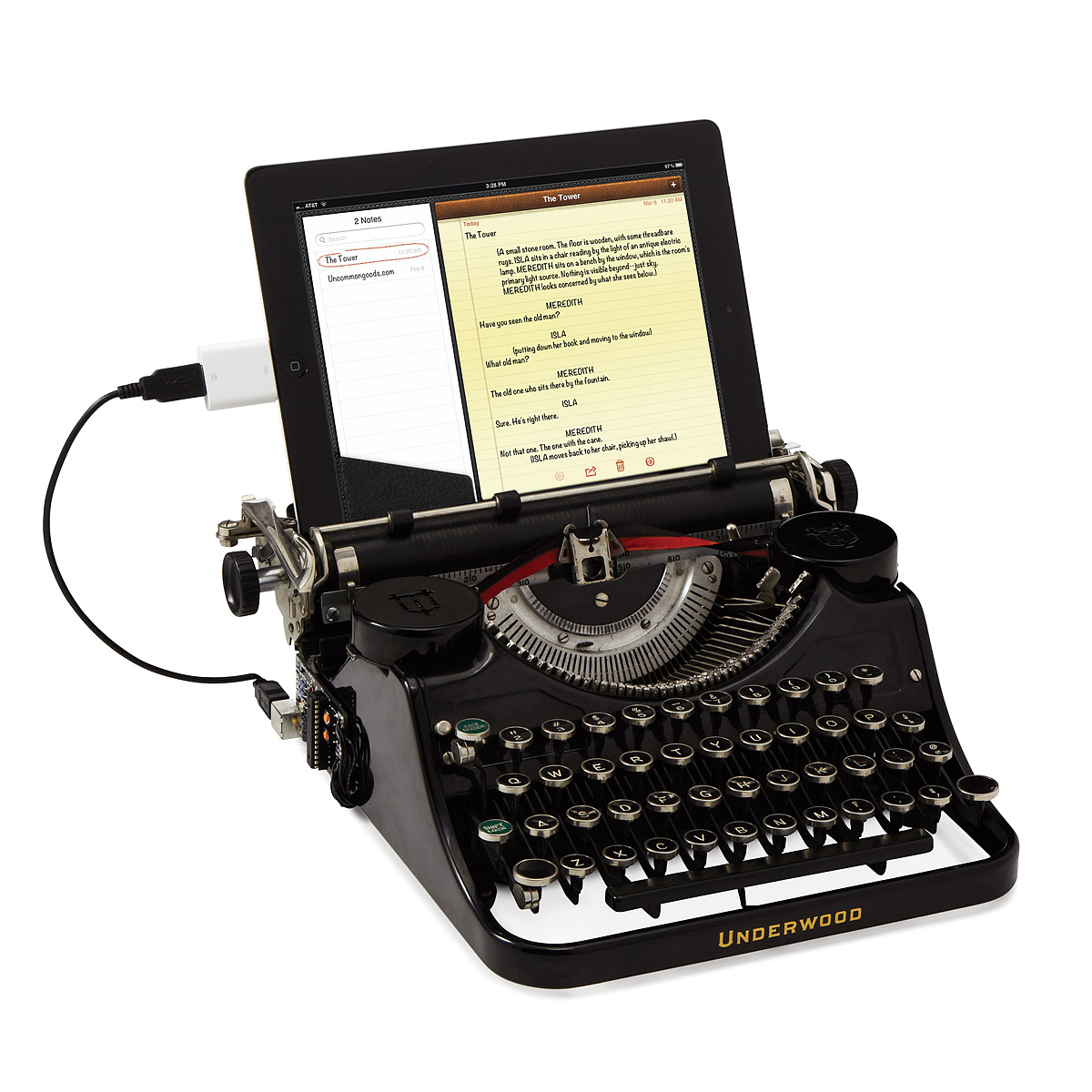
Via our ex(cellent)-graduate assistant Jeff Howanek, the USB typewriter:
A New Lease On Type
Think back, do you remember the last time you used a typewriter? Do you recall the resonant click clack of the keys as you plugged in every letter, eventually forming words, sentences, paragraphs, even whole manuscripts? What about the delight you felt sliding the carriage back into place with a zip and ring whenever it was time to start a new line of copy? Even a tech fanatic can admit that there was something uniquely exciting about using a typewriter that you just can’t replicate typing into a smartphone, an iPad or a computer. The thrill of using a typewriter may be passing from memory, but Jack Zylkin’s groundbreaking innovation brings this mechanical marvel out of retirement and offers a nod to its influence on the development of modern automation. For ardent admirers of the look, feel, and robust quality of an old-fashioned manual typewriter, the USB TypewriterTM allows you to use this once obsolete tool as a keyboard that plugs into any USB-capable device, such as your PC, Mac, or even your iPad! Plus, this new-and-improved gadget features all the advanced functions of a modern keyboard, such as ctrl, alt, esc, and arrow keys, so your typewriter is ready to keep up with your twenty-first century demands. Made in Philadelphia.
Would this make Marshall McLuhan seize up, or what?
Big takeout yesterday by Yahoo! News on the six-month anniversary of the Scott Brown/Elizabeth Warren People’s Pledge (via ABC’s OTUS):
Outside money ban in Massachusetts Senate race is working, but at what price?
What’s one way to blunt the effects of outside interest groups on politics? Ban them. That’s what Republican Sen. Scott Brown and Democratic challenger Elizabeth Warren did in their Massachusetts Senate race. The two candidates struck a unique deal in January (pdf) to penalize one another if any outside group bought advertising to influence their race–and it has worked. Maybe too well. Consultants and political observers now question whether the ban has come at an electoral price.
Brown was the driving force behind the agreement, dubbed the “People’s Pledge.” After weathering a negative special election campaign against Martha Coakley in 2010 and then facing attacks from the League of Conservation Voters and the League of Women Voters in his race against Warren in 2011, Brown lobbied hard for the arrangement. When Warren, a Harvard Law professor and consumer advocate, agreed in Jan. 2012 to a pact requiring each candidate to pay penalties to charity if outside groups advertised for them or against their opponent, the move was viewed as a coup for Brown who held a 2-1 cash advantage.
Now, not so much, since Warren is pounding Brown in fundraising results.
That’s led to a couple of interesting responses. For starters, it’s got the Brown forces whistling past the graveyard:
Brown’s campaign and his Republican supporters disagree with the suggestion that the pact has put them in a bind, saying Brown would never have entered into the agreement if it could have hurt his campaign and he continues to firmly stand behind the pact’s true purpose– keeping outside spending at bay.
Beyond that, the Super PAC men are getting antsy:
“They’re champing at the bit from the outside,” Tony Cignoli, a Massachusetts-based political consultant who works mostly with Democrats but has clients from all political parties, told Yahoo News. “What we’re hearing from a lot of the consultants in both camps… is that there is so much at stake in Massachusetts with this particular race, it’s very difficult for outsiders to stay out.”
Cignoli says “the feeling is it’s inevitable [the pact] will be broken.” Others aren’t so sure. In the meantime, the ad hits just keep on comin’, as noted today in ABC’s The Note:
The U.S. Chamber of Commerce will air new ads hitting five Democratic Senate candidates and incumbents, ABC’s Chris Good reports. Targeting votes on health care, energy, and regulations, the Chamber will go after Sen. Bill Nelson of Florida, Sen. Jon Tester of Montana, Rep. Martin Heinrich of New Mexico, Sen. Sherrod Brown of Ohio and Rep. Tammy Baldwin of Wisconsin.
Representative sample:
That could be Elizabeth Warren being held accountable and called a job killer.
But no, thanks to the “true purpose” of the People’s Pledge.