Fun Facts To Know & Tell About Karl Rove

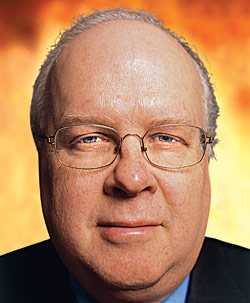
Snapshots from Joe Hagan’s drive-by profile of Karl Rove in the current New York magazine:

Goddangit, Baby, We’re Making Good Time

With a new master plan for the GOP, Karl Rove is revving up for a comeback.

Lede:

Karl Rove is driving through Central Texas with his girlfriend, on the way to a weekend quail hunt.

“I’ve been called up by my emergency Texas militia unit to help stop an invasion of Texas blue quail in the Big Bend region,” he guffaws over a crackly phone line, somewhere outside Fredericksburg.

The man George W. Bush used to call Turd Blossom narrates the passing landscape—“The bottomlands are characterized by oak and mesquite, and the highlands are characterized by mountain juniper, a.k.a. cedar,” he drawls—and also takes a shot at the passing political scene: President Obama’s speech on the Tucson tragedy (“Good,” not “great”) and Sarah Palin’s video addressing the shooting (“I view it more as a lost opportunity than I do a seminal event”).

He even weighs in on a hot script circulating in Hollywood, College Republicans, about his own early years as a fresh-faced party apparatchik on the make. “They got it all wrong!” he says of the script, which he claims overemphasizes the importance of his onetime close colleague, Lee Atwater, the notorious strategist behind Bush 41. Perhaps Rove would consider consulting to set the record straight?

“For the right price, baby!” yells Rove, sending his gal pal into squeals of laughter.

“That’s my agent,” he quips.

The woman, Karen Johnson, is a lobbyist rumored to have been Rove’s mistress before his divorce from his second wife in 2009. When she tells him they’ve already reached the exit for Junction, ­Texas, Rove is impressed: “Goddangit, baby! We’re making good time!”

Everywhere else, though, Rove is just making good, despite his hardscrabble beginnings:

Modest though he may at times pretend to be, Rove has always seen himself as more than a glorified factotum. As he’s happy to remind you, he considers himself a policy intellectual, a man of letters who reveres Winston Churchill and posts his reading list on his website. Since the seventies, when he was a lonely college nerd—whose father, reportedly gay, left the family to an erratic mother who pocketed his school money and left Rove to fend for himself—bunking in a storage closet in a frat house in Utah, he’d been a self-made man.

Who, as they say, worships his creator – and the almighty dollar, despite the efforts of others to limit money’s influence on American politics.

For Rove, [John] McCain’s hand- wringing over the influence of corporate money was all well and good, but money was the game, period. Rove has often been cast as the reincarnation of President William McKinley’s political adviser, Mark Hanna, who famously said there are only two things important in politics: money and “I can’t remember what the second one is.”

Money is certainly the game for Rove’s fundraising machine American Crossroads.

And – oh, yes – for Rove himself:

Before Rove and his partner Ed Gillespie, the former counselor to Bush in the White House, had even slapped a name on it, American Crossroads had $25 million in commitments, mostly from patrons in Texas. To sweeten the deal, Rove said he wouldn’t take a dime for his efforts, acting only as an informal adviser, and hired as the group’s operator a well-regarded former Bush-administration official, Steven Law, who had been Senator Mitch McConnell’s chief of staff. That freed Rove to launch a separate but equally important campaign, the sort that’s become a staple of the modern campaign: the nonstop promotion of his new memoir, which sent Rove on a tour of 111 cities in 90 days, starting in March 2010. From January to November 2010, in between dozens and dozens of fund- raisers, paid speeches, and public readings, he wrote 61 op-ed columns, appeared on Fox News 83 times, and posted 1,400 tweets. His brand, and his bank account, were on the rise.

Which left him free to dope-slap Sarah Palin for “lacking gravitas” and to try – unsuccessfully – to kneecap Texas Gov. Rick Perry’s reelection campaign.

Boffo finish of Hagan’s piece:

A lot of Rove’s friends tell me he’s misunderstood. Even enemies say so. Rove is not evil, says former Bush campaign strategist and apostate Matthew Dowd, nor is he a genius. Instead, he says, Rove is a self-marketer of his own reputation.

“What happened in 2010 had nothing to do with Karl and nothing to do with American Crossroads and everything to do with the political environment,” Dowd says. “Karl maintains a lot of the myth in a world not based totally in facts.”

The same, he says, goes for the 2012 presidential election. “The reason why a Republican is nominated won’t be because of Karl,” he says. “That doesn’t mean he won’t create a narrative.”

About the nominee. And himself, of course.

Posted in Uncategorized | Tagged , , , , , | 3 Comments

It’s Good To Live In A Two-Daily Town (Parsons Brinckerhoff Edition)

From Thursday’s Boston Globe:

Big Dig firm to help run T project

Board initially leery of hiring company; will aid MBTA on locomotive deal

Parsons Brinckerhoff is back!

The folks who gave you shoddy Big Dig construction, massive cost overruns, endless deadline delays, and one tragic tunnel death are once again the go-to guys for the Bay State:

Yesterday, the MBTA agreed to hire Parsons Brinckerhoff as a subcontractor on an $8.7 million deal to help the state manage its $115 million purchase of 20 new commuter rail locomotives, to be built in Idaho. Some on the MBTA’s board of directors seemed initially hesitant, but state Secretary of Transportation Jeffrey B. Mullan convinced them that it was time to move on.

“PB Americas is one of the great engineering companies in the United States,’’ he said. “It has a long history of excellence. I know that mistakes were made on the Artery/Tunnel project, and people paid for those mistakes, and it resulted in an extreme, unfortunate incident on Interstate 90. But I think that PB has, not just in Massachusetts but throughout the nation and indeed the world, proven its capabilities time and time again.’’

Pardon me, Mr. Mullan, but that “extreme, unfortunate incident on Interstate 90” was in fact the death of Milena Del Valle.

The Globe piece never challenged Mullan’s statement, nor did MBTA board of directors member Ferdinand Alvaro Jr.:

Alvaro said he was reassured by Mullan’s statement and by a packet of materials about Parsons Brinckerhoff’s “corporate citizenship.’’

Then again, Thursday’s Boston Herald challenged . . . nothing. It had no story about the rehab deal with PB.

But Friday’s Herald roared back with . . . an Associated Press wire service piece. (UPDATE: Only on the web, not in the dead-tree edition.)

Where’s the outrage, you feisty local tabloid?

What – too busy keeping track of Boston’s Brooke Astor lookalike Steven Tyler?

Shame on you.

Posted in Uncategorized | Tagged , , , , , , , | Leave a comment

Why The Missus And I Never Met John Galliano

John Galliano, celebrated fashion designer and anti-Semite, delivered his now infamous Hitler-loving rant at favorite Paris bistro La Perle, located on rue Vieille-du-Temple in the Marais district.

Small world: Several years ago the Missus and I rented an apartment three doors down from La Perle. And in the ensuing years, I have obsessively bought baguettes from the patisserie four doors down from La Perle.

But we never went into the bistro itself.

It always seemed too hip for us.

Now we know why.

Posted in Uncategorized | Tagged , , , , | Leave a comment

NYT: America’s Assignment Desk (Bob Probert Edition)

Thursday New York Times page one report:

Hockey Brawler Paid Price, With Brain Trauma

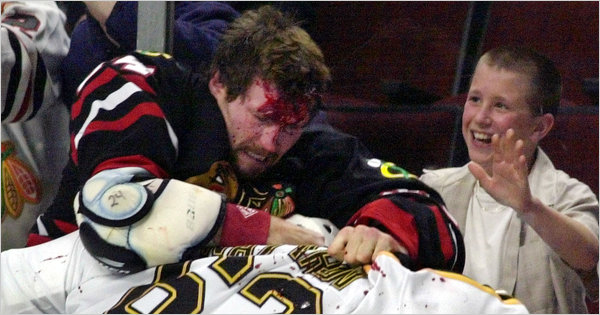
TECUMSEH, Ontario — For 16 seasons, Bob Probert’s fists were two of hockey’s most notorious weapons, winning most of his 246 fights and feeding the N.H.L.’s fondness for bare-knuckle brawling.

But the legacy of Probert, who died last July of heart failure at 45, could soon be rooted as much in his head as his hands. After examining Probert’s brain tissue, researchers at Boston University said this week that they found the same degenerative disease, chronic traumatic encephalopathy, whose presence in more than 20 deceased professional football players has prompted the National Football League to change some rules and policies in an effort to limit dangerous head impacts.

As night follows the day, Thursday WBUR “All Things Considered” report:

BOSTON — Over the course of his 16 seasons in the National Hockey League, Bob Probert gained a reputation as an aggressor. He took part in nearly 250 on-ice brawls, and he racked up 3,300 penalty minutes along the way.

Probert died of a heart attack last year at the age of 45. Since then, researchers at Boston University have found that the constant hits he took to his head may have been a factor in why he developed a degenerative brain condition called chronic traumatic encephalopathy.

Brain trauma caused by hockey is a condition that hits close to home in Boston; earlier this season, the Bruins lost stars Patrice Bergeron and Marc Savard to concussions.

Chris Nowinski, a co-director of Boston University’s Center for the Study of Traumatic Encephalopathy, spoke with WBUR’s All Things Considered host Sacha Pfeifferabout what the NHL is doing to reduce head injuries among its athletes — and whether the culture of fighting in professional hockey is contributing to brain trauma among players.

If for economic reasons the Times scales back its news coverage, every news organization scales back its news coverage.

For better or worse, those are the stakes.

Posted in Uncategorized | Tagged , , , , | Leave a comment

That’s Rich: Why The Times Columnist Bolted To New York Magazine

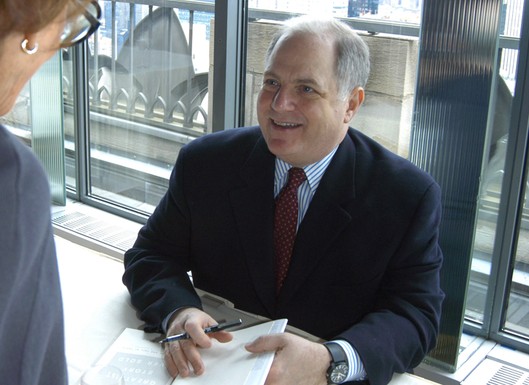
By one reading, New York Times columnist Frank Rich is just another pawn in the chess smackdown between the Times and New York magazine.

Via MediaWeek:

Since September, the New York Times Magazine has had New York magazine editor Adam Moss up against the ropes. Tuesday, Moss pulled a Micky Ward, taking Times op-ed giant Frank Rich for New York.

As editor of the New York Times Magazine, Moss created the weekly that readers know today before decamping to New York in 2004. Last September—perhaps as an act of long-overdue revenge—the Times Magazine snagged Hugo Lindgren, who Moss had hired twice at New York, to be its new editor. As the New York Observer pointed out at the time, the move marked the beginning of an “intriguing rivalry” between the two publications.

According to Rich, though, his move was all about the Times (via WWD):

“As much as I love the Times, there was no way for me to reinvent myself at the Times,” said Rich. “I’ve been a critic, I’ve been a columnist at the magazine, a senior writer writing pieces for the well of the magazine, and then did both kinds of op-ed columns, including one they very nicely created for me.”

Hard to believe that the Times wouldn’t have created anything Rich wanted next.

Your speculation goes here.

Posted in Uncategorized | Tagged , , , , | 2 Comments

Doing Good Before Doing Well

In these parlous economic times, college graduates are turning toward public service jobs to tide them over until private sector jobs bounce back.

From Wednesday’s New York Times:

In 2009 alone, 16 percent more young college graduates worked for the federal government than in the previous year and 11 percent more for nonprofit groups, according to an analysis by The New York Times of data from the American Community Survey of the United States Census Bureau. A smaller Labor Department survey showed that the share of educated young people in these jobs continued to rise last year.

“It’s not uncommon for me to hear of over 100 applications for a nonprofit position, sometimes many more than that, and many more Ivy League college graduates applying than before,” said Diana Aviv, chief executive of Independent Sector, a trade group for nonprofits. “Some of these people haven’t been employed for a while and are happy to have something. But once they’re there, they’ve recalibrated and reoriented themselves toward public service.”

It is not clear, though, whether a different starting point will truly “recalibrate” these workers’ long-term career aspirations — that is, whether their newfound paths will stick, or if they will jump to more lucrative careers when jobs are more plentiful.

No kidding.

For decades (specifically the ’60s and ’70s), the hardworking staff operated on the belief that civil service exams were the last refuge of the liberal arts major.

That led to semi-lucrative gigs with the U.S. Postal Service (seasonal), Cincinnati’s street-paving crew (flatout lied about educational status to get a summer’s worth of work), and the Social Security Administration (see The Redemption Unit).

So, take heart, recent college graduates.

With any luck, in 40 years you’ll be . . . a blogger.

Posted in Uncategorized | Tagged , , , , | 2 Comments

Public/Private Sector Compensation Bakeoff (David Leonhardt Edition)

New York Times columnist David Leonhardt has weighed in on the public/private salary rumpus triggered by the Wisconsin union- busting campaign, and he delivers a customarily level-headed verdict:

[A]cademic papers spanning more than 30 years have found that government workers receive compensation that is similar — with somewhat lower salaries and somewhat better benefits on average — to that of private sector workers with similar qualifications. One study went so far as to include workers’ scores on an intelligence test, to ensure the comparison was apples to apples. Over all, government workers are modestly underpaid or overpaid, depending on which technical accounting assumptions are used to value their pensions.

Either way, modestly is the crucial word. There is no good case that government pay is a major cause of the budget problems now facing states.

The major cause, Leonhardt says, is that pesky kicking-the-can-down-the-road inclination of local, state, and federal governments:

The delaying of costs is obvious. Both politicians and union leaders have decided that generous future benefits offer the easiest way to hold down spending and still satisfy workers. The result is government pay that’s skewed too heavily toward pensions and health insurance.

To be clear, I’m making an argument that’s different from “Government workers are overpaid.” I’m saying that they are paid in the wrong ways — in ways that make life easier on union leaders and elected officials, at least initially, but that eventually hurt both workers and taxpayers.

The solution, Leonhardt says, is not to cut the pay and benefits of public workers, but to “get rid of the deferred benefits that make no sense — the wasteful health plans, the pensions that start at age 55 and still let retirees draw a full salary elsewhere, the definitions of disability that treat herniated discs as incurable.”

Then again, what’s really incurable is the partisan instinct not to solve problems, but to exploit them.

Everything – and everyone – else is just caught in the crossfire.

Posted in Uncategorized | Tagged , , , , , | Leave a comment

It’s Good To Live In A Two-Daily Town (Howard Bryant Edition)

The hardworking staff has met author/ESPN senior writer/former Boston Herald columnist Howard Bryant on several occasions, and he always struck us as a decent, thoughtful, accomplished journalist. So it was distressing to learn of his arrest this past weekend for assault and battery on both his wife and a police officer.

Tuesday’s Boston Globe buried the story in the Miscellany section of its SportsLog column:

ESPN writer Bryant pleads not guilty

Howard Bryant, a senior writer for ESPN, pleaded not guilty to domestic assault and battery, assault and battery on a police officer, and resisting arrest charges at a hearing in Greenfield. State police say Bryant, 42, was arrested in front of a pizza parlor in the Western Massachusetts town of Buckland Saturday after witnesses told police they saw a man choking and pinning a woman against a parked car. After stopping Bryant and his wife, Veronique, police said Bryant refused to let a state trooper handcuff him and struck the state trooper in the chest with his elbow. Police said they have five witness statements. At the hearing, the court released Bryant’s $5,000 bail, which he had paid Saturday, and he was released on personal recognizance. Bryant, who lives in nearby Ashfield, said he and his wife had a verbal argument, but that he did not assault her. “I put one hand on her shoulder bone. We had an argument; we had a spat. I did not hurt her,’’ Bryant said. His wife also denied that he assaulted her . . .

Tuesday’s Herald, on the other hand, published a full-throated defense of Bryant:

Wife denies ESPN scribe assaulted her

The wife of ESPN sports scribe Howard Bryant is standing by her man, saying she’s “never been a victim of abuse” — even after state police busted him for what witnesses described as a violent attack on her outside a small town pizza shop.

“I’m not a victim of abuse — never been. Not now. Not ever,” Veronique Bryant told the Herald during a phone interview yesterday — her husband of nine years at her side.

Bryant, 42, a former Herald sports columnist living in Ashfield, pleaded not guilty to domestic assault and battery, assault and battery on a police officer and resisting arrest in Greenfield District Court. He was released on personal recognizance.

Now comes the tricky part, though – Bryant’s defense. Here’s his initial foray, also via the Herald:

Lawyer for ESPN’s Bryant says race to blame for arrest

The attorney for ESPN senior writer Howard Bryant — who was arrested over the weekend for allegedly assaulting his estranged wife outside a pizza shop in front of their 6-year-old son — said the sports scribe was busted because he is black.

State police said Bryant, 42, put up a fight and struck a trooper with his elbow when they tried to arrest him after witnesses said he roughed up his wife outside a pizza shop shortly after noon Saturday in the small western Massachusetts town of Buckland.

“If Howard Bryant was Caucasian and was on the streets having exactly the same conversation with his wife — nobody would have even noticed,” his attorney Buz Eisenberg, told the Herald today.

This is unfortunate – and predictable – all the way around the course.

Posted in Uncategorized | Tagged , , , , , , , | Leave a comment

Public/Private Sector Compensation Bakeoff (PBS NewsHour Edition)

More grist for the salary mill, via Tuesday’s PBS NewsHour (video embedded):

Protests in Wisconsin, Elsewhere Stir Debate on Public vs. Private Pay, Benefits

And we take up the contentious question of public- versus private-sector pay with Harley Shaiken of the University of California, Berkeley, where he specializes in labor issues, and Chris Edwards, who works on tax and budget issues at the Cato Institute, which is dedicated to free markets and limited government.

Harley Shaiken, let’s put our cards on the table first. You don’t see public-sector employees as being overcompensated, right?

HARLEY SHAIKEN, University of California, Berkeley: Absolutely not.

And I think there’s ample data that indicate that they are not overcompensated. The average public worker in the United States earns about $49,000. But when you adjust for, as you put it earlier, education, experience, the character of the job, public workers earn — their wages are 11 percent less than those in the private sector.

If you add all the benefits into that picture, they’re 7 percent less. That’s hardly overcompensated. Are there cases in some occupations, some states where they are? Perhaps. But I think, overall, they are paid less than their private-sector counterparts, and the state really is a place where those who earn least ought — the state ought to be setting the standard for better pay, not for sweatshops, even within the constraints of a very serious fiscal situation on a state level.

JEFFREY BROWN: All right. All right. We’re going to walk through some of those.

But, Chris Edwards, first, your cards here. You see an unhealthy balance in the — how the public sector employees are compensated.

CHRIS EDWARDS, Cato Institute: I think, for state and local workers, their wages on average across the country are pretty well in line with the private sector. Teachers and police and fire, the academic studies I have seen, the wages are pretty reasonable and competitive.

It’s the benefits where the state and local workers have a huge advantage. And to give you a couple examples, virtually all full-time state and local workers get old-fashioned defined benefit pension plans that are typically very generous. Private-sector workers, very few of them get these defined benefit pension plans anymore.

So these government pension plans are far more lucrative generally than private sector 401(k) plans. Secondly, virtually all full-time state and local workers get retiree health subsidies. So, the typical worker state-local retires at, say, age 55 or 56. Then they get 10 years of health care subsidies before the federal Medicare kicks in.

That’s the type of benefits that people in the private sector simply don’t get. And finally, as your piece pointed out, public-sector workers get a lot more job stability. They have huge job stability, which has a value. So, a private sector teacher earning $40,000 and a government teacher earning $40,000, they’re not exactly comparable, because the government worker has a much more stable job.

Discuss among yourselves.

Posted in Uncategorized | Tagged , , , , , , , , | Leave a comment

Rachel Maddow Realizes A Lifelong Dream

Rachel Maddow’s MSNBC show Monday night featured an interview with Wisconsin state Sen. Jon Erpenbach (D-umb).


Yes, Erpenbach actually said “off the record” on live television (around 7:42 of the clip).

Maddow: Sen. Erpenbach, are there any Republicans who are thinking about siding with Democrats on this issue – that may be the way this ends at this point.

Erpenbach: Off the record?

Maddow: Yeah, except we’re on TV . . .

Erpenbach: Yeah, so I can’t speak for them, but off the record . . .

Afterward, Maddow said:

You know, that’s every interviewer’s dream: A person who looks at you on television live and says, Is this off the record? It’s ab-so-lute-ly perfect.

And ab-so-lute-ly stupid, don’t forget.

Posted in Uncategorized | Tagged , , , , | 2 Comments