
From the great Tom Toles, Washington Post editorial cartoonist:
 My word!
From the great Tom Toles, Washington Post editorial cartoonist:
My word!
Tom Brady, Girlyman (Part Umpteen).
Via Monday’s Boston Herald Inside Track:
Tom & Gi’s wild ride
Wwwwwweeeeeeeeee! New England Patriots [team stats] QB/QT Tom Brady[stats] scored some alone time with his beauteous bikini-clad Brazilian bride Gisele Bundchen in Los Cabos, Mexico, over the weekend. And what better way for the couple to bond than to bomb down the frigid water slide at their hotel’s pool? No. 12 looks rather, um, shocked, no?
Photo:
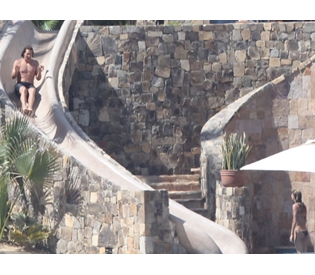 Closeup:
Girly, yes?
As the corruption trial of former Massachusetts House Speaker Sale DiMasi proceeds apace, it’s instructive to track the coverage in Boston’s two dailies.
From Monday’s Boston Globe:
The witnesses expected this week include David Simas, a White House adviser and Patrick’s former deputy chief of staff; Doug Rubin, a Democratic strategist who helped manage both of Patrick’s campaigns and served as the governor’s chief of staff; Leslie A. Kirwan, Patrick’s former budget chief, who is now a top financial officer at Harvard; and David Morales, the governor’s former commissioner of health care finance.
From Monday’s Boston Herald:
Members of Gov. Deval Patrick’s first-term administration will be sucked into the drama of former House Speaker Sal DiMasi’s corruption trial this week. Former Administration and Finance head Leslie Kirwan left during Patrick’s first term but had a key role in the computer software contract that DiMasi allegedly helped steer toward Cognos. David Simas, Patrick’s former deputy chief of staff, also could be called to the stand. Simas now works for President Obama.
Notice anyone who’s missing?
That would be Doug Rubin, former Patrick chief of staff and current lobbyist/Herald columnist. And – face! – Rubin has a column in the same edition of the Herald, right alongside a second Herald DiMasi trial piece that doesn’t mention Doug.
The hardworking staff has already questioned why Rubin is in the news pages of the Herald rather than on the op-ed page.
Now we’re questioning why Rubin is out of the news pages.
Is it just me or is there something odd about this piece in today’s New York Times:
Free Speech on Twitter Faces Test
SAN FRANCISCO — What began as seamy gossip about an affair between a famous British soccer player and a reality TV star has quickly become another test over how far the rights to privacy and free speech extend online, where social media operate in countries with vastly different laws.
The soccer player has been granted a so-called super-injunction, a stringent and controversial British legal measure that prevents media outlets from identifying him, reporting on the story or even from revealing the existence of the court order itself.
But tens of thousands of Internet users have flouted the injunction by revealing his name on Twitter, Facebook and online soccer forums, sites that blur the definition of the press and are virtually impossible to police.
And not just Internet users – news organizations have also revealed the name:
[T]he soccer player’s name is now so widely known that it has become a running joke, discussed — with the name bleeped out — on prime-time television. Foreign publications like Forbes.com and The Sunday Herald, a Scottish paper, have printed his name.
But not the Times. Which is fine, except wouldn’t you think the piece would mention why the paper’s withholding the name? Just asking.
P.S. The hardworking staff isn’t revealing the name in hopes that the Times will question our decision.
 So after Boston University had conferred honorary doctorates on Frank (Always Color Inside the Lines) Stella, Nina (Proud BU Dropout) Totenberg, and Jacques (The Most Cookin’ Professor) Pépin, it was Katie, BU the Door.
Introduced as someone who had scaled the “Olympian heights of journalism” (your WTF goes here), former Coulda Been Spectacular anchor Katie Couric received an honorary Doctor of Humane Letters and delivered the keynote address at BU’s 138th Commencement exercises.
The graduating class of 2011 loved it.
Couric is a rock star more than a journalist to young people who rarely watch her on the CBS Evening News. If they did, 1) Couric would probably still be there; and 2) there’d be a lot fewer Centrum Silver ads during the newscast.
Regardless . . .
Couric provided the requisite BU inside jokes (“I’m happy to be speaking at BU instead of my safety school BC”) – although not as many, the hardworking staff thinks, as U.S. Attorney General Eric Holder delivered last year.
She also provided the soundbite du jour regarding her tenure at the CBS anchor desk: “The critics said I lacked gravitas, which I’ve decided is Latin for testicles.”
Ba-da-boom.
Mostly, though, Couric quoted from her new book The Best Advice I Ever Got: Lessons From Extraordinary Lives, a collection of essays from people slightly less famous than Couric.
Representative sample: “Linda Ellerbee said, ‘Sometimes you’re the pigeon, and sometimes you’re the statue.”
As today’s Boston Herald describes it:
Couric also used the speech to plug her book, “The Best Advice I Ever Got,” sampling from its contents to warn students that setbacks are inevitable and “it’s how you handle that adversity that defines who you are.” Then she told students to look under their chairs.
“I’m joking! If you want the book you have to buy it,” Couric said. “Who do you think I am, Oprah?”
Exactly. Or not exactly. You be the judge.
(Full disclosure: I’m a mass communication professor at Boston University so I have a vested interest in how things work out for BU grads.)
UPDATE: Here’s the video.
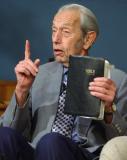
Even America’s Heartland can’t take heart in predictions of YESTERDAY’S endtimes.
From The Oklahoman:
Prediction of world’s end is premature — again
OAKLAND, Calif. — They spent months warning the world of the apocalypse, some giving away their belongings or draining savings accounts. And so they waited Saturday for the appointed hour to arrive.
When 6 p.m. came and went, and no extraordinary cataclysm occurred, Keith Bauer — who drove his family 3,000 miles from Maryland to California for the Rapture — took it in stride.
“I was trying to push the skepticism away because I believe in God,” he said outside the gated Oakland headquarters of Family Radio International, whose founder, Harold Camping, has been broadcasting the prediction for years. “I was hoping for it because I think heaven would be a lot better than this earth.”
Yeah but – this earth is what we’re stuck with.
Seriously.
LinkedIn, the adult version of Facebook, went public this week and its IPO was boffo, as the Weekend Wall Street Journal summarized:
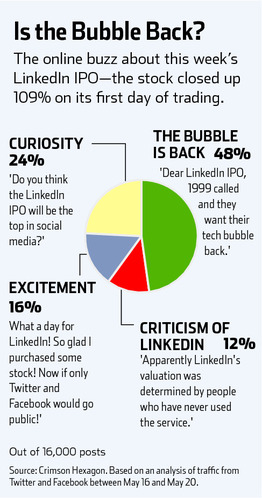
LinkedIn’s shares more than doubled in their first day of trading, setting the stage for debuts from other Internet companies such as Facebook and Groupon. The outsize demand for the stock of an Internet company that is growing rapidly but had a profit of $15.4 million last year is the latest sign of the surge—some say bubble—in Web valuations. By Thursday’s 4 p.m. close, the stock had soared 109% to $94.25. At day’s end, LinkedIn was valued at $8.9 billion.
That slingstock was totally buzzworthy, as the Journal helpfully charted:
Nowhere in the analysis, however, was the category Criticism of Morgan Stanley and Bank of America’s Merrill Lynch Division. Those two outfits managed LinkedIn’s IPO, and, according to new (and sharp) New York Times op-ed columnist Joe Nocera, they scammed LinkedIn, which received $45 per share in the initial public offering.
When LinkedIn’s shares started trading on the New York Stock Exchange, they opened not at $45, or anywhere near it. The opening price was $83 a share, some 84 percent higher than the I.P.O. price. By the time the clock had struck noon, the stock had vaulted to more than $120 a share, before settling down to $94.25 at the market’s close. The first-day gain was close to 110 percent.
I have no doubt that most everyone at LinkedIn was thrilled to see the run-up; most executives at start-ups usually are. An I.P.O. is an important marker for any company. And, of course, the executives themselves are suddenly rich. But, in reality, LinkedIn was scammed by its bankers.
Nocera’s reasoning:
The fact that the stock more than doubled on its first day of trading — something the investment bankers, with their fingers on the pulse of the market, absolutely must have known would happen — means that hundreds of millions of additional dollars that should have gone to LinkedIn wound up in the hands of investors that Morgan Stanley and Merrill Lynch wanted to do favors for. Most of those investors, I guarantee, sold the stock during the morning run-up. It’s the easiest money you can make on Wall Street.
And the hardest lesson an IPO can teach.
Lede of New York Times movie critic A.O. Scott’s review of Woody Allen’s new film, “Midnight in Paris:”
The definitive poem in English on the subject of cultural nostalgia may be a short verse by Robert Browning called “Memorabilia.” It begins with a gasp of astonishment — “Ah, did you once see Shelley plain?” — and ends with a shrug: “Well I forget the rest.” Isn’t that always how it goes? The past seems so much more vivid, more substantial, than the present, and then it evaporates with the cold touch of reality. The good old days are so alluring because we were not around, however much we wish we were.
Interesting and erudite, yes? But why no link to the full text of Browning’s “Memorabilia”? Isn’t that what the web is supposed to do, A.O.?
Whatever, that’s what the hardworking staff is supposed to do.
So (via The Poetry Foundation) . . .
Memorabilia
Ah, did you once see Shelley plain,And did he stop and speak to you?And did you speak to him again?How strange it seems, and new!But you were living before that,And you are living after,And the memory I started at—My starting moves your laughter!I crossed a moor, with a name of its ownAnd a certain use in the world no doubt,Yet a hand’s-breadth of it shines alone‘Mid the blank miles round about:For there I picked up on the heatherAnd there I put inside my breastA moulted feather, an eagle-feather—Well, I forget the rest.
Commentary, via SparkNotes:
The title of this poem suggests a kind of memory that is linked with physical objects. Browning’s encounter with the man who has met Shelley takes its importance from the fact that this man was oncephysically with Shelley and is now physically with Browning. This second-degree encounter with the great poet, now dead, corresponds metaphorically to the second-degree encounter with the eagle, now flown away having left only a feather; but the encounters also correspond physically, in that the physical object of the feather triggers the thought of the human encounter. This suggests a much more mundane and direct concept of natural reality and memory than that postulated by the Romantics (to whom Shelley belonged). Neither the encounter with the feather (nature) nor the memory of Shelley result in rapture or epiphany in Browning’s poem (as they do in Romantic lyrics); rather, they imply a sense of loss and distance, of separation.
Indeed, not only does memory fail to lead to rapture, it has very little evocative power at all: Browning does not remember the rest of his walk on the moor beyond the finding of the feather. Moreover, Browning places little faith here in the life of the mind, the ability of analysis: he finds himself unable to elaborate more on the relationship between the feather and the man who met Shelley. Yet somehow this world of mundane physical objects and faint mental suggestions can provide as much material for poetry as the wild spiritual inspirations of Shelley’s “West Wind” or Wordsworth’s daffodils.
A.O. Scott, take (Spark)note.
So the hardworking staff opened up the mailbag this week and out poured a letter with this return address:
And this on the envelope:
“2012 can’t come soon enough.”
The hardworking staff was intrigued.
The letter itself was the usual fundraising eyewash:
Dear Friend,
I am so thankful for the American patriots across our nation who voted this past November to bring Congress back to the ideals of our Founding Fathers.
The White house heard loud-and-clear that Americans don’t want cradle-to-grave government control of our lives. We don’t want government bureaucrats deciding . . .
And please contribute to SarahPAC and etc.
But back to that Gov. Sarah Palin: Is it just a coincidence that the current issue of The Atlantic features a Joshua Green piece (headline: The Tragedy of Sarah Palin) that’s quite admiring of Palin’s gubernatorial record in Alaska?
Representative sample:
As governor, Palin demonstrated many of the qualities we expect in our best leaders. She set aside private concerns for the greater good, forgoing a focus on social issues to confront the great problem plaguing Alaska, its corrupt oil-and-gas politics. She did this in a way that seems wildly out of character today—by cooperating with Democrats and moderate Republicans to raise taxes on Big Business. And she succeeded to a remarkable extent in settling, at least for a time, what had seemed insoluble problems, in the process putting Alaska on a trajectory to financial well-being. Since 2008, Sarah Palin has influenced her party, and the tenor of its politics, perhaps more than any other Republican, but in a way that is almost the antithesis of what she did in Alaska. Had she stayed true to her record, she might have pointed her party in a very different direction.
A different perspective, to be sure.
Especially in light of the current wave of Palin for President stories.
Representative sample (via Mediaite):
Sarah Palin is inching ever closer to announcing a presidential run. The former governor visited Greta Van Susteren tonight and teased she had “the fire in the belly” to do it, but that much of the criticism from the media was teetering close to too much for her and her family to bear. Van Susteren took the comment defensively as Palin challenged her to “lead” her colleagues away from the harsher reporting, to which Van Susteren replied, “don’t take the bait.”
The whole messhegoss:
Sure sounds like Sarah’s feelin’ that spirit of helping America find its true self, which is to say, her. Your feelin’ goes here.
 Click to subscribe to RSS

 Campaign Outsider