
From our Right Hand Doesn’t Know What the Left Hand Is Doing desk
Wall Street Journal columnist Bret Stephens, who’s damned good and has a newly minted Pulitzer to prove it, wrote this yesterday:
The Evil in Boston
Before we move on from Boston—move on from psychoanalyzing the Brothers Tsarnaev, and their parents; move on from fretting about when, exactly, Dzhokhar should have his Miranda rights read to him; move on from the (irrelevant) history lesson about Chechnya; move on from the speechifying about the importance of tolerance; move on from the search for terrorist connections, Islamist influences and personal motives; move on, period—let’s remind ourselves just what this duo was up to on the afternoon of April 15, 2013.
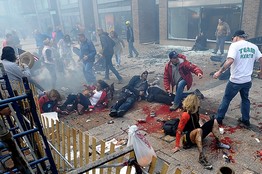
And that was this: “The main intention, certainly the main effect, was to send a thousand tiny metal knives flying at supersonic speeds in every direction from the blast. That is what Palestinian “engineers” do when they add nails and ball bearings—and, sometimes, rat poison—to the vests of suicide bombers. These are maiming operations, in their own class of cruel.”
Stephens, as it happens, witnessed a suicide bombing on a Jerusalem bus in 2004:
“The ground was covered in glass; every window of the bus had been blasted,” I wrote later that day. “Inside the wreckage, I could see three very still corpses and one body that rocked back and forth convulsively. Outside the bus, another three corpses were strewn on the ground, one face-up, two face-down. There was a large piece of torso ripped from its body, which I guessed was the suicide bomber’s. Elsewhere on the ground, more chunks of human flesh: a leg, an arm, smaller bits, pools of blood.”
But that falls far short of capturing his memory of the event, Stephens writes.
[H]uman carnage is beyond description, a fact known mainly to those—now including several hundred people in Boston—who have seen it for themselves. To see it is to understand it; to understand it is to have no real words for it.
That’s why so much of the commentary about Boston seems so curiously off point. It treats the horror of what was done, and the nihilism that was required to do it, as mere givens. Why spend any time staring mutely into the abyss when we could be speaking sagely about, say, the alienation of angry young Muslim men? Or the pros and cons of Twitter during the course of a manhunt?
Two pages later in the Journal, there’s this:
Investigating Terror in the Age of Twitter
In an incredibly short span of five days last week, America went from a nation under attack by terrorists to one made proud as law-enforcement agencies quickly identified the suspected Boston bombers and tracked them down. The attack, the investigation, the manhunt and the swift resolution were unprecedented. So too was the way that law enforcement employed digital tools to do its job.

Now just waiting for Bret Stephens’ letter to the editor.
P.S. This is the hardworking staff’s gala 3000th post. Thanks to all you splendid readers for being so . . . splendid.

 Campaign Outsider
Congrats to the HWS, and thanks for the continued great work.