Two-Handed NYT Coverage Of Social Media In Egypt

Sunday’s New York Times is its own compare-and-contrast exercise regarding the power of social media to “[fuel] the fires of the Egyptian protests.”

In the news pages, there’s this report:

Anger and a Facebook Page That Gave It Voice

It started with Khaled Said being beaten to death by Egyptian police, reportedly because he had evidence of police corruption. From the Times piece:

Within five days of his death, an anonymous human rights activist created a Facebook page — We Are All Khaled Said— that posted cellphone photos from the morgue of his battered and bloodied face, and YouTube videos played up contrasting pictures of him happy and smiling with the graphic images from the morgue. By mid-June, 130,000 people joined the page to get and share updates about the case.

It became and remains the biggest dissident Facebook page in Egypt, even as protests continue to sweep the country, with more than 473,000 users, and it has helped spread the word about the demonstrations in Egypt, which were ignited after a revolt in neighboring Tunisia toppled the government there.

Here, on the other hand, is what Frank Rich has to say in his Sunday column:

Among cyber-intellectuals in America, a fascinating debate has broken out about whether social media can do as much harm as good in totalitarian states like Egypt.

[snip]

This provocative debate isn’t even being acknowledged in most American coverage of the Internet’s role in the current uprisings. The talking-head invocations of Twitter and Facebook instead take the form of implicit, simplistic Western chauvinism. How fabulous that two great American digital innovations can rescue the downtrodden, unwashed masses. That is indeed impressive if no one points out that, even in the case of the young and relatively wired populace of Egypt, only some 20 percent of those masses have Internet access.

Rich says elsewhere that social media “do play a role in organizing, publicizing and empowering participants in political movements in the Middle East and elsewhere.”

Just not a very important one.

This compare-and-contrast is not to call for a one-handed Times. Just interesting to observe occasions where the right hand doesn’t agree with what the left hand is saying.

Posted in Uncategorized | Tagged , , , , , | 1 Comment

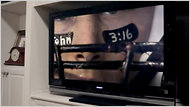
Fox 86es John 3:16 Super Bowl Ad

As the hardworking staff has noted, there are lots of scambit ads associated with Super Bowl LXV (spots submitted with the express purpose of being rejected by Super Bowl broadcaster Fox Sports, the better to get press).

But only one got its own Beliefs column in the New York Times.

Namely, Fixed Point Foundation‘s “John 3:16” spot:

From the Times piece:

It is a reference to a Bible verse: “For God so loved the world that he gave his one and only Son, that whoever believes in him shall not perish but have eternal life . . . ”

[snip]

But according to Fox Sports, which will broadcast the Super Bowl this year, the verse you can see in the stands on television is not suitable for a commercial. The network’s rejection of a 30-second spot centered on John 3:16 is just one example of an advertising culture that can be allergic to expressions of faith.

Fox Sports, for its part, issued this statement:

“Fox Broadcasting Company does not accept advertising from religious organizations for the purpose of advancing particular beliefs or practices.”

No, they leave that to Fox News.

Posted in Uncategorized | Tagged , , , , , , , , | 3 Comments

Campaign Outsider Super Bowl Ad Preview©

As if you needed more Super Bowl pre-press, here’s Campaign Outsider’s clip ‘n’ save guide to Sunday’s adstravaganza:

Celebrity Sweepstakes

The glitterati bakeoff features Faith Hill in a Teleflora spot, Kim Kardashian shilling for Skechers, and a Best Buy ad with Justin Bieber and Ozzy Osbourne (the Missus is hoping he’ll bite Justin Bieber’s head off).

Scambits to Get: 1) Ads Rejected; 2) News Coverage

Yeah – like JesusHatesObama had $3 million if its ad got accepted.

Also deep-sixed: PETA, Ashley Madison, John 3:16, and the NFL Players Association.

Then again, they did get more than their money’s worth.

(Other rejects here, via The Daily Caller.)

The Usual Suspects

Bridgestone, E*Trade, GoDaddy, Pepsico, Universal, Disney, yawn.

See previews here (via – once again – The Daily Caller).

And have a super Super Bowl.

Posted in Uncategorized | Tagged , , , , , , , , , | 1 Comment

Campaign Outsider Thirty-Second Theater Review®

The Druid and Atlantic Theater Company’s mordantly melancholy and thoroughly terrific production of Martin McDonagh’s The Cripple of Inishmaan (part of ArtsEmerson’s Irish Festival) has only two more days to run – Saturday and Sunday.

The writing is smart – and smarts – and the acting is first-rate.

See it if you can.

UPDATE: Boston Globe’s Don Aucoin says I like it too!

Posted in Uncategorized | Tagged , , , | 1 Comment

Hooked On iPhonecs

Two high-profile/high-tech hall monitors have weighed in on the much-awaited Verizon iPhone, and as Johnny Most (rest his soul) liked to say, “It’s good!!!

From New York Times gadget guru David Pogue’s review:

It’s here. After almost four years of speculation, the iPhone will finally come to Verizon’s network on Feb. 10.

And to answer everyone’s question, the Verizon iPhone is nearly the same as AT&T’s iPhone 4 — but it doesn’t drop calls. For several million Americans, that makes it the holy grail.

Ditto Walter Mossberg’s Wall Street Journal review:

I’ve been testing a Verizon iPhone 4 and comparing it to an AT&T iPhone 4, which has been out since last summer. The phones themselves are essentially identical, except for the fact that they have different radios inside to accommodate the two carriers’ differing network technologies. They aren’t interchangeable.

On the big question, I can say that, at least in the areas where I was using it, the Verizon model did much, much better with voice calls. In numerous tries over nine days, I had only three dropped calls on the Verizon unit, and those were all to one person who was using an AT&T iPhone in an especially bad area for AT&T: San Francisco. With the nearly identical AT&T model, I often get that many dropped calls in one day.

Oddly enough, San Francisco was grounded-call-zero for Pogue as well:

I took the Verizon iPhone to five cities, including the two Bermuda Triangles of AT&T reception: San Francisco and New York. Holding AT&T and Verizon iPhones side by side in the passenger seat of a car, I dialed 777-FILM simultaneously, and then rode around until a call dropped. (Why that number? Because I wanted to call a landline, eliminating the other person’s cell reception from the equation. Also, Mr. Moviefone can carry the entire conversation by himself, so I could concentrate on the testing.)

In San Francisco, the AT&T phone dropped the call four times in 30 minutes of driving; the Verizon phone never did.

So, to review:

Verizon iPhone pretty good.

AT&T iPhone not so good.

[UPDATE: For phone calls, that is. Here’s how Mossberg sums it up:]

Bottom line: In my tests, the new Verizon version of the iPhone did much better at voice calling than the AT&T version, and offers some attractive benefits, like unlimited data and a wireless hot-spot capability. But if you really care about data speed, or travel overseas, and AT&T service is tolerable in your area, you may want to stick with AT&T.

Discuss among yourselves.

(Full disclosure: The hardworking staff uses a Motorola Droid smartphone, so we really don’t care.)

Posted in Uncategorized | Tagged , , , , , , , , | 1 Comment

Ada Louise Huxtable: MFA’s American Wing Fails To Take Flight

Wednesday’s Wall Street Journal devoted a full page of its Leisure & Arts section to the new Art of the Americas Wing at Boston’s Museum of Fine Arts.

And – no surprise here – the paper’s dual reviews featured dueling ledes.

From the Journal’s Leisure & Arts features editor Eric Gibson:

Hats off to Boston Museum of Fine Arts Director Malcolm Rogers for having his priorities in the right place with the new Art of the Americas Wing. He resisted the temptation of glitzy architecture and instead put the emphasis on art.

From the Journal’s storied architecture critic Ada Louise Huxtable:

It’s all about the art. It’s not about the architecture. End of review—except for some persistent questions about museum design.

Specifically, in contrast to the recent American Wing redesign at New York’s Metropolitan Museum of Art:

The [MFA’s] new court, like all of [Foster + Partners’] work, is rational, corporate and cool. Designed for flexibility, there will undoubtedly be many opportunities for change. But the contrast with the covered court of the American Wing of New York’s Metropolitan Museum, redesigned by Kevin Roche in collaboration with the chairman of the American Wing, Morrison Heckscher, and reopened in 2009, is both striking and instructive. The enclosing frame leaves open sky and park views. The MFA court is roofed with an extension of the uniform gallery lighting, making it feel totally enclosed. Even its exterior planting looks and feels remote.

Worse yet, Huxtable writes:

There are no subtleties or surprises, no risks taken. The new wing is an unassailably logical solution, superbly executed and singularly lifeless, largely redeemed by curatorial and installation expertise. The MFA’s collection of early Americana would be wonderful anywhere, in any kind of setting.

Just don’t expect that extra dimension of wonder and delight that architecture can add to art.

Before you write Huxtable off as just one more New York snot, remember that – against all odds (and conventional wisdom) – she loved Boston City Hall.

From her 1969 New York Times review:

Boston can celebrate with the knowledge that it has produced a superior public building in an age that values cheapness over quality as a form of public virtue. It also has one of the handsomest buildings around, and thus far, one of the least understood.

It is a product of this moment and these times – something that can be said of successful art of any period. And it is a winner, in more ways than one.

But the MFA’s new wing, to Huxtable, is a loser. In one very big way.

Posted in Uncategorized | Tagged , , , , , , , | Leave a comment

Al Jazeera’s ‘CNN Moment’ in the U.S.?

The conventional wisdom (via the Los Angeles Times) has it that the current Egyptian uprising will be to the Al Jazeera English cable network what the Persian Gulf War was to CNN in the early 1990s:

Some American pundits have been calling this Al Jazeera’s “CNN moment,” referring to that network’s coverage of the Gulf War, which catapulted it into popularity. But it goes beyond the question of whether Al Jazeera English will finally become part of a premium cable package. Never before has civil unrest on this scale been chronicled in real time with such intimate and multi-platform ambition.

The LA Times calls it “superlative coverage of the protests first in Tunisia and now in Egypt.”

Judge for yourself here.

Posted in Uncategorized | Tagged , , | 2 Comments

The Redemption Unit, V

(See I, II, III, and IV)

Interlude

My nom de plume in The Free Nameless News was J. Redmond Tardi, largely because I was late for work all the time. Part of the reason was that I took public (as opposed to rapid) transportation every day – specifically, the MBTA’s Arborway line, whose vehicles were one stop away from the Trolley Museum.

Then again – to be fair – mostly I was late just about every day because just about every night I was out writing jazz reviews for any second-rate music magazine that would have me. I knew virtually nothing about jazz at the time, which is why I concentrated on the second-rate magazines. But I got to see a lot of first-rate music. Being late for work was part of the system I developed in the summer of 1976.

It went like this: After work I’d go across the street to The Great Gatsby’s, wash the day away with three Wild Turkeys, go home, take a nap, then go out to see whoever was in town. I’d return home around one o’clock, do some writing, and eventually go to bed with a double album of Thelonius Monk on the stereo spindle.

And arrive late at work the next morning.

So I started going in on Saturdays, just to get within shouting distance of 40 hours a week. Saturdays were easy – no phones, no claimants, just paperwork and gossip. And there were donuts, except when there weren’t because I got in too late. Either way, I’d put in four or five hours of what had to be the least productive time in SSA history (which is saying a lot), and call it a week.

One Saturday afternoon, walking home with two bags of canned goods from the Hi-Lo, I saw my roommate’s car – The Fireball – headed the wrong way down our street. That didn’t strike me as unusual, since Jamaica Plain has long been famous for its two-way one-way streets (a sort of vigilante urban planning). Here’s what was unusual: it wasn’t my roommate driving the car, and the car had been stolen three days earlier.

The latter occurred despite the best efforts of my roommate, who chained together the steering wheel and the brake pedal every night, theoretically immobilizing the Fireball.  That was standard practice on Sheridan street, where the cars sported more chains than Mr. T. The standard practice eventually led car thieves to carry small saws, so they could cut through the steering wheel and slip the chain off.

Which is what they must’ve done to the Fireball. I ran up the hill as best I could with two bags of canned goods, burst into the apartment, breathlessly told my roommate to call the cops, and fell to the floor. He made the call and ran down to the bottom of the hill, where, to his surprise, the thief had parked the car – legally, no less. The police, like Christmas, arrived eventually and asked me for a description of the driver, which I was generally unable to provide.

“It happened so quickly, I really didn’t get a good look at him, officers. I think he was wearing a red plaid jacket, though.”

“Well, let’s take a walk around and look for him, shall we?”

That was the last thing I wanted to do, since poking around  with a policeman was no way to endear yourself to the fine patrons of the neighborhood establishments. Nonetheless I ventured several feet into the Hyde Square Bowl (“Nope, I don’t see him here”), Hyde Square Tavern (“Nope, not here”) and, most apprehensively, Los Villalinos (“Nope”).  That night, my roommate parked the Fireball at a friend’s house in the suburbs.

The reason I didn’t want to parade around with the cops was simple: I walked through Hyde Square three or four nights a week right after closing time at the local watering holes, and I didn’t want anyone to have a wrong impression of me.

Posted in Uncategorized | Tagged , , , , , | 4 Comments

Metro Boston Pimps Out Its Front Page

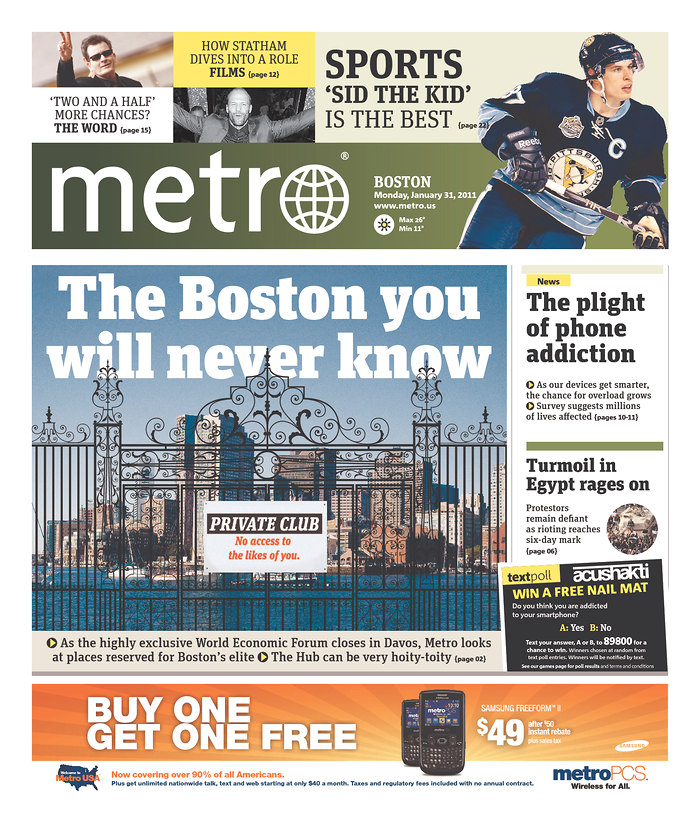
Local commuters got a bit of a surprise in – or rather, on – their copy of Metro Boston Monday morning: A four-page Revlon ad that wrapped the actual newspaper.

It featured a front page entirely occupied by a cosmetics ad topped by a Metro Boston banner – just to make it look like a real Page One.

(Which the hardsearching staff couldn’t find an image of, but here’s what the inside spread looked like:)

And here’s the actual Page One of Monday’s Metro Boston:

That same edition featured an ear that extended above the other pages to accommodate a Babson College MBA infosession ad.

As far as we can tell, Metro Boston hasn’t sold off the masthead yet.

But give them time.

Posted in Uncategorized | Tagged , , , | 4 Comments

Bill Keller’s Revisionist History

The hardworking staff finally got around to finishing New York Times executive editor Bill Keller’s 8000-word wet kiss to himself about his handling of the WikiLeaks documents (and manhandling of Julian Assange, apparently) over the past six months.

Along the way, Keller talked about a couple of other controversial Times reports:

The first, which was published in 2005 and won a Pulitzer Prize, revealed that the National Security Agency was eavesdropping on domestic phone conversations and e-mail without the legal courtesy of a warrant. The other, published in 2006, described a vast Treasury Departmentprogram to screen international banking records.

(Note the helpful link to the Pulitzer.)

Keller talked about the process of dealing with the White House over such delicate material, and hearkened back to 2005:

I have vivid memories of sitting in the Oval Office as President George W. Bush tried to persuade me and the paper’s publisher to withhold the eavesdropping story, saying that if we published it, we should share the blame for the next terrorist attack. We were unconvinced by his argument and published the story . . .

Yeah, after having held it for a year at the White House’s request.

But that doesn’t make as neat – or as tough – a story, does it?

Posted in Uncategorized | Tagged , , , , , | 1 Comment