
From Monday’s Boston Herald:
Perkins has a new vision
School for blind shortens name, introduces new Braille device
The Perkins School for the Blind is shortening its name but continuing its global mission of helping blind and visually-impaired individuals reach their full potential in society through its academic and technology offerings.
A key tool to achieve that goal will be the new Perkins SMART Brailler, which will be unveiled today at Perkins’ Watertown campus. Resembling a typewriter with Braille keys, the $1,995 device has a computer with an audio/visual output that says each letter a blind or visually-impaired user types out.
Carolyn Assa, Perkins’ executive director of communications, said the device can work in several languages, including English, Spanish, French, German, Russian and Portuguese, and helps users better find their literate footing alongside sighted individuals.
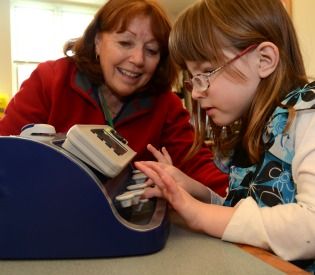
That’s the latest in a long history of technological advances the Perkins School has developed. But it didn’t register with everyone.
From Monday’s Wall Street Journal:
New Gadgets Assist the Blind
Companies Are Developing Technologies That Allow Visually Impaired Users to Feel More Connected to Society
For decades, technologies to assist the blind have focused on the simple mechanics of day-to-day living—helping the visually impaired safely cross a street or turn on a stove.
Increasingly, a new generation of products is on the rise to help enhance visually impaired consumers’ emotional well-being and keep them more connected to society.
“That’s really where the frontier is,” says Julian Dailly, external-affairs director at the Royal London Society for Blind People. After all, says Mr. Dailly, the challenge of being blind can be “as much about being depressed as it is about getting down the street.”
From entertainment to fashion, a number of companies are developing new technologies that they say can help boost individual confidence and allow visually impaired users to participate more completely in society—by helping them to enjoy Broadway theater and TV programs, to pick out color-coordinated outfits and more.
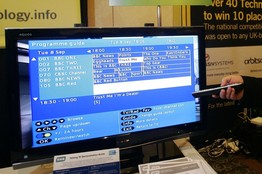
No mention of Perkins in the Journal piece, but plenty of attention to Talking TV, Voiceover, and etc.
The hardworking staff might be biased here (we contribute, along with the Missus, to Perkins), but it seems a nod in Perkins’ direction might have ben appropriate in the WSJ piece.
Especially in light of this:
Globally, there are 285 million people who have some form of sight loss, including 39 million who are blind, according to the World Health Organization. The overall graying trend across Europe and the U.S., as well as significant swaths of Asia, also has increased the need for assisted-reading and other technologies to help cope with diminished vision.
Which means a whole lot of people could use an international Braille machine a lot more than a Broadway theater device.
But maybe we’re just old-fashioned in a new-fangled world.

 Campaign Outsider