
This week’s horrific London riots thankfully seem to be subsiding. Up to now, many news reports, such as this New York Times piece, have likened the wave of civilian violence to riots 25 years ago:
Nothing remotely like it had been seen in London since 1985, when another eruption that occurred mainly among black youths led to violent running battles with the police. Known as the Broadwater Farm riots for the housing project where it began, the turmoil took place in the Tottenham district, where the current unrest started on Saturday.
Then again, there was this remarkable passage from a Tuesday Wall Street Journal report:
“It’s long overdue. We get nothing but harassment by the police,” said Joseph Fitzgerald, a 38-year-old who has lived in the Hackney area all his life. He described himself as a community worker and also attributed rising tension to increased poverty stemming from the financial crisis.
But as he spoke, Mr. Fitzgerald was contradicted by a friend who called the violence standard hooliganism. “Nobody’s poor in England,” said Bobinda Singh, a local shopkeeper. “The trouble is more about teenage gangs.”
Chuka Umunna, an opposition Labour member of Parliament, whose constituency covers areas of south London hit by riots, said these riots were different to those in the 1980s which were sparked by poor relations between the local community and police. Mr. Umunna said that while police-community relations weren’t perfect today, they were vastly improved from a few decades ago.
This time “a minority of people are seeking to take advantage of the situation and do what they like to the community,” he said.
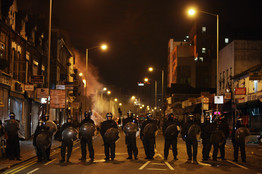
Nobody’s poor in England? Seriously?
But there was a very different kind of London riot five years after the Broadwater Farm incident, and the Missus and I found ourselves right in the middle of it.
It was Saturday, March 31 1990, and Margaret Thatcher’s Tory government had just initiated a poll tax, which replaced property levies with a head tax on most adults in local communities.
We’ll let the BBC take it from there:
An anti-poll tax rally in central London has erupted into the worst riots seen in the city for a century.
Forty-five police officers are among the 113 people injured as well as 20 police horses.
A total of 340 people have been arrested in the heart of London’s West End, popular with musical and theatre goers, as cars have been overturned and set alight.
Four tube stations have been shut for safety reasons as police try to clear the streets, with much of central London now cordoned off.
Demonstrators have attacked police with bricks and cans.
Fire fighters attempting to extinguish the blazes have been hit with wood and stones.
Restaurants have been forced to close early by the violence which left shop windows smashed and many businesses with their contents looted.
Eyewitness reports describe a cloud of black smoke over Trafalgar Square.

Helpful YouTube video:
The Missus and I happened to be in the West End that day, attending a matinee performance of, I think, The Man of the Hour. About halfway through, we heard glass shattering and a general tumult outside. Upon emerging from the theater, we saw windows shattered and cars aflame and disorder everywhere.
But we also had theater tickets for that night, so we soldiered into one of the few open West End restaurants, where we were promptly ushered to a window table (presumably upon the same theory as a hotel automatically assigning you the worst room, in hopes you won’t complain).
We did.
“Eh, something further back,” I said resolutely.
The Missus and I dined without further incident, took in another play, and wrote the whole thing off to Rude Britannia.
Postscript:
The BBC report also noted this:
[The poll tax] unpopularity contributed to the downfall of Margaret Thatcher who resigned in November 1990 after 11 years at the helm of British politics.
It also contributed to the Missus and I going to Paris instead of London for the next 20 years.

 Campaign Outsider